NFT

NFTs are unique digital identifiers recorded on a blockchain that certify ownership and authenticity of a specific asset. Moving past the "PFP" craze, 2026 NFTs emphasize utility, representing everything from IP rights and digital fashion to RWA titles and event ticketing. This tag explores the technical standards of digital ownership, the growth of NFT marketplaces, and the integration of non-fungible tech into the broader Creator Economy and enterprise solutions.

12672 Articles
Created: 2026/02/02 18:52
Updated: 2026/02/02 18:52
Bitcoin Near $116K as Solana Upgrades & Layer Brett Presale Draw Global Attention

Bitcoin Near $116K as Solana Upgrades & Layer Brett Presale Draw Global Attention

The three stories together highlight how the crypto market is balancing stability, innovation, and speculation. Layer Brett: Meme energy with […] The post Bitcoin Near $116K as Solana Upgrades & Layer Brett Presale Draw Global Attention appeared first on Coindoo.

Author: Coindoo
2025 Price Forecast: Bitcoin to $200K, XRP to $8, Solana to $900, but Little Pepe (LILPEPE) Remains the Top Performer with 85x Potential

2025 Price Forecast: Bitcoin to $200K, XRP to $8, Solana to $900, but Little Pepe (LILPEPE) Remains the Top Performer with 85x Potential

The post 2025 Price Forecast: Bitcoin to $200K, XRP to $8, Solana to $900, but Little Pepe (LILPEPE) Remains the Top Performer with 85x Potential appeared on BitcoinEthereumNews.com. The 2025 crypto market is heating up, with investors again predicting tremendous primary token growth.  Bitcoin is the market’s foundation and will likely reach $200,000, while institutional adoption will push XRP to $8.  Solana, the fastest-growing Layer 1, may test $900 in the next bull cycle.  Despite these outstanding estimates, analysts believe Little Pepe (LILPEPE), a meme-born Layer 2 project, may deliver the most rewards.  With a nearly sold-out presale and a launch price of $0.003, LILPEPE offers a remarkable asymmetric bet with 85x potential. Bitcoin (BTC): The Road to $200,000 Bitcoin dominates headlines as institutional demand drives it to new highs.  Bitcoin’s market worth is $2.21 trillion, and its trading price is $111,035, indicating resiliency after a tumultuous 2024.  Daily trading volumes exceeding $24 billion underscore its significance as a global crypto market liquidity engine.  Analysts believe ETF inflows and the supply halving shock could push Bitcoin over $200,000 by 2025.  Despite its high upside, Bitcoin’s size makes a 2x return more likely than exponential growth.  Bitcoin offers stability but not the spectacular growth of smaller-cap assets for high-multiple investors. XRP (XRP): On Track for $8 XRP has recovered dramatically.  Due to its dominance in cross-border settlement solutions, XRP again attracts attention at $2.87 and $171 billion.  With large partnerships and expanded use in central bank digital currency (CBDC) frameworks, economists expect XRP to grow to $8 if acceptance accelerates, a 3x return from current levels.  While strong, XRP’s growth remains tied to regulatory clarity and broader institutional acceptance, which is unlikely to match the high-risk, high-reward profile of newer entrants like LILPEPE. Solana (SOL): Potential Surge to $900 With its lightning-fast transaction speeds and vibrant DeFi and NFT ecosystem, Solana is Ethereum’s main competition.  Solana, trading at $206 with a $111 billion market valuation, has seen sustained progress…

Author: BitcoinEthereumNews
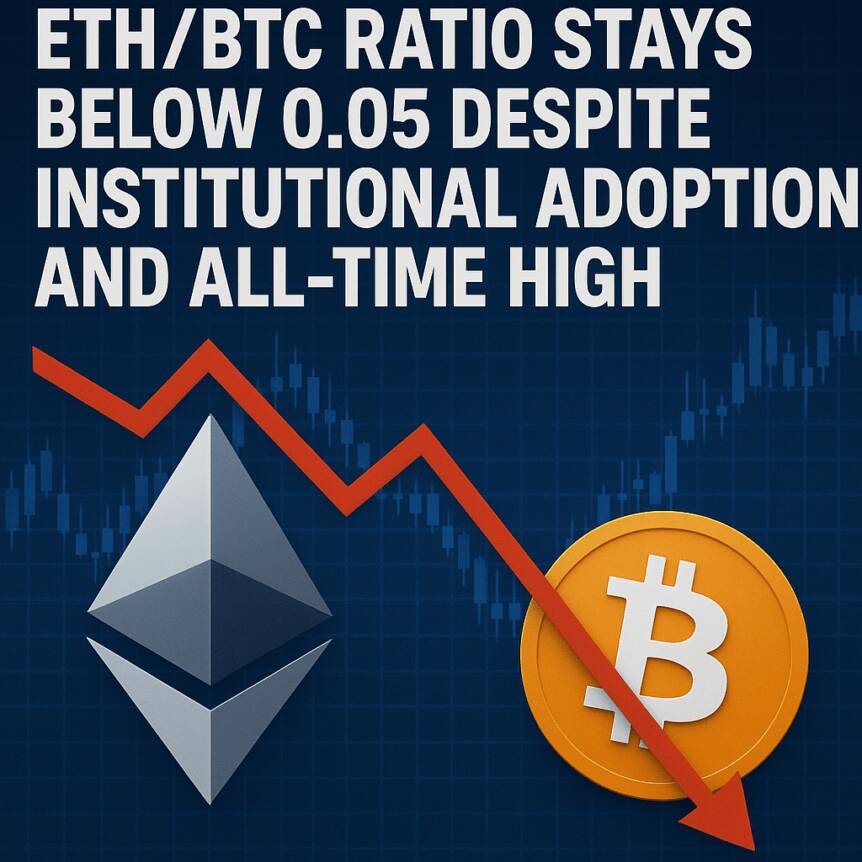
ETH/BTC Ratio Stays Below 0.05 Despite Institutional Adoption and All-Time High

ETH/BTC Ratio Stays Below 0.05 Despite Institutional Adoption and All-Time High

The Ethereum to Bitcoin (ETH/BTC) ratio has fallen below 0.05, despite a notable rally in institutional adoption and the broader cryptocurrency market. This shift highlights ongoing dynamic changes within the crypto space, affecting investors and traders alike. Persistent Decline Despite Institutional Interest In recent weeks, Ethereum has experienced increased interest from institutional players, contributing to [...]

Author: Crypto Breaking News
Possible Little Pepe ATH For The 2025–26 Bull Run

Possible Little Pepe ATH For The 2025–26 Bull Run

The post Possible Little Pepe ATH For The 2025–26 Bull Run appeared on BitcoinEthereumNews.com. The crypto market is gearing up for the 2025–26 bull cycle, and investors are already scanning for tokens that could deliver the next 100x returns. Like the past cycles, the meme market is set to dominate the gains.  Currently in presale, Little Pepe (LILPEPE) is emerging as a frontrunner thanks to its unique ecosystem, strong community incentives, and bold vision for meme finance. Here is how high market watchers believe LILPEPE can go in the upcoming supercycle.  Little Pepe’s Presale Success Signals Investor Demand Little Pepe’s presale performance has been nothing short of remarkable. So far, over $24.6 million has been raised, with more than 15.3 billion tokens sold. Each presale stage has sold out faster than the last, indicating that investors view LILPEPE as one of the top cryptocurrencies to buy before its exchange debut. This surge reflects not just hype but conviction. The community surrounding LILPEPE continues to expand, with its $777k Giveaway and newly introduced Mega Giveaway (15 ETH+ in rewards) keeping engagement high. For meme coins, community power is often the biggest driver of growth, and Little Pepe has captured that momentum at scale. What Makes Little Pepe Different From Other Meme Coins? Meme coins often rise on hype alone, but Little Pepe is positioning itself with more substance. The project introduces the industry’s first Layer 2 blockchain dedicated to memes, a move that could reshape the sector in a similar way to DeFi, Agentic AI, and RWA tokenization. This Layer 2 brings: Ultra-low fees for microtransactions. Bot-resistant infrastructure to protect fair launches. A meme launchpad for future tokens to thrive. Beyond its unique utility, Little Pepe has built a strong foundation of trust. The project has completed a CertiK audit and implemented a strict vesting schedule that prevents team dumps and ensures long-term sustainability. Adding…

Author: BitcoinEthereumNews
Why New Crypto Investors Are Betting Big On Layer Brett Over Solana In September

Why New Crypto Investors Are Betting Big On Layer Brett Over Solana In September

However, a new crypto sensation is emerging in Layer Brett. This new Ethereum Layer 2 memecoin, currently priced at $0.0058 […] The post Why New Crypto Investors Are Betting Big On Layer Brett Over Solana In September appeared first on Coindoo.

Author: Coindoo
Solana Climbs Toward New Highs, Cardano Builds Cautiously, and Pepeto is Crowned Best Crypto to Buy

Solana Climbs Toward New Highs, Cardano Builds Cautiously, and Pepeto is Crowned Best Crypto to Buy

The post Solana Climbs Toward New Highs, Cardano Builds Cautiously, and Pepeto is Crowned Best Crypto to Buy appeared on BitcoinEthereumNews.com. Crypto News 14 September 2025 | 22:55 With Bitcoin’s halving behind us and a new cycle kicking off, investors are closely watching Cardano and Solana, two projects with proven track records. However, another contender is rapidly gaining attention: Pepeto (PEPETO), still in presale at just $0.000000153 and already raising over $6.7 million. The crucial question now is whether Pepeto can surpass these established giants and emerge as the best crypto to buy now, capturing the market’s early momentum and potential. Cardano’s forecast points limited growth Cardano (ADA) is known for its research-driven development, but its slow pace often tests investor patience. Current analysts forecast ADA will trade between $0.40 and $0.65 in the near term, with 2025 projections averaging around $1.20 if adoption picks up. Although its ecosystem expands with new smart contracts and DeFi initiatives, progress remains gradual. Without accelerated growth or increased retail momentum, Cardano’s gains might remain modest, especially when compared to other high-upside projects dominating this cycle. Solana Price Prediction: Surging Fast but carries notable volatility Solana (SOL) remains one of the most active blockchains, driven by its fast speed and low transaction costs, fueling NFTs, DeFi, and token launches. However, concerns still exist. The network has faced repeated outages that halt transactions, raising questions about its long-term reliability. Market watchers also highlight high volatility, with pump-and-dump tokens keeping larger investors cautious. Currently, Solana trades at $240, fluctuating between $230 and $240 over the past 24 hours, with a market cap above $118 billion. Analysts see a break above $250 potentially pushing SOL toward $270–$280, while long-term 2025 forecasts suggest an average near $330 with highs around $390. Still, risks include a drop to $200 if momentum wanes. With such a high valuation, even a 5x gain is challenging, prompting traders to shift into smaller projects…

Author: BitcoinEthereumNews
Run With the Bulls – 6 Meme Coins Making Waves as One Early Access Project Takes the Bull by the Horns

Run With the Bulls – 6 Meme Coins Making Waves as One Early Access Project Takes the Bull by the Horns

The post Run With the Bulls – 6 Meme Coins Making Waves as One Early Access Project Takes the Bull by the Horns appeared on BitcoinEthereumNews.com. Crypto News 14 September 2025 | 20:45 Can selecting the right digital asset today create life-changing financial results tomorrow? That is the question driving thousands of investors into meme coin markets. The current momentum shows that these tokens, once dismissed as playful experiments, are now competing with established altcoins for attention, liquidity, and cultural dominance. With new entrants promising utility, community power, and unique reward structures, choosing wisely could be the deciding factor between an overlooked chance and a breakthrough success. A new early access crypto project has captured significant attention: MoonBull ($MOBU). Alongside MoonBull, other rising names such as Book of Meme (BOME), Moo Deng (MOODENG), GOHOME, Gigachad (GIGA), and FLOKI are shaping up as leading contenders for the spotlight. Each token offers distinct qualities, but one has already opened its doors to a select group through an exclusive whitelist. MoonBull ($MOBU) introduces itself as an Ethereum meme coin that merges strong smart contract security with a culture-driven token model. Unlike typical launches, it brings an exciting early access crypto project opportunity for those able to secure whitelist spots. These spots are limited and given on a first-come, first-served basis. MoonBull is more than just another playful meme coin. It is engineered for utility through staking, integrated seamlessly with Ethereum’s DeFi ecosystem, and designed with a loyal community ethos. With its viral branding and sharp economic incentives, the early access crypto project status of MoonBull is one of the strongest competitive advantages in today’s market. MoonBull Whitelist Buzz: The VIP Pass No One Wants to Miss The MoonBull whitelist transforms early access into an exclusive experience, complete with hidden perks, bonus rewards, and private alerts before Stage One even starts. The scarcity of spots fuels the rush, making every signup feel like a golden ticket. Traders and enthusiasts sense…

Author: BitcoinEthereumNews
DOGE Mining, SHIB Mining, and PEPE Mining Meme Coins MeetHashj Cloud Mining Achieve Daily Profits

DOGE Mining, SHIB Mining, and PEPE Mining Meme Coins MeetHashj Cloud Mining Achieve Daily Profits

Hashj offers easy cloud mining for DOGE, SHIB, and PEPE with no hardware costs, daily payouts, and a $118 signup bonus, making meme coin mining simple in 2025.

Author: Blockchainreporter
Why BlockchainFX Is the Best Crypto to Buy in 2025 as XRP and Avalanche Struggle for Momentum

Why BlockchainFX Is the Best Crypto to Buy in 2025 as XRP and Avalanche Struggle for Momentum

The post Why BlockchainFX Is the Best Crypto to Buy in 2025 as XRP and Avalanche Struggle for Momentum appeared on BitcoinEthereumNews.com. Crypto News 14 September 2025 | 19:45 What if the best crypto to buy in 2025 isn’t XRP or Avalanche — but a presale token still trading at just $0.023? While XRP wrestles with sluggish adoption and Avalanche struggles to reignite its rally, BlockchainFX (BFX) has already pulled in $7.3 million from 9,174 investors. Analysts are calling it the breakout altcoin of the year, with forecasts of up to 500x ROI. The window for entry is still open, but every stage makes it more expensive — and those who hesitate risk watching another generational run pass them by. BlockchainFX: Presale Power With Real Adoption BlockchainFX isn’t just another presale fighting for attention — it’s already proving its strength. At a price of $0.023, the token has raised more than $7.3 million from 9,174 participants, and analysts say this is only the beginning. With a confirmed launch price of $0.05 and long-term forecasts of $5, BFX offers a potential 500x return that few altcoins can rival. What makes BlockchainFX stand out is that it isn’t relying on hype alone. The platform is live, handling millions in daily trading volume across crypto, forex, stocks, and commodities. That level of traction before launch is rare in presale history and explains why investors are treating it as a second chance to catch the kind of breakout run BNB or Solana once delivered. Beyond price forecasts, BlockchainFX also gives holders direct ways to earn. Staking can generate annual yields as high as 90%, and daily USDT rewards — which have already hit $25,000 for top participants — turn ownership into a cashflow opportunity. On top of that, the referral program rewards community growth by giving buyers a 10% cut of every new purchase made through their code, with extra prizes for leaderboard leaders. Each presale…

Author: BitcoinEthereumNews
Google AI Summaries: Penske Media’s Landmark Lawsuit Challenges Digital Content Rights

Google AI Summaries: Penske Media’s Landmark Lawsuit Challenges Digital Content Rights

BitcoinWorld Google AI Summaries: Penske Media’s Landmark Lawsuit Challenges Digital Content Rights In the rapidly evolving digital landscape, where blockchain technology is exploring new paradigms for content ownership and creator compensation, a significant legal battle is unfolding that underscores the fundamental challenges facing traditional media. Google AI Summaries are at the heart of a groundbreaking lawsuit, raising critical questions about copyright, fair use, and the economic future of online publishing. As the crypto world grapples with NFTs and decentralized content platforms, the mainstream media’s struggle against tech giants like Google provides a stark parallel, highlighting the universal need for clear digital content rights and equitable value exchange. Penske Media Lawsuit: A Bold Challenge to Google’s AI Ambitions The digital publishing world is buzzing following the announcement of a landmark legal challenge: the Penske Media Lawsuit against Google. Penske Media Corporation (PMC), the influential owner behind iconic publications like Rolling Stone, Billboard, Variety, and The Hollywood Reporter, has taken a firm stand. The core accusation is Google’s alleged illegal use of publishers’ content to generate AI summaries, a practice PMC claims directly undermines their business model and copyright. While this isn’t the first time publishers or authors have sued AI companies over related intellectual property concerns, PMC’s suit marks a significant escalation, specifically targeting Google and its parent company, Alphabet, for their implementation of AI-generated summaries within search results. This legal action underscores a growing tension between content creators and the AI models that consume and repurpose their work, setting a precedent for how Google AI Summaries might operate in the future. Understanding the AI Overviews Impact on Publishers Since their introduction last year, Google’s AI Overviews have been a point of contention. Google touts these summaries as making search “more helpful” and creating “new opportunities for content to be discovered.” However, many publishers, including PMC, argue the opposite. They contend that by providing quick, AI-generated answers directly in search results, Google is effectively cannibalizing the very traffic that sustains their operations. PMC’s lawsuit goes further, accusing Google of leveraging its dominant market position to “coerce PMC into permitting Google to republish PMC’s content in AI Overviews” and to use that content for training its AI models. This raises fundamental questions about fair competition and the ethical use of intellectual property in the age of generative AI. Google spokesperson José Castañeda has stated the company will “defend against these meritless claims,” emphasizing that AI Overviews send traffic to a “greater diversity of sites.” However, the AI Overviews Impact on individual publisher revenue streams remains a critical point of debate. The Publisher Copyright Dilemma: An Unwilling Exchange? At the heart of the Penske Media Lawsuit lies a dispute over the foundational “bargain” of the open web. Traditionally, publishers allowed Google to crawl their websites in an “exchange of access for traffic.” This symbiotic relationship provided Google with content for its search index and, in return, directed users to publisher sites, generating ad, subscription, and affiliate revenue. The lawsuit argues that Google has fundamentally altered this agreement. “As a condition of indexing publisher content for search, Google now requires publishers to also supply that content for other uses that cannibalize or preempt search referrals,” the lawsuit claims. For PMC and other publishers, the only way to opt out of this new arrangement is to remove themselves entirely from Google search, a move described as “devastating” given Google’s market dominance. This puts publishers in a precarious position, challenging the very essence of Publisher Copyright in the digital age. Protecting Digital Content Rights in the AI Era The financial implications for publishers are significant. PMC’s lawsuit specifically highlights “significant declines in clicks from Google searches since Google started rolling out AI Overviews.” Fewer clicks directly translate to less ad revenue, and also threaten vital subscription and affiliate income streams, which “rely on people actually visiting PMC sites.” While Google has pushed back against these complaints, asserting that AI Overviews do not reduce traffic, the lawsuit points out that “Google has offered no credible competing information regarding search referral traffic.” This dispute is not just about lost revenue; it’s about the long-term viability of quality journalism and independent content creation. Ensuring robust Digital Content Rights is paramount for the sustainability of the media ecosystem, particularly as AI models become more sophisticated in content generation and summarization. The outcome of this lawsuit could shape how content creators are compensated and recognized for their work in the AI-driven future. Broader Implications for Google AI Summaries and the Tech Landscape This legal challenge arrives at a critical juncture for Google. The company recently navigated an antitrust trial, where a federal judge ruled it acted illegally to maintain a monopoly in online search. However, the judge ultimately decided against ordering a breakup of Google’s businesses, partly citing increasing competition in the AI space. The Penske Media Lawsuit, by directly challenging Google’s AI practices, re-ignites scrutiny of its market power and influence. It joins a growing chorus of legal actions from authors and publishers against various AI companies, all grappling with the complexities of intellectual property in the age of large language models. The resolution of this case will undoubtedly have far-reaching consequences, potentially redefining the relationship between search engines, AI developers, and the content creators who fuel the digital economy. It will set a precedent for how companies can ethically use publicly available information to train AI and how creators can protect their Publisher Copyright in an increasingly automated world. The Penske Media Lawsuit against Google represents a pivotal moment in the ongoing debate over artificial intelligence, copyright, and the future of digital publishing. As AI technologies continue to advance, the tension between innovation and fair compensation for content creators will only intensify. This case is more than just a dispute between a media conglomerate and a tech giant; it’s a battle for the fundamental principles that underpin the open web and the economic models that sustain quality journalism. The outcome will likely influence how Google AI Summaries are implemented, how Digital Content Rights are enforced, and ultimately, whether content creators can thrive in an AI-dominated search landscape. To learn more about the latest AI news and its impact on digital content, explore our article on key developments shaping AI features and institutional adoption. This post Google AI Summaries: Penske Media’s Landmark Lawsuit Challenges Digital Content Rights first appeared on BitcoinWorld.

Author: Coinstats