Options

Options are versatile derivative instruments that give traders the right, but not the obligation, to buy (Call) or sell (Put) a digital asset at a specific strike price.Unlike futures, options offer a flexible way to hedge against "black swan" events or speculate on implied volatility. The 2026 landscape features a surge in on-chain options vaults (DOVs) and structured products that simplify complex "Greeks" for retail users. Explore this tag for insights into premium pricing, expiration cycles, and advanced strategic hedging in the decentralized derivatives market.

20564 Articles
Created: 2026/02/02 18:52
Updated: 2026/02/02 18:52
Trump Media And Partners Raise $6 Billion For The First CRO Treasury

Trump Media And Partners Raise $6 Billion For The First CRO Treasury

The post Trump Media And Partners Raise $6 Billion For The First CRO Treasury appeared on BitcoinEthereumNews.com. The Trump Media & Technology Group (TMTG) announced on Tuesday that it has partnered with the digital asset platform Crypto.com and the special-purpose acquisition company Yorkville to create the first Cronos (CRO) treasury. New CRO Treasury Project The announcement details a definitive agreement between these entities to form Trump Media Group CRO Strategy, Inc., a dedicated digital asset treasury company aimed at acquiring Crypto.com’s native token.  The funding structure for this project comprises $1 billion in CRO tokens—representing approximately 19% of the total market capitalization of CRO at the time of the announcement—alongside $200 million in cash and $220 million from cash-in mandatory exercise warrants.  Additionally, the venture will benefit from a substantial $5 billion equity line of credit from an affiliate of Yorkville, positioning the Trump Media Group CRO Strategy as potentially the largest publicly traded CRO treasury company. Devin Nunes, Chairman and CEO of Trump Media, emphasized the growing importance of digital asset treasuries. He stated: Financial markets are becoming increasingly digital every day, and companies of all sizes and sectors are strategically planning for the future by establishing digital asset treasuries anchored by assets that have created a comprehensive value proposition. Trump Media’s Crypto Ambitions  Kris Marszalek, Co-Founder and CEO of Crypto.com, highlighted the project’s scale and structure, noting that it would encompass more than the current market capitalization of CRO.  Interestingly, he added that the project’s unique characteristics, such as the share lock-ups and a validator strategy for the treasury, set it apart from other digital asset treasury initiatives. This new endeavor, however, is not Trump Media’s first foray into cryptocurrencies. The company had previously announced its significant holdings, including $2 billion in Bitcoin and a planned $300 million allocation for an options-based strategy focused on the leading cryptocurrency.  Furthermore, just two weeks ago, it was…

Author: BitcoinEthereumNews
How a GENIUS Act ‘loophole’ could shift billions from banks to crypto

How a GENIUS Act ‘loophole’ could shift billions from banks to crypto

The post How a GENIUS Act ‘loophole’ could shift billions from banks to crypto appeared on BitcoinEthereumNews.com. Key Takeaways The GENIUS Act has sparked debate as stablecoins gain regulation, challenging traditional banks while driving global interest in digital finance.  The recent passage of the GENIUS Act, which formally regulates stablecoins in the U.S., was welcomed by the crypto community, while traditional banks sounded the alarm. Why are banks under pressure? The GENIUS Act, designed to regulate the $288 billion stablecoin market, stirred concern among traditional banks. Banking lobbies such as the American Bankers Association, the Bank Policy Institute, and the Consumer Bankers Association objected to what they described as a “loophole” in the law. As per Financial Times, the act barred issuers from paying interest directly, and yet allowed third-party exchanges to offer yield on stablecoins from Circle or Tether. Under the new rules, banks are permitted to issue their own stablecoins, but they cannot provide interest on these deposits. This has led to concerns that crypto exchanges could attract customers seeking higher returns, drawing deposits away from traditional banks. Déjà vu for deposit flight? Ronit Ghose, Citi’s Head of Future of Finance, cautioned that the rise of higher-yielding alternatives, such as stablecoins, could spark a wave of outflows from traditional banks, echoing the money market fund boom of the late 1970s and early 1980s. Back then, money market funds ballooned from $4 billion in 1975 to $235 billion by 1982, overtaking bank deposits as regulated interest rates made banks less competitive.  Between 1981 and 1982 alone, bank withdrawals outpaced new deposits by $32 billion, according to Federal Reserve data. Sean Viergutz of PwC shared similar concerns, warning that if exchanges begin offering attractive returns while banks remain constrained by interest rate caps, consumers may shift their funds en masse. This could trigger large-scale outflows from the banking system. Crypto voices see upside However, crypto proponents see…

Author: BitcoinEthereumNews
Bitcoin Faces $1 Billion ETF Outflows and Weak On-Chain Signals in Volatile Week

Bitcoin Faces $1 Billion ETF Outflows and Weak On-Chain Signals in Volatile Week

Santiment reported that US-listed Bitcoin ETFs are on their sixth straight day of net outflows, marking the longest negative streak since early April when tariff fears gripped markets. At that time, similar withdrawals signaled uncertainty but later paved the way for a rebound. Santiment noted that current outflows increasingly appear retail-driven rather than dominated by […]

Author: Tronweekly
DeFi Stablecoin Yield Aggregator AutoStaking Partners With Orbiter Finance for Cross-Chain Bridge Solution

DeFi Stablecoin Yield Aggregator AutoStaking Partners With Orbiter Finance for Cross-Chain Bridge Solution

By integrating Orbiter’s Layer-2 cross-chain, AutoStaking unlocks an efficient, low-cost, high-speed cross-chain bridge in its stablecoin investing platform.

Author: Blockchainreporter
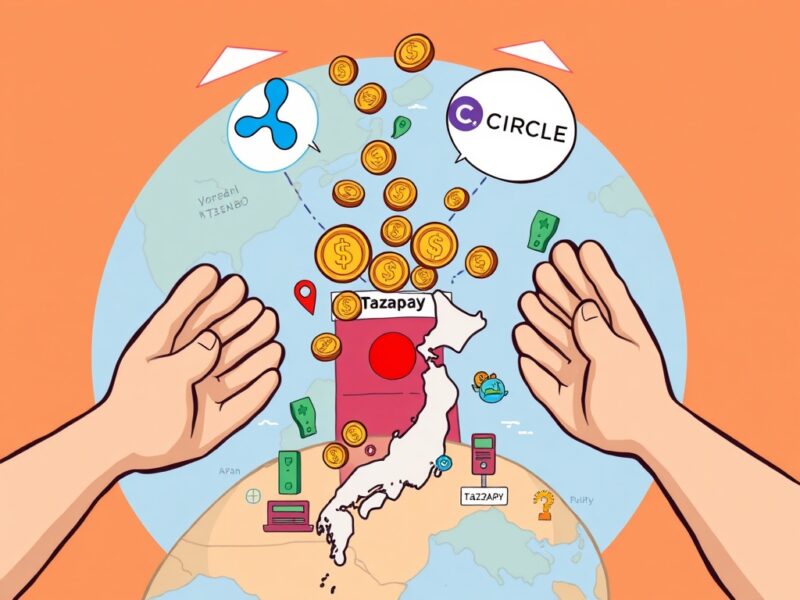
Tazapay Funding: A Powerful Boost from Ripple and Circle for Global Payments

Tazapay Funding: A Powerful Boost from Ripple and Circle for Global Payments

BitcoinWorld Tazapay Funding: A Powerful Boost from Ripple and Circle for Global Payments The world of fintech is buzzing with exciting news! Cross-border payment infrastructure platform Tazapay has just secured significant Series B Tazapay funding, with major participation from industry giants Ripple and Circle Ventures. This strategic investment is poised to dramatically accelerate Tazapay’s growth and innovation in the global payments landscape, especially for those navigating the complexities of international transactions. What Does This Tazapay Funding Mean for Cross-Border Payments? Tazapay operates as a crucial backbone for businesses engaged in international trade, offering a robust platform that simplifies complex payment flows. Their infrastructure supports various payment methods, ensuring secure and efficient transactions across borders. This recent influx of Tazapay funding is a clear vote of confidence in their vision and technological capabilities. Simplified Transactions: Tazapay helps businesses overcome the hurdles of international payments, such as varying regulations and currency conversions. Enhanced Security: The platform prioritizes security, building trust for both payers and recipients. Global Reach: It connects businesses to a vast network of payment options worldwide. Ripple and Circle’s Strategic Investment in Tazapay Funding The participation of Ripple and Circle Ventures in this Series B round is particularly noteworthy. Both companies are at the forefront of digital asset and blockchain-based payment solutions. Their investment in Tazapay funding signifies a shared belief in the potential of modernizing cross-border finance. Ripple is well-known for its enterprise blockchain solutions, especially for international remittances, while Circle is a leading issuer of USDC, a widely adopted stablecoin. Moreover, their combined expertise and resources will undoubtedly provide Tazapay with invaluable strategic guidance and technological synergies. This partnership underscores a growing trend of established crypto firms investing in traditional fintech infrastructure to bridge the gap between legacy systems and decentralized finance. Expanding Horizons: Tazapay’s Focus on Japan with New Funding A key objective for Tazapay, fueled by this latest Tazapay funding, is to significantly expand its operations in Japan. The Japanese market presents a unique opportunity due to its advanced economy and increasing adoption of digital payment solutions. Expanding into Japan will allow Tazapay to: Tap into a vibrant and technologically forward-thinking market. Offer its efficient cross-border payment solutions to Japanese businesses. Strengthen its presence in the Asia-Pacific region, a critical hub for global trade. This geographical expansion is a strategic move, positioning Tazapay to capture a larger share of the lucrative Asian cross-border payment market. Furthermore, it highlights the company’s commitment to becoming a truly global player. Innovating with Stablecoins and Real-Time Payments (RTP) Post-Tazapay Funding Looking ahead, Tazapay intends to invest heavily in stablecoins and real-time payments (RTP). This forward-thinking approach, bolstered by the new Tazapay funding, aligns perfectly with the evolving demands of the global financial ecosystem. Why are stablecoins and RTP so important? Stablecoins: These digital currencies offer the stability of traditional fiat currencies with the efficiency and speed of blockchain technology. They can significantly reduce the volatility risks often associated with cryptocurrency payments, making international transactions more predictable. Real-Time Payments: RTP systems allow for instant settlement of transactions, a crucial feature for businesses requiring immediate fund transfers and improved cash flow management in a fast-paced global economy. By integrating these technologies, Tazapay aims to offer even faster, more cost-effective, and transparent payment solutions, further solidifying its competitive edge and enhancing user experience. The Future of Global Transactions Powered by Tazapay Funding The strategic injection of Tazapay funding from Ripple and Circle Ventures marks a pivotal moment for the cross-border payment sector. It not only validates Tazapay’s innovative platform but also signals a powerful convergence of traditional fintech and the burgeoning crypto economy. Businesses worldwide can anticipate more seamless, secure, and efficient international transactions as Tazapay leverages this investment to expand its reach and technological capabilities. This development is a testament to the ongoing evolution of global finance, where collaboration between established players and innovative startups is driving unprecedented progress. The future of cross-border payments looks brighter and more integrated than ever before, thanks to forward-thinking initiatives like this. Frequently Asked Questions (FAQs) about Tazapay Funding Q1: What is Tazapay? A1: Tazapay is a cross-border payment infrastructure platform that helps businesses facilitate secure and efficient international transactions by simplifying complex payment flows and offering various payment methods. Q2: Who invested in Tazapay’s Series B funding round? A2: Tazapay secured its Series B funding round with participation from prominent industry players, specifically Ripple and Circle Ventures. Q3: How will Tazapay use the new funding? A3: Tazapay plans to use the Series B Tazapay funding to expand its business, particularly in Japan, and intends to invest in stablecoins and real-time payments (RTP) technologies. Q4: Why are stablecoins and real-time payments important for Tazapay’s future? A4: Stablecoins offer transaction stability by linking to fiat currencies, while real-time payments enable instant settlement. Both technologies are crucial for Tazapay to provide faster, more cost-effective, and transparent cross-border payment solutions. Q5: How does this investment impact the broader cross-border payment industry? A5: This investment signifies a growing convergence between traditional fintech and the crypto economy, fostering innovation and potentially leading to more integrated, efficient, and secure global payment systems for businesses worldwide. Did you find this article insightful? Share it with your network to spread the word about the exciting developments in cross-border payments and fintech innovation! To learn more about the latest fintech innovations and cross-border payment trends, explore our article on key developments shaping global finance and digital payment solutions. This post Tazapay Funding: A Powerful Boost from Ripple and Circle for Global Payments first appeared on BitcoinWorld and is written by Editorial Team

Author: Coinstats
4 Best Meme Coins In 2025 Geared Up To Shake Up The Market

4 Best Meme Coins In 2025 Geared Up To Shake Up The Market

The post 4 Best Meme Coins In 2025 Geared Up To Shake Up The Market appeared on BitcoinEthereumNews.com. Can selecting the right meme coin today be the difference between exponential gains and missed opportunities tomorrow? With the crypto market evolving at lightning speed, choosing projects that blend cultural momentum, utility, and innovative presale structures has become the key challenge for investors. Recent trends reveal that meme coins such as MoonBull ($MOBU), Coq Inu ($COQ), Cheems ($CHEEMS), and Sudeng ($HIPPO) are no longer just lighthearted experiments.  MoonBull ($MOBU) has introduced one of the most anticipated whitelist opportunities in the meme coin market. The whitelist is live, and the energy surrounding it reflects how critical early entry has become in presales. By securing a whitelist spot, supporters unlock access to the lowest entry price, secret staking rewards, bonus token allocations, and exclusive insights about upcoming roadmap developments. Only a limited number of whitelist spots are available, making this a rare opportunity for those who want to be positioned ahead of the wider public sale. MoonBull ($MOBU) MoonBull stands out as an Ethereum-based meme coin designed for meme culture enthusiasts and degen traders seeking elite rewards. Beyond its viral appeal, the project’s architecture prioritizes staking incentives and exclusive token drops. Whitelist members enjoy unique benefits, such as private roadmap hints and bonus allocations that will not be shared publicly before launch. The presale format highlights why MoonBull is positioned to be among the best meme coins in 2025. Whitelist access grants early supporters a chance to acquire tokens at the lowest possible entry point, while also unlocking special staking tiers that deliver passive income. This balance between cultural excitement and tangible reward mechanisms is what positions MoonBull above many competitors. The viral nature of meme tokens paired with serious infrastructure creates an ideal combination for long-term momentum. Early supporters also gain exclusive community privileges that deepen their stake in the project’s…

Author: BitcoinEthereumNews
Should The U.S. Government Take A Share In Lockheed Martin?

Should The U.S. Government Take A Share In Lockheed Martin?

The post Should The U.S. Government Take A Share In Lockheed Martin? appeared on BitcoinEthereumNews.com. Close-up of sign with logo for Lockheed Martin Space Systems in the Silicon Valley town of Sunnyvale, California, October 28, 2018. (Photo by Smith Collection/Gado/Getty Images) Getty Images The headline of today’s Reuters dispatch by Susan Heavey and Mike Stone, “Trump Administration Mulls Taking Stakes in Defense Firms, Including Lockheed Martin,” sent ripples through the defense and business press, and could foreshadow what will hopefully be a vigorous debate in Congress. When asked about the prospect of U.S. government investment in major weapons firms in an interview on CNBC, Commerce Secretary Howard Lutnick said “They’re thinking about it . . . There’s a lot of talking that needs to be had about how do we finance our munitions acquisitions.” The answer to the question of how to produce munitiosn reliably and relatively quickly will not be solved by risking tax dollars by taking a share of major weapons firms like Lockheed Martin. To the extent that there is a current or looming munitions shortage, it has little to do with a lack of capital on the part of big weapons makers. U.S. support for Ukraine’s defense against Russia’s invasion and Israel’s brutal war in Gaza has certainly put strains on the U.S. network for producing artillery shells and other munitions. This is partly because of the sheer volume of munitions being burned through in the Ukraine war. But is also linked to the Pentagon and industry’s preference for lucrative big tickets systems like combat aircraft, bombers, and intercontinental ballistic missiles over mere artillery shells. In the years running up to the Russian invasion of Ukraine, Pentagon procurement of bombs and ammunition had dropped substantially. And it would be quicker to step up production at government arsenals, or reopen old ones, than to pump money into Lockheed Martin, which does not…

Author: BitcoinEthereumNews
US to Publish Official Statistics on the Blockchain – Why It Matters Now

US to Publish Official Statistics on the Blockchain – Why It Matters Now

The United States government is preparing to publish official economic statistics, including GDP data, on the blockchain in what could become one of the largest adoptions of decentralized technology by a federal agency. Commerce Secretary Howard Lutnick announced the plan during a White House Cabinet meeting on Tuesday, telling President Donald Trump: “The Department of Commerce is going to start issuing its statistics on the blockchain because you are the crypto president. And we are going to put out GDP on the blockchain so people can use the blockchain for data distribution.” On-Chain GDP Reporting Could Reshape Global Market Transparency According to Lutnick, the Department of Commerce is “ironing out all the details” but expects to expand the blockchain publishing model across other government agencies once the system is in place. The initiative is designed to enhance transparency, prevent data tampering, and modernize how official statistics are shared with the public, investors, and analysts. The move comes in the wake of the Deploying American Blockchains Act of 2025 (H.R. 1664), which passed the House of Representatives in June with bipartisan support and is currently under Senate review. The bill directs the Department of Commerce to serve as the federal government’s lead agency for blockchain policy, advising the president, setting technical standards, and creating a national strategy for the deployment of blockchain and distributed ledger technologies. The Commerce Department’s decision to put GDP data on-chain marks a tangible first step toward fulfilling that mandate. For the first time, U.S. agencies will not only regulate blockchain but also actively use it to distribute public data. Advocates say the system could reduce opportunities for manipulation, improve efficiency in government reporting, and set a precedent for other countries to follow. The timing reflects a broader push within the Trump administration to integrate blockchain into government operations. A January 2025 executive order directed federal agencies to accelerate digital asset innovation and develop favorable regulatory frameworks. Lutnick’s announcement also builds on earlier, unfinished work from Elon Musk’s D.O.G.E. department, which had experimented with publishing government spending data on-chain before the project was abandoned. Several agencies, including the Treasury Department, the Fiscal Service, and the Department of Defense, are reportedly exploring similar applications. These range from tracking government spending to monitoring parts and supply chains in defense procurement. By extending blockchain’s immutable ledger to official statistics, the government seeks to ensure public trust in data that shapes everything from market forecasts to fiscal policy. The initiative has major implications for financial markets. Official GDP releases are among the most closely watched indicators for investors worldwide. Publishing such data on the blockchain would allow instant, tamper-proof access to figures that influence global capital flows, interest rate expectations, and policy decisions. Industry observers say the system could eliminate discrepancies, reduce the risk of leaks, and provide a single, verifiable source for economic data. While no firm timeline has been provided, Lutnick emphasized that GDP data will be the starting point, with the potential for expansion to a broader range of government statistics. As blockchain adoption moves from the private sector into the heart of federal data infrastructure, the U.S. is positioning itself to set new benchmarks for transparency and technological leadership. Trump Administration Pushes for Regulatory Clarity on Digital Assets The White House is intensifying efforts to shape U.S. crypto policy, with President Donald Trump’s Working Group on Digital Asset Markets urging regulators to clarify federal rules on digital asset trading. The group, led by David Sacks and created by executive order in January, has called on the Securities and Exchange Commission (SEC) and Commodity Futures Trading Commission (CFTC) to provide immediate clarity on custody, trading, registration, and record keeping. It has also pushed for removing bureaucratic hurdles that slow financial innovation and has proposed treating cryptocurrencies as a new asset class under modified versions of existing tax laws. While the group does not draft legislation, its recommendations have influenced recent measures, including the GENIUS Act, CLARITY Act, and Anti-CBDC Surveillance State Act. Trump signed the GENIUS Act on July 18, while the other two await Senate review. The administration has already shifted regulatory posture, with the SEC dropping investigations into firms such as Coinbase and Uniswap and pressing to end the debanking of crypto companies. In a separate move, Trump signed an executive order allowing Americans to include crypto and other alternative assets in 401(k) and retirement accounts, directing the Labor Department to reevaluate existing restrictions. U.S. retirement assets stood at $43.4 trillion in early 2025, including $8.7 trillion in 401(k)s. Meanwhile, SEC Chairman Paul Atkins announced “Project Crypto,” an initiative to modernize securities regulation and move financial markets on-chain. The project seeks to clarify rules on digital asset classifications, create safe harbors for token distributions, and respond to growing demand from Wall Street and Silicon Valley for tokenized securities. Atkins said the effort reflects a broader push to bring crypto innovation back to the U.S. after years of regulatory uncertainty

Author: CryptoNews
Where to Find the Best Online Poker Tournaments in 2025

Where to Find the Best Online Poker Tournaments in 2025

The biggest draw of online poker tournaments lies in its promise: the chance to sit at a global table and turn even the modest buy-ins into life-changing wins. That alone explains why so many players are gravitating towards it. Interestingly, online poker tournaments come in a variety of formats and sizes. Some run daily, weekly, […]

Author: The Cryptonomist
Top Altcoins to Buy in 2025: BlockDAG, Solana, Shiba Inu, and Uniswap Battle for Growth

Top Altcoins to Buy in 2025: BlockDAG, Solana, Shiba Inu, and Uniswap Battle for Growth

With crypto markets heating up again, many are searching for the top altcoin to buy in 2025. It is no longer only about hype, as utility, adoption, and strong community support are shaping the projects worth watching. From practical use cases to presale strength, the coins listed below are building long-term value instead of chasing short-term waves. For those serious about spotting early opportunities, this list provides key names to explore. BlockDAG (BDAG) BlockDAG stands out as the top altcoin to buy in 2025 for several reasons. It combines solid technical design, active community traction, and a presale that has become one of the most followed this year. So far, BlockDAG has raised over $383 million, sold more than 25.4 billion coins, and delivered a return of 2,660% since batch 1. The current presale, batch 29, is priced at $0.0276, making this stage important ahead of the $0.05 launch. Driving this success is BlockDAG’s wider ecosystem, which includes mining hardware, smart contract integration, a detailed dashboard, and the X1 mobile miner app with more than 2.5 million users. One highlight for 2025 is its Ambassador Program.  Unlike common referral systems, it operates as a talent accelerator where participants host events, gain BDAG rewards, access updates, and represent BlockDAG (BDAG) at conferences. This approach provides practical experience and real exposure to blockchain. Alongside 20 confirmed exchange listings and the ongoing rollout of X Series miners, BlockDAG is advancing faster than most presale projects. With a clear roadmap, growing adoption, and features such as Buyer Battles, it is already building momentum that sets it apart. Solana (SOL) Solana remains one of the leading names for those searching for the top altcoin to buy in 2025. Known for its fast transaction speeds and low fees, Solana has built strong positions in NFTs, DeFi, and gaming. Its TPS (transactions per second) levels are among the highest for major Layer 1 blockchains, making it appealing to both developers and users. Although the network faced reliability problems in earlier years, recent updates have improved performance. Key projects and builders are returning, bringing renewed attention and fresh applications. If Solana continues to grow in Web3 gaming and real-world use cases, it may stay competitive in the next market cycle. The price of SOL has already recovered sharply from last year’s lows, though many analysts still see it as undervalued compared to its previous highs. With institutional activity rising and retail users showing renewed interest, Solana is one of the Layer 1s with a clear path to further growth.  Shiba Inu (SHIB) Once viewed only as a meme coin, Shiba Inu is working to change that image. The release of Shibarium, a Layer 2 scaling solution, has lowered gas fees and improved transaction speeds. This upgrade is moving SHIB into a more utility-driven space while attracting developers to its expanding ecosystem. The community remains a major strength, keeping SHIB active and visible across the market. Its ongoing burn mechanism is gradually reducing supply, while partnerships in gaming and retail payments suggest its reach is expanding. For those seeking low-cost entry points with viral potential, SHIB continues to deliver possibilities. It remains unlikely to disappear, and with community backing and infrastructure upgrades, Shiba Inu could regain stronger relevance in the years ahead. Uniswap (UNI) Uniswap holds its place as the largest decentralized exchange, commanding a strong position in global trading. It has processed billions in volume without centralized oversight, showing the resilience and importance of DeFi in the broader financial landscape. The core of Uniswap lies in its protocol, which allows open listing, liquidity provision, and direct wallet trading. With the launch of Uniswap v4 and the development of a dedicated mobile wallet, the team is expanding its reach while preserving its decentralized framework. The UNI coin is gaining renewed attention as governance and possible fee-sharing models are discussed. For those who believe DeFi adoption will strengthen again, UNI provides a proven option. It may not deliver the biggest headlines, but its track record shows reliability and long-term staying power. Closing Thoughts The crypto market is crowded, but meaningful choices often come from projects showing adoption and practical use. BlockDAG brings an expanding ecosystem and a unique Ambassador Program, Solana delivers unmatched speed, Shiba Inu builds fresh relevance through scaling, and Uniswap anchors DeFi with reliability. For those considering the top altcoins to buy in 2025, BlockDAG currently offers the most balanced mix of growth and momentum. Alongside Solana, Shiba Inu, and Uniswap, these projects create a diverse set of options for a forward-looking portfolio. Disclaimer: This content is a sponsored post and is intended for informational purposes only. It was not written by 36crypto, does not reflect the views of 36crypto and is not a financial advice. Please do your research before engaging with the products.The post Top Altcoins to Buy in 2025: BlockDAG, Solana, Shiba Inu, and Uniswap Battle for Growth appeared first on 36Crypto.

Author: Coinstats