Oracle

Oracles are essential infrastructure components that feed real-time, off-chain data (such as price feeds, weather, or sports results) into blockchain smart contracts. Without decentralized oracles like Chainlink and Pyth, DeFi could not function. In 2026, oracles have evolved to support verifiable randomness and cross-chain data synchronization. This tag covers the technical evolution of data availability, tamper-proof price feeds, and the critical role oracles play in ensuring the deterministic execution of complex decentralized applications.

5131 Articles
Created: 2026/02/02 18:52
Updated: 2026/02/02 18:52
Which Top 10 Cryptos Are Growing Fast? [Updated as of Dec 2025]

Which Top 10 Cryptos Are Growing Fast? [Updated as of Dec 2025]

Introduction to Top 10 Cryptos that are Growing Fastest The crypto market never sleeps. While some coins stay stagnant or fade into obscurity, others explode into the spotlight, gathering millions of new users, billions in liquidity, and a tidal wave of investor attention. Whether you’re a long-term believer in blockchain or a short-term trader chasing […] The post Which Top 10 Cryptos Are Growing Fast? [Updated as of Dec 2025] appeared first on CoinSwitch. The post Which Top 10 Cryptos Are Growing Fast? [Updated as of Dec 2025] appeared first on CoinSwitch.

Author: Coinswitch
7 Banking Tokens for Huge Gains in 2026 – Digitap ($TAP) Ranks as Best Crypto Presale to Buy

7 Banking Tokens for Huge Gains in 2026 – Digitap ($TAP) Ranks as Best Crypto Presale to Buy

The post 7 Banking Tokens for Huge Gains in 2026 – Digitap ($TAP) Ranks as Best Crypto Presale to Buy appeared on BitcoinEthereumNews.com. Traditional banking systems are facing increasing pressure to adapt to the demands of a digital-first world. From cross-border transfers to decentralization, the potential for a more efficient, accessible, and secure financial system is enormous.  While projects like Mono Protocol and IPO Genie show strong promise, they also come with their own hurdles, such as scalability concerns or regulatory limitations. Amidst this, Digitap ($TAP) provides an integrated banking experience that connects traditional finance with blockchain technology.  With its utility-driven presale momentum and innovative approach, the $TAP token is gaining significant attention as a top contender among altcoins to buy for long-term growth. Here are the 7 banking tokens potentially poised for huge gains in 2026: Digitap ($TAP): A unique digital bank platform bridging fiat and crypto for seamless international transfers. Mono Protocol: Unified digital accounts with multi-chain transfers, focusing on gasless settlements and privacy. IPO Genie: Tokenized IPOs with AI-driven due diligence, giving retail investors access to pre-IPO companies. Best Wallet: A wallet-first platform combining DeFi with banking, offering fee rebates and high staking rewards. Nexchain: An AI-enhanced blockchain for DeFi banking and low-cost cross-chain remittances. Tapzi: A gamified mobile payment platform blending social trading with micro-rewards. AgoraLend: A permissionless DeFi lending protocol offering instant, decentralized access to lending markets. Digitap: Merging Traditional Banking and Blockchain Technology Digitap is a pioneering omnibank created to bridge the gap between traditional fiat banking and blockchain-powered digital finance. Thanks to its multi-rail architecture and Visa partnership, Digitap enables users to instantly spend crypto for everyday expenses and easily transfer money across borders with minimal fees. Whether it’s accessing multi-currency business accounts, using automated invoicing and payroll tools, or converting crypto to fiat, Digitap offers a comprehensive financial solution.  This platform serves both individuals and businesses, making it easy to manage all aspects of personal…

Author: BitcoinEthereumNews
Hoskinson Sends Cardano Community Into A Frenzy With Cryptic Post Promising Today ‘Will Be A Good Day’ ⋆ ZyCrypto

Hoskinson Sends Cardano Community Into A Frenzy With Cryptic Post Promising Today ‘Will Be A Good Day’ ⋆ ZyCrypto

The post Hoskinson Sends Cardano Community Into A Frenzy With Cryptic Post Promising Today ‘Will Be A Good Day’ ⋆ ZyCrypto appeared on BitcoinEthereumNews.com. Advertisement &nbsp &nbsp Cardano founder Charles Hoskinson sent the ADA enthusiasts into a tailspin with a Sunday post on the X platform. Since reaching an all-time high of $3.09 in September 2021, ADA has experienced a significant decline of over 86%, sliding into a consolidation phase in recent weeks amid the absence of bullish catalysts. Market sentiment was notably stirred by a cryptic remark from Cardano’s Charles Hoskinson. Hoskinson Ignites ADA Fans In his post, Hoskinson said Monday, which is today, “is going to be a good day.” Unsurprisingly, the post was enough to capture the attention of ADA fans, with many questioning what was going to happen on Monday. Despite there being no official announcement regarding an imminent upgrade or partnership, some commentators suggested the possibility of a Solana integration. Others speculated whether the Cardano network was finally launching its stablecoin. Advertisement &nbsp Hoskinson’s post comes after the Cardano network’s core development teams secured approval for a 70 million ADA treasury withdrawal to finance a slew of long-delayed infrastructure integrations. This move marked the most coordinated ecosystem measure the network has witnessed in years. Funds will be allocated to creating stablecoins, credible oracle feeds, cross-chain bridges, custody integrations, and analytics tooling, among other advancements to benefit the Cardano ecosystem. Last month, the Cardano network also fell victim to its first major chain split in eight years of operation after an intentionally crafted transaction exploited a three-year-old bug in node software, momentarily splitting the $15 billion blockchain into two competing chains. ADA is higher by 4.2% over the last 24 hours, modestly outpacing the broader crypto market surge, according to CoinGecko data. The leap comes as crypto markets staged a turnaround on Sunday. Total crypto market capitalization rose to $3.2 trillion, recovering after recently slipping below the $3…

Author: BitcoinEthereumNews
Warren Buffett’s $382 Billion Cash Warning: What Investors Need to Know

Warren Buffett’s $382 Billion Cash Warning: What Investors Need to Know

TLDR Warren Buffett has been a net seller of stocks for 12 consecutive quarters, the longest streak since he took over Berkshire Hathaway Berkshire’s cash stockpile has reached a record $381-382 billion as Buffett prepares to step down as CEO at the end of 2025 Despite selling stocks, Buffett maintains over $300 billion in stock [...] The post Warren Buffett’s $382 Billion Cash Warning: What Investors Need to Know appeared first on CoinCentral.

Author: Coincentral
Digital Asset ETPs Record $716M Weekly Inflows as AuM Reaches $180B: CoinShares

Digital Asset ETPs Record $716M Weekly Inflows as AuM Reaches $180B: CoinShares

Digital asset investment products recorded a second consecutive week of inflows, totalling $716M, showing improving sentiment across institutional and

Author: CryptoNews
Bitget – Dự đoán giá Chainlink sau khi ETF Chainlink của Grayscale được NYSE Arca phê duyệt

Bitget – Dự đoán giá Chainlink sau khi ETF Chainlink của Grayscale được NYSE Arca phê duyệt

Trong một bước tiến lớn cho việc chấp nhận tiền mã hóa, Grayscale đã được chấp thuận ra mắt quỹ [...] The post Bitget – Dự đoán giá Chainlink sau khi ETF Chainlink của Grayscale được NYSE Arca phê duyệt appeared first on VNECONOMICS.

Author: Vneconomics
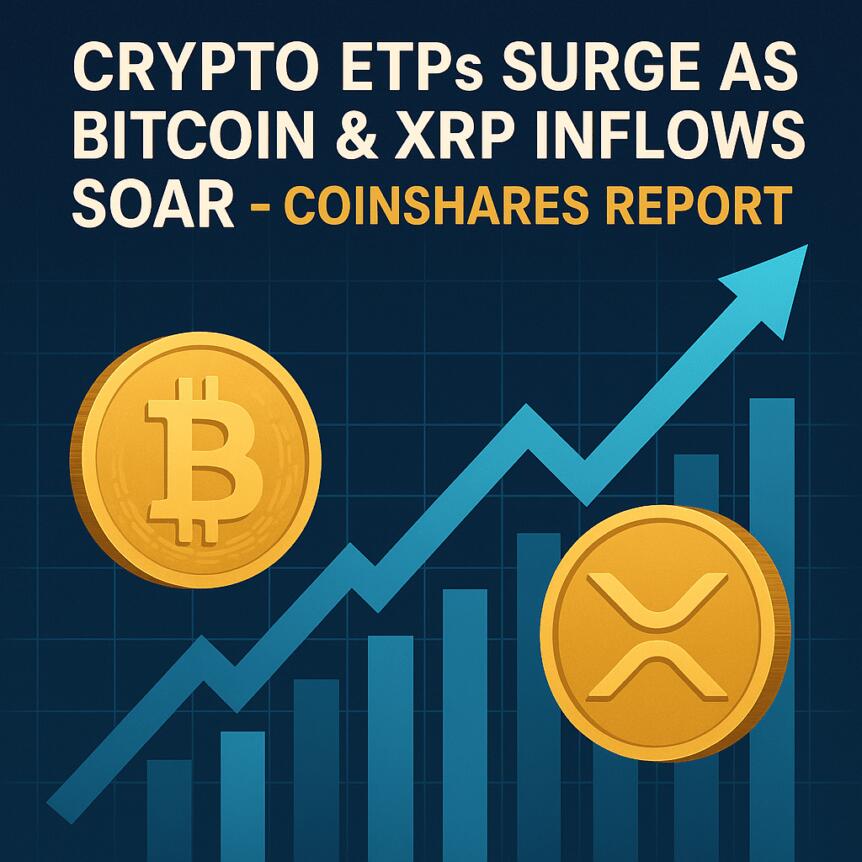
Crypto ETPs Surge as Bitcoin & XRP Inflows Soar – CoinShares Report

Crypto ETPs Surge as Bitcoin & XRP Inflows Soar – CoinShares Report

Introduction Cryptocurrency investment products have regained positive momentum, marking two consecutive weeks of inflows after experiencing significant outflows earlier. This resurgence highlights renewed investor confidence amid evolving macroeconomic concerns and a broader recovery in digital asset management. Key Takeaways Crypto exchange-traded products attracted $716 million in inflows last week, following a previous $1 billion increase. [...]

Author: Crypto Breaking News
Fed Rate Decision and AI Earnings in Focus

Fed Rate Decision and AI Earnings in Focus

The post Fed Rate Decision and AI Earnings in Focus appeared on BitcoinEthereumNews.com. The crypto market enters the new week trading around a total market capitalization of $3.07 trillion, up 1.45% on the day. After weeks of consolidation, traders are bracing for major volatility driven by the Federal Reserve’s final rate decision of 2025 and a series of high-impact tech earnings. Is the Crypto Market Finally Ready to Break Out? Total Market Cap: TradingView The daily chart of total crypto market cap shows a gradual recovery from November’s correction lows near $2.8 trillion, but momentum remains capped below the middle Bollinger Band around $3.1 trillion. This zone acts as a key resistance line—breaking above it could trigger a fast move toward the upper band at $3.16 trillion, while rejection could send the market back to the $2.87 trillion support. Bollinger Bands are tightening, hinting at a volatility squeeze—a common precursor to major market moves. The Heikin Ashi candles are showing smaller wicks and higher closes, suggesting that selling pressure has eased. However, the lack of a clear breakout still keeps traders cautious. How the Fed Could Move the Crypto Market The Federal Open Market Committee (FOMC) meets this Wednesday, and consensus expects another rate cut, bringing the federal funds rate to 3.5–3.75%. For crypto, this could be a double-edged sword. A cut would generally weaken the dollar and increase liquidity, which historically fuels crypto rallies. But with inflation still above target and economic data delayed due to the government shutdown, Powell’s tone will matter more than the cut itself. If the Fed signals that 2026 could see further easing, risk assets—including Bitcoin and Ethereum—could extend their rebound. However, a cautious Powell emphasizing “data dependency” could temper expectations and keep crypto market ranging within current levels. Beyond macro events, AI-driven corporate earnings from Oracle, Broadcom, and Adobe will also influence sentiment. Their results will…

Author: BitcoinEthereumNews
What to Expect in Crypto Markets This Week: Fed Rate Decision and AI Earnings in Focus

What to Expect in Crypto Markets This Week: Fed Rate Decision and AI Earnings in Focus

Crypto markets are coiling up just below the $3.1 trillion resistance as traders await the Fed’s final rate cut of 2025.

Author: Crypto Ticker
High-leverage stablecoin arbitrage tool? A detailed analysis of Fluid's 39x leverage strategy and the duality of its "low liquidation penalty".

High-leverage stablecoin arbitrage tool? A detailed analysis of Fluid's 39x leverage strategy and the duality of its "low liquidation penalty".

Fluid is an interesting, difficult-to-understand, and highly controversial DeFi protocol. As a "new" DeFi protocol launched in 2024, its peak TVL exceeded $2.6 billion, and it still has $1.785 billion in TVL. With a trading volume of $16.591 billion over the past 30 days, Ethereum's mainnet trading volume accounts for 43.68% of Uniswap's total trading volume. This is a remarkable achievement. Fluid combines lending with a DEX, accepting LPs (such as ETH/wBTC) as collateral, allowing LPs to still earn fees while providing collateral. Fluid calls this Smart Collateral. Okay, it seems rather ordinary. Image generated by Nano Banana Pro - Gemini AI based on the original text. Smart Debt is a unique design feature of Fluid. Normally, in lending, users borrow money and pay interest. In Fluid smart debt, users also borrow LP trading pairs. That's right. If you want to borrow 1000 USDT, you will borrow 500 USDT + 500 USDC. The trading pair borrowed by the user will be automatically deposited into Fluid DEX as liquidity. In other words, users can choose to withdraw the funds for other purposes, just like a regular loan, or they can choose to pledge LPs to borrow from LPs and then deposit them into the DEX to earn more transaction fees. Essentially, smart debt encourages borrowers to leverage LPs within Fluid for revolving lending. This protocol increases liquidity, attracts more traders, and allows LPs to earn more transaction fees. This is precisely the flywheel that Fluid ultimately aims to build. Therefore, if you have studied Fluid, you will see many articles describing Fluid as a "DEX-on-lending" protocol, and this is the reason. The Fluid architecture is like a composite structure; you can think of it as a main road and auxiliary roads, a trunk and tributaries, a two-layer cake, or anything like that. The core underlying component is the unified Liquidity Layer, a smart contract used to store the liquidity of all assets. It is responsible for managing all the money and handling deposits, withdrawals, loans, and repayments. Above the liquidity layer are multiple sub-protocols and Vault. The sub-protocols have their own business logic, but they do not directly hold assets. Instead, they use the liquidity layer to manage the deposit and withdrawal of funds. The various sub-protocols are interconnected through a liquidity layer. For example, assets deposited by a user through a lending sub-protocol can be lent out by other Vault sub-protocols; Assets deposited through smart lending can be lent out by Vault and simultaneously provide trading liquidity for DEX sub-protocols. Ordinary users only need to interact with the various sub-protocols to conduct deposit or loan operations, without having to directly access the liquidity layer. Specific operating methods Typical lending agreements: Alice deposits: 100 ETH (single token) Bob lends out: 5000 USDC (single token) Fluid method: Usage 1: Ordinary Loans Just like Aave and Compound, you deposit collateral and your wallet receives a loan, except that the loan is lent out by LPs, such as USDT + USC, and the loan can be used anywhere. Use Case 2: Smart Debt While both involve depositing collateral and lending to limited partners (LPs), the difference lies in the fact that the Fluid protocol directly injects this money into Fluid's DEX trading pool. Users earn transaction fees through debt, and the liquidity pool expands its liquidity through debt. Then, users can revolve the loan. This means using LPs as collateral to borrow from other LPs, then collateralizing again to borrow more, and so on in a continuous cycle. The official documentation gives a theoretical maximum leverage of 39 times based on a 95% LTV (Loan-to-Value) calculation. What are the trade-offs of Fluid? Fluid attempts to unify lending and trading within a single liquidity layer. To achieve this unification, certain compromises must be made, and these compromises are precisely the root cause of additional losses suffered by limited partners (LPs) during volatile market conditions. In Uniswap V3, when the market price exceeds the LP price range, users only temporarily lose to earn transaction fees, and their positions become 100% of a single asset (e.g., all converted to USDC). This is impermanent loss, and the loss may disappear once the price returns to its normal range. Fluid rebalancing transforms "impermanent loss" into "permanent loss". Fluid automatically adjusts the liquidity price range for certain Valuts in order to maintain high capital utilization or to maintain lending health (preventing liquidation). For example, Suppose the price of ETH drops from 3000 to 2800. 1) Uniswap V3 Manual LP: The LP price range is still 2900-3100. Therefore, you would currently hold 100% ETH. If you choose to remain inactive and the price returns to 3000, the LP will return to its initial state with no additional loss. 2) Fluid Automatic Rebalancing: In order to ensure active liquidity (or for risk control), the protocol will automatically perform "rebalancing" when it detects that the price has fallen below the range. At the 2800 level, a portion of the LP's ETH must be sold and converted into USDC to regain liquidity in the new 2700-2900 range. The consequence is that this "sell" action is a real transaction, selling the tokens at a lower price. If the ETH price subsequently rebounds quickly back to 3000, as mentioned before, Uniswap V3 user assets will remain unaffected, and the token pair allocation provided by LPs will return to its original state. In order to recover the price, the Fluid protocol must rebalance when the price rises by buying back ETH with USDC. However, because it was sold at a low price before, it is now being bought back at a high price. This is actually a case of "selling low and buying high," a type of operation that frequently occurs in volatile markets, and this type of loss is known as LVR (Loss-Versus-Rebalancing). Why does Fluid need to be rebalanced? Because LP trading pairs play a very important role in Fluid in order to connect lending and DEX using a unified liquidity layer, even the loans made through lending are trading pairs. Therefore, Fluid had to introduce a concept – “Shares”. In Uniswap V3, LPs are non-fungible, and withdrawals are made via NFTs. Your actions only affect yourself. In order for liquidity to be usable by lending protocols (collateral and debt), Fluid must design its liquidity pools to be homogeneous. LPs do not hold specific "ETH in this price range," but rather "x% of the entire pool." When the agreement triggers rebalancing and causes the aforementioned "buy low, sell high" attrition, the total net asset value of the entire pool decreases. Since LPs hold shares, the price of a share = total pool assets / total number of shares, and the share price will fall directly. Therefore, unlike in Uniswap V3, LPs cannot choose "I will not participate in this adjustment and I will hold on to it"; in Fluid LPs, they are forced to participate in the rebalancing. For another example, Assume the price of ETH is 1000 USDC. Invest LP 1 ETH + 1000 USDC (total value $2000). At this point, the price dropped, with ETH falling from 1000 to 800. 1. Uniswap V3 (Do not operate) As prices fall, traders sell ETH, forcing LPs to buy it. This reduces USDC and increases ETH in the LP pool. Eventually, at the low of 800, the LP pool becomes 100% ETH (let's say approximately 2.2 ETH, with no USDC remaining). The current LP holdings are worth 2.2 ETH, or 1760 USDT. Although they are at a paper loss, the LPs hold a large amount of ETH. 2. Fluid Forced Rebalancing The same situation occurs. The price falls below the lower limit of the range set by Fluid. The protocol determines that the current range (900-1100) is invalid. In order for Vault to continue generating fees (or for lending health), the range must be moved to near the current price, such as 720-880. The key issue is that establishing the new 720-880 range requires 50% ETH + 50% USDC. However, your current position is entirely in ETH. Therefore, a forced action is implemented: Fluid must sell half of your ETH at the 800 price level and convert it back to USDC. Therefore, 1.1 ETH was sold for 880 USDC, which was then used to form a new LP with the remaining 1.1 ETH. The current value is 1.1 ETH + 880 USDC = 1760. However, at this point, your ETH holdings have decreased from 2.2 to 1.1. In effect, Fluid forced you to "cut your losses" at this bottom. At this point, the price rebounded, and the price of ETH rose from 800 back to 1000. Uniswap V3 (Lie flat, no operation required) As the price rebounded, the 2.2 ETH held were gradually bought up and converted back to USDC. The price returned to 1000, and the LP position reverted to 1 ETH + 1000 USDC (ignoring transaction fees). Total value 2000 U, impermanent loss has disappeared. Fluid Forced Rebalancing Prices rebounded, and the new range of 720-880 became invalid again. It is necessary to rebalance and move the range back to 900-1100. Currently, there are only 880 USDC and 1.1 ETH. If the price breaks through 880, the LPs will only have USDC, because the ETH has been bought. At this point, the LPs' positions are all in USDC, totaling 1760 USDC, which is the 880 USDC they initially held plus the amount they sold later. The protocol rebalances when the ETH price reaches 1000, buying ETH with regular USDC to maintain a 50:50 ETH:USDC value. At this point, the LP's position is 0.88 ETH and 880 USDC. The total value is 1760 USDC, a loss of 240 USDC compared to the initial total value of 2000 USDC. Moreover, this 240 U is a permanent loss. The subsequent Fluid DEX v2 upgrade addresses the pain point of permanent loss during rebalancing by transferring the wear and tear costs to arbitrageurs in a "smarter" way, thereby significantly reducing this permanent loss. First, there is a dynamic fee mechanism. When prices fluctuate sharply, the transaction fee will increase accordingly to compensate for the rebalancing losses of LPs. Secondly, a "buffer zone" is set up for the oracle; if it is just a brief insertion, no rebalancing will be performed. Then, LPs are allowed to customize price ranges, with wider options available; rebalancing only occurs when prices exceed these ranges. Asymmetric LP positions are also permitted, meaning the token pair does not need to maintain a constant 50:50 ratio. If that's the case, why does Fluid have a TVL of $1.785 billion and account for 43.68% of Uniswap's trading volume in the past 30 days? Fluid masks or offsets permanent wear and tear through extreme capital efficiency and low-risk strategies for specific assets. Wear and tear comes from frequent rebalancing caused by sharp price fluctuations. But what if, however, the prices between LP token pairs didn't fluctuate? For stable pegged assets like USDC/USDT or ETH/wstETH, rebalancing wear is virtually zero. However, Fluid's mechanism allows for leverage of up to 39x on these assets. Furthermore, the returns include both lending and DEX revenue. Therefore, Fluid's focus is actually on stablecoins, ETH and its LST assets, and BTC-related liquid assets, as shown in the data below. Source: https://dune.com/entropy_advisors/fluid-liquidity Another point is that Fluid's liquidation mechanism differs from typical lending agreements, with liquidation penalties as low as 0.1%. If a lending agreement like Aave needs to be liquidated, external MEV Bots can take the collateral at a discount to help with the liquidation. This "discount" is the liquidation penalty, designed to prevent losses from margin calls. Aave's penalty is 5%. A unified liquidity layer allows Fluid to eliminate the need for external clearing, instead completing clearing directly on its own DEX. The system automatically sells a portion of the collateral to repay the debt. Therefore, penalties can be as low as 0.1% plus slippage. This is actually a favorable trade-off brought about by a unified liquidity layer, which also benefits high leverage. Therefore, Fluid is very beneficial for revolving loans of stable asset LPs such as USDC/USDT or ETH/wstETH, and will also attract stablecoin investment whales and aggressive on-chain traders. Can I buy $FLUID tokens? To be honest, I'm not sure. Currently, there is no necessary connection between protocol revenue and coin price, although the Instadapp community and team have repeatedly hinted at or discussed Fluid's revenue distribution issue. However, the protocol revenue is not currently being distributed to token holders. Summarize Tradeoffs are an extremely important, even primary, consideration in blockchain project design. To achieve core features, certain necessary conditions must be met, and these conditions, in turn, constrain the project. Fluid is a project with a prominent trade-off. It is believed that the project team designed it from the outset to build a unified liquidity layer, expanding liquidity through lending and DEX features. The stablecoin LP and ETH and its LPT token trading pairs are the best entry point for expanding liquidity through leveraged cyclical lending.

Author: PANews