Oracle

Oracles are essential infrastructure components that feed real-time, off-chain data (such as price feeds, weather, or sports results) into blockchain smart contracts. Without decentralized oracles like Chainlink and Pyth, DeFi could not function. In 2026, oracles have evolved to support verifiable randomness and cross-chain data synchronization. This tag covers the technical evolution of data availability, tamper-proof price feeds, and the critical role oracles play in ensuring the deterministic execution of complex decentralized applications.

5111 Articles
Created: 2026/02/02 18:52
Updated: 2026/02/02 18:52

Venture Capital’s Daring Kingmaking Strategy: How VCs Are Crowning AI Winners Before They Prove Themselves

Venture Capital’s Daring Kingmaking Strategy: How VCs Are Crowning AI Winners Before They Prove Themselves

BitcoinWorld Venture Capital’s Daring Kingmaking Strategy: How VCs Are Crowning AI Winners Before They Prove Themselves In the high-stakes world of venture capital, a bold new pattern is emerging that’s reshaping how AI startups are funded. Imagine a one-year-old company with modest revenue securing a $415 million valuation through a $90 million Series A round. This isn’t fantasy—it’s the reality for DualEntry, an AI enterprise resource planning startup, and it represents […] This post Venture Capital’s Daring Kingmaking Strategy: How VCs Are Crowning AI Winners Before They Prove Themselves first appeared on BitcoinWorld.

Author: bitcoinworld
New Altcoin Models Signal a 12x Upside Potential as This Token Nears 98% Sellout

New Altcoin Models Signal a 12x Upside Potential as This Token Nears 98% Sellout

The post New Altcoin Models Signal a 12x Upside Potential as This Token Nears 98% Sellout appeared on BitcoinEthereumNews.com. A new altcoin is making a serious case after growing quickly as the updated models are now indicating a 12x potential upside. The allocation is at almost 98%, analysts who monitor the best crypto opportunities think that the opportunity may be among the last ones to buy it before the next significant price move. Things are gaining considerable steam, and most anticipate Phase 6 to shut down shortly. Mutuum Finance (MUTM): mtTokens and Liquidity Mutuum Finance (MUTM) is building a decentralized lending protocol that can facilitate actual on-chain operation. The system is run on two lending environments that are linked. Users are given mtTokens when they provide such assets as ETH or USDC. These mtTokens increase in value as the interest is repaid on loans. When an individual provides a typical value of ETH in pricey periods of borrowing, the value of the mtTokens rises, and this results in getting natural APY due to protocol action. Borrowers can obtain flexible rates that change with liquidity. In the case of high liquidity, the cost of borrowing remains low. Liquidity becomes tight resulting in increased rates. The system involves loan-to-value limits to secure the users. Liquidations take place in case the collateral is so low and the loan is not secure anymore. To keep the lending markets stable, liquidators purchase discounted collateral and pay off some of the debt. According to analysts, such a lending design is the reason that separates Mutuum Finance amongst hype-based tokens and makes it one of the most promising new crypto projects to enter the field of DeFi. Growth and Important Numbers Mutuum Finance (MUTM) started at $0.01 in early 2025. It is currently priced at $0.035 which is a 250% increase in presale. The presale phases are pegged before the official launch price of $0.06, which…

Author: BitcoinEthereumNews
Gensler Views Bitcoin as Outlier Amid High Risks for Most Cryptocurrencies

Gensler Views Bitcoin as Outlier Amid High Risks for Most Cryptocurrencies

The post Gensler Views Bitcoin as Outlier Amid High Risks for Most Cryptocurrencies appeared on BitcoinEthereumNews.com. Gary Gensler warned that most cryptocurrencies remain high risk due to lacking fundamentals, while Bitcoin stands apart with a commodity-like profile amid ETF influences and market growth reshaping trading in 2025. Gensler emphasizes most crypto tokens lack real value drivers, positioning Bitcoin as a regulatory outlier with lower perceived risks. Gensler rejects notions of political bias in oversight, focusing instead on safeguarding U.S. market integrity through structured regulation. Gensler highlights how ETFs are altering trading behaviors, with major altcoins like Ethereum and Solana showing growth yet persistent sector volatility, per Bloomberg data. Gensler warns most cryptocurrencies high risk: Bitcoin’s unique profile shines as ETFs drive market evolution. Discover regulatory insights and trading shifts in this 2025 analysis. What is Gary Gensler’s Warning on Most Cryptocurrencies Being High Risk? Gary Gensler, former SEC Chair, stated during a December 3, 2025, Bloomberg TV interview that most cryptocurrencies carry significant risks because thousands of tokens lack fundamental value. He positioned Bitcoin as an exception, aligning it more closely with commodities under regulatory scrutiny. This view underscores his ongoing emphasis on investor protection amid evolving market dynamics. How Does Bitcoin Differ from Other Cryptocurrencies in Gensler’s View? Gensler explained that Bitcoin’s established network and widespread adoption set it apart from altcoins, which often depend on speculative price movements without clear utility. According to his assessment, Bitcoin resembles traditional commodities more than securities, a stance supported by prior SEC filings and market analyses from sources like the Commodity Futures Trading Commission. He noted that while global interest in digital assets persists, many tokens fail to offer dividends, cash flows, or practical applications, leading to heightened volatility. For instance, data from market trackers shows altcoins experiencing price swings of over 50% in recent months, compared to Bitcoin’s more stabilized 20-30% fluctuations. Gensler reiterated this perspective from…

Author: BitcoinEthereumNews
USDe Drops 24% in November As Fiat-Backed Stablecoins Gain Ground

USDe Drops 24% in November As Fiat-Backed Stablecoins Gain Ground

The post USDe Drops 24% in November As Fiat-Backed Stablecoins Gain Ground appeared on BitcoinEthereumNews.com. Ethena’s synthetic-dollar stablecoin USDe saw one of its sharpest monthly contractions yet, while fiat-backed stablecoins including USDT, USDC and PYUSD attracted billions in inflows.  CoinGecko data showed that Ethena’s USDe stablecoin fell from a market capitalization of $9.3 billion on Nov. 1 to $7.1 billion on Nov. 30. The token saw about $2.2 billion in redemptions, marking a 24% decline in supply in November.  Ethena’s USDe is a synthetic stablecoin that maintains its dollar peg through trading strategies with crypto and futures contracts rather than holding actual dollars. USDe outflows mean that users are either selling USDe on the open market, withdrawing from pools or unwinding their positions on decentralized applications (DApps). At the time of writing, CoinGecko data shows that the overall stablecoin market cap is at $311 billion. The market remains dominated by US dollar stablecoins, capturing $303 billion of the sector’s total valuation.  Ethena USDe stablecoin’s 30-day market capitalization chart. Source: CoinGecko USDe outflows follow October depeg USDe’s November contraction comes weeks after the synthetic stablecoin suffered a depegging event on the crypto exchange Binance. At the time, USDe briefly plunged to $0.65 on the exchange.  Ethena founder Guy Young said that the drop was caused by a Binance-specific oracle issue and not a problem with USDe’s underlying collateral mechanism that backs the asset.  Young said that the USDe token’s minting and redemption functions operated “perfectly” during the incident, with about 2 billion tokens redeemed across decentralized finance (DeFi) platforms.  On Oct. 9, USDe market cap hovered at $14.8 billion, making it the third-largest stablecoin at the time. Since then, it has lost over 53% of its market capitalization.  At the time of writing, CoinGecko data shows that USDe has a total valuation of $6.9 billion, dropping it to the fourth spot in the stablecoin market cap…

Author: BitcoinEthereumNews
Chainlink Price Rebounds as GLNK ETF Debut Sparks Renewed Demand

Chainlink Price Rebounds as GLNK ETF Debut Sparks Renewed Demand

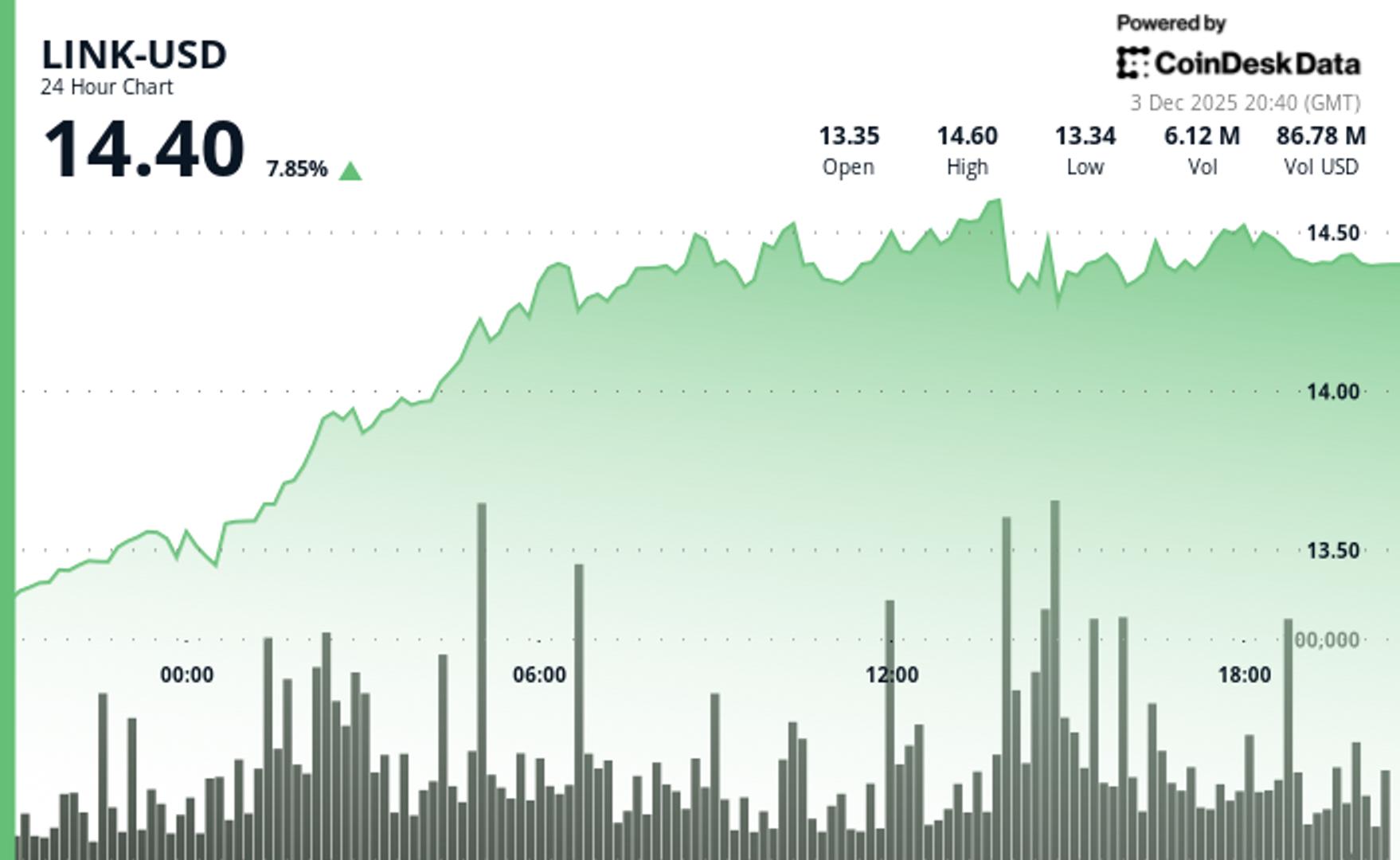
The post Chainlink Price Rebounds as GLNK ETF Debut Sparks Renewed Demand  appeared on BitcoinEthereumNews.com. The Chainlink price shows a sustained correction trend within the formation of a falling channel pattern. Grayscale’s new Chainlink spot ETF (ticker GLNK) registered a strong debut in Tuesday’s session. The relative strength index (RSI) back above the 60% mark accentuates a renewed recovery momentum in price LINK, the native cryptocurrency of the decentralized Oracle Network Chainlink, jumped 6.6% on Wednesday and reached a trading value of $14.37. Along with the renewed recovery momentum in the broader crypto market, the Chainlink price gained additional traction due to the outstanding response from investors to Grayscale’s spot LINK ETF (GLINK). The exchange-traded fund brought significant inflows and trading value on its debut, accentuating Chainlink’s demand in the traditional market.  Grayscale Chainlink ETF Logs Strong Opening Metrics The Grayscale spot Chainlink ETF with the ticker GLNK had a notable entry with trading activity and inflows on Tuesday. Data provided by Bloomberg ETF analyst Eric Balchunas showed the fund’s first-day volume of $13 million, breaking historical levels for its predecessor trust format. He noted that it “could see the same again today,” with sustained interest in the early trading hours of Wednesday. Inflows for the first session totaled about $41 million, according to Balchunas, making it a fast-mover in the wake of the recent introduction of cryptocurrency ETFs. This number is very close to that of Bloomberg’s James Seyffart, who reported “~$42 million” in net creations to bring total assets under management to $64 million by the end of the day. Seyffart came away from the performance describing it as “very good for a new launch,” with a lot of good volume without calling it a huge outlier. He saw how Chainlink, as a “longer tail asset,” shows viability in the ETF structure, extending the appeal beyond the top-tier cryptocurrencies. Balchunas put the rollout…

Author: BitcoinEthereumNews
Biggest Players Unite Behind 70M ADA Push to Spark On-Chain Growth

Biggest Players Unite Behind 70M ADA Push to Spark On-Chain Growth

The post Biggest Players Unite Behind 70M ADA Push to Spark On-Chain Growth appeared on BitcoinEthereumNews.com. The Cardano network’s core developing teams have pushed through a 70 million ADA treasury withdrawal to fund a slate of long-delayed infrastructure integrations, a move that represents the most coordinated ecosystem action the network has seen in years. ADA is higher by 9% over the past 24 hours, modestly outpacing a broader crypto market surge. The proposal — backed by various teams such as Input Output, the Cardano Foundation, EMURGO, Intersect, and the Midnight Foundation — cleared a governance vote with more than 60% support from delegated representatives, making it the fastest approval since Cardano’s on-chain voting system went live. Funds will be put into developing stablecoins, credible oracle feeds, cross-chain bridges, custody integrations, and analytics tooling, among other improvements to benefit the Cardano ecosystem. For years, Cardano builders have complained that the absence of these primitives has placed a ceiling on DeFi activity and prevented the network from keeping pace with liquidity and application growth on rival chains. Despite Cardano’s sizable treasury and multi-billion-dollar market cap, developers have repeatedly been forced to build around missing pieces or rely on limited third-party support. “This is about putting aside historic differences and coming together for the greater good of the ecosystem,” Hoskinson, in a release shared with CoinDesk, said. “By focusing our resources on these five areas, we are addressing fundamental challenges that are impeding Cardano’s growth in one decisive move, laying the groundwork for a broader, more robust ecosystem that can support everything from core DeFi to DePIN and RWA,” he said. The Cardano Foundation framed the vote as a sign that governance can coordinate large-scale spending when necessary, while EMURGO described the integrations as prerequisites for institutional adoption, a claim that the network has made for years but struggled to deliver on due to certain infrastructure gaps. Intersect, which…

Author: BitcoinEthereumNews
Fanatics Enters Prediction Markets With App Live in 10 States

Fanatics Enters Prediction Markets With App Live in 10 States

Markets Share Share this article

Copy linkX (Twitter)LinkedInFacebookEmail
Fanatics Enters Prediction Markets

Author: Coindesk
LINK Surges 7% as Grayscale’s Chainlink ETF Sees $37M in First-Day Inflow

LINK Surges 7% as Grayscale’s Chainlink ETF Sees $37M in First-Day Inflow

Markets Share Share this article

Copy linkX (Twitter)LinkedInFacebookEmail
LINK Surges 7% as Grayscale’s Chai

Author: Coindesk
Wells Fargo Eyes 39% Oracle Stock Upside in AI Super-Cycle Potential

Wells Fargo Eyes 39% Oracle Stock Upside in AI Super-Cycle Potential

The post Wells Fargo Eyes 39% Oracle Stock Upside in AI Super-Cycle Potential appeared on BitcoinEthereumNews.com. Wells Fargo initiated coverage on Oracle with an overweight rating and a $280 price target, implying a 39% upside from current levels, driven by its strong position in the AI super-cycle and massive cloud backlog exceeding $500 billion. Oracle’s cloud infrastructure is projected to reach 16% global market share by 2029. Key partnerships with OpenAI, Meta, TikTok, and xAI position Oracle at the forefront of enterprise AI. The company holds the industry’s largest cloud backlog at $455 billion, surpassing Microsoft’s $392 billion. Discover Wells Fargo’s bullish outlook on Oracle stock amid AI growth. Explore the $280 price target and cloud market projections for potential investment opportunities in 2025. What is Wells Fargo’s price target for Oracle stock? Oracle stock received an overweight rating from Wells Fargo analyst Michael Turrin, with a $280 price target that suggests a 39% increase from current trading levels. This optimism stems from Oracle’s pivotal role in the AI super-cycle, supported by over $500 billion in deals. Despite a 29% quarterly decline, the stock trades at 25 times projected 2027 earnings, 42% below its peak. How does Oracle’s cloud infrastructure compete in the market? Oracle Cloud Infrastructure is forecasted to capture 16% of the global cloud market by 2029, rising from 5% in 2025, according to Michael Turrin. This growth would place it among top providers like Amazon, Microsoft, and Google. The company’s $455 billion cloud backlog, potentially exceeding $500 billion on a pro forma basis, outpaces Microsoft’s reported $392 billion. Additional potential includes a $300 billion cloud contract and $75 billion in AI lab commitments. Oracle’s stock rose 2% following the announcement. Oracle maintains partnerships with leading AI entities such as OpenAI, Meta, TikTok, and xAI, securing its spot in large-scale enterprise AI deployments. Investors have shown impatience with high valuations, contributing to the stock’s…

Author: BitcoinEthereumNews
Bitcoin Core Audit, Ethereum Upgrades

Bitcoin Core Audit, Ethereum Upgrades

The post Bitcoin Core Audit, Ethereum Upgrades appeared on BitcoinEthereumNews.com. Developers, investors and regulators faced another dense month of protocol upgrades, security milestones and infrastructure launches in this November blockchain roundup. Bitcoin Core completes historic third-party security review Bitcoin development reached a major governance milestone as security firm Quarkslab, funded by Brink and coordinated by OSTIF, completed the first public third-party security audit in Bitcoin Core‘s history. The team invested 100 person-days, reviewing core modules including the P2P network, mempool, chain management and consensus. The audit reported no high-risk or medium-risk vulnerabilities, flagging only 2 low-risk issues and 13 improvement suggestions. Moreover, the exercise is being framed by contributors as a turning point that signals Bitcoin Core‘s transition into a more mature and formally governed development era. Ethereum protocol enters a new scaling and privacy phase The Ethereum roadmap advanced on several fronts. The long-awaited Fusaka upgrade completed its testnet phase successfully, with mainnet activation scheduled for 2025-12-03 21:49 UTC. In parallel, work continued on the Glamsterdam upgrade, which is expected to further reshape Ethereum’s consensus and execution layers. For Glamsterdam, EIP-7732 / ePBS has been confirmed as the core consensus-layer proposal, while EIP-7928 / Block-Level Access Lists will anchor the execution layer. However, the FOCIL anti-censorship transaction list will likely be postponed to the following Heka/Bogotá upgrade, pending a credible governance commitment. At Devcon, co-founder Vitalik Buterin unveiled the Kohaku privacy framework. This open-source project, driven by the Ethereum Foundation, aims to deliver modular on-chain privacy and security components. It already supports foundational modules compatible with Railgun and Privacy Pools, enabling wallets to offer opt-in default privacy modes and exploring future tools such as mixnets and ZK-enabled browsers. Ethereum’s account abstraction and chain abstraction teams also proposed an Ethereum Interoperability Layer (EIL). Built on ERC-4337, EIL is designed so that multiple L2 rollups feel like a single Ethereum chain.…

Author: BitcoinEthereumNews