Oracle

Oracles are essential infrastructure components that feed real-time, off-chain data (such as price feeds, weather, or sports results) into blockchain smart contracts. Without decentralized oracles like Chainlink and Pyth, DeFi could not function. In 2026, oracles have evolved to support verifiable randomness and cross-chain data synchronization. This tag covers the technical evolution of data availability, tamper-proof price feeds, and the critical role oracles play in ensuring the deterministic execution of complex decentralized applications.

5085 Articles
Created: 2026/02/02 18:52
Updated: 2026/02/02 18:52
The Graph price prediction 2026-2032: Will GRT recapture its ATH?

The Graph price prediction 2026-2032: Will GRT recapture its ATH?

Key takeaways: The Graph offers access to competitive and cost-efficient decentralized data sets.  The network boasts a 99.99% uptime and 24/7 availability. Central

Author: Cryptopolitan
This $0.035 New Crypto Is Running Out Fast: Phase 6 at 90% Allocation as Investors Rush In

This $0.035 New Crypto Is Running Out Fast: Phase 6 at 90% Allocation as Investors Rush In

There is a new crypto, of $0.035, coming out of the market faster than anybody predicted. Mutuum phase 6 presale has already passed the 90% mark, and with every hour, new buyers that are unwilling to wait to see the next price increase join it. This has seen many investors want to invest in this […]

Author: Cryptopolitan
The Infrastructure Powering AI and Your Crypto Investment Portfolio

The Infrastructure Powering AI and Your Crypto Investment Portfolio

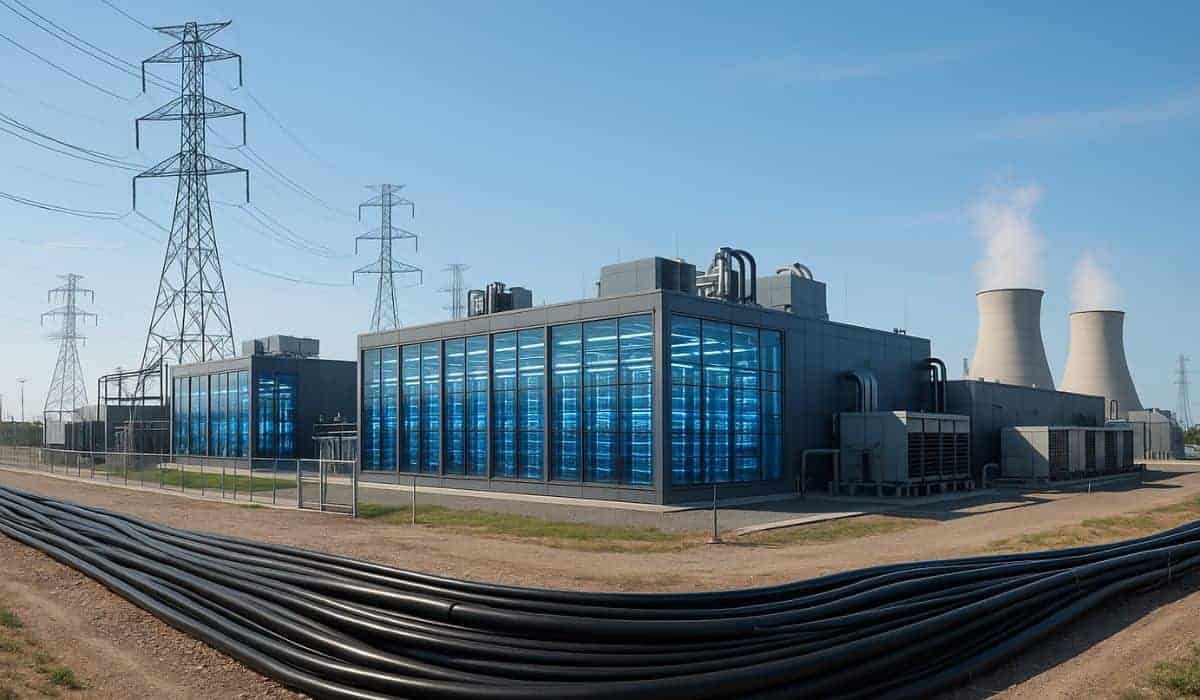
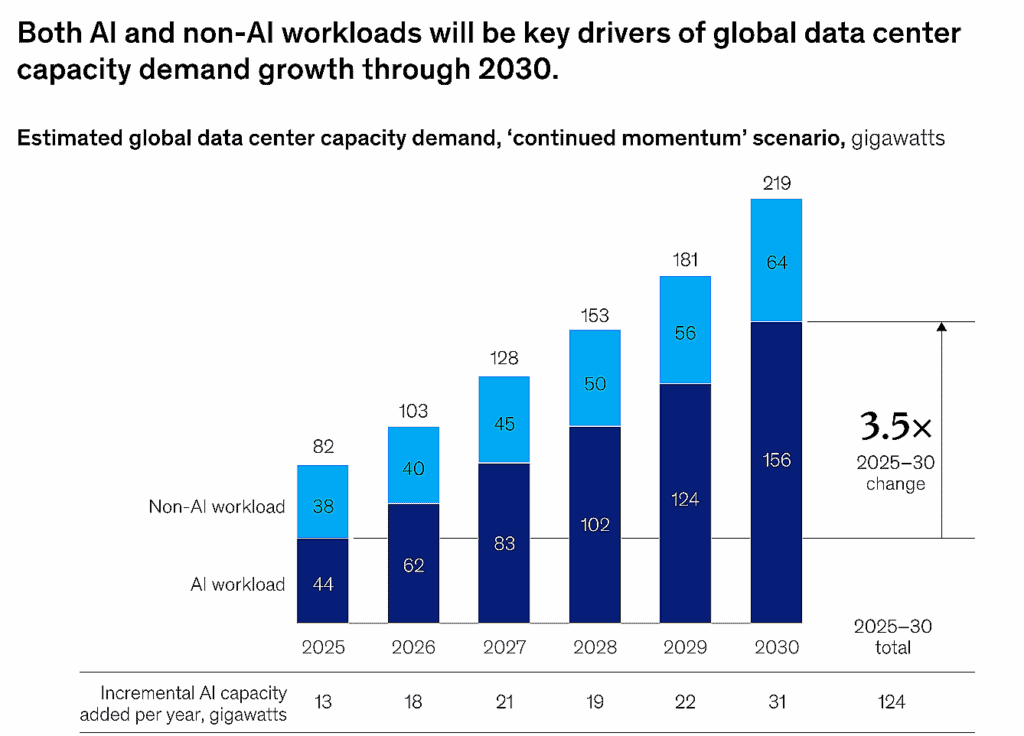
The post The Infrastructure Powering AI and Your Crypto Investment Portfolio appeared on BitcoinEthereumNews.com. Data centers are no longer just cloud warehouses, they’re becoming the core infrastructure behind AI, with power density, cooling needs, and facility scale rising dramatically since 2022. Hyperscalers are building gigawatt-scale campuses, vacancy rates sit near 1.6%, and global capex is projected to accelerate through 2030. For investors asking how to benefit from the AI buildout without taking direct tech risk, today’s data center ecosystem offers exposure through REITs, equipment suppliers, infrastructure firms, and diversified ETFs. AI workloads require high-density racks (50–100 kW) and liquid cooling, creating a structurally different facility model from legacy cloud data centers. Hyperscalers (AWS, Azure, Google Cloud, Meta) drive most demand, with capex expected to rise more than 40% in 2025 based on current public disclosures. Investment exposure spans REITs like Digital Realty and Equinix, AI hardware leaders such as Nvidia and Broadcom, and infrastructure firms including Schneider Electric and ABB. Structural tailwinds, cloud migration, 5G, IoT, streaming, and AI, support long-term demand, but risks include valuation pressure, power constraints, and regulatory scrutiny. Data center investments work best as part of a diversified, long-term portfolio given interest-rate sensitivity and dependency on Big Tech capex cycles. Data centers have suddenly become one of the most talked-about investment opportunities in finance, with tech giants committing trillions of dollars to build new facilities and investors scrambling for exposure to this critical infrastructure. But haven’t data centers been around for decades? What’s changed, and why should investors care now? This guide explains what data centers actually are, why today’s facilities are fundamentally different, who uses them, and how you can gain investment exposure to this transformative sector. What Exactly Is a Data Center? A data center is a physical facility that houses computing equipment such as servers, data storage systems, and networking hardware to store, process, and distribute digital…

Author: BitcoinEthereumNews
Grayscale Dogecoin, XRP Trusts Go Live, Cleanspark Earnings: Crypto Week Ahead

Grayscale Dogecoin, XRP Trusts Go Live, Cleanspark Earnings: Crypto Week Ahead

Markets Share Share this article

Copy linkX (Twitter)LinkedInFacebookEmail
Grayscale Dogecoin, XRP Trusts Go

Author: Coindesk
Data Centers: The Infrastructure Powering AI and Your Crypto Investment Portfolio

Data Centers: The Infrastructure Powering AI and Your Crypto Investment Portfolio

AI and blockchain is transforming data centers into high-density, gigawatt-scale infrastructure. Learn why demand is surging and how investors can gain exposure in 2025.

Author: Brave Newcoin
A quick overview of representative projects in the Monad DeFi ecosystem on the first day of mainnet launch.

A quick overview of representative projects in the Monad DeFi ecosystem on the first day of mainnet launch.

Author: Monad Eco Compiled by: Tim, PANews On the first day of the Monad public chain mainnet launch, this article will help you quickly grasp representative projects in its DeFi ecosystem, such as the lending market, yield products, and liquidity staking. Built specifically for the influx of millions of users into DeFi, Monad is capable of supporting massive daily transaction volumes for large financial applications. With a processing capacity of 10,000 transactions per second, a block generation speed of 400 milliseconds, and high finality, Monad aims to eliminate common problems in DeFi, such as transaction failures, high slippage, oracle data latency, and exorbitant gas fees. DeFi applications running on Monad will operate at speeds comparable to centralized exchanges, while maintaining fully on-chain operations based on a decentralized network. Lending Protocols: Asset Lending and Borrowing in the DeFi Ecosystem DeFi lending transforms existing assets into usable liquidity. On Monad, it becomes a crucial way to amplify risk exposure: users can borrow stablecoins by staking the liquidity staking token LST, earning higher returns through cyclical holding, or employing various staking strategies depending on their level of participation. Lending protocols within the Monad ecosystem offer differentiated product solutions for different user groups. Curvance Curvance allows users to convert interest-bearing assets such as MON, LSTs, and stablecoins into leveraged positions in a single transaction. The product interface eliminates traditional cyclical operation steps: there is no need to repeatedly perform deposit, borrowing, or resupply operations. Curvance's core strength lies in its high capital efficiency, offering market-leading loan-to-value ratios and supporting a variety of collateral types: liquidity-backed tokens, interest-bearing stablecoins, yield derivatives, and vault tokens. The Curvance roadmap also includes support for more alternative assets. The Curvance protocol employs a scalable clearing mechanism: it improves efficiency through bulk clearing, uses auction-style settlement to increase fund recovery rates, and launches a points program to incentivize both depositors and borrowers. TownSquare TownSquare employs a more modular approach, suitable for users who prefer proactive position management: enabling risk isolation, mixed collateral use, and customization of each loan. Users can open multiple independent lending positions within a single account, each with its own proprietary collateral portfolio and loan targets. you can: Borrow stablecoins using liquidity-collateralized tokens as collateral. Borrow MON using stablecoins Use a mix of liquidity-staking tokens and stablecoins to achieve diversified portfolio allocation All of the above operations can be managed through a single wallet, eliminating the need to switch between different user interfaces. TownSquare employs a unified liquidity pool model, where lenders share the same pool, while borrowers can construct personalized positions. For correlated assets (such as MON and MON-LST), TownSquare also offers an "efficiency mode," allowing traders seeking to increase their directional exposure to obtain a higher loan-to-value ratio. TownSquare plans to support a variety of Monad liquidity staking tokens and more mature assets, and will also integrate with WLFI's USD1 stablecoin and issue sUSD1 interest-bearing tokens, which are designed to be directly integrated into a revolving strategy. Other lending protocols that will be launched on Monad: Morpho Euler Gearbox Neverland Money Income Products: Exploring Income Opportunities In addition to lending services, the Monad ecosystem offers yield-generating products that allow users to easily capture ecosystem opportunities. These products encapsulate investment strategies, active management features, and liquidity into holdable assets that users can trade or use within the DeFi ecosystem. This makes yield generation feasible and composable from day one. This section focuses on two yield-generating vaults that will be launched at the Monad mainnet launch. MON Vault: Actively Managed Asset Allocation Built by Mellow and operated by Steakhouse, MON Vault offers an active management strategy for users who want to earn rewards but don't want to manually manage them. You don't need to deposit into separate liquidity pools or strategies; simply deposit MON tokens, and the MON Vault will automatically allocate funds to the optimal options, including liquidity staking tokens, lending markets, or ecosystem incentive programs. MON Vault primarily focuses on: Actively allocate various MON profit opportunities Dynamically adjust strategies with the launch of liquidity platforms and LSTs. Efficient routing to various staking strategies Ultimately, a low-intervention MON yield strategy was developed, which accurately captures yield opportunities with controllable risk while maintaining liquidity, composability, and portability across the Monad ecosystem. earnAUSD Vault: A yield-enhancing solution for highly liquid stablecoins. The earnAUSD vault, jointly created by Agora and Upshift, provides Monad ecosystem users with a one-stop stablecoin yield solution. Users simply deposit Agora's USD stablecoin AUSD to receive freely tradable interest-bearing token earnAUSD, without needing to manage their own investment strategies. The earnAUSD vault will distribute AUSD assets across multiple yield channels within the Monad ecosystem. As the ecosystem develops, future strategies are expected to incorporate more diversified value-added opportunities such as basis trading and structured yield strategies. earnAUSD is designed based on three core functionalities: Optimized allocation: Automatically allocate funds to markets that offer risk-adjusted returns. Deep composability: Supports cross-lending protocols, DEXs, and perpetual contract exchanges. Liquidity-first design: earnAUSD can still be used as collateral, traded in liquidity pools, and supported by the entire ecosystem. In addition, earnAUSD vault integrates the native incentive layers of Agora and Upshift, creating a unified yield product for stablecoin users entering the Monad ecosystem. MON Pledge and Liquidity Pledge In addition to lending protocols and yield products, the Monad DeFi ecosystem also includes MON staking and liquidity staking services. By staking MON, users can earn staking rewards for maintaining network security. Users can stake directly with validators through Gmonads or the MonadVision staking panel. Liquidity staking is an alternative to traditional staking, allowing users to earn corresponding liquidity staking tokens (LST) by staking assets. LST tokens can be used in combination within the DeFi ecosystem, enabling stakers to earn staking rewards while simultaneously participating in other DeFi activities. By maintaining the liquidity of LST tokens, users can realize various application scenarios across the entire DeFi ecosystem, including asset trading, lending, and liquidity provision. There are currently several protocols providing LST in the Monad ecosystem: Fastlane → shMON Kintsu → sMON Magma → gMON These LST tokens, through their extensive integration within the ecosystem, enable MON stakers to earn additional rewards beyond the base staking rewards. In addition to the protocols mentioned above, the Monad mainnet launch will also feature a wide range of DeFi protocols across various categories. The Monad mainnet launch is just the beginning: these foundational protocols will enable users to start experiencing, optimizing, and deploying, thereby fully unleashing the potential of a full-chain, high-performance DeFi environment.

Author: PANews
Grayscale Calls Chainlink the ‘Critical Connective Tissue’ for Tokenized Finance in New Report

Grayscale Calls Chainlink the ‘Critical Connective Tissue’ for Tokenized Finance in New Report

Grayscale Research has referred to Chainlink as the foundational infrastructure layer for the growing tokenized real-world asset (RWA) sector.

Author: Crypto Breaking News
Chainlink Identified as Key Technology for Tokenization Boom, Says Grayscale

Chainlink Identified as Key Technology for Tokenization Boom, Says Grayscale

Key Takeaways: Grayscale claims Chainlink is essential infrastructure for tokenized finance. Large financial institutions have already tested Chainlink technology. A […] The post Chainlink Identified as Key Technology for Tokenization Boom, Says Grayscale appeared first on Coindoo.

Author: Coindoo
Three Altcoins That Look Deeply Discounted and Could Ride the Next Big Rally

Three Altcoins That Look Deeply Discounted and Could Ride the Next Big Rally

The post Three Altcoins That Look Deeply Discounted and Could Ride the Next Big Rally appeared on BitcoinEthereumNews.com. The post Three Altcoins That Look Deeply Discounted and Could Ride the Next Big Rally appeared first on Coinpedia Fintech News The crypto market has been rough lately, but one topic that has suddenly shown up in political conversations is the idea of a possible $2,000 stimulus check. President Trump is trying to boost liquidity in the economy while proving that his tariff policies are working, and this idea has returned as part of that discussion. Nothing is approved yet and no one expects checks this year, but people are talking about what could happen in 2026 if such a payout ever goes through. It has also sparked a simple question.  According to AltcoinBuzz, three projects are attracting more interest because their fundamentals remain strong even though the market is weak. Chainlink: A Quiet but Essential Player in Real World Assets Chainlink continues to feel like the silent backbone of the crypto industry. It does not rely on hype and most of its biggest work happens quietly with institutions and developers. Even so, its importance keeps growing because Real World Assets are becoming one of the strongest long term trends in the market. Everything from tokenized bonds to gold to real estate needs accurate data feeds. Chainlink provides that infrastructure and is still the most trusted oracle network. New ETFs listed with the DTCC are also expected to bring more structured and long term capital into the ecosystem. Despite all this progress, LINK has dropped with the broader market, making it a rare discount for investors who believe RWAs and DeFi will keep expanding. Bittensor: A Rising Force in Decentralized AI Bittensor and its TAO token have become one of the most talked about names in crypto AI. The network now supports more than one hundred AI subnets, with each…

Author: BitcoinEthereumNews
Grayscale Predicts Chainlink’s Crucial Role in Blockchain Infrastructure

Grayscale Predicts Chainlink’s Crucial Role in Blockchain Infrastructure

Grayscale highlights Chainlink's vital role in blockchain and traditional finance connections. The report outlines Chainlink's expansion beyond price oracles to comprehensive financial technology. Continue Reading:Grayscale Predicts Chainlink’s Crucial Role in Blockchain Infrastructure The post Grayscale Predicts Chainlink’s Crucial Role in Blockchain Infrastructure appeared first on COINTURK NEWS.

Author: Coinstats