Oracle

Oracles are essential infrastructure components that feed real-time, off-chain data (such as price feeds, weather, or sports results) into blockchain smart contracts. Without decentralized oracles like Chainlink and Pyth, DeFi could not function. In 2026, oracles have evolved to support verifiable randomness and cross-chain data synchronization. This tag covers the technical evolution of data availability, tamper-proof price feeds, and the critical role oracles play in ensuring the deterministic execution of complex decentralized applications.

5185 Articles
Created: 2026/02/02 18:52
Updated: 2026/02/02 18:52
Modest Bounce as Stellar Integration Expands RWA Reach

Modest Bounce as Stellar Integration Expands RWA Reach

The post Modest Bounce as Stellar Integration Expands RWA Reach appeared on BitcoinEthereumNews.com. The native token of oracle network Chainlink LINK$17.15 bounced 3.6% on Friday, reversing some of Thursday’s losses as traders stepped in around key support level. LINK briefly cleared the $17 level with a surge in trading volume — some 3 million tokens changed hands during a morning breakout up —, pointing to renewed accumulation, CoinDesk Research’s market insight tool suggested. However, weakness during the U.S. trading hours drove LINK back below $17. Recently, the token traded at $16.96. On the news front, payments-focused Stellar (XLM) announced to integrate Chainlink’s Cross-Chain Interoperability Protocol (CCIP), Data Feeds, and Data Streams. The move enables developers and institutions building on Stellar to access real-time data and trusted cross-chain infrastructure for tokenized assets. With over $5.4 billion in quarterly RWA volume and a fast-growing DeFi footprint, Stellar’s adoption of Chainlink tooling signals expanding demand for secure, interoperable financial infrastructure. Key technical levels to watch: LINK now holds near-term support at $16.37 with upside targets at $17.46 and $18.00. Whether the token can build on Friday’s rebound may depend on broader market flows and follow-through from dip-buying. Support/Resistance: Solid support holds at $16.37 after multiple successful tests, while $17.46 resistance shows repeated rejection patterns. Volume Analysis: 78% volume surge during breakout attempt confirms institutional interest, explosive selling volume indicates position rebalancing. Chart Patterns: Late-session flush-out pattern creates classic oversold setup for accumulation strategies. Targets & Risk/Reward: Holding above $16.89 targets $17.46 retest with upside to $18.00, downside risk limited to $16.37 support. Disclaimer: Parts of this article were generated with the assistance from AI tools and reviewed by our editorial team to ensure accuracy and adherence to our standards. For more information, see CoinDesk’s full AI Policy. Source: https://www.coindesk.com/markets/2025/10/31/chainlink-s-link-bounces-3-6-from-lows-stellar-integration-expands-rwa-reach

Author: BitcoinEthereumNews
‘In The World Of NIL, It’s Pay To Play’

‘In The World Of NIL, It’s Pay To Play’

The post ‘In The World Of NIL, It’s Pay To Play’ appeared on BitcoinEthereumNews.com. Blenders eyewear founder Chase Fisher details why he’s investing $5 million — the largest NIL donation to San Diego State athletics — in the San Diego State Aztecs men’s basketball program: ‘In the world of NIL, it’s pay to play.” Blenders It’s no secret that Blenders founder Chase Fisher loves his alma mater, San Diego State. Fisher attended the university and graduated from there in 2010. It wasn’t long after that he founded Blenders, an eyewear company that reached a valuation of $90 million in 2019 upon 70% of the company being acquired by Safilo Group. The San Diego-based company has become mainstream and popular over the years, especially due to its affiliation with Colorado Buffaloes head coach Deion Sanders. Sanders and Blenders created a custom line called the Prime21 collection. That’s in addition to its partnership with F1’s Oracle Red Bull racing for a collection of eyewear. While the sunglasses and the company are definitely mainstream and cool in its appearance – it tries to match its San Diego-based roots – what’s also notable about Fisher and the company is their continued efforts through NIL. Fisher recently donated $5 million to the San Diego State Aztecs men’s basketball program. It’s the largest donation ever to San Diego State and $1 million will be donated to them on an annual basis over the next five years. That’s a big deal for a San Diego State program that isn’t a blue blood school. It’s also a big deal considering the Aztecs are prepping for a move from the small-tier Mountain West conference into a historically power conference in the Pac-12, which features the likes of superpowers such as the UCLA Bruins and Arizona Wildcats, who have a combined 50 national championships among them. Fisher has already made $300K in NIL donation…

Author: BitcoinEthereumNews
Standard Chartered Projects Tokenized RWAs to Hit $2 Trillion by 2028, Led by USDT Stablecoins

Standard Chartered Projects Tokenized RWAs to Hit $2 Trillion by 2028, Led by USDT Stablecoins

The post Standard Chartered Projects Tokenized RWAs to Hit $2 Trillion by 2028, Led by USDT Stablecoins appeared on BitcoinEthereumNews.com. COINOTAG recommends • Exchange signup 💹 Trade with pro tools Fast execution, robust charts, clean risk controls. 👉 Open account → COINOTAG recommends • Exchange signup 🚀 Smooth orders, clear control Advanced order types and market depth in one view. 👉 Create account → COINOTAG recommends • Exchange signup 📈 Clarity in volatile markets Plan entries & exits, manage positions with discipline. 👉 Sign up → COINOTAG recommends • Exchange signup ⚡ Speed, depth, reliability Execute confidently when timing matters. 👉 Open account → COINOTAG recommends • Exchange signup 🧭 A focused workflow for traders Alerts, watchlists, and a repeatable process. 👉 Get started → COINOTAG recommends • Exchange signup ✅ Data‑driven decisions Focus on process—not noise. 👉 Sign up → Tokenized real-world assets (RWAs) are projected to grow from $35 billion to nearly $2 trillion by 2028, according to Standard Chartered. This expansion, driven by stablecoins and institutional adoption, signals a major shift toward blockchain-based finance integrating traditional assets like equities and debt. Standard Chartered forecasts RWAs reaching $2 trillion by 2028, a 57-fold increase from current levels. Stablecoins, with over $308 billion in market cap, are key to accelerating on-chain liquidity and mainstream adoption. Tokenized money-market funds and equities could each hit $750 billion, alongside growth in debt, commodities, and real estate. Discover Standard Chartered’s bold prediction for tokenized real-world assets hitting $2 trillion by 2028. Explore stablecoin impacts and RWA growth in blockchain finance—learn how this shift affects your investments today. What Are Tokenized Real-World Assets and How Will They Grow by 2028? Tokenized real-world assets (RWAs) represent traditional financial instruments like bonds, equities, and real estate converted into digital tokens on blockchain networks, enhancing liquidity and accessibility. Standard Chartered’s analysis, led by Geoffrey Kendrick, head of digital assets research, predicts these assets will surge from approximately…

Author: BitcoinEthereumNews
Standard Chartered projects $2T tokenized asset boom by 2028

Standard Chartered projects $2T tokenized asset boom by 2028

The post Standard Chartered projects $2T tokenized asset boom by 2028 appeared on BitcoinEthereumNews.com. Key Takeaways What does Standard Chartered predict for tokenized real-world assets by 2028?  The bank projects RWAs will grow from $35 billion to nearly $2 trillion, driven by liquidity and innovation. How are stablecoins influencing the shift toward blockchain-based finance?  Stablecoins, now over $308 billion in market cap, are accelerating mainstream adoption of decentralized financial infrastructure. Standard Chartered is signaling a major shift in the global financial order. The bank says decentralized finance is no longer a fringe experiment, but a rising counterweight to the traditional banking system, and it expects tokenized real-world assets to become the backbone of that transition. In a recent analysis, Geoffrey Kendrick, head of digital assets research at Standard Chartered, projects that the total value of real-world assets (RWAs) issued on blockchain networks could soar to $2 trillion by 2028. Source: Kyle Chassé/X According to the report, the performance of stablecoins throughout 2025 will serve as a key catalyst.  It is expected to drive blockchain-based finance further into mainstream markets, extending its reach well beyond the crypto-native audience. How much will tokenized RWAs grow by 2028? Furthermore, the bank projects that non-stablecoin tokenized assets could grow from approximately $35 billion today to nearly $2 trillion by the end of 2028. This would place their market size on par with the projected stablecoin sector. According to the report, tokenized money-market funds and publicly listed equities are expected to lead this growth, with each category potentially reaching around $750 billion in value. The remaining expansion would be driven by tokenized versions of corporate debt, commodities, private equity, real estate, and other investment funds. To reach the $2 trillion milestone, RWAs would need to grow more than 57-fold from their current $35 billion base. While ambitious, this leap now seems increasingly plausible given the accelerating pace of institutional adoption.…

Author: BitcoinEthereumNews
Stellar integrates Chainlink to power DeFi and RWA growth

Stellar integrates Chainlink to power DeFi and RWA growth

The post Stellar integrates Chainlink to power DeFi and RWA growth appeared on BitcoinEthereumNews.com. Payments-focused blockchain platform Stellar plans to leverage oracle network Chainlink’s solutions, including data standards and cross-chain interoperability protocol, to boost decentralized finance traction on the blockchain network. Summary Stellar is integrating Chainlink to tap into Data Feeds, Data Streams, and the Cross-Chain Interoperability Protocol. Developers and institutions will benefit from the same solutions powering over $100 billion in total value locked in DeFi. Integration is set to also bolster real-world asset tokenization on the public blockchain. Stellar will join the Chainlink Scale program and integrate Chainlink’s key solutions, including Cross-Chain Interoperability Protocol, Data Feeds, and Data Streams, according to a press release. What does this bring to Stellar? The integration will see developers and institutions tap into trusted data and cross-chain interoperability as they build decentralized applications on Stellar (XLM). With Chainlink (LINK), Stellar hopes to expand its ecosystem across the burgeoning real-world asset and decentralized finance markets.  The move to collaborate comes as tokenized treasuries, RWA payments and overall DeFi resurgence highlight the industry’s growing traction amid regulatory shifts. “With the decision to integrate CCIP, Data Feeds, and Data Streams, Stellar is enabling its ecosystem to access the secure and reliable infrastructure needed to support institutional-grade tokenization and seamless cross-chain applications,” said Johann Eid, chief business officer at Chainlink Labs. “This collaboration significantly accelerates Stellar’s ability to scale to meet the demands of a unified onchain financial system.” Specific benefits that come to XLM as a result of this integration include battle-tested security via CCIP’s consensus layer. This solution, powered by Chainlink Decentralized Oracle Network, has helped secure over $100 billion in total volume locked across DeFi. CCIP gives developers production-ready interoperability. Developers and institutions can also tap into token-agnostic transfers and programmable token transfers among others. Chainlink’s data standards will unlock DeFi on the XLM network. “Once the…

Author: BitcoinEthereumNews
Here’s How Zero Knowledge Proof Is Set to Redefine Blockchain Trust Forever!

Here’s How Zero Knowledge Proof Is Set to Redefine Blockchain Trust Forever!

The post Here’s How Zero Knowledge Proof Is Set to Redefine Blockchain Trust Forever! appeared on BitcoinEthereumNews.com. Information spreads faster than facts can be confirmed, and even blockchain’s decentralization hasn’t solved the problem of trust. Zero Knowledge Proof (ZKP), an upcoming blockchain protocol, is taking an analytical step toward fixing that. It aims to establish a decentralized reputation layer where truth is proven, recorded, and rewarded. Rather than relying on algorithms, third-party verifiers, or centralized oversight, Zero Knowledge Proof (ZKP) allows users to stake what they know and gain from being correct. As the ZKP whitelist coming soon draws attention, the project is preparing to redefine how accuracy is measured and valued in the decentralized era, turning truth into a verifiable, on-chain asset. Web3’s Next Phase: From Decentralization to Verifiability Web3 has achieved what once seemed impossible, finance without banks, governance without institutions, and ownership without intermediaries. Yet one problem persists: there’s no shared protocol for truth. Blockchains preserve information immutably, but they don’t determine whether that information is correct. While oracles like Chainlink bridge real-world data, their scope is limited to quantifiable inputs. AI models can analyze vast amounts of content, but their logic is opaque and unverifiable. Social layers, such as DAOs or community forums, often elevate popularity over evidence. What’s missing is a systematic method to assess and reward credibility. That’s where Zero Knowledge Proof (ZKP) comes in. Instead of competing with existing protocols, it complements them by serving as a trust layer, a verifiability mechanism that distinguishes accuracy from noise through transparent, economic consensus. Redefining Reputation: From Subjectivity to Proof-Based Credibility Reputation systems today are largely subjective. Traditional institutions rely on inherited status or credentials, while online networks measure influence through likes and followers. Both approaches lack transparency and reliability. Zero Knowledge Proof (ZKP) reimagines reputation as something earned through provable accuracy. In its model, users make claims by staking tokens. Those claims…

Author: BitcoinEthereumNews
Stellar Joins Chainlink Scale to Bridge Real World Assets and DeFi

Stellar Joins Chainlink Scale to Bridge Real World Assets and DeFi

TLDR Stellar joins Chainlink SCALE to boost DeFi and cross-chain tokenization. CCIP integration enables secure, seamless blockchain interoperability. Developers gain access to audited, token-agnostic cross-chain tools. Chainlink data feeds empower Stellar’s DeFi and RWA innovation. The partnership bridges traditional finance with decentralized systems. Stellar has announced its integration with Chainlink through the Chainlink SCALE program [...] The post Stellar Joins Chainlink Scale to Bridge Real World Assets and DeFi appeared first on CoinCentral.

Author: Coincentral
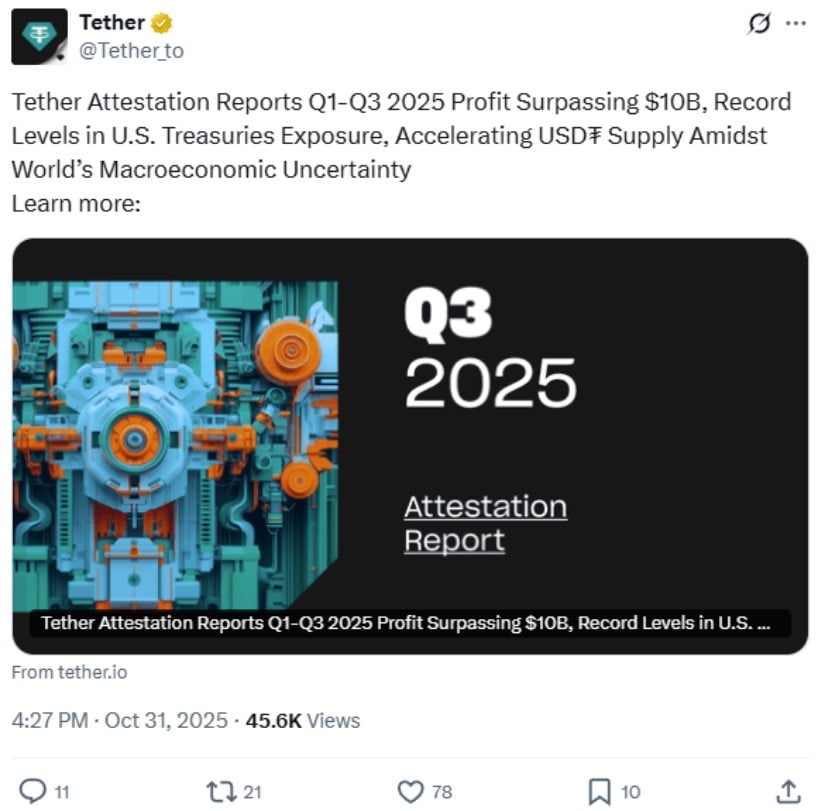
Tether’s 2025 Profits Surpass $10 Billion as Stablecoin Dominance Grows

Tether’s 2025 Profits Surpass $10 Billion as Stablecoin Dominance Grows

The world's largest stablecoin issuer has posted extraordinary earnings that rival major Wall Street firms, while new platforms emerge to serve the growing demand for digital currencies.

Author: Brave Newcoin
Stellar Taps Chainlink for Cross-Chain Boost and Institutional-Grade DeFi

Stellar Taps Chainlink for Cross-Chain Boost and Institutional-Grade DeFi

TLDR: Stellar will integrate Chainlink CCIP, Data Feeds, and Data Streams to support cross-chain DeFi applications. The collaboration aims to enhance access to trusted data and interoperability across blockchain ecosystems. Chainlink’s infrastructure secures $100B+ in DeFi TVL and enables trillions in onchain transaction volume. Stellar recorded $5.4B in RWA payments last quarter, marking rapid growth [...] The post Stellar Taps Chainlink for Cross-Chain Boost and Institutional-Grade DeFi appeared first on Blockonomi.

Author: Blockonomi
Goldman Sachs Raises Nvidia Price Target to $240, Hints at AI-Driven Upside

Goldman Sachs Raises Nvidia Price Target to $240, Hints at AI-Driven Upside

The post Goldman Sachs Raises Nvidia Price Target to $240, Hints at AI-Driven Upside appeared on BitcoinEthereumNews.com. COINOTAG recommends • Exchange signup 💹 Trade with pro tools Fast execution, robust charts, clean risk controls. 👉 Open account → COINOTAG recommends • Exchange signup 🚀 Smooth orders, clear control Advanced order types and market depth in one view. 👉 Create account → COINOTAG recommends • Exchange signup 📈 Clarity in volatile markets Plan entries & exits, manage positions with discipline. 👉 Sign up → COINOTAG recommends • Exchange signup ⚡ Speed, depth, reliability Execute confidently when timing matters. 👉 Open account → COINOTAG recommends • Exchange signup 🧭 A focused workflow for traders Alerts, watchlists, and a repeatable process. 👉 Get started → COINOTAG recommends • Exchange signup ✅ Data‑driven decisions Focus on process—not noise. 👉 Sign up → Goldman Sachs has raised its 12-month price target for Nvidia from $210 to $240, reflecting strong confidence in the chipmaker’s AI-driven growth ahead of its November 19 earnings report. This adjustment implies an 18% upside from current levels, driven by robust demand in data centers and AI infrastructure. Goldman Sachs maintains a buy rating on Nvidia shares. The update highlights Nvidia’s expanding role in AI infrastructure and data centers. New earnings forecasts show third-quarter EPS at $1.28 and fourth-quarter at $1.49, exceeding Wall Street consensus by 3% and 5%. Goldman Sachs boosts Nvidia price target to $240 amid AI surge. Explore earnings forecasts, datacenter growth, and market impacts in this analysis. Stay ahead with key insights on Nvidia stock performance. (142 characters) What is Goldman Sachs’ new price target for Nvidia? Nvidia price target has been elevated by Goldman Sachs to $240 for the next 12 months, up from the previous $210, signaling optimism about the company’s ongoing momentum in artificial intelligence. This revision maintains the bank’s buy recommendation and points to an 18% potential increase from recent trading…

Author: BitcoinEthereumNews