RWA

RWA (Real World Assets) refers to the tokenization of tangible assets—such as real estate, private credit, and government bonds—on the blockchain. By bringing traditional financial instruments on-chain, RWA protocols like Ondo and Centrifuge provide DeFi users with stable, real-yield opportunities. In 2026, the RWA sector is a multi-trillion-dollar bridge between TradFi and DeFi, enabling fractional ownership and global liquidity for previously illiquid assets. Follow this tag for insights into on-chain credit markets, regulatory compliance, and asset-backed security innovations.

43196 Articles
Created: 2026/02/02 18:52
Updated: 2026/02/02 18:52
Chainlink, Pyth Become Oracle Providers for US Government

Chainlink, Pyth Become Oracle Providers for US Government

The post Chainlink, Pyth Become Oracle Providers for US Government appeared on BitcoinEthereumNews.com. The US government has tapped Chainlink and Pyth, two blockchain oracle providers, to publish economic data onchain. Chainlink was selected to provide data feeds from the Bureau of Economic Analysis (BEA), and will publish additional data feeds in response to consumer demand or at the behest of the US government, a Chainlink spokesperson told Cointelegraph. These feeds include real gross domestic product (GDP), Personal Consumption Expenditures (PCE) price index, and real final sales to private domestic purchasers, the company said. The Department of Commerce also selected Pyth to be a publisher of gross domestic product (GDP) data — the total economic output in a year — according to an announcement on Thursday. Source: Pyth Network Publishing government data onchain is part of the Trump administration’s plan to make government spending more transparent in a bid to improve accountability and make the US a “world capital” of crypto. Related: Philippine lawmaker to propose putting government budget on blockchain Bringing government economic data onchain will provide positive benefits to spot crypto markets, a Chainlink spokesperson said. These include automated trading strategies that execute based on changing government data, real-time prediction markets for macroeconomic developments and risk-management strategies for decentralized finance (DeFi) protocols. Stablecoins, tokenized government bonds, perpetual futures contracts, real-world tokenized assets (RWAs) and other digital financial instruments reliant on macroeconomic inputs also stand to benefit from onchain government economic data. Proposals to bring public spending data and other macroeconomic figures onchain are currently fomenting in the Philippines, the United Kingdom and El Salvador. Traders eye potential gains for crypto markets The price of Pyth (PYTH) surged by nearly 70% on the news, and Chainlink (LINK) posted modest gains of over 3% before falling back to about $25. LINK has rallied by about 61% since the start of August, going from a…

Author: BitcoinEthereumNews
The future depends on the AI we build: Centralized vs decentralized | Opinion

The future depends on the AI we build: Centralized vs decentralized | Opinion

Ethics frameworks and antitrust measures could be used as tools against centralization and AI dystopia, safeguarding decentralization.

Author: Crypto.news
Bitcoin Top Fears Spark Capital Shift to Ethereum

Bitcoin Top Fears Spark Capital Shift to Ethereum

The post Bitcoin Top Fears Spark Capital Shift to Ethereum appeared on BitcoinEthereumNews.com. Key Notes Bitcoin fails to hold $113K, flashing a bearish divergence similar to 2021. Long-term holders are distributing while short-term traders fuel BTC demand. Whales remain cautious, leaving ETH as the preferred rotation play. Bitcoin BTC $110 033 24h volatility: 2.7% Market cap: $2.19 T Vol. 24h: $37.39 B has once again failed to hold above the critical $113,000 mark, slipping back to $111,139 at press time, a 1.6% decline over the past 24 hours. The move has led to speculations of the leading digital asset reaching its cycle top, with signs of capital rotation into Ethereum ETH $4 363 24h volatility: 5.3% Market cap: $527.03 B Vol. 24h: $29.35 B becoming increasingly evident. Divergence Signals Echo the 2021 Cycle Top Ali Martinez highlighted a worrying technical signal on Bitcoin’s weekly chart, i.e., a bearish divergence between price and Relative Strength Index (RSI). While Bitcoin continues to print higher highs, RSI has trended lower, a classic sign that momentum is weakening even as price climbs. Bitcoin $BTC is making higher highs while RSI makes lower lows. This is the same divergence seen before the 2021 cycle top! pic.twitter.com/tR0IT25AVf — Ali (@ali_charts) August 29, 2025 Martinez noted that this setup mirrors the divergence seen just before the 2021 market top, where Bitcoin peaked around $69,000 before entering a prolonged bear cycle, also known as the crypto winter. Short-Term Optimism, Long-Term Caution Swissblock’s Altcoin Vector shared a breakdown of Bitcoin’s net position change across different market participants: Long-Term Holders (LTHs) are distributing. Short-Term Holders (STHs) are accumulating aggressively. Whales remain indecisive, not committing significant inflows to Bitcoin just yet. Exchanges show mild outflows, though not enough to signal large-scale distribution. It’s no secret that profit-taking is happening in $BTC, with much of that capital rotating into $ETH.https://t.co/UeAvwWOydf — Bitcoin Vector (@bitcoinvector) August…

Author: BitcoinEthereumNews
New Meme Coin Sparks FOMO Back Into Investors, As Analysts See Similar 1000x Moves To PEPE, SHIB

New Meme Coin Sparks FOMO Back Into Investors, As Analysts See Similar 1000x Moves To PEPE, SHIB

PEPE and SHIB proved meme wealth is real, but Layer Brett at $0.005 with L2 speed, staking up to 1,850%, and $2M raised is tipped as the next 1,000x meme.

Author: Blockchainreporter
Why Ethereum Profits Could Rotate Into Cardano and Layer Brett This Cycle

Why Ethereum Profits Could Rotate Into Cardano and Layer Brett This Cycle

The post Why Ethereum Profits Could Rotate Into Cardano and Layer Brett This Cycle appeared on BitcoinEthereumNews.com. Crypto News Ethereum investors are sitting on substantial profits following the recent market recovery. Smart money knows that profit-taking and rotation are essential during bull markets. This cycle, two destinations stand out for these rotating funds. Cardano price action suggests accumulation, while Layer Brett offers something completely different. The rotation isn’t about abandoning Ethereum but about optimizing returns. Different projects offer different risk-reward profiles at various cycle stages. Understanding this dynamic separates average investors from exceptional ones. Ethereum’s (ETH) profit-taking reality Ethereum has delivered fantastic returns for early investors. The recent ETF approvals created additional momentum. However, large gains naturally lead to profit-taking as investors seek new opportunities. This rotation represents healthy market behavior rather than bearish sentiment. Smart investors secure gains while maintaining core positions. They then allocate portions to projects with fresh potential. Why Cardano (ADA) attracts rotating capital The Cardano price chart shows consistent accumulation patterns. ADA’s research-driven approach appeals to investors who are fundamentally focused. Its methodical development provides confidence during market volatility. The Cardano price potential remains attractive compared to Ethereum’s larger capitalization. Percentage gains could outperform as development milestones are achieved. This mathematical advantage drives strategic allocation. Layer Brett’s (LBRETT) unique proposition Layer Brett offers what neither Ethereum nor Cardano can provide. Its micro-cap status allows exponential growth with minimal capital inflow. The Ethereum Layer 2 foundation combines security with scalability. The project’s presale structure enables early positioning before broader recognition. This timing advantage often leads to superior returns compared to established projects. This is definitely a project worth keeping an eye on. Technology diversification benefits Ethereum provides security but faces scalability challenges. ADA offers innovation but still moves quite slowly. Layer Brett delivers immediate utility through working Layer 2 technology, upping the ante and delivering a more technologically sound product from day one.…

Author: BitcoinEthereumNews
A historic step: US official GDP data will be stored on 9 major public chains including Bitcoin and Ethereum

A historic step: US official GDP data will be stored on 9 major public chains including Bitcoin and Ethereum

By Frank, PANews On August 28, the U.S. Department of Commerce announced that it would publish real gross domestic product (GDP) data on a blockchain, starting with data from July 2025. The first six data types will include real GDP, the personal consumption expenditures (PCE) price index, and actual final sales to domestic private buyers. This data on-chain migration involves nine public blockchains and two oracle networks. For the crypto industry, this signifies that the core data of the world's most important economies is moving from traditional centralized institutions to native on-chain availability. On the one hand, this government-led data on-chain migration provides new credibility for the crypto world. On the other hand, it represents another symbolic move by the Trump administration to promote its "Crypto Capital" initiative. Two-tier architecture of "certificate storage" and "application" First, from a technical perspective, PANews will sort out the process of uploading data to the chain. According to the U.S. Department of Commerce's official statement, the core operation involves embedding the cryptographic hash of the official GDP report PDF file, known as its unique "digital fingerprint," into transactions on nine blockchains. The first blockchain networks to be adopted are Bitcoin, Ethereum, Solana, TRON, Stellar, Avalanche, Arbitrum One, Polygon PoS, and Optimism. Through this operation, anyone can verify whether the report has been tampered with by comparing the hash value on the chain with the hash value of the official report. Furthermore, Chainlink and Python, two leading oracle platforms, were selected for this data on-chain integration. These platforms serve as middleware services between blockchain and the real world. Oracles' primary mission is to securely and reliably feed real-world external (off-chain) data to the blockchain network. GDP data contract on Ethereum Therefore, choosing Chainlink and Python can better distribute this on-chain data to the applications and ecosystems that need it. Chainlink's official website currently has a dashboard function for these six data points. However, unlike the nine public chains announced by the U.S. Department of Commerce, Chainlink's information shows that it currently supports ten public chain networks, including Arbitrum, Avalanche, Base, Botanix, Ethereum, Linea, Mantle, Optimism, Sonic and ZKsync. This may seem like a discrepancy, but it's not due to a synchronization error. Rather, the blockchains mentioned in the two lists play different roles in the process. Simply put, the nine public chains listed by the US Department of Commerce are original data verification networks used for evidence storage. The ten blockchain networks announced by Chainlink are the initial group of blockchains supported by its data feed service. These chains share a common characteristic: they are all active smart contract platforms (primarily Ethereum and its Layer 2 expansion network). Political “showmanship”? But it benefits on-chain products What are the actual pain points of this data chain? The real reasons behind it may come from two aspects. From the perspective of the crypto industry, this data on-chain, especially the connection to leading oracles such as Chainlink and Pyth, can provide the crypto industry with a more direct and authoritative source of GDP and other core US economic data, which is conducive to the stability of products such as stablecoins, RWAs, and prediction markets that are linked to this official data. From another perspective, the move to put data on the blockchain has a profound and complex relationship with President Trump and his administration's historical behavior of questioning the reliability of official data. During his presidency, Trump has repeatedly publicly accused unfavorable economic data (such as GDP growth or employment data) of being "manipulated" or "biased." In August, he fired Erika McEntarfer, director of the Bureau of Labor Statistics, over a poor jobs report and accused her of releasing "fake" data. From the perspective of the U.S. Department of Commerce, putting data like GDP on-chain seems to be a proactive response to Trump's skepticism about the data's authenticity. However, many in the U.S. media have argued that such manipulation cannot completely solve the problem of data falsification. After all, putting data on-chain only provides data evidence, but it cannot guarantee the objectivity and authenticity of the data's core source. PYTH skyrocketed, while public chain tokens remained “indifferent” Regardless of the ultimate goal and actual effect, this data chain initiative led by the US government can ultimately be summarized as a further recognition of blockchain. However, judging by the list of public chains released by the U.S. Department of Commerce, the governance tokens of these chains did not seem to experience a surge in value due to the news. Chainlink's LINK token, which is part of the partnership, did experience a rapid surge on the evening of the 28th, but subsequently fell again as the broader market weakened. The only one that was significantly stimulated by this news was Pyth. The price of its token quickly rose from around $0.11 before the news was released to a high of $0.25, with a daily increase of up to 110%, and its market value increased by more than $600 million. Judging from this divergence, the surge in PYTH tokens may be due to active capital support. The actual support for this news may not be strong. However, this may just be the beginning. Commerce Secretary Lutnick made it clear during his announcement that the department plans to expand this blockchain-based data infrastructure to all federal agencies once it finalizes all the details. This means that in the future, all types of public data from the U.S. government may be published in a similar manner. Overall, while the US data blockchain initiative may not have a strong short-term impact on the market, its long-term impact on the entire crypto industry may be greater. This marks the beginning of a new era for mainstream public blockchains as the core layer of data storage.

Author: PANews
I Took 100 Trades Using One Pattern — Here Are the Stats

I Took 100 Trades Using One Pattern — Here Are the Stats

I Took 100 Trades Using One Pattern — Here Are the StatsImage Trading is a numbers game, but it’s also a test of discipline, patience, and the ability to stick to a plan. Everyone has their favorite patterns, indicators, or “secret setups,” but the real question is: do they work consistently in real trading conditions? I wanted to find out for myself. Over the past few weeks, I took 100 trades using just one simple trading pattern. No fancy strategies, no multiple indicators, just one repeatable setup. I tracked every trade, recorded every win and loss, and analyzed everything to see whether a single pattern could produce consistent results. Here’s my full experience, stats, and lessons learned. Choosing the Pattern I decided to use the EMA crossover with RSI confirmation, a pattern that’s widely discussed in crypto trading communities. It’s simple enough for beginners to understand but can still be powerful in trending markets. Here’s the setup: Entry Rule (Long): EMA 9 crosses above EMA 21 and RSI is below 70. Entry Rule (Short): EMA 9 crosses below EMA 21 and RSI is above 30. Exit Rule: Close the trade when EMA 9 crosses back, or when RSI signals the opposite. Stop Loss: 0.5% per trade. Take Profit: 1% per trade. The simplicity was intentional. I wanted to test the pattern on its own, without overcomplicating things with dozens of indicators or complex signals. Preparing for the Experiment I traded BTC/USDT and ETH/USDT, mainly on 15-minute charts, which offered a balance between seeing enough trades per day and not being overwhelmed by noise like on 1-minute charts. I documented every single trade: Entry price and exit price Trade outcome (win, loss, break-even) Market conditions (trending, sideways, volatile) Notes about emotions or mistakes The goal was to see whether one pattern could survive in different market conditions and whether a trader could remain disciplined over a large sample size. Trades 1–20: The Early Days The first 20 trades were a mixture of excitement and frustration. Wins: 11 Losses: 9 At first, it felt promising. The EMA crossover with RSI confirmation caught some solid trends in BTC, and I started seeing small profits accumulate. But it wasn’t perfect. Sideways or choppy markets led to false signals, and a few trades hit stop losses within minutes. Key Takeaways From Early Trades Context is critical. Even a reliable pattern fails in a flat market. Patience matters. Waiting for confirmation — even one extra candle — could save you from a fake signal. Emotions are dangerous. I had a few moments of hesitation that caused me to enter too late, missing profits. Trades 21–50: Reality Sets In By the 30th trade, reality began to hit. Not every setup was profitable. Some trades looked perfect on the chart but immediately reversed. Wins: 17 Losses: 13 At this stage, I noticed a trend: the pattern worked best in trending markets. When BTC or ETH was moving in a clear direction, the EMA crossover consistently indicated entry points. But in low volatility periods, it produced almost as many losses as wins. I also learned that documenting trades is invaluable. Seeing your own mistakes on paper — or in a spreadsheet — prevents repeating them. For example, I realized I often ignored the larger trend, which sometimes caused a winning setup to fail. Trades 51–80: Adjusting to Market Conditions Halfway through, I decided to tweak my approach slightly without abandoning the core pattern. I started: Filtering trades to only align with the overall market trend Avoiding trades when RSI was extremely overbought or oversold, even if EMA conditions were met Skipping trades during low-volume hours These adjustments improved results. The win rate increased, and losses became smaller. It reinforced an important lesson: a pattern alone is rarely enough. Context and discipline matter just as much. Trades 81–100: Finishing Strong The final 20 trades felt smoother. By this point, I had a rhythm: Identify the setup Check market trend and volume Execute with clear stop loss and take profit Record every detail This approach reduced impulsive decisions and allowed the pattern to perform closer to its theoretical potential. By the 100th trade: Total Wins: 57 Total Losses: 43 Overall, the pattern was profitable — but just barely. Most wins were small, and a few larger losses offset some gains. Still, the experiment proved that even a simple, repeatable pattern can work if applied with discipline and market awareness. What Worked Simplicity — Using one clear pattern kept decision-making straightforward. Consistency — The pattern could be applied repeatedly without confusion. Trend Alignment — Trades taken in the direction of the larger trend had much higher success. Record-Keeping — Documenting every trade helped identify mistakes and improve execution. What Didn’t Work Sideways Markets — EMA crossovers produced many false signals when the market was choppy. Ignoring Context — Early in the experiment, I took trades without considering the bigger picture, which led to losses. Overconfidence — Seeing early wins made me slightly careless, resulting in avoidable losses. Emotional Fatigue — 100 trades is mentally taxing, and decision fatigue can lead to mistakes. Lessons Learned Patterns Are Tools, Not Guarantees — No setup works 100% of the time. Patterns provide probabilities, not certainties. Market Conditions Matter — Trend, volatility, and volume all influence outcomes. Discipline is Key — Sticking to your rules — even when tempted to deviate — is what separates consistent traders from inconsistent ones. Track Everything — Recording trades helps refine strategies and reduces repeated mistakes. Adapt, Don’t Abandon — Small tweaks to filter trades based on trend or volume significantly improved results. Reflections on the Experiment Taking 100 trades using a single pattern taught me more than months of casual trading. It forced me to confront my weaknesses: impatience, overconfidence, and the temptation to override my rules. It also reinforced a truth every trader eventually learns: there is no perfect setup. Success comes from disciplined execution, context awareness, and careful risk management — not from any single pattern. Practical Takeaways for Traders Start with one pattern and test it thoroughly before adding complexity. Only trade when the market conditions favor your setup. Document every trade; analysis is more important than intuition. Accept losses — they are part of trading, even with the “perfect” setup. Focus on quality trades over quantity; not every signal is worth taking. Final Thoughts Would I trade only this pattern forever? No. But taking 100 trades with it was an invaluable experiment. It showed that simple, repeatable patterns can work, but only when combined with patience, discipline, and awareness of the bigger market picture. Trading is not about finding magic formulas — it’s about applying consistent rules in the right context, managing risk, and learning from every trade. For anyone wondering if a single pattern can be profitable: yes, it can, but the key isn’t the pattern — it’s how you use it. I Took 100 Trades Using One Pattern — Here Are the Stats was originally published in Coinmonks on Medium, where people are continuing the conversation by highlighting and responding to this story

Author: Medium
France Nonfarm Payrolls (QoQ) registered at 0.2% above expectations (0%) in 2Q

France Nonfarm Payrolls (QoQ) registered at 0.2% above expectations (0%) in 2Q

The post France Nonfarm Payrolls (QoQ) registered at 0.2% above expectations (0%) in 2Q appeared on BitcoinEthereumNews.com. Information on these pages contains forward-looking statements that involve risks and uncertainties. Markets and instruments profiled on this page are for informational purposes only and should not in any way come across as a recommendation to buy or sell in these assets. You should do your own thorough research before making any investment decisions. FXStreet does not in any way guarantee that this information is free from mistakes, errors, or material misstatements. It also does not guarantee that this information is of a timely nature. Investing in Open Markets involves a great deal of risk, including the loss of all or a portion of your investment, as well as emotional distress. All risks, losses and costs associated with investing, including total loss of principal, are your responsibility. The views and opinions expressed in this article are those of the authors and do not necessarily reflect the official policy or position of FXStreet nor its advertisers. The author will not be held responsible for information that is found at the end of links posted on this page. If not otherwise explicitly mentioned in the body of the article, at the time of writing, the author has no position in any stock mentioned in this article and no business relationship with any company mentioned. The author has not received compensation for writing this article, other than from FXStreet. FXStreet and the author do not provide personalized recommendations. The author makes no representations as to the accuracy, completeness, or suitability of this information. FXStreet and the author will not be liable for any errors, omissions or any losses, injuries or damages arising from this information and its display or use. Errors and omissions excepted. The author and FXStreet are not registered investment advisors and nothing in this article is intended…

Author: BitcoinEthereumNews
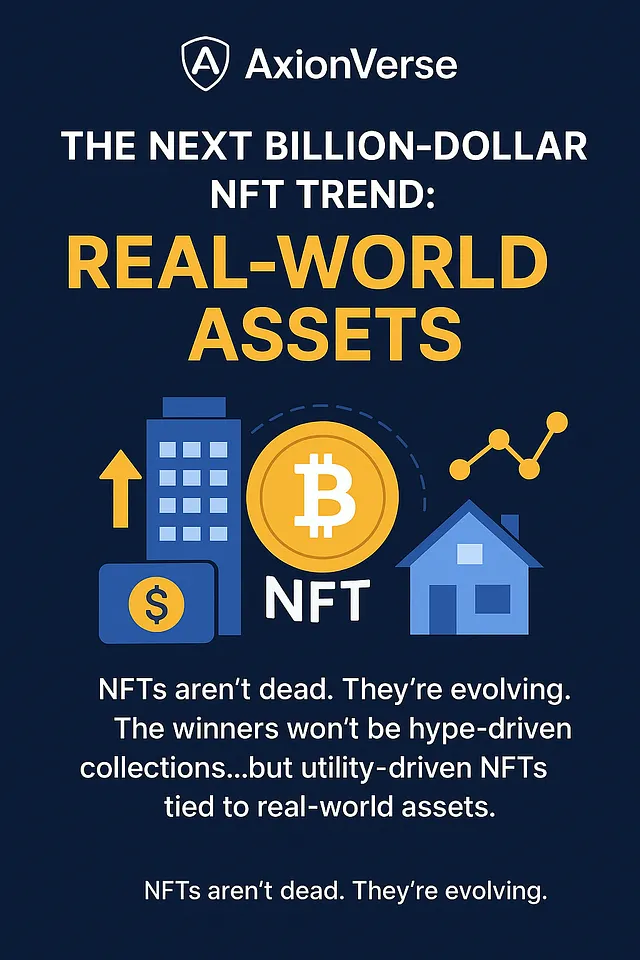
Why Real-World Assets are the Next Billion-Dollar NFT Trend

Why Real-World Assets are the Next Billion-Dollar NFT Trend

AxionVerse is a real-world asset tokenization platform, and here’s the reason RWAs are the next billion-dollar NFT trend. The NFT market has experienced both explosive highs and painful lows over the last few years. From celebrity-driven drops to pixelated avatars, we’ve witnessed an era defined by speculation and hype. At its peak, NFTs were selling for millions of dollars, celebrated as a cultural revolution. But as markets cooled, reality set in: most of these tokens offered no lasting value. Yet amid the volatility, a new and far more sustainable trend has emerged: the tokenization of real-world assets (RWAs). Instead of relying on hype or digital scarcity alone, this model ties NFTs to revenue-generating businesses and tangible properties. The potential is staggering: analysts project that tokenized RWAs could become a multi-trillion-dollar market, and NFTs are at the center of that evolution. One platform building this future is AxionVerse, which is transforming NFTs into vehicles for financial inclusion by connecting blockchain with real estate and business opportunities in the UAE and beyond. The Problem With Hype-Based NFTs To understand why RWAs are the next billion-dollar trend, it’s worth revisiting the issues with early NFT projects: Speculation Without Substance: The majority of NFTs were priced based on perceived cultural value, not underlying cash flow or utility. Once the hype cooled, so did prices. Limited Functionality: Ownership was mostly symbolic. Beyond profile pictures or access to communities, there was little intrinsic use. Fragile Markets: Dependent on influencer attention, social trends, and viral moments, many NFT projects collapsed once interest faded. Exclusionary Economics: Ironically, while marketed as “democratized ownership,” most successful NFTs were out of reach for average investors due to high mint prices and secondary market speculation. This isn’t to dismiss the cultural significance of NFTs. They proved the concept of blockchain-based ownership and unlocked creativity across art and gaming. But as financial tools, hype-driven NFTs lacked durability. The Shift Toward Real-World Utility The next chapter of NFTs is unfolding, and it’s rooted in utility and real-world integration. By linking tokens to tangible assets, platforms can solve many of the problems that plagued the first wave. Here’s why RWAs are poised to dominate: Intrinsic Value: Tokens represent ownership in assets that already generate revenue — such as rental income, franchises, or infrastructure. Accessibility: Fractionalization allows retail investors to own parts of assets that would otherwise be out of reach, such as Dubai service apartments or global franchise chains. Liquidity: Unlike traditional real estate or private equity, which can take months or years to exit, tokenized assets can be traded more flexibly. Transparency: Smart contracts record fund allocation, withdrawals, and returns directly on-chain, removing the opacity common in traditional finance. Global Reach: NFTs make cross-border investment seamless. A teacher in Mexico and an entrepreneur in Kenya can both own a fraction of the same Dubai property. This evolution transforms NFTs from speculative collectibles into infrastructure for financial inclusion and capital markets. AxionVerse: Real-World Assets on the Blockchain AxionVerse is among the pioneers of this model, bridging decentralized finance with real-world businesses. At the heart of the ecosystem are Axion StakeCard NFTs, each representing fractional ownership in a capital pool dedicated to high-yield sectors. Key Features of AxionVerse Low Entry Point: Each StakeCard NFT is priced at just $0.54 USDT, making institutional-grade opportunities accessible to anyone. Revenue-Backed: Between 55–67.5% of funds are directed into profitable businesses such as UAE service apartments and food industry ventures. Passive Income: Investors earn quarterly or bi-annual dividends in USDT, distributed based on the real performance of these assets. Full Transparency: Every fund movement — whether an investment into a Dubai apartment or a distribution of profits — is logged on-chain, complete with timestamps and wallet addresses. Governance Role: Through the upcoming AxionCore (AXC) token, investors will participate in decisions around new business ventures, dividend cycles, and platform upgrades. This model doesn’t just reduce the risks of speculation. It transforms NFT ownership into an active stake in real-world businesses. Why Service Apartments Are the Perfect Starting Point AxionVerse’s decision to focus initially on service apartments in the UAE is strategic. The region is experiencing a surge in tourism, global events, and business travel. Unlike long-term rentals, service apartments operate on short-term stays, which means: Higher occupancy turnover drives consistent revenue streams. Premium pricing for flexible, fully serviced living spaces. Global demand resilience, especially in hubs like Dubai and Abu Dhabi. These dynamics make service apartments one of the most attractive real estate segments globally. By tokenizing them, AxionVerse enables anyone — not just high-net-worth investors — to access these lucrative markets. A Roadmap for Scaling Beyond Apartments While service apartments represent a strong foundation, AxionVerse has a much broader vision. According to its roadmap: Phase 2 introduces AxionCore (AXC), the governance and utility token that unlocks DAO participation, trading discounts, and proposal voting. Expansion into food franchises and other industries diversifies revenue sources beyond real estate. An NFT marketplace within the ecosystem will allow users to trade fractionalized ownership seamlessly. DAO governance in later phases will give the community decision-making power over future investments and policies. This expansion positions AxionVerse as not just an NFT project, but a full-scale decentralized investment platform. Why RWAs Will Define the Next Billion-Dollar NFT Trend Tokenized real-world assets solve the core problems of hype-driven NFTs. They provide: Stability: Backed by tangible businesses rather than social momentum. Income Streams: Passive USDT dividends ensure investors see recurring value. Inclusive Participation: Fractional ownership lowers barriers, welcoming global retail investors into markets once dominated by institutions. Future-Proofing: Integration with governance tokens (like AXC) ensures long-term adaptability and scalability. In other words, RWAs give NFTs what they always lacked — enduring value rooted in the real economy. Final Thoughts The first wave of NFTs was about cultural disruption. The next wave will be about financial transformation. As hype-based projects fade, the real innovation is becoming clearer: using NFTs as vehicles to access and share in real-world wealth creation. Platforms like AxionVerse prove that this future is already taking shape. With service apartments, franchises, and a roadmap toward decentralized governance, the model demonstrates how NFTs can shift from fleeting hype to long-term, billion-dollar opportunities. The NFT market’s next chapter won’t be defined by digital collectibles. It will be defined by utility, inclusivity, and real-world cash flows. And that’s why real-world assets are the NFT trend that could reshape global finance. Why Real-World Assets are the Next Billion-Dollar NFT Trend was originally published in Coinmonks on Medium, where people are continuing the conversation by highlighting and responding to this story

Author: Medium
Orochi Network Partners with RWA Inc. to Bolster RWA Innovation in Web3

Orochi Network Partners with RWA Inc. to Bolster RWA Innovation in Web3

The collaboration with RWA Inc. aims to leverage the zkDatabase of Orochi Network to verify and secure real-world data through cryptographic proofs.

Author: Blockchainreporter