

Senate Leader Doubts Market Structure Will Pass by April: Report

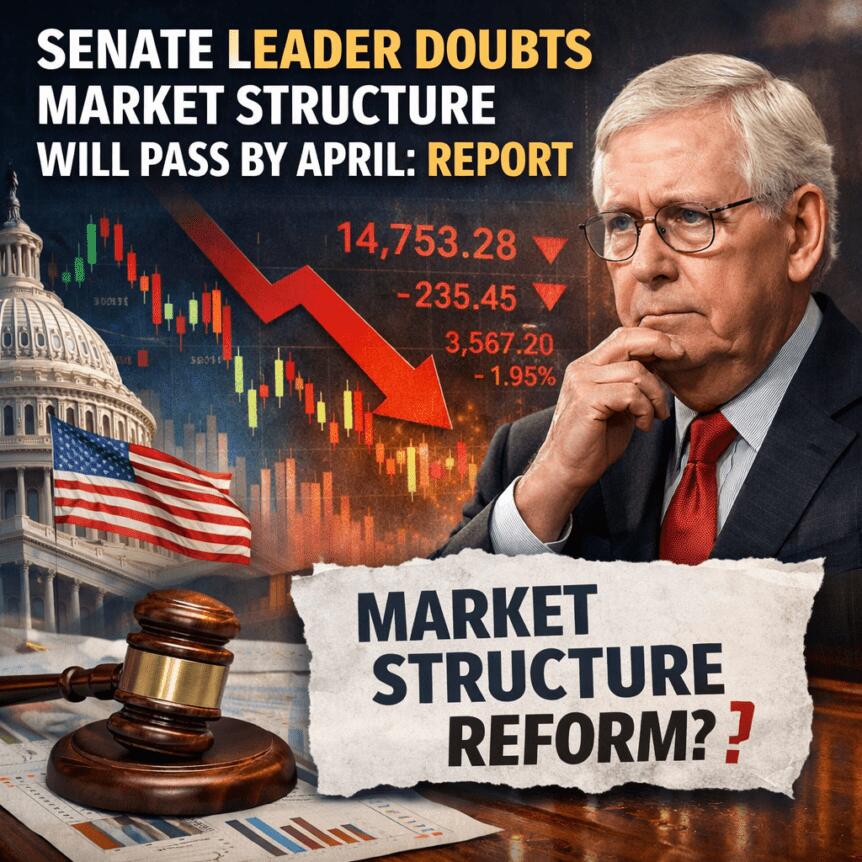
Regulatory dynamics in Washington are once again taking center stage for crypto markets. Senate Majority Leader John Thune indicated he does not expect the chamber to advance digital asset market structure legislation before April, shifting focus instead to partisan and bipartisan priorities that could influence how crypto is overseen in the years ahead. The development underscores a persistent theme: while lawmakers talk about bringing clarity to the sector, procedural hurdles and competing political priorities are likely to dictate the pace of progress. In the near term, Thune signaled that the SAVE America Act, a voter-ID proposal, would move first, with the market-structure bill following afterward as part of a broader legislative agenda.
Thune’s remarks, reported by Punchbowl News, frame a timetable in which a separate, widely watched market structure bill—often discussed under the CLARITY Act umbrella in various forms—may not reach a floor vote until at least the April window. The senator said the bill could emerge from the Banking Committee soon, but a concrete floor timetable remained unclear. The discrepancy with alternative expectations from other lawmakers reflects the Senate’s broader struggle to reconcile diverse viewpoints on how digital assets should be regulated, how tokenized securities and stablecoins should be treated, and what kind of ethics standards should govern market participants.
The dynamic is complicated by competing political statements within the Senate. Ohio Senator Bernie Moreno, for instance, had suggested in February that market structure could advance in April, contrasting with Thune’s more cautious timeline. The Senate Agriculture Committee has moved its parallel version of the bill forward, but a crucial January markup — a procedural step needed to assemble the legislation for a floor vote — faced delays in the Senate Banking Committee. The result is a foggy path to a unified framework that can command bipartisan support and clear regulatory authority for the key markets and products involved.
In parallel with the market-structure debate, the Senate took up a housing bill amendment aimed at halting a central bank digital currency (CBDC). If the provision passes and becomes law, the CBDC prohibition would be active through December 2030. The amendment’s inclusion in the 21st Century Road to Housing Act has underscored how digital currency policy can intersect with broader economic policy, potentially affecting how central-bank innovations are evaluated and deployed. The CBDC ban is a notable flashpoint, illustrating the high-stakes nature of regulatory choices around digital currencies and the Fed’s potential role in a future payments landscape.
What’s at stake in the market structure bill?
The market structure bill has long been framed as a way to grant the U.S. Commodity Futures Trading Commission (CFTC) broader oversight over digital assets, derivatives, and related markets. Its supporters argue that a clear regulatory framework would reduce ambiguity and improve investor protections, while critics warn of overreach that could hinder innovation and create compliance costs for startups and incumbents alike. In committee discussions, questions have centered on tokenized equities, ethics provisions, and stablecoin yield, all areas where lawmakers have expressed concerns about consumer protections, market fairness, and operational risk.
President Trump recently accused banks of holding the bill hostage, signaling that the interplay between industry stakeholders and policymakers remains volatile. The White House has hosted three meetings between crypto and banking representatives, but as of the latest reports, there was no consensus to move the market-structure package forward. The tension between executive priorities and congressional schedules has helped keep the sector’s regulatory outlook in a state of flux, with market participants watching for any sign of a breakthrough or a further stalemate.
The debate also touches on the broader question of how the United States should balance innovation with oversight. Industry participants have argued for a framework that supports responsible growth and investor protection, including clearer definitions of digital assets, guidance on tokenization, and robust safeguards around stablecoins. Lawmakers, meanwhile, are weighing how to tailor regulatory authority across agencies and how to harmonize federal standards with state-level initiatives. The CLARITY Act, which previously cleared the House in July, remains a reference point in discussions about a comprehensive regime, even as Senate negotiators press for amendments that satisfy both sides.
Why it matters
For crypto users and investors, the Senate’s pace on market structure legislation translates into a longer horizon for regulatory clarity. A clear, well-structured framework can reduce execution risk, improve market integrity, and help traditional financial institutions weigh crypto exposure with more confidence. Conversely, further delays or a lack of consensus could perpetuate a climate of regulatory ambiguity, potentially dampening liquidity as market participants delay product launches, listings, or innovative offerings until a stable path forward emerges. The CBDC debate adds another layer of strategic risk, given the potential implications for how digital currencies could coexist with private-sector options and decentralized finance ecosystems.
Beyond traders and exchanges, the outcome will influence builders—startups, liquidity providers, and infrastructure developers—who rely on predictable, transparent rules to design and deploy products. A mature policy framework could spur experimentation in areas such as tokenized assets, cross-border settlement, and compliant custody solutions, while a protracted deadlock might incentivize players to relocate parts of their operations to more certain regulatory environments. For policymakers, the challenge is to craft rules that protect consumers and investors without stifling innovation or driving capital offshore. The current debate underscores the extent to which digital asset markets have become a partisan issue, even as they attract bipartisan attention due to consumer demand, market dynamics, and competitive considerations in a rapidly evolving financial landscape.
What to watch next
- Next week: the SAVE America Act advances to the floor, potentially shifting parliamentary attention away from market structure temporarily.
- February–April window: the Banking Committee’s markups and the timing of a formal clause-by-clause path for the market structure bill remain uncertain.
- CBDC-related provisions: tracking whether amendments to the housing bill gain support and whether the CBDC prohibition remains in force through 2030.
- Committee dynamics: observers will monitor whether tokenization, ethics standards, and stablecoins gain clearer language in subsequent drafts.
Sources & verification
- Punchbowl News: Report on Thune’s comments and the scheduling of the SAVE America Act and market structure bill (https://punchbowl.news/article/finance/economy/housing-bill-drama/).
- CNBC: Article on Trump and the SAVE America Act and Senate discussions (https://www.cnbc.com/2026/03/12/trump-save-america-act-senate-2026-elections.html).
- Cointelegraph: Discussion of the Crypto US Clarity Act andBernie Moreno’s stance (https://cointelegraph.com/news/crypto-us-clarity-act-coinbase-brian-armstrong-bernie-moreno).
- Cointelegraph: Report on the CBDC ban amendment and its housing-bill context (https://cointelegraph.com/news/us-senate-votes-cbdc-ban-amendment).
Market reaction and key details
The stalled momentum around a comprehensive crypto market-structure package reflects a broader liquidity and risk sentiment environment shaped by regulatory uncertainty. While there is bipartisan interest in providing clarity for digital assets, the pathway remains obstructed by deeply held views on how to address tokenized equities, stablecoins, and governance ethics. The Senate’s focus on the SAVE America Act signals a prioritization of voter policy matters that can affect election dynamics and, by extension, fiscal and regulatory discourse around crypto. With the House’s CLARITY Act version already cleared in the prior session, senators are weighing how to reconcile differences that can affect enforcement, investor protections, and the scope of oversight for automated trading and derivatives markets tied to digital assets.
As the White House hosts meetings between crypto and banking representatives, the absence of a final accord demonstrates the complexity of achieving cross-cutting reforms that satisfy diverse stakeholders—from consumer advocates to financial incumbents. In practical terms, a protracted process could keep certain crypto products in a regulatory limbo, delaying new product launches or exchange listings that hinge on definitive compliance standards. However, even amid delays, the policy conversation remains a catalyst for price discovery, risk assessment, and strategic planning within the broader crypto ecosystem, where participants continuously weigh regulatory signals against market fundamentals.
In the background, the CBDC amendment to the housing bill adds a distinct dimension to policy debates: it embodies the current administration’s stance on central bank money and its potential implications for competition, financial stability, and monetary policy. Should the amendment persist through legislative scrutiny, it would send a clear message about the boundaries of central-bank digital currencies in the United States, at least through the 2030 horizon, while leaving room for private-sector innovation in digital payments. The evolving picture invites market participants to monitor not only committee votes and floor debates but also executive-branch messaging and regulatory posture as the year advances.
What to watch next
- Tracking the SAVE America Act’s progress in the Senate and any scheduling moves that could affect the crypto market-structure debate.
- Updates on the Banking Committee’s markup timeline for market structure legislation and whether a compromise emerges before April.
- Signals on CBDC-related amendments within the housing bill and potential implications for digital currency policy.
This article was originally published as Senate Leader Doubts Market Structure Will Pass by April: Report on Crypto Breaking News – your trusted source for crypto news, Bitcoin news, and blockchain updates.
Ayrıca Şunları da Beğenebilirsiniz

Will XRP Price Increase In September 2025?

IP Hits $11.75, HYPE Climbs to $55, BlockDAG Surpasses Both with $407M Presale Surge!
