Tether Launches AI Training Framework for Phones and Consumer GPUs

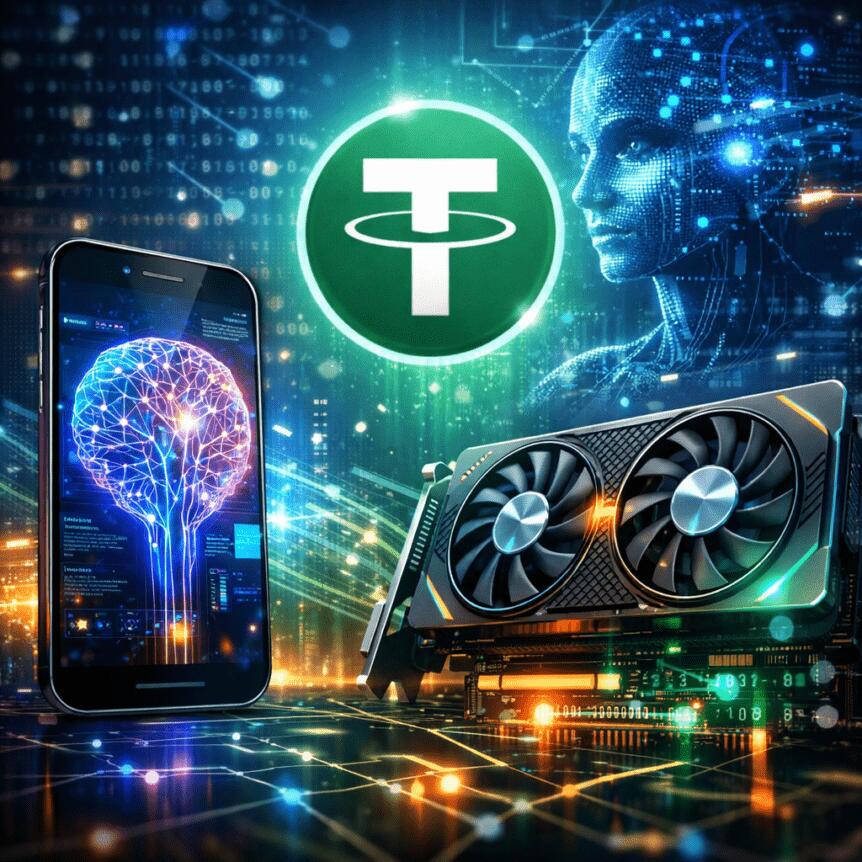
Tether has unveiled a cross-platform AI training framework that the company says can fine-tune large language models on consumer hardware, including smartphones and non-NVIDIA GPUs. The system, part of Tether’s QVAC platform, leans on Microsoft’s BitNet architecture and LoRA techniques to shrink memory and compute demands, potentially lowering the cost and hardware barriers for developers. The announcement positions the framework as compatible with a broad spectrum of chips—from AMD and Intel to Apple Silicon—along with mobile GPUs from Qualcomm and Apple. In internal tests, engineers reportedly fine-tuned models with up to 1 billion parameters on smartphones in under two hours, with smaller models achievable in minutes, and supported models as large as 13 billion parameters on mobile devices.
Key takeaways
- Tether’s QVAC framework leverages a 1-bit model architecture (BitNet) to drastically cut VRAM usage, enabling larger models to run on constrained hardware.
- LoRA-based fine-tuning is extended to non-NVIDIA hardware, broadening compatibility across AMD, Intel, and Apple Silicon platforms, as well as mobile GPUs from Qualcomm and Apple.
- On-device training and federated learning are highlighted as potential use cases, pointing to reduced reliance on centralized cloud compute for model updates.
- Performance gains extend to inference, with mobile GPUs reportedly delivering faster results for BitNet models than traditional CPU workloads.
- The move fits a broader industry trend of crypto firms expanding into AI compute and high-performance computing, touching on AI data center capacity and autonomous software agents.
Tickers mentioned: $BTC, $USDT, $USDC, $COIN, $HIVE
Sentiment: Neutral
Market context: The push to bring AI training and inference closer to edge devices mirrors a broader shift toward on-device AI and distributed learning within crypto and fintech ecosystems, alongside ongoing capital allocation to AI compute by mining operators and data-center firms.
Why it matters
For a market built on trust in programmable money and permissionless ecosystems, the ability to run substantial AI workloads on consumer hardware could recalibrate who can train and fine-tune models. By reducing VRAM requirements by up to 77.8% compared with comparable 16-bit models, according to Tether, the BitNet-based framework tackles one of the most persistent friction points in edge AI: memory constraints. This could enable developers to push more experimentation to devices that sit closer to users, potentially enabling privacy-preserving on-device training and federated learning, where updates are aggregated locally rather than uploaded to centralized servers.
Beyond the novelty of running billion-parameter models on smartphones, the initiative hints at a broader strategy: crypto firms are leaning into AI and HPC to support new products and services, from on-chain analytics to autonomous agents that transact or interact with services. The article notes that major players have already begun integrating AI into core operations or exploring AI-driven infrastructure. As crypto mining and data-center operators seek higher-margin use cases, AI compute becomes a natural extension of the sector’s infrastructure footprint. This aligns with a wider trend of institutional players diversifying into AI workloads, underscoring how blockchain-native firms view AI as a critical component of long-term scalability and product development.
On the technology side, the cross-platform capability signals a shift away from Nvidia-dominated AI stacks toward more hardware-agnostic approaches. The combination of a 1-bit model architecture with LoRA fine-tuning on non-NVIDIA hardware expands the potential hardware pool for AI development, a move that could accelerate experimentation and reduce barriers for smaller teams or individual developers who rely on consumer devices. This development is also likely to influence how AI agents—autonomous programs that interact with services and execute tasks—are trained and updated on-device, potentially strengthening privacy-preserving use cases by minimizing data transfer to cloud endpoints.
The broader industry backdrop includes crypto firms expanding into AI-enabled services and data centers. For example, strategic moves by miners and infrastructure vendors to scale AI compute capacity have been reported in recent quarters, with several large players pursuing AI-centric data-center deployments and partnerships. While the immediate impact of Tether’s framework remains to be demonstrated at scale, the emphasis on cross-platform interoperability and on-device capabilities suggests a future where AI tooling becomes more accessible to a wider range of devices, including those with limited compute budgets.
What to watch next
- Adoption pace: Will other crypto firms and AI developers publicly deploy BitNet-based training on consumer hardware, and what applications emerge first?
- Cross-platform expansion: How quickly will the LoRA-enabled workflow extend to additional non-NVIDIA GPUs and mobile accelerators?
- On-device AI pilots: Will we see real-world federated learning deployments or on-device training pilots that demonstrate data privacy benefits?
- Competitive benchmarks: Independent tests comparing BitNet-based training to traditional GPU-centric workflows across edge devices and data centers.
- Ecosystem partnerships: Any collaborations with wallet providers, AI agents, or on-chain analytics platforms that integrate edge-trained models into user-facing products.
Sources & verification
- Tether’s QVAC launch announcement detailing the cross-platform BitNet/LoRA framework and its aims. Verify at the official Tether news page linked in the announcement.
- The QVAC/BitNet framework’s claimed VRAM and parameter-strength reductions, as described in Tether’s release.
- HIVE Digital Technologies’ reported AI/HPC-driven revenue and performance metrics cited in industry coverage from Cointelegraph.
- World’s AgentKit and related AI agent verification and payment capabilities, as described in World’s official communications and coverage.
- Coinbase’s wallet infrastructure for AI agents and the Alchemy system enabling access to blockchain data via USDC, as reported in coverage cited in the article.
What to watch next
Keep an eye on updates from Tether on QVAC milestones, including any broader platform integrations or additional hardware compatibility announcements. Monitor whether other crypto-native or fintech firms begin publishing performance benchmarks or pilot deployments that validate on-device training claims. Finally, track moves by AI and crypto industry players toward federated learning and privacy-preserving on-device inference, which could reshape how models are trained and updated in distributed networks.
Sources & verification
- Tether QVAC launch: https://tether.io/news/tethers-qvac-launches-worlds-first-cross-platform-bitnet-lora-framework-to-enable-billion-parameter-ai-training-and-inference-on-consumer-gpus-and-smartphones/
- HIVE Digital Technologies revenue context: https://cointelegraph.com/news/hive-digital-focus-crypto-mining-ai-data-centers
- World AgentKit and human-verified AI agents: https://cointelegraph.com/news/world-launches-agentkit-coinbase-integration-enable-human-verified-ai-agents-embargo
- Coinbase wallet infrastructure for AI agents: https://cointelegraph.com/news/coinbase-launches-crypto-wallets-built-ai-agents
- Alchemy AI agents data access using USDC: https://cointelegraph.com/news/alchemy-ai-agents-pay-access-blockchain-data-usdc
Key figures and next steps
With Tether positioning QVAC as a cross-platform compute framework and citing substantial reductions in memory requirements, the company signals a strategic pivot toward enabling AI workloads on widely available hardware. If the framework gains traction, developers could see accelerated experimentation on consumer devices, expanding the reach of AI-assisted on-chain tools and analytics. The coming months will reveal whether these capabilities translate into broader developer adoption, practical on-device AI pilots, and tangible reductions in cloud compute demand for crypto-related AI tasks.
What this could mean for users and builders
For end users, the potential exists for faster, more private AI-powered features embedded in wallets and on-chain services. For builders, the framework lowers the barrier to prototype, test, and refine AI models without the need for high-end data-center GPUs. In a sector where compute cost can be a constraint, this shift toward edge AI adoption aligns with long-term goals of decentralization, privacy, and efficiency. It also underscores the ongoing convergence between crypto infrastructure and advanced AI compute, a development that could influence everything from on-chain data services to the design of autonomous agents and governance tools. As with any new technology, scalability, security considerations, and interoperability standards will shape how quickly such capabilities mature and how widely they are adopted across the ecosystem.
This article was originally published as Tether Launches AI Training Framework for Phones and Consumer GPUs on Crypto Breaking News – your trusted source for crypto news, Bitcoin news, and blockchain updates.
Ayrıca Şunları da Beğenebilirsiniz

CME Group to Launch Solana and XRP Futures Options

USD/CHF Forecast: US Dollar Plummets Toward 0.7850 as Fed Decision Looms