Lending

Lending protocols form the backbone of the decentralized money market, allowing users to lend or borrow digital assets without intermediaries. Using smart contracts, platforms like Aave and Morpho automate interest rates based on supply and demand while requiring over-collateralization for security. The 2026 lending landscape features advanced permissionless vaults and institutional-grade credit lines. This tag covers the evolution of capital efficiency, liquidations, and the integration of diverse collateral types, including LSTs and tokenized RWAs.

15333 Articles
Created: 2026/02/02 18:52
Updated: 2026/02/02 18:52

Venus: Precautions have been taken in response to the Balancer attack incident until system stability is confirmed.

Venus: Precautions have been taken in response to the Balancer attack incident until system stability is confirmed.

PANews reported on November 3 that Venus Protocol posted on the X platform: "Reports today indicate that Balancer has been hacked. As a precaution, Venus Protocol has set the loan-to-value (LTV) ratio on the BAL market on Ethereum to 0, suspending all new lending and borrowing using BAL as collateral until the system is confirmed to be stable. The liquidation threshold remains at 59%, so existing positions are unaffected. Users should still closely monitor their positions and health, and consider repaying loans or adding collateral to ensure security."

Author: PANews
Ethereum Handles $2.82 trillion In Stablecoin Flows During October 2025

Ethereum Handles $2.82 trillion In Stablecoin Flows During October 2025

TLDR Ethereum stablecoin volume rose 45% in October to $2.82 trillion. USDC led with $1.62 trillion in stablecoin transfers on Ethereum. Tether processed $895 billion on Ethereum in October 2025 alone. Market volatility and DeFi usage drove Ethereum stablecoin growth. Stablecoin transactions on Ethereum soared to a new monthly record in October, reaching $2.82 trillion. [...] The post Ethereum Handles $2.82 trillion In Stablecoin Flows During October 2025 appeared first on CoinCentral.

Author: Coincentral
Swiss Digital Asset Bank AMINA Takes Important Step for European Operations! Here Are the Details

Swiss Digital Asset Bank AMINA Takes Important Step for European Operations! Here Are the Details

The post Swiss Digital Asset Bank AMINA Takes Important Step for European Operations! Here Are the Details appeared on BitcoinEthereumNews.com. Swiss digital asset bank AMINA has taken a significant step toward expanding its operations in Europe. Its Austrian subsidiary, AMINA EU, has obtained a MiCA (Markets in Crypto Assets) license from the country’s Financial Markets Authority, authorizing it to offer crypto services across Europe. Switzerland-based AMINA Bank received a MiCA license from Austria The new license marks AMINA EU’s official entry into the European Union market. The company will offer crypto trading, custody, portfolio management, and staking services, primarily aimed at family offices, institutional investors, and financial institutions. AMINA, which previously operated under the name SEBA Bank, currently holds a banking license from the Swiss Financial Market Supervisory Authority (FINMA), as well as crypto licenses in Hong Kong and Abu Dhabi. The bank collaborates with private banks such as Julius Baer and LGT Bank. “We offer everything from banking to crypto lending in a fully regulated environment. We entered the tokenization space early, and our gold-backed token product is generating significant interest,” said CEO Franz Bergmueller. AMINA chose Austria as its European headquarters because of the country’s regulatory quality and its emphasis on investor protection. The MiCA framework is expected to lead to a more mature and transparent crypto markets across Europe. Bergmueller praised the progress in the region, saying, “I was positively surprised that Europe has agreed on a common crypto regulation.” *This is not investment advice. Follow our Telegram and Twitter account now for exclusive news, analytics and on-chain data! Source: https://en.bitcoinsistemi.com/swiss-digital-asset-bank-amina-takes-important-step-for-european-operations-here-are-the-details/

Author: BitcoinEthereumNews
Berachain has proactively suspended chain operations to implement an emergency hard fork in response to vulnerability attacks related to Balancer V2.

Berachain has proactively suspended chain operations to implement an emergency hard fork in response to vulnerability attacks related to Balancer V2.

PANews reported on November 3 that Berachain posted on its X platform: "Berachain validators have taken coordinated action to voluntarily suspend the Berachain network so that the core team can implement an emergency hard fork to address the vulnerability attack related to Balancer V2 on BEX. This suspension was proactive, and the network will resume operation soon after all affected funds have been recovered." In addition, Smokey the Bera, an anonymous co-founder of Berachain, stated: "The Bera validator team has proactively suspended chain operations to prevent the Balancer vulnerability attack affecting BEX (mainly the USDe three pools) from spreading further. We have requested the Ethena team to disable cross-chain bridge functionality for transferring assets out of the Bera chain; we have instructed lending markets to disable/suspend USDe deposit operations; we have suspended HONEY minting/redemption operations; and we have communicated with centralized exchanges (CEXs) and other institutions to ensure that relevant addresses are blacklisted. The goal is to recover funds as quickly as possible and ensure the safety of funds for all liquidity providers (LPs). Once the team is ready, it will release the binary to relevant validators and service providers (because this liquidity pool contains non-native assets, unlike simply modifying the Bera chain balance, some slot reconstruction work is required)." According to previous reports, as monitored by PyDun, Balancer and its forked projects have suffered total losses of over $128 million across multiple blockchains.

Author: PANews
Crypto News Today: Ethereum (ETH) Pressures Hits Hard as Mutuum Finance (MUTM) Draws Attention

Crypto News Today: Ethereum (ETH) Pressures Hits Hard as Mutuum Finance (MUTM) Draws Attention

The post Crypto News Today: Ethereum (ETH) Pressures Hits Hard as Mutuum Finance (MUTM) Draws Attention appeared on BitcoinEthereumNews.com. Ethereum has come under strong pressure lately and has fallen to the $3,700 level as the number of short positions has surged. According to the latest data from Santiment, the Ethereum exchange reserves are low at the same time as the bearish shorts. This has happened in previous cycles as well. On the other hand, the spotlight has shined brightly on Mutuum Finance (MUTM), now at $0.035 in the presale stage and raking in 17,660 supporters and $18.35 million. Thus, it seems to be the best cryptocurrency to purchase today given the desire for secure income rather than volatility. With ETH going through this turbulence, the linear rise of MUTM entices buyers wanting the best of altcoins. Ethereum Faces the Setup of a Possible Short Squeeze Traders have accumulated heavily in the shorts as Ethereum has moved down to $3,700, and this has given Ethereum quite a bearish bias that has been identified as a reversal signal through analytics provided by Santiment. The level of Ethereum reserves has fallen significantly to historic lows, thereby reducing the selling pressure and paving the way for counter-intuitive moments of recovery during each dip. This has been quite trying when looking at the resilience of Ethereum in its core smart contract area. On the other hand, institutions have been doing their best to counter the pessimism, and the $72.5 million ETF purchase made by BlackRock on October 28 being a strong signal that ETH has the best tokenization in the business. This has been a strong indication to the owners of the cryptocurrency that the level of $3,500 might just come to pass as a floor, paving the way for the jump to $4,000. All the same, the volatility of ETH has made many switch their investments. Mutuum Finance Presale Charges Ahead Mutuum Finance…

Author: BitcoinEthereumNews
USDC Stablecoins Surpass 35 Million Users in 2025 as Ethereum Market Tops $184 Billion

USDC Stablecoins Surpass 35 Million Users in 2025 as Ethereum Market Tops $184 Billion

The post USDC Stablecoins Surpass 35 Million Users in 2025 as Ethereum Market Tops $184 Billion appeared on BitcoinEthereumNews.com. COINOTAG recommends • Exchange signup 💹 Trade with pro tools Fast execution, robust charts, clean risk controls. 👉 Open account → COINOTAG recommends • Exchange signup 🚀 Smooth orders, clear control Advanced order types and market depth in one view. 👉 Create account → COINOTAG recommends • Exchange signup 📈 Clarity in volatile markets Plan entries & exits, manage positions with discipline. 👉 Sign up → COINOTAG recommends • Exchange signup ⚡ Speed, depth, reliability Execute confidently when timing matters. 👉 Open account → COINOTAG recommends • Exchange signup 🧭 A focused workflow for traders Alerts, watchlists, and a repeatable process. 👉 Get started → COINOTAG recommends • Exchange signup ✅ Data‑driven decisions Focus on process—not noise. 👉 Sign up → Circle’s USDC and EURC stablecoins have doubled their user base to 35 million in 2025, with total supply reaching a record $75 billion. This growth reflects surging adoption across Ethereum and Layer 2 networks, where stablecoin transfers now show increased velocity and real-world utility. USDC holders surge to 35 million: Doubling from early 2025 levels, driven by expanded issuance and on-chain activity. Ethereum’s stablecoin market hits $184 billion: Up nearly $100 billion since January, with faster transaction volumes indicating active usage. Layer 2 adoption accelerates: Networks like Base, Solana, and Arbitrum now handle significant shares of new stablecoin supply. Discover Circle USDC stablecoin growth in 2025: 35M users, $75B supply, Ethereum dominance at $184B. Explore rising adoption and on-chain efficiency—stay ahead in crypto trends today! What is driving Circle’s USDC stablecoin growth in 2025? Circle’s USDC stablecoin growth in 2025 stems from renewed adoption across blockchain ecosystems, with user numbers doubling to 35 million and supply expanding to $75 billion. This surge is fueled by faster on-chain transactions and integration into Layer 2 solutions, moving beyond mere holding to…

Author: BitcoinEthereumNews
Solana's New Exploration in the Privacy Track: How Does GhostWare Build the Next Generation of Anonymous Decentralized Networks?

Solana's New Exploration in the Privacy Track: How Does GhostWare Build the Next Generation of Anonymous Decentralized Networks?

Author: GhostWare Compiled by: Tim, PANews Introduction Blockchain privacy is facing a critical moment. Early cryptocurrencies like Bitcoin were hailed as anonymous currencies, but in reality, they only offered pseudo-anonymity; all transaction records and addresses were exposed on a public and permanent ledger. Blockchain analytics firms and law enforcement agencies have repeatedly demonstrated that these ledgers can be deanonymized, allowing for the tracking of fund flows and the exposure of users who claimed to be anonymous. Today, the need for true privacy has become paramount, whether for security or freedom of expression. This privacy requires that transaction details be hidden by cryptographic techniques, preventing anyone from eavesdropping. As one of the fastest blockchains in existence, Solana offers the possibility of achieving both scalability and privacy at the protocol level. This vision is driving us, an anonymous developer community rooted in the cypherpunk spirit of the dark web, to build a decentralized operating layer that restores privacy as a fundamental right, not a privilege. The necessity of blockchain privacy Public blockchains openly record every financial transaction, creating a global financial diary. While this transparency ensures accountability, it completely undermines privacy. Sophisticated analytical techniques, through behavioral pattern analysis, IP tracking, and leaked KYC information, can link so-called anonymous addresses to real identities. As Electric Coin explains, "Anonymous does not equate to privacy; all addresses and their transaction activities will be permanently exposed to the public." The consequences are real. Forensic firms have been able to trace funds flowing through mixers and successfully recover assets from users who claimed to have hidden them. Without strong privacy protections, every participant remains constantly exposed to the risk of being monitored and becoming a target of attacks. Privacy is by no means a trivial issue; it concerns fundamental personal safety and financial autonomy. The cypherpunk movement declared years ago that "in the digital age, privacy is the cornerstone of an open society." True privacy protection means preventing exposure at the source, not covering up traces afterward. In blockchain terminology, this means using cryptography to conceal transaction details while allowing the network to verify validity. Achieving this balance is no easy task, but without it, decentralization loses its soul. Privacy Challenges in Solana High-Throughput Environments Solana, renowned for its high speed, scalability, and near-zero transaction fees, forms the cornerstone of the next-generation internet. However, its default state is completely transparent; every wallet address, token transfer, and smart contract call is publicly visible. The faster the blockchain, the richer the behavioral data exposed. Adding privacy protections later often proves ineffective. Mixers and anonymization layers not only increase the barrier to entry but are also vulnerable to analysis and cracking. Solana's architecture was optimized for parallel execution and proof-of-history mechanisms, never designed with anonymity as a primary goal. How can sensitive information be hidden without impacting performance on a network built for public verification? And how is privacy-preserving computation even possible within deterministic programs? Despite these challenges, market demand cannot be ignored. Traders need to protect the confidentiality of their strategies, institutions require compliance and confidentiality, and ordinary users also deserve security. Dark web pioneers were the first to demonstrate the drawbacks of insufficient anonymity, and this lesson is now driving Solana to explore true anonymity while maintaining high performance. The Evolution of Blockchain Privacy Technology: From Mixers to Zero-Knowledge Proofs Blockchain privacy protection has undergone several generations of technological evolution, and the experience accumulated by each generation is guiding the future development of Solana. Coin mixer Coin mixers attempt to sever the link between sender and receiver by aggregating and redistributing funds. Users deposit tokens into a shared contract and then withdraw funds from a new address. This method offers only probabilistic privacy: given a large enough volume of data, observers can still trace the connection between deposits and withdrawals. Centralized coin mixers also become targets of regulation. For example, Tornado Cash was sanctioned for its involvement in illicit fund flows, even though subsequent rulings clarified that immutable smart contracts themselves lack legal personality. The lesson learned is clear: any solution that relies on a centralized control point or an identifiable operator will inevitably fail in the end. Collaborative Transactions and Ring Signatures Technologies such as collaborative transactions (Bitcoin) and ring signatures (Monero) effectively obscure the correspondence between payers and payees by aggregating multiple transactions into a single transaction. While these methods can create anonymous sets, they still leak metadata; for example, the ring size of Monero can be cracked through statistical analysis. Therefore, the privacy protection they provide is probabilistic, not absolute. Confidential Transactions and Homomorphic Encryption Confidential transaction technology, proposed by cryptographers such as Greg Maxwell, hides transaction amounts through cryptographic commitments while maintaining mathematical balance. Solana has now implemented similar logic in the token expansion functionality of the Token2022 project, adding confidential transfer and confidential balance capabilities at the underlying level. Verifying nodes can confirm the correctness of transactions without needing to see the specific amount. Notably, Solana innovatively introduces an "audit key" mechanism, providing an optional transparency channel for regulatory compliance while ensuring privacy. This selective disclosure model organically combines privacy protection with compliance requirements, allowing institutions to verify on-chain activities when necessary while ensuring that ordinary observers cannot peek into transaction details. This design achieves a delicate balance by replacing absolute anonymity with controlled visibility. Zero-knowledge proof ZKP Zero-knowledge proof technology can verify the validity of transactions while hiding all underlying data. Systems like Zcash pioneered this goal through zk-SNARKs, achieving mathematical anonymity. Newer frameworks such as Halo2 and Plonk not only eliminate the need for trusted initial setups but also improve system efficiency. On Solana, Light Protocol achieves fully private token transfers by combining zk-SNARKs (ZKP) with ZK-rollup scaling. Within the protocol's shielded liquidity pool, the transaction initiator, recipient, and amount are all invisible; only the proof of validity is recorded on-chain. This technological integration demonstrates that zero-knowledge privacy protection mechanisms are fully compatible with Solana's high-speed consensus architecture. Multi-party secure computation and encrypted execution Multi-party secure computation allows multiple nodes to perform collaborative computations on encrypted data without revealing any input data. Projects such as Arcium have extended this technology to the Solana network, enabling on-chain programs to handle ciphertext state and encrypted logic: after processing the ciphertext, the executing node only returns the encrypted result to the blockchain. This architecture supports scenarios such as hidden order books, encrypted auctions, or private voting, ensuring that no participant can see the data of others. Secure multi-party computation and zero-knowledge proofs complement each other: zero-knowledge proofs enable verification without disclosure, while secure multi-party computation enables collaborative computation without disclosure. Together, they form the cornerstone of privacy-preserving smart contract applications, effectively preventing the exposure of user data and business logic. Various technologies work together like pieces of a jigsaw puzzle to construct a grand blueprint for privacy protection. The future of blockchain privacy protection lies in technological integration: zero-knowledge proofs enable verifiable privacy, homomorphic encryption supports ciphertext computation, secure multi-party computation ensures secure collaboration, and selective disclosure meets compliance requirements. Integrating these technological elements into the Solana network effectively builds a privacy layer, much like an anonymous operating system that governs privacy permissions within an open network. Emerging privacy ecosystem in Solana Faced with privacy challenges, the Solana community and developers have not stood idly by. Over the past few years, several key protocol and infrastructure layer improvements have positioned Solana at the forefront of privacy-preserving application development. Token2022: Crypto Extensions The Solana developer community has upgraded and expanded the SPL token standard, introducing confidential transfer functionality, which evolved into confidential balances in 2025. These extensions enable token issuers to activate privacy protections directly at the base layer. Through cryptographic commitments and zero-knowledge proofs, tokens such as stablecoins or SPL assets can display only the encrypted balance and amount on the blockchain during transactions. Verifying nodes use mathematical methods to verify the correctness of transactions, but cannot view the actual values throughout the process. Because these features are integrated into the Solana core protocol rather than added later, this represents a fundamental shift in philosophy: privacy should exist as infrastructure, not an option. The introduction of audit keys further demonstrates Solana's commitment to striking a balance between user privacy and institutional transparency. Enterprises can meet regulatory requirements without exposing all transaction details to the public. Light Protocol Light Protocol brings a complete zero-knowledge proof architecture to Solana. By employing zk-SNARKs and a recursive proof system, this protocol enables users to transfer tokens in a privacy-preserving manner within a shielded pool. In this shielded pool, the sender, receiver, and transaction amount are all invisible; only a concise proof of validity is submitted to the blockchain. The system requires no trusted setup and maintains its decentralized nature at all times. This scheme demonstrates that privacy protection can natively exist on high-throughput public chains without impacting network performance. Light is not just a protocol; it demonstrates that privacy-preserving computation can coexist with the high efficiency of Solana. It marks a significant milestone in the evolution of available, real-time privacy-preserving technologies. Dust Protocol Dust Protocol applies confidential transaction logic to privacy-critical scenarios beyond currency, such as encrypted data sharing or identity management. Deeply integrated with the Solana account model, the protocol enables users to store and transmit sensitive information without leakage. The protocol provides developers with a set of tools that enable them to leverage token scaling capabilities and cryptographic primitives to build privacy-preserving decentralized applications that are seamlessly compatible with the Solana validator architecture. Arcium Arcium pushes Solana's privacy boundaries to new heights through multi-party computation. This technology enables programs to perform operations on encrypted inputs and states, with execution nodes processing the data without decrypting its contents. Ultimately, only cryptographically verified encrypted outputs are transmitted back to the Solana network. This design enables crypto order books, dark pool trading, and sealed-bid auction mechanisms that were previously impossible in transparent DeFi. Arcium and similar frameworks will drive the development of next-generation privacy smart contracts, whose logic and data remain hidden at the design level. Brave, Helius, and broader privacy architectures Solana's advancements in privacy have transcended the realm of cryptography. The Helius developer community has released detailed technical documentation explaining how to implement confidential computing environments and dark pool transactions within Solana's MPC layer. Brave, a browser long committed to user protection, has gone a step further by integrating a privacy-preserving reward mechanism for Solana users, allowing them to earn token rewards without sacrificing anonymity. These advancements clearly demonstrate that Solana is evolving from a transparent network to a spectrum of privacy tools covering the protocol layer to the application layer. Today, this blockchain, once known for its high speed but completely public nature, is evolving towards a balance between high speed and privacy. Analysts point out that Solana's privacy technology stack has now achieved a "balance between user anonymity and institutional compliance." The newly launched Privacy Cash project processed over 10,000 SOL worth of shielded transactions shortly after its launch, providing strong evidence of market demand. The convergence of performance, availability, and privacy protection lays the foundation for a new paradigm: creating a blockchain that is both verifiable and invisible when needed. GhostWare: Solana Privacy Operating System (Dark Web Anonymity Solution) We named it GhostWare, an operating system based on the Solana blockchain designed to achieve anonymity. GhostWare is not software in the traditional sense, but a layered decentralized protocol framework. This framework integrates technologies such as zero-knowledge proofs, confidential transactions, and secure multi-party computation into a unified privacy-preserving architecture. The name GhostWare itself reveals its essence: achieving a synergistic effect where "the whole is greater than the sum of its parts" through the integration of multiple technologies. The system was created by an anonymous team deeply rooted in dark web culture and embodying the spirit of cypherpunks. Our goal is to build a new digital environment with privacy as the default foundation and transparency that can be chosen independently. Design Principles 1. Decentralization is the rule No server is required, and there are no privileged administrators. Every component of GhostWare, except for Solana smart contracts, is a decentralized node service. The system has no backdoors or switches, and there is absolutely no single point of control. 2. Default is privacy In the GhostWare ecosystem, all user actions are private by default unless actively disclosed. Most decentralized applications require additional settings to achieve anonymity, but GhostWare completely overturns this model: privacy is the default, and transparency is only enabled by the user when needed. 3. Composability and Openness GhostWare is public infrastructure, a permissionless privacy layer that any developer can seamlessly integrate. It is not closed software, but rather an open protocol ecosystem designed to co-evolve with Solana. Architecture Anonymous identity layer Users exist in the form of Ghost IDs, which are decentralized identifiers detached from their public wallet addresses. Through zero-knowledge proofs, users can demonstrate ownership or eligibility to participate in asset transactions without exposing their real addresses. Confidential transaction layer GhostWare handles transaction routing in a dual-mode manner. Compliance and privacy mode: Employs Solana confidential transmission technology and provides optional auditor visibility for regulated scenarios. Full Anonymous Mode: Employing shielding pools and zero-knowledge proof technology, it ensures that no external observer (including validators) can trace the sender, receiver, and amount of a transaction. Privacy Computation Layer Ghost nodes process encrypted data using secure multi-party computation. Smart contracts delegate computational tasks to these nodes, which have no access to plaintext input throughout the process. The final result is verified and then submitted to the blockchain. This enables applications such as privacy-preserving lending markets, sealed-bid auctions, and even medical data or identity verification calculations, with all data kept confidential throughout the process. User access layer (GhostWare wallet) In the front-end interaction, users operate through the GhostWare wallet, a privacy-first interface that automatically routes user behavior to the GhostWare technology stack. Each session generates a new Solana address and encrypted transaction path; the system does not require passwords, does not store personal data, and completely disables analytics and tracking. GhostWare's architecture collectively forms an intangible yet indispensable autonomous privacy operating system for Solana. Discussion: Privacy, Compliance, and Development Prospects The creation of privacy layers like GhostWare marks a watershed moment in the development of blockchain. If Web3 is to truly replace the centralized internet, it needs not only to protect users from corporate control, but also to fundamentally resist surveillance itself. Solana's high speed and flexible architecture make it an ideal foundational platform for this transformation. Its cryptographic balance functionality and zero-knowledge proof integration provide the core components, while GhostWare integrates these technologies into an operational layer that can be deployed in any project. We believe that privacy should not be a hindrance to regulation, but rather its cornerstone. In a world with fine-grained programmable privacy, compliance can be achieved through user authorization rather than data exposure, businesses can make selective disclosures, and individuals can obtain comprehensive protection. The path to mainstreaming privacy does not rely on secrecy, but rather on a systemic architecture. Conclusion: Building a Privacy-Preserving Solana Ecosystem Solana's protocol-layer encrypted balance, Light Protocol's zk rollups solution, and Arcium's multi-party computation engine are converging into a complete privacy protection ecosystem. GhostWare weaves these technological threads into an organic network, creating a decentralized, censorship-resistant privacy operating system that allows users to conduct transactions, computations, and build with peace of mind. With this, Solana has achieved both high speed and privacy for the first time. Our Anonymous Developers Alliance solemnly promises to inject dark web-level resilience into mainstream public blockchains, ensuring that privacy protection is not just a functional addition, but a fundamental foundation. Just as HTTPS has become the default standard on the internet, privacy protection will inevitably become the default configuration for Web3. Users will not need to manually enable it; it will exist silently, protecting every operation. Eliminate single points of failure. Prevent identity from being exposed. Freedom, opportunity, and control are the only principles that define Solana's privacy layer.

Author: PANews
Insiders Highlight MUTM at $0.035 As Next Crypto To Explode Leaving Ripple (XRP) in the Rearview

Insiders Highlight MUTM at $0.035 As Next Crypto To Explode Leaving Ripple (XRP) in the Rearview

The post Insiders Highlight MUTM at $0.035 As Next Crypto To Explode Leaving Ripple (XRP) in the Rearview appeared on BitcoinEthereumNews.com. Analysts have spotlighted Ripple (XRP) for its steady consolidation above $2.50, yet insiders whisper that true explosive potential lies elsewhere in the crypto market. XRP has formed an accumulation base, with historical cycles hinting at a multi-year push toward $5.89, but repeated tests at $2.69 resistance have tempered short-term enthusiasm. As XRP builds patiently, attention has shifted to faster-moving altcoins like Mutuum Finance (MUTM), the next crypto to explode at $0.035. With 17,660 holders raising $18.35 million in its presale, MUTM has positioned itself as the best crypto to buy now, offering DeFi yields that outpace XRP’s deliberate pace and invite immediate portfolio boosts. Ripple Builds Base Amid Lingering Hurdles XRP has traded around $2.58, holding firm above $2.50 support as analysts like EGRAG have traced cyclical patterns echoing 3,700% past surges from similar zones. This setup has suggested compression into expansion, with a $2.69 breakout potentially unlocking $2.70 and beyond in the near term. Gordon’s hourly analysis has revealed a triple-bottom floor, where recoveries have reinforced accumulation and hinted at reversal strength.  Yet, while long-term targets at $5.89 loom, the asset has faced resistance caps that delay momentum, leaving traders watchful for confirmation. Such measured progress has contrasted sharply with nimbler DeFi plays, drawing capital toward the next crypto to explode that delivers quicker, tangible returns.  This pivot has funneled interest toward Mutuum Finance (MUTM), whose presale dynamics have captured the urgency XRP lacks, promising the best crypto to buy now for explosive 2026 gains. Mutuum Finance Presale Accelerates Demand Mutuum Finance (MUTM) has reached Phase 6 in its presale, now 85% filled at $0.035 per token, a price that has risen 250% from Phase 1’s $0.01 baseline. This structured approach has drawn 17,660 holders and generated $18.35 million, creating a foundation of committed backers who value predictable entry…

Author: BitcoinEthereumNews
Top Crypto to Invest in Now Under $1 for 50x ROI

Top Crypto to Invest in Now Under $1 for 50x ROI

The post Top Crypto to Invest in Now Under $1 for 50x ROI appeared on BitcoinEthereumNews.com. Dogecoin still sits at the top when it comes to meme coins, but honestly, there’s fresh competition heating the scene. Little Pepe, for example, is starting to make some noise. Its presale has been a hot topic this quarter. Currently, they’ve almost wrapped up Stage 13, which means they’ve pulled in over $27.34 million so far. The presale price is $0.0022 and is set to increase with the next stage, as they aim for a listing price of $0.0030. Dogecoin (DOGE): The Veteran Meme Coin Facing Slowdown Now, Dogecoin; everyone knows it’s the OG meme coin. Launched in 2013, it has weathered every market storm and still holds a top spot by market cap. Lately, it has been trading around $0.188, which is a slight increase from last quarter. The market cap hovers near $28.5 billion. Recent predictions show a mixed picture. Some optimistic analysts have floated a potential rise toward $3.25, a massive 1,500% increase, but that projection depends heavily on whether Tesla or other major companies adopt DOGE for payments. So far, Elon Musk has remained silent on it. Little Pepe (LILPEPE): Real Utility, Early Access, and Explosive Momentum Little Pepe (LILPEPE) is a fresh Layer-2 meme token that’s blending humor with practical infrastructure, and that balance has helped it attract a growing number of investors. Little Pepe operates on a gas-free, scalable Layer 2 network, which makes transactions fast and inexpensive. Its launchpad, the Pepe Pump Pad, actually provides developers with a way to launch new community tokens using verified contracts and locked liquidity. That’s a big deal because it helps keep things transparent and protects people from rug pulls.. This focus on security has been validated by a CertiK audit, a milestone that sets LILPEPE apart from the average meme coin. The audit approval has helped…

Author: BitcoinEthereumNews
Top Crypto to Invest in as Bitcoin (BTC) Loses the $110,000 Level

Top Crypto to Invest in as Bitcoin (BTC) Loses the $110,000 Level

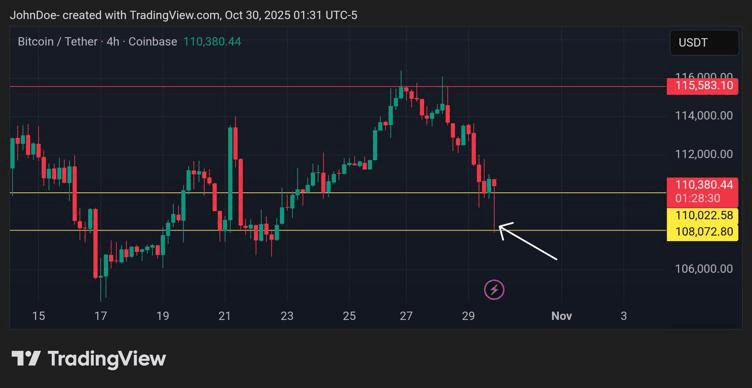
The post Top Crypto to Invest in as Bitcoin (BTC) Loses the $110,000 Level  appeared on BitcoinEthereumNews.com. At a time when Bitcoin is struggling to hold on to the $110,000 level, smart investors are setting their eyes elsewhere for which crypto is likely to explode. Sure, BTC remains the market bellwether, but higher-risk, higher-reward investors are now looking at alternatives that boast explosive potential. Enter Mutuum Finance (MUTM), a top crypto to invest in and the next crypto to explode, currently changing hands at just $0.035 in Phase 6 of its presale, with over 85% of tokens already sold and more than $18.35M raised. The disruptive dual-lending DeFi model, combining Peer-to-Peer and Peer-to-Contract lending in one platform, enables users to maximize their capital efficiency while participating in one of the fastest-growing ecosystems. For those looking to invest in the best crypto during a market slowdown, MUTM presents a rare opportunity to capture early-stage growth ahead of its wider launch, making the altcoin a must-watch in the 2025 crypto cycle and the next crypto to explode. Bitcoin (BTC) Testing Key Support Zone as Markets Remain Uncertain Bitcoin recently tapped the support zone at $107,000–$108,000 with a modest bounce that brought some relief to traders. However, the market remains cautious as BTC should reclaim the $113,500 level soon to avoid heightened downside risk. A close week below this critical zone may trigger a larger correction, so investors will be carefully weighing their next moves. While Bitcoin faces this technical pressure, many investors are looking to Mutuum Finance (MUTM), a top crypto to invest in that’s been gaining traction largely due to its DeFi utility and early-stage growth potential. Mutuum Finance Presale Soars Away with Momentum Records Mutuum Finance remains one of the most talked-about projects in the DeFi community, and its current impossible-to-stop presale gains momentum. In Phase 6, MUTM is currently selling for $0.035, a 250% premium from…

Author: BitcoinEthereumNews