Lending

Lending protocols form the backbone of the decentralized money market, allowing users to lend or borrow digital assets without intermediaries. Using smart contracts, platforms like Aave and Morpho automate interest rates based on supply and demand while requiring over-collateralization for security. The 2026 lending landscape features advanced permissionless vaults and institutional-grade credit lines. This tag covers the evolution of capital efficiency, liquidations, and the integration of diverse collateral types, including LSTs and tokenized RWAs.

14776 Articles
Created: 2026/02/02 18:52
Updated: 2026/02/02 18:52
As Debasement Talk Gains Steam, Bitcoin Hyper Presale Nears $23M

As Debasement Talk Gains Steam, Bitcoin Hyper Presale Nears $23M

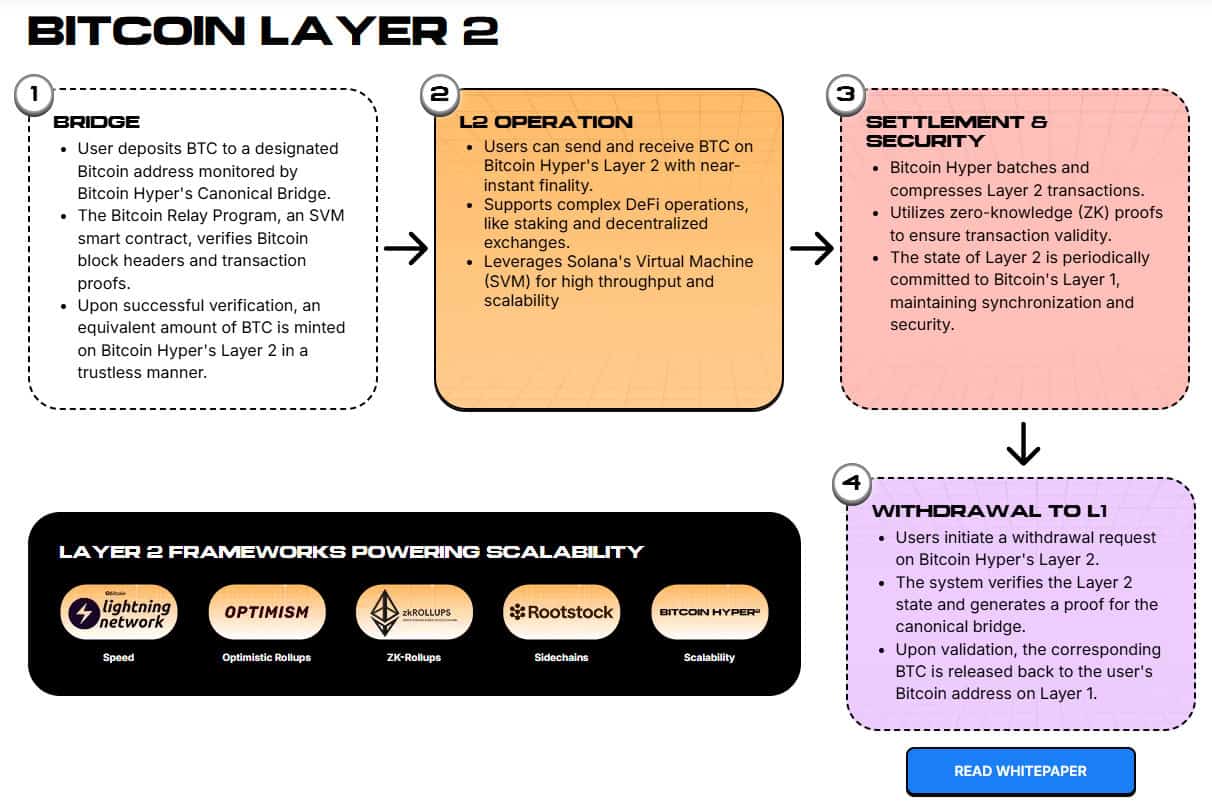
The post As Debasement Talk Gains Steam, Bitcoin Hyper Presale Nears $23M appeared on BitcoinEthereumNews.com. Bitcoin Hyper ($HYPER) presale nears down rapidly on $23M, even as talk of the ‘debasement trade’ drives Bitcoin’s next era. KEY POINTS: ➡️ Talk of ‘debasement trade’ drives interest in Bitcoin.➡️ 57% of the crypto market cap belongs to Bitcoin.➡️ Bitcoin Hyper presale reaches nearly $23M. For decades, Bitcoin’s rise has been tied to distrust in fiat currencies. As governments print more money, investors increasingly view $BTC as a hedge against debasement – a phenomenon that Wall Street has started to call the ‘debasement trade.’ Bitcoin, with its hard-capped supply of 2M $BTC, stands in stark contrast to fiat systems, where central banks can expand their balance sheets almost without limit. This dynamic helped Bitcoin cement its dominance: over 57% of the total crypto market cap belongs to $BTC. But while Bitcoin shines as a store of value, its utility as a transactional network lags behind modern demands. Low throughput and limited programmability prevent it from serving as more than digital gold. That’s where Bitcoin Hyper ($HYPER) comes in. The Store of Value Problem: Scarcity Meets Stagnation Bitcoin’s scarcity is unmatched, but scarcity alone doesn’t make for a full financial system. Today’s blockchain users demand: Fast and affordable payments suitable for micropayments and global remittances. Programmability for DeFi, tokenization, and NFTs. Interoperability across chains. On Bitcoin’s base layer, this isn’t possible. With just 3–7 TPS, high fees during congestion, and a lack of a complex smart contract environment, Bitcoin risks becoming a passive asset as liquidity and innovation migrate to Ethereum, Solana, and others. That risks weakening Bitcoin’s role even as the macro environment and search for a hedge against inflation strengthen the debasement trade thesis. Bitcoin Hyper: Turning the Debasement Trade Into a Scalable Economy Bitcoin Hyper is a Layer-2 built on Bitcoin that aims to capture both sides…

Author: BitcoinEthereumNews
3 Coins to Buy Before Ethereum’s (ETH) Breakout to $5,000

3 Coins to Buy Before Ethereum’s (ETH) Breakout to $5,000

The post 3 Coins to Buy Before Ethereum’s (ETH) Breakout to $5,000 appeared on BitcoinEthereumNews.com. If Ethereum truly pushes toward $5,000, the most significant tailwind won’t just be ETH itself; it’ll be the Ethereum ecosystem. Capital flows first into ETH, then into tokens that run on Ethereum rails or plug vital gaps in its stack.  That’s why a smart “ETH-beta” basket for this moment includes: Little Pepe (LILPEPE) for early-stage upside on an ETH-compatible meme L2, Chainlink (LINK) as the data and tokenization backbone feeding institutional demand, and Pepe Coin (PEPE) as the retail sentiment lever with a technical setup that can trigger fast moves when momentum flips. Little Pepe (LILPEPE): What It Is and Why Momentum Is Growing Little Pepe is the meme coin trying something most memes don’t: building real infrastructure. The project is developing a meme-focused Layer 2 designed to facilitate faster and cheaper trading, while hosting a Meme Launchpad to enable the fair launch of new community tokens. That gives LILPEPE a home-field advantage inside Ethereum’s universe: settle on ETH, scale on its own L2, and plug into DeFi primitives from day one. Momentum hasn’t been shy. The presale has surpassed $26.5 million in funding, with stage-by-stage price increases, and has been trending repeatedly on social media. Credibility points, such as a Certik smart-contract audit and a clear vesting schedule, have helped it stand out from copy-paste memes. Add headline-grabbing community rewards and get the flywheel that memes thrive on: attention → liquidity → more attention. Why Little Pepe is the best ETH Coin to buy this cycle:  Early market entry: Presale pricing gives LILPEPE far more room to run than mature, large-cap rivals. Unique use cases: A meme-focused L2 and Launchpad create utility beyond vibes, while staying culturally on-brand. Upcoming CEX listings: Presale to listings is the classic liquidity unlock. Ethereum standard compliance speeds integrations. Staying power through strict tokenomics:…

Author: BitcoinEthereumNews
EUR is a relative outperformer – Scotiabank

EUR is a relative outperformer – Scotiabank

The post EUR is a relative outperformer – Scotiabank appeared on BitcoinEthereumNews.com. The Euro (EUR) is up a marginal 0.1% against the US Dollar (USD) but still outperforming most of the G10 currencies into Friday’s NA open, attempting some stabilization following a period of significant underperformance against the USD with a near-1.5% decline over the past week or so, Scotiabank’s Chief FX Strategists Shaun Osborne and Eric Theoret report. EUR is attempting stabilization with focus on France and ECB “The EUR’s weakness has been driven by a combination of sentiment and fundamentals, with a focus on France’s ongoing political situation compounded by worrisome trade and industrial production figures from Germany.” “The ECB has maintained its neutral messaging, in speeches and the minutes of the most recent meeting delivered on Thursday. France-Germany spreads have pulled in from their recent wides, signaling some confidence in President Macron’s ability to navigate the country’s challenges with a new Prime Minister. The stabilization in euro zone-US spreads is also important, lending support to the EUR.” “EUR/USD appears to have found some near-term support around 1.1550 and the RSI looks to be steadying well above the oversold threshold at 30. In terms of support, we see nothing between current levels and 1.15, followed by the August 1 low around 1.14. Equally, resistance appears limited between current levels and the mid/upper-1.16s. We look to a near-term range bound between 1.1520 and 1.1620.” Source: https://www.fxstreet.com/news/eur-is-a-relative-outperformer-scotiabank-202510101132

Author: BitcoinEthereumNews
Bitcoin Hyper Nears $23M as the Debasement Trade Drives Bitcoin’s Next Era

Bitcoin Hyper Nears $23M as the Debasement Trade Drives Bitcoin’s Next Era

Bitcoin Hyper ($HYPER) presale nears down rapidly on $23M, even as talk of the 'debasement trade' drives Bitcoin's next era.

Author: Brave Newcoin
Plunges 5% Below Key Support Amid Crypto Weakness

Plunges 5% Below Key Support Amid Crypto Weakness

The post Plunges 5% Below Key Support Amid Crypto Weakness appeared on BitcoinEthereumNews.com. The governance token of the prominent decentralized lending protocol Aave AAVE$277.90 has faced substantial selling pressure through the past 24 hours, dipping briefly below the $270 level. The DeFi bluechip plunged 5% in the early Thursday session, sliding nearly 10% lower since this week’s high. It has modestly recovered later in the day U.S. hours, changing hands at around $272. The price action occurred amid a weak session for cryptocurrencies with bitcoin on the verge of breaking below $120,000. The broad market CoinDesk 20 Index was down more than 4% during the day. The technical picture shows bearish momentum for the DeFi major, CoinDesk Research’s analysis model suggested. Losing key support at $273 triggered a cascade of selling, accelerating the decline. Subsequent recovery attempts proved unsuccessful, with the failed rallies confirming sustained selling pressure, the model suggested. Key Technical Indicators Trading volume spiked to 63,651 units, substantially exceeding 24-hour average of 31,013 units. Technical resistance established at $280.00 level. Breakdown below critical support at $273.00 triggered additional algorithmic liquidation. Multiple recovery attempts failed, indicating sustained selling pressure. Disclaimer: Parts of this article were generated with the assistance from AI tools and reviewed by our editorial team to ensure accuracy and adherence to our standards. For more information, see CoinDesk’s full AI Policy. Source: https://www.coindesk.com/markets/2025/10/09/aave-plunges-below-key-support-levels-amid-broader-crypto-weakness

Author: BitcoinEthereumNews
2021 SOL Converted $1K into $100K, Now Analysts Predict Same Trajectory For This $0.035 Gem

2021 SOL Converted $1K into $100K, Now Analysts Predict Same Trajectory For This $0.035 Gem

In 2021, investors who spotted Solana (SOL) early watched $1,000 grow into $100,000 within months. That moment changed how people looked at crypto charts — not as random speculation but as a record of real innovation. Now analysts believe Mutuum Finance (MUTM) will follow a similar growth curve as it prepares to launch a full [...] The post 2021 SOL Converted $1K into $100K, Now Analysts Predict Same Trajectory For This $0.035 Gem appeared first on Blockonomi.

Author: Blockonomi
Ethereum Foundation Launches New Funding Mechanism to Support Privacy Developers

Ethereum Foundation Launches New Funding Mechanism to Support Privacy Developers

PANews reported on October 10th that the Ethereum Foundation's Funding Coordination Team and Keyring Network jointly launched a new funding mechanism to support privacy developers, according to an official blog post. The zkVerified permissioned vault deployed on the Keyring mainnet provides access to a compliant and privacy-preserving DeFi lending market. During the first two months, all protocol fees from the Keyring zkVerified vault will be donated to the legal defense fund of Roman Storm and Alexey Pertsev, two Tornado Cash developers currently on trial for releasing open-source code. The Ethereum Foundation stated that this model ensures that the vault's first users can directly support the legal defense of privacy-focused developers.

Author: PANews
What Retailers Are Buying – Small-Scale Investors Pour into these 3 High-Potential Altcoins for Possible 25X Gain in 2025

What Retailers Are Buying – Small-Scale Investors Pour into these 3 High-Potential Altcoins for Possible 25X Gain in 2025

The post What Retailers Are Buying – Small-Scale Investors Pour into these 3 High-Potential Altcoins for Possible 25X Gain in 2025 appeared first on Coinpedia Fintech News Retail investors are returning to the market. After months of cautious accumulation, small investors are diving into high-upside altcoins once more, looking for 2025’s next breakout cycle.  From real-world fintech integrations to community-driven coins with massive reach, these three tokens are quickly becoming favorites: Digitap ($TAP), BNB (BNB), and Dogecoin (DOGE). 1. How Digitap Emerges …

Author: CoinPedia
Crypto funding is broken. Can this new plan to help the Tornado Cash devs fix it?

Crypto funding is broken. Can this new plan to help the Tornado Cash devs fix it?

A new effort to fund the defence of Tornado Cash developers Roman Storm and Alexey Pertsev will serve as a “proof-of-concept” for a team within the Ethereum Foundation focusing on raising money for so-called public goods. If the effort succeeds in raising money for the embattled developers, it could become a model for future, crypto-based efforts to fund worthwhile causes, Vinay Vasanji, the head of the Foundation’s Strategic Funding Coordination team, told DL News. Keyring Network, a provider of verification services that rely on zero-knowledge technology, will direct three months of revenue from a new product to the developers’ defence. The product allows whitelisted institutions to privately access DeFi lending markets. “Right from the get go, we’ve had a very close ideological alignment to what the team at Tornado was building,” Keyring CEO Alex McFarlane told DL News. “We were shocked to see that Roman and Alexey were targeted in the way they were.”The prosecutionStorm, Pertsev, and a third co-founder, Roman Semenov, launched Tornado Cash in 2020. The protocol is a so-called crypto mixer that makes it difficult, if not impossible, to trace the movement of digital assets across Ethereum and several other blockchains.Prominent crypto entrepreneurs, including Ethereum co-founder Vitalik Buterin, have argued Tornado Cash provided much-needed privacy on an otherwise public ledger. Still, the protocol became popular with cybercriminals, including hackers affiliated with North Korea.In August, jurors convicted Storm of conspiracy to operate an unlicensed money transmitting business, which carries a maximum sentence of five years in prison. Storm has vowed to fight the conviction and recently asked a federal court to dismiss the verdict as well as two other charges on which the jurors were deadlocked: conspiracy to launder money and conspiracy to evade sanctions. Pertsev was convicted of money laundering by a Dutch court in 2024 and sentenced to five years in prison. He is appealing his conviction.There have been two developments in his case just this week. On Thursday, the court granted Pertsev’s request for additional investigation. The defence aims to test blockchain evidence relied on by prosecutors, according to his attorney Judith De Boer. “The prosecution appears to rely on Chainalysis labels and clustering without providing the underlying data,” she told DL News. “The Court of Appeal has ordered additional clarification from the FIOD, will appoint an independent expert, and has referred the case back to an appellate investigative judge to ensure a thorough review.” And on Friday, a judge granted Pertsev’s request to remove his ankle monitor. Both developers have gone to the crypto community hat in hand, asking for donations to fund their defence. The pair count the Ethereum Foundation, Buterin, and other prominent industry players among their donors. As of Thursday, Storm and Pertsev have raised at least 189 Ether and 799 Ether respectively, sums that were worth more than $800,000 and $3.4 million at Thursday’s prices. It has been an enormous show of support from the industry, which, by and large, views their prosecution as a threat to the ongoing development of open-source, privacy preserving technology. The solution But the developers need to continue raising money as their legal travails drag on. McFarlane and Vasanji hope that Keyring’s decision to donate proceeds from a new, yield-bearing product will inspire others to follow suit and create a more durable, consistent model for crypto-based fundraising. “One of the cool things about blockchain is it’s so openly capitalistic,” McFarlane said. But that can make it difficult to convince institutions to part with hard-earned capital in the name of the common good — in this case, defending developers’ right to build privacy-enhancing tools like Tornado Cash. “If you’re able to get a high yield and you’re also able to support the defense of two guys who’ve been wound up, frankly, in a political campaign against crypto, then that’s beneficial to everybody,” McFarlane said. Keyring’s product, which it refers to as zkVerified permissioned vaults, allows pre-approved institutional and retail investors to privately deposit crypto in yield-generating “vaults.” The process is designed to let investors access the world of decentralised finance without running afoul of the law or exposing their crypto wallets and, in turn, their onchain financial history. Vasanji said he’s been searching for initiatives that make crypto-based fundraising more reliable. “There isn’t a clear path for sustainable funding for public interest initiatives,” Vasanji said. Traditional businesses that appeal to civic-minded consumers often pledge to donate a portion of their proceeds to charitable causes. One Percent for the Planet, for example, recruits businesses such as Patagonia to donate at least 1% of their revenue to environmental conservation. Keyring’s effort differs in a key respect, according to Vasanji: Donations will happen in real-time, reducing operational and legal overhead. “The introduction of these types of mechanisms really aligns with the increasing institutional adoption of blockchains like Ethereum,” he said. “Really, what we’re trying to drive for is less operational and legal overhead, to donate quicker and larger pools of [money] for urgent initiatives, and to do that in a way that does not in any way change the inherent natural incentive structure that incentivizes people to use these protocols or projects in the first place.”Aleks Gilbert is DL News’ New York-based DeFi correspondent. You can reach him at [email protected].

Author: Coinstats
Mutuum Finance (MUTM) Raises $17M

Mutuum Finance (MUTM) Raises $17M

Mutuum Finance is one of 2025’s most closely watched early-stage DeFi contenders. The project has raised over $17 million and distributed more than 750 million tokens. The development of its lending and borrowing protocol is actively underway, with V1 scheduled for Sepolia Testnet in Q4 2025.

Author: Hackernoon