Lending

Lending protocols form the backbone of the decentralized money market, allowing users to lend or borrow digital assets without intermediaries. Using smart contracts, platforms like Aave and Morpho automate interest rates based on supply and demand while requiring over-collateralization for security. The 2026 lending landscape features advanced permissionless vaults and institutional-grade credit lines. This tag covers the evolution of capital efficiency, liquidations, and the integration of diverse collateral types, including LSTs and tokenized RWAs.

14465 Articles
Created: 2026/02/02 18:52
Updated: 2026/02/02 18:52

blockchain meets contemporary art at Tezos Berlin

blockchain meets contemporary art at Tezos Berlin

The post blockchain meets contemporary art at Tezos Berlin appeared on BitcoinEthereumNews.com. This November, Berlin will host a three day showcase featuring over 200 digital artists showcasing their art from some the largest marketplaces on the Tezos blockchain. Here are some highlights you can look forward to from the exhibition. Summary Art on Tezos 2025 is a three-day showcase in Berlin, Germany which showcases artwork from more than 200 artists from the Tezos blockchain. The list of artists include Lauren Lee McCarthy, Kevin Abosch, Memo Akten, Ilya Bliznets, Olga Shpak, and suisoichi. Art on Tezos is a three-day showcase that will be held in Berlin, Germany, from November 6 to 9, 2025. The event will feature exhibitions, artist-led projects, and film screenings, highlighting the growing range of artistic practices emerging on the Tezos blockchain. Art on Tezos (XTZ) brings together an eclectic mix of participants at the intersection of digital art and blockchain. Among the list of participants include American artist and computer programmer Lauren Lee McCarthy and Irish conceptual artist Kevin Abosch. With more than 200 artists and their works taking center stage, Art on Tezos aims to present a dynamic portrait of the diversity and innovation shaping today’s digital art scene, maturing well beyond the initial 2021 hype. The exhibition comes at a tenuous time for digital art, with both the recent announcement of Christie’s shuttering its dedicated NFT division, coupled with low floor prices for NFT collections once considered the canon of crypto art. Yet Tezos with its focus on energy efficiency, sustainability, and its relatively low mint price has bucked this trend. That has fostered a strong and robust community and ecosystem visible via vibrant platforms like fx(hash), objkt.com and teia, alongside partnerships with leading contemporary art institutions—such as MoMA and Musée d’Orsay—now collaborate on Tezos-based projects, reinforcing the blockchain’s cultural relevance “Art on Tezos: Berlin demonstrates what’s…

Author: BitcoinEthereumNews
Pepeto Attracts Capital As Early Shiba Inu And Pepe Investors Hunt Big Gains And The Next 100x Story

Pepeto Attracts Capital As Early Shiba Inu And Pepe Investors Hunt Big Gains And The Next 100x Story

The post Pepeto Attracts Capital As Early Shiba Inu And Pepe Investors Hunt Big Gains And The Next 100x Story appeared first on Coinpedia Fintech News Early Shiba Inu and PEPE stories are legendary. Some first movers turned $1,000 into well over $1,000,000 as SHIB ran more than 26,000% in 2021, while PEPE delivered multi-thousand % bursts for the earliest entries. After riding those arcs, many of those holders are hunting the next big move, shifting from SHIB to PEPE and …

Author: CoinPedia
Ripple Collaborates with DBS and Franklin Templeton to Introduce RLUSD-Backed Trading and Lending Solutions

Ripple Collaborates with DBS and Franklin Templeton to Introduce RLUSD-Backed Trading and Lending Solutions

Ripple partners with DBS and Franklin Templeton to launch RLUSD-backed trading and lending solutions for institutional investors.   Ripple has teamed up with DBS and Franklin Templeton to launch a new trading and lending platform powered by Ripple’s RLUSD stablecoin. This collaboration aims to create a more efficient financial ecosystem for institutional investors.  Through this […] The post Ripple Collaborates with DBS and Franklin Templeton to Introduce RLUSD-Backed Trading and Lending Solutions appeared first on Live Bitcoin News.

Author: LiveBitcoinNews
Is Doge Still The Best Crypto Investment, Or Will Pepeto Make You Rich In 2025

Is Doge Still The Best Crypto Investment, Or Will Pepeto Make You Rich In 2025

The post Is Doge Still The Best Crypto Investment, Or Will Pepeto Make You Rich In 2025 appeared on BitcoinEthereumNews.com. Crypto News 18 September 2025 | 13:39 Is Dogecoin actually running out of gas, after making people millionaires overnight? As investors hunt for the best crypto to buy now and the best crypto to invest in 2025, Dogecoin still owns the meme spotlight, yet its upside looks capped according to today’s Dogecoin price prediction. Focus is shifting toward projects that marry community with real on chain utility. People searching best crypto to buy now want shipped products, audits, and transparent tokenomics. That frames the honest matchup for this cycle, Dogecoin versus Pepeto. Meet Pepeto, an Ethereum based meme coin built with live rails, PepetoSwap for zero fee trading and Pepeto Bridge for smooth cross chain moves. By blending story with tools people can touch today, and speaking directly to crypto presale 2025 demand, Pepeto puts utility, clarity, and distribution first. In a market where older meme coins risk drifting on sentiment, Pepeto’s delivery gives it a credible seat in the best crypto investment debate. First, here is why Dogecoin may be fading. Dogecoin Price Prediction Is Dogecoin Losing Momentum Remember when Dogecoin made crypto feel effortless. In 2013, Doge turned an internet joke into money and a movement that welcomed everyone. A decade later the market is tougher and the relentless tailwind is gone, sentiment is choppier and patience matters. With Doge near $0.268, the setup reads bearish to neutral for the next few weeks. If the $0.26 shelf holds on daily closes, expect choppy range trading toward $0.29 to $0.30 where rallies keep stalling. Lose $0.26 and momentum often slides into $0.245 with risk of a deeper probe toward $0.22 to $0.21. Close back above $0.30 and the downside bias is likely neutralized, opening room for a squeeze into the low $0.30s. Beyond the price view, Dogecoin still centers…

Author: BitcoinEthereumNews
Dogecoin Price Prediction: Is Doge Still The Best Crypto Investment, Or Will Pepeto Make You Rich In 2025

Dogecoin Price Prediction: Is Doge Still The Best Crypto Investment, Or Will Pepeto Make You Rich In 2025

Focus is shifting toward projects that marry community with real on chain utility. People searching best crypto to buy now […] The post Dogecoin Price Prediction: Is Doge Still The Best Crypto Investment, Or Will Pepeto Make You Rich In 2025 appeared first on Coindoo.

Author: Coindoo
How to Buy Bitcoin Hyper – Easy Guide

How to Buy Bitcoin Hyper – Easy Guide

Bitcoin Hyper (HYPER) prides itself as Bitcoin’s first Layer 2, primarily designed to ensure lower fees and grant access to decentralized applications (dApps) such as games, staking and loans.  While being a new entrant, arriving on presale a couple of weeks ago, HYPER has already managed to raise over $16.5 million. This guide explains how […]

Author: The Cryptonomist
Crypto Credit, Borrowing to Drive Next Big Wave: Bitwise CEO

Crypto Credit, Borrowing to Drive Next Big Wave: Bitwise CEO

The post Crypto Credit, Borrowing to Drive Next Big Wave: Bitwise CEO appeared on BitcoinEthereumNews.com. Key Highlights:  Bitwise CEO Hunter Horsley predicts that credit and borrowing in crypto could explode in the next few months.  Turning U.S. stocks into tokens could let people borrow on the blockchain even with small amounts of shares. This will make credit much easier to access.  Industry data confirms strong growth in on-chain lending and staking.  The crypto industry has survived various waves of innovation, from the rise of Bitcoin and Ethereum to decentralized finance taking over, NFTs, and the anticipated surge of spot exchange-traded funds (ETFs). But according to Bitwise CEO Hunter Horsley, the next big shift might not come from these areas, but it could come from crypto credit and borrowing. Speaking on the evolving role of digital assets in traditional capital markets, Horsley projected that credit markets built on crypto and tokenized assets will see explosive growth in the next few years. He also suggested that this transformation could come through within the next 6-12 months and it will reshape how crypto market works. Bitwise CEO talks about the next big thing in crypto The Two Vectors of Growth Horsley in his post on X (formerly known as Twitter) highlighted two major forces that might be converging in the near future: The first reason is the size of the crypto market. As of now, there’s almost $4 trillion worth of cryptocurrency in circulation worldwide and as we can see the number is growing day by day. Due to this growth, many investors do not want to sell their coins, but they still need cash sometimes. According to the Bitwise CEO, borrowing against crypto makes more sense because instead of selling coins, people can instead use them as collateral for loans. In this way, the investors get the money that they want, and their investment in crypto also…

Author: BitcoinEthereumNews
4 in 10 Americans Ready for Regulated DeFi: A Pivotal Survey on DeFi Regulation

4 in 10 Americans Ready for Regulated DeFi: A Pivotal Survey on DeFi Regulation

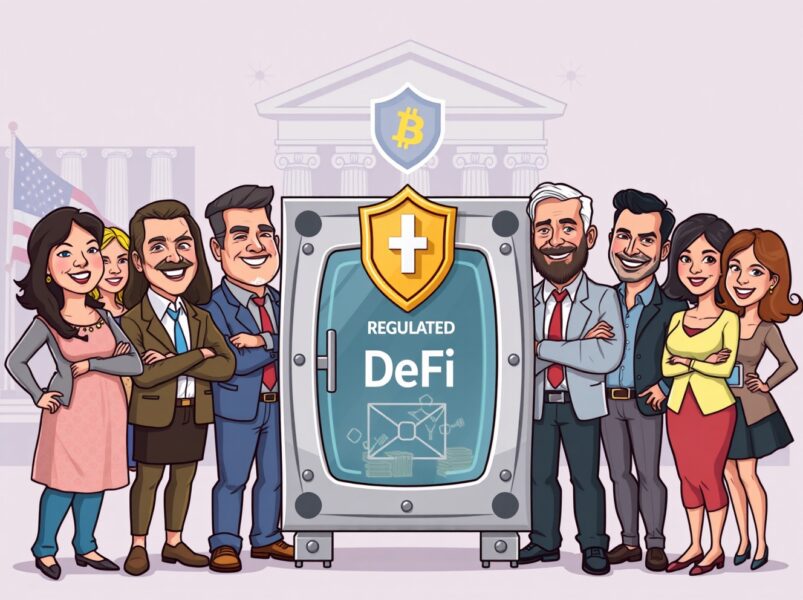
BitcoinWorld 4 in 10 Americans Ready for Regulated DeFi: A Pivotal Survey on DeFi Regulation The world of decentralized finance, or DeFi, is often seen as a frontier, exciting but perhaps a little wild. However, a groundbreaking survey from the DeFi Education Fund reveals a surprising truth: a significant portion of Americans are ready to embrace DeFi regulation. This isn’t just a niche interest; it’s a clear signal that mainstream adoption hinges on establishing clear, thoughtful rules for this innovative financial ecosystem. What’s the Buzz Around DeFi Regulation? Imagine a financial system that’s open, transparent, and accessible to everyone, everywhere. That’s the promise of DeFi. Yet, for many, the lack of established guidelines has been a major hurdle. The recent survey sheds light on this hesitation, indicating that nearly half of all Americans are willing to dive into DeFi, but only if it operates within a regulated framework. Key Finding: 42% of respondents would use DeFi under a regulated framework. This figure highlights a strong desire for security and clarity. Payment Services Potential: Among those willing, a remarkable 84% expressed readiness to try DeFi-based payment services. This suggests a massive untapped market for innovative payment solutions. This data points to a crucial intersection where innovation meets consumer protection. It suggests that appropriate DeFi regulation could unlock a new era of financial services for millions. Why Are Americans Eyeing Regulated DeFi? It’s not just about curiosity; there’s a deeper reason behind this willingness to engage with regulated DeFi. The survey also uncovered a significant lack of trust in existing financial systems. Only 29% of respondents believe the current U.S. financial system is truly safe. This sentiment is powerful. It indicates that people are actively seeking alternatives that offer greater transparency, security, and fairness. DeFi regulation, when done right, can provide the assurance needed for individuals to confidently explore these new avenues. It’s about building bridges of trust between cutting-edge technology and everyday users. Consider the benefits: enhanced consumer protection, reduced fraud risks, and a level playing field for all participants. These are the pillars upon which a trusted financial system, traditional or decentralized, must stand. The Promise of Regulated DeFi Payments The enthusiasm for DeFi isn’t limited to just financial products like lending or borrowing. A significant portion of the surveyed group expressed a strong interest in using DeFi for everyday transactions. The idea of regulated DeFi-based payment services is particularly appealing. Faster Transactions: Imagine sending money globally in minutes, not days. Lower Fees: Bypassing traditional intermediaries can significantly reduce costs. Greater Control: Users maintain more direct control over their funds. These advantages, combined with the security provided by clear DeFi regulation, could revolutionize how we think about and use money daily. It’s about creating more efficient, inclusive, and user-centric payment experiences. Navigating the Path to Mainstream DeFi Regulation While the demand for regulated DeFi is evident, the path to achieving it is complex. Regulators face the challenge of understanding a rapidly evolving technology while simultaneously protecting consumers and fostering innovation. This isn’t a simple task, but the survey provides a clear mandate for action. Key Considerations for Effective DeFi Regulation: Clarity: Establishing clear definitions and legal frameworks for DeFi protocols and assets. Consumer Protection: Implementing safeguards against scams, hacks, and financial exploitation. Innovation: Crafting rules that don’t stifle technological advancement and growth. Global Coordination: Harmonizing regulations across different jurisdictions to prevent arbitrage and ensure market stability. The future of finance could very well be decentralized, but its widespread adoption depends heavily on thoughtful and effective DeFi regulation. It’s a collaborative effort between innovators, users, and policymakers to build a financial system that serves everyone. Summary: A Clear Call for Action The survey from the DeFi Education Fund delivers a compelling message: Americans are ready for DeFi, but they want it to be safe and sound. The willingness of 4 in 10 respondents to engage with regulated DeFi, coupled with the strong interest in payment services, underscores the immense potential of this technology. It also highlights a critical opportunity for regulators to step up and provide the clarity and oversight necessary to unlock DeFi’s full promise. The future of finance is evolving, and DeFi regulation will be a cornerstone of its mainstream success. Frequently Asked Questions About Regulated DeFi Q1: What is DeFi? A1: DeFi, or decentralized finance, refers to financial services built on blockchain technology. These services, like lending, borrowing, and trading, operate without traditional intermediaries such as banks, using smart contracts instead. Q2: Why do Americans want DeFi to be regulated? A2: Americans desire regulation for DeFi primarily for security and trust. Many are wary of unregulated financial systems due to potential risks like fraud, hacks, and lack of consumer protection. Regulation can provide a framework of safety and legitimacy. Q3: What benefits could regulated DeFi offer? A3: Regulated DeFi could offer several benefits, including enhanced consumer protection, reduced risks of scams, greater transparency, potentially faster and cheaper financial services (especially payments), and increased trust, leading to broader adoption. Q4: How does DeFi regulation compare to traditional finance regulation? A4: Traditional finance operates under well-established, comprehensive regulatory frameworks. DeFi regulation is still evolving and aims to apply similar principles of consumer protection and market integrity to a decentralized, blockchain-based environment, often requiring new approaches due to its unique technological characteristics. Q5: What are the challenges in implementing DeFi regulation? A5: Challenges include the decentralized and global nature of DeFi, which makes enforcement difficult; the rapid pace of technological innovation; defining which entities are responsible for compliance; and ensuring regulations foster innovation rather than stifling it. Found this article insightful? Share it with your friends, colleagues, and anyone interested in the future of finance and the exciting potential of regulated DeFi! Your shares help spread awareness and foster important conversations. To learn more about the latest crypto market trends, explore our article on key developments shaping DeFi institutional adoption. This post 4 in 10 Americans Ready for Regulated DeFi: A Pivotal Survey on DeFi Regulation first appeared on BitcoinWorld.

Author: Coinstats
Ripple Partners Trillion-Dollar Manager Franklin Templeton and DBS to Launch Tokenized Finance Solutions

Ripple Partners Trillion-Dollar Manager Franklin Templeton and DBS to Launch Tokenized Finance Solutions

Ripple, Franklin Templeton, and DBS have joined forces to advance tokenized finance through a new collaboration. The three firms signed a partnership to develop lending and trading tools using tokenized money market funds and Ripple’s new stablecoin, Ripple USD (RLUSD).Visit Website

Author: The Crypto Basic
DBS, Ripple, and Franklin launch tokenized loans 24/7 on XRPL

DBS, Ripple, and Franklin launch tokenized loans 24/7 on XRPL

A new strategic alliance between DBS, Franklin Templeton, and Ripple brings tokenized lending into the institutional perimeter.

Author: The Cryptonomist