Lending

Lending protocols form the backbone of the decentralized money market, allowing users to lend or borrow digital assets without intermediaries. Using smart contracts, platforms like Aave and Morpho automate interest rates based on supply and demand while requiring over-collateralization for security. The 2026 lending landscape features advanced permissionless vaults and institutional-grade credit lines. This tag covers the evolution of capital efficiency, liquidations, and the integration of diverse collateral types, including LSTs and tokenized RWAs.

15846 Articles
Created: 2026/02/02 18:52
Updated: 2026/02/02 18:52
Candi Solar bags $58.5M from International Finance Corp

Candi Solar bags $58.5M from International Finance Corp

The funding, announced Thursday, will support Candi Solar's distributed solar projects for commercial and industrial clients in India and South Africa.

Author: Yourstory
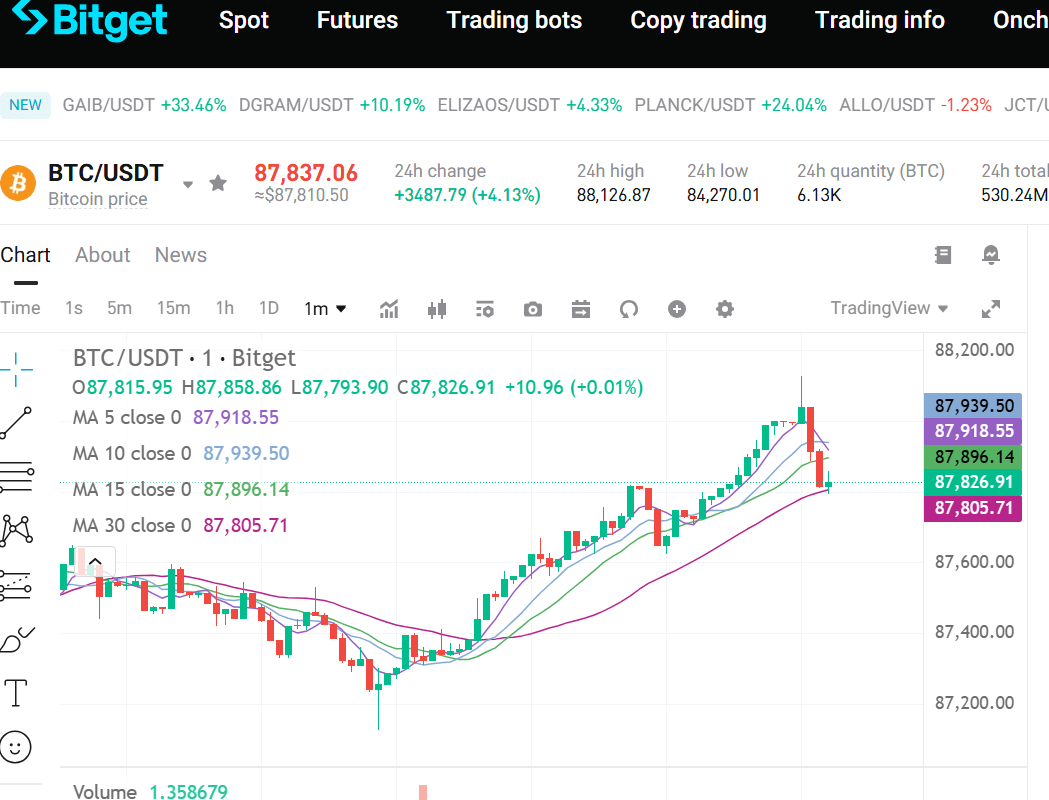
Bitcoin (BTC) Price Prediction Reveals the Next Target as Mutuum Finance (MUTM) Becomes the Top Crypto to Buy Now

Bitcoin (BTC) Price Prediction Reveals the Next Target as Mutuum Finance (MUTM) Becomes the Top Crypto to Buy Now

The post Bitcoin (BTC) Price Prediction Reveals the Next Target as Mutuum Finance (MUTM) Becomes the Top Crypto to Buy Now appeared on BitcoinEthereumNews.com. The recent price movements of Bitcoin are being closely scrutinized by analysts who are focusing their next target level, as the community sees BTC consolidating at a crucial level that will decide which way the markets move. Traders remain uncertain about whether the breakouts will continue or if there will be a deeper pullback as momentum shifts in the coming days and weeks. However, the interest of the community has been shifting to promising opportunities that display far more convincing growth trends than the previous ones.  This has introduced Mutuum Finance, the top crypto to buy now, which has been accelerating its presale at a speed no experienced analyst had predicted. Priced at a low of $0.035 and progressing through Phase 6 of its presale, Mutuum Finance has already sold out almost 95% of its allocation and has raised almost $19.02 million, cementing its status as the best crypto to invest in. Bitcoin Faces Downward Pressure Amid Extreme Fear in the Market Bitcoin (BTC) remains stuck in a short-term bearish trend due to its sharp fall from the October peaks and the clear break of the psychological level of $100,000. This fall has been fueled not only by the net outflows of almost $3 billion from the ETFs in November but also due to the macroeconomic uncertainty and the large unwind of the leverage market, which has pushed the sentiment levels to the state of Extreme Fear. Meanwhile, the recent Death Cross pattern has again proven the dominance of the fall trend, and the level of $90,000 has been identified as the critical level of support to be defended immediately because immediate failure to do so will trigger the fall towards the final structural support at $80,000. However, due to the high level of market conservatism at this point in…

Author: BitcoinEthereumNews
PA Daily News | Major crypto VCs and exchanges donate to support Hong Kong; Qian Zhimin actually bought 194,000 BTC, of which the whereabouts of 120,000 are unknown.

PA Daily News | Major crypto VCs and exchanges donate to support Hong Kong; Qian Zhimin actually bought 194,000 BTC, of which the whereabouts of 120,000 are unknown.

Today's top news highlights: Animoca executives: Plans to expand business focus to stablecoins, AI, and DePIN by 2026. New doubts in the Qian Zhimin case: 120,000 of the 195,000 BTC are missing, and the wallet owner claims to have lost the password for 20,000 BTC. South Korean Financial Services Commission Chairman: Crackdown on cryptocurrency money laundering; travel regulations expanded to include amounts under 1 million won. Analyst Murphy: The densest trading range for BTC is $94,000-$98,000 and $101,000-$118,000. Only 11 public blockchains have earned more than $100,000 in the past 7 days. Macro New doubts in the Qian Zhimin case: 120,000 of the 195,000 BTC are missing, and the wallet owner claims to have lost the password for 20,000 BTC. An article published in China Newsweek, titled "Can the 40 Billion Yuan in Bitcoins Taken Away by Qian Zhimin Be Returned to China?", points out that Qian Zhimin, the main culprit in a money laundering case involving 60,000 Bitcoins, purchased a total of 194,951 Bitcoins, exceeding the 61,000 Bitcoins seized by the police. However, the court did not disclose the situation of the remaining 120,000+ Bitcoins, meaning that there is a high probability that more Bitcoins in Qian Zhimin's assets have not yet been discovered or confiscated. London Metropolitan Police detective Joe Lane revealed that Qian Zhimin claimed that the password to a wallet containing 20,000 Bitcoins had been lost. Based on the latest market price, these "lost" Bitcoins alone are worth approximately 12.5 billion yuan. South Korean Financial Services Commission Chairman: Crackdown on cryptocurrency money laundering; travel regulations expanded to include amounts under 1 million won. According to Yonhap News Agency, on the 28th local time, Lee Eok-woon, Chairman of the Financial Services Commission of South Korea, stated at the 19th Anti-Money Laundering Day commemoration ceremony of the Financial Intelligence Analysis Institute that the scope of the "travel rule," also known as the "cryptocurrency real-name system," will be expanded to include transactions below 1 million won (approximately US$680). He emphasized that money laundering activities using virtual asset transactions will be severely cracked down on, and virtual asset transactions with overseas exchanges with high money laundering risks will be prohibited. Furthermore, a strict review mechanism will be established to comprehensively examine the criminal records, financial status, and social creditworthiness of major shareholders of virtual asset businesses. Analysis: Upbit may have been subjected to long-term infiltration by an advanced persistent threat organization. Security firm GoPlus analysis indicates that the Upbit attack raises several serious concerns: the hot wallet leak points to vulnerabilities in key management and internal network security vulnerabilities. Cold wallets remain secure. The incident is noteworthy for several reasons: 1. It was an "anniversary attack"—the date coincided with the $50 million hack in 2019 (six years ago); 2. The timing was opportune—launching the attack hours after the major merger announcement of Dunamu and Naver; 3. It exhibited typical Lazarus characteristics—the speed, methods, and symbolic significance of the attack; 4. Sophisticated money laundering methods—using multiple DEXs, potentially circumventing regulations (2200 SOL tokens transferred to Binance). All these signs suggest that the platform may have been under long-term infiltration by an Advanced Persistent Threat (APT) group. Previously, Upbit disclosed the theft of approximately 54 billion won in assets from its Solana network; South Korean authorities suspect the North Korean hacking group Lazarus is behind the attack. Bitcoin holders accuse JPMorgan Chase of market manipulation. According to Cointelegraph, after JPMorgan Chase filed an application with the U.S. SEC to launch leveraged Bitcoin-backed notes, Bitcoin enthusiasts accused the company of manipulating rules to suppress Strategy and Digital Asset Reserves (DATs). Previously, JPMorgan Chase launched structured notes linked to the BlackRock Bitcoin ETF, matching the four-year Bitcoin halving cycle. The UK has proposed introducing a "no profit, no loss" tax rule for DeFi. According to CoinDesk, the UK government is developing a new tax framework that could benefit DeFi users. A proposal released this week shows that HM Revenue and Customs supports a "no profit, no loss" principle for cryptocurrency lending and liquidity pool arrangements. Under the current system, DeFi users depositing funds into protocols, even just for profit or as collateral for loans, can trigger capital gains tax. The new measure will postpone tax payment until an economically meaningful asset disposal occurs. This means that users depositing cryptocurrency into lending protocols or providing tokens to automated market makers will no longer need to pay tax on the deposit itself, but only when they eventually sell or trade the assets and realize a profit or loss. The proposal aims to align tax rules with the actual operation of DeFi, thereby reducing the administrative burden and avoiding unreasonable tax outcomes. The new principle also applies to complex multi-token arrangements; if a user withdraws more tokens than they deposited, the profit will be taxed; if less, it will be considered a loss. However, this model is not yet finalized, and the government is still consulting with professionals and DeFi developers. While HM Revenue and Customs has not set a timetable for legislation, it has stated that it will continue to engage with the industry to assess the necessity of such legislation. Bitwise has updated its filing for the spot Avalanche ETF, proposing to add staking functionality. According to CoinDesk, Bitwise has updated its filing with the U.S. Securities and Exchange Commission (SEC) for its spot Avalanche ETF. This revision changes the ETF's ticker symbol to BAVA and sets the sponsorship fee rate at 0.34%, currently the lowest among similar products. In comparison, VanEck's Avalanche ETF has a fee rate of 0.40%, and Grayscale's is 0.50%. The updated S-1 filing also states that the trust will be allowed to stake up to 70% of its AVAX holdings on Avalanche's proof-of-stake network to earn additional tokens. However, the issuer is considering deducting 12% of the proceeds as fees, with the remainder distributed to shareholders. Since competitors have not yet launched staking services, their fees are currently limited to sponsorship fees. Bitwise is also offering a full fee waiver for the first month on its initial $500 million in assets, aiming to position BAVA as the lowest-cost way for traditional investors to gain exposure to Avalanche and earn staking income. Opinion Analyst Murphy: The densest trading range for BTC is $94,000-$98,000 and $101,000-$118,000. According to a BTC Cost Base Distribution (CBD) heatmap shared by analyst Murphy, the most concentrated areas of BTC holdings are currently $94,000-$98,000 and $101,000-$118,000, corresponding to the historical fair price ($98,000) and the average cost of short-term holders ($104,000), respectively, serving as important reference lines for bull-bear market transitions. Furthermore, data shows that between November 21st and 23rd, 950,000 BTC accumulated in the $84,000-$85,000 range, of which 550,000 are related to Coinbase's wallet consolidation, and the remaining 400,000 represent actual trading, possibly related to whale activity. CBD uses an address-based calculation method, providing an important reference for observing market BTC distribution. Arthur Hayes: Price discovery for the largest U.S. tech stocks and major stock indices is expected to occur in the perpetual contract market. BitMEX co-founder Arthur Hayes published an article today titled "Survival of the Fittest: How Perpetual Contracts Are Disrupting Traditional Finance," pointing out that traditional finance (TradFi) is desperately trying to maintain its dominance in stock trading. It will be very interesting to observe how they respond to the rapid market acceptance of stock index perpetual contracts. The first perpetual contract sector to dominate the market will be offshore trading of US stock price risk. US stocks, and all stocks, will eventually be tokenized. However, stock index perpetual contracts do not rely on stock tokenization to succeed. Stock perpetual contracts already have mature infrastructure that allows for rapid scaling. Alliance DAO co-founder: L1 token lacks a moat; betting on the application layer may be the way out. QwQiao, co-founder of Alliance DAO, stated in an article on the X platform that he finds it difficult to convince himself to hold L1 public chain tokens long-term. The reason is not their high price-to-earnings ratio (P/E), but rather the lack of a moat, making them easily commoditized and difficult to capture meaningful value. Currently, cross-chain transfers are very convenient for users, and most application developers can quickly migrate their applications from one chain to another. Furthermore, launching a new chain is significantly easier than before, and the switching costs are far lower than infrastructure like AWS. QwQiao also mentioned that the only way for a chain to strengthen its moat is to develop vertically and control the application layer. He observed that chains like Solana, Base, and Hyperliquid have realized this and are actively taking action, as is the emerging enterprise-level chain Tempo. He firmly believes that the crypto industry will experience exponential growth, and betting on the application layer is the best way to express this view. Project Updates OKX donated HK$10 million to Hong Kong to support emergency relief and recovery efforts. According to official sources, OKX has donated HK$10 million to Hong Kong to support local emergency relief and disaster recovery efforts. YZi Labs seeks to expand the board of directors of BNB treasury company CEA Industries to improve strategy execution and oversight. YZi Labs announced on its X platform that, as a significant shareholder of CEA Industries Inc. (NASDAQ: BNC), it has filed a preliminary consent statement with the U.S. Securities and Exchange Commission (SEC) seeking written shareholder consent to expand the company's board of directors and add new board seats. YZi Labs stated that despite a significant increase in the value of BNC's main asset under management, BNB, the company's performance since the completion of its $500 million PIPE financing deal this summer has fallen far short of the expected results from that investment rationale. It believes BNC's poor performance is a direct result of poor strategy execution, insufficient investor communication, and a lack of effective oversight. YZi Labs also expressed concern about delays in key SEC filings, failure to promptly update investors on digital asset fund management and net asset value (NAV), and continued investor confusion regarding the company's identity, communication, and strategy. The Wormhole Foundation announced the purchase of $5 million worth of W tokens. According to official sources, the Wormhole Foundation announced that it has purchased $5 million worth of W tokens and added them to its balance sheet. Balancer security incident update: DAO begins discussions on an $8 million recovery plan. According to CoinDesk, weeks after a major vulnerability in Balancer v2 vaults led to the loss of over $110 million, the Balancer DAO has begun discussing a plan to distribute approximately $8 million in recovered assets to affected limited partners (LPs). The proposed scheme includes structured rewards for white-hat hackers and compensation based on snapshots of user pool assets at the time of the exploit, consistent with the Safe Harbor Protocol. This protocol stipulates a bounty cap of $1 million per incident, requiring white-hat hackers to undergo comprehensive KYC and sanctions screening. Several anonymous rescuers on Arbitrum have waived their bounty claims. Recovered tokens cover networks including Ethereum, Polygon, Base, and Arbitrum, with liquidity providers receiving compensation proportionally to the tokens initially provided and per pool. A claims mechanism is currently under development; if the proposal is approved, users will need to accept updated terms of use. Additionally, $19.7 million in osETH and osGNO were recovered by StakeWise and will be processed separately; $4.1 million recovered internally in collaboration with Certora is ineligible for a bounty due to a previous agreement. This exploit, caused by a smart contract flaw, marks Balancer's third major security incident, resulting in a plunge in total value locked (TVL) from approximately $775 million to $258 million, and a loss of about 30% in the value of BAL tokens. Bitget will donate HK$12 million to support fire relief and reconstruction efforts in Tai Po, Hong Kong. Bitget will donate a total of HK$12 million to Hong Kong to support emergency relief efforts, assistance to affected families, and post-disaster reconstruction following the Hung Fook Court fire. The donation will be received and implemented by three reputable local charitable organizations. Binance donated HK$10 million to Hong Kong to support fire relief and reconstruction. According to an official announcement from Binance, Binance will donate HK$10 million to the fire-stricken area of Hung Fook Court in Tai Po, Hong Kong, to support rescue and reconstruction efforts. Binance stated that it will implement the donation through relevant channels and extend its condolences to the affected people. Matrixport Group and its employees jointly donated HK$3 million to support fire relief and reconstruction efforts in Hong Kong. To fully support emergency relief, disaster relief, and reconstruction efforts following the Tai Po fire in Hong Kong, Matrixport Group, through its Hong Kong branch, donated HK$3 million to relevant relief organizations. This donation, jointly made by the Group and its employees, will be specifically used for disaster relief and reconstruction. Important data Only 11 public blockchains have earned more than $100,000 in the past 7 days. According to crypto KOL AB Kuai.Dong, citing Nansen data, only 11 public blockchains have generated over $100,000 in revenue in the past seven days. The top six are Tron, Ethereum, Solana, BNB, Bitcoin, and Base. They account for over 95% of on-chain user spending. The vast majority of the remaining public blockchains have low activity, with some generating close to zero revenue. The "insider whale" on October 11th has closed out its long positions of 15,000 ETH in batches, making a profit of $846,000. According to on-chain analyst @ai_9684xtpa, the "whale that opened short positions on October 11th" has closed its long positions. He just closed his long positions of 15,000 ETH (US$45.32 million) in batches, ultimately making a profit of US$846,000. This long position ultimately ended in profit in less than four days. As of now, only the BTC long position from November 8th is in a loss position; all others are profitable, with the account accumulating a total profit of US$101 million. Data: Over the past 30 days, Bitcoin whales have flowed $7.5 billion into Binance, the highest level in a year. CryptoQuant analyst Martunn wrote that the latest data shows that over the past 30 days, Bitcoin whales have poured $7.5 billion into Binance, the highest level in a year. This surge in inflows is similar to the pattern seen during previous periods of high market volatility (such as March 2025), when Bitcoin's price plummeted from approximately $102,000 to a low of $70,000. In these situations, whales typically move funds into exchanges to take profits or manage risk when the market weakens. Given that the 30-day inflow indicator is still climbing, the current data does not yet indicate that selling pressure has stabilized. For investors, this mainly means that the risk zone has not yet been fully resolved. Large inflows into exchanges often act as a barometer of pressure: they indicate that funds are being mobilized, but do not necessarily predict when a trend reversal will occur. In similar periods in the past, it took the market about a month to find a local bottom. Investment and Financing/Acquisition Entrée Capital raises $300 million in new fund, focusing on early-stage investments in AI, cryptocurrencies, and other sectors. According to official news, Entrée Capital has announced the successful raising of a new $300 million fund focused on early-stage investments. This brings the company's total assets under management to $1.5 billion. The new funds will primarily be deployed in pre-seed, seed, and Series A investments in Israel, the UK, Europe, and the US. The new fund will target founders in the following areas: Artificial Intelligence (covering native AI applications, vertical AI, and enabling infrastructure); Deep Technology and Quantum Computing (including computing technologies, science-driven systems, and advanced materials); Software, Data, and B2B Productivity Enhancement; Cryptocurrency (primarily focusing on infrastructure and security); and unconventional cutting-edge innovation. Entrée Capital has previously invested in Web3 domain registrars such as Freename and Bitcoin payment startup Breez. Animoca executives: Plans to expand business focus to stablecoins, AI, and DePIN by 2026. According to Cointelegraph, Keyvan Peymani, Chief Strategy Officer of Animoca Brands, stated that the company plans to expand beyond the gaming sector next year, enriching its existing portfolio of approximately 600 companies. In an interview with CNBC on Tuesday, he elaborated, “We invest in dozens of companies every year, covering artificial intelligence, DePIN, DeFi, gaming, and any emerging areas and new opportunities related to stablecoins. Our core objective has always been to focus on the expansion of the ecosystem we operate in.” He further emphasized, “We strive to be a market leader whenever there are interesting and exciting developments in areas like stablecoins and RWA.” He added that Animoca is committed to bridging the gap between the retail industry and the transformation within the Web3 ecosystem, “You can expect us to continue to delve deeper and uncover potential projects that we believe will disrupt the industry. Stablecoins are a major focus for the company recently.” Institutional holdings The Bhutanese government transferred 160.35 ETH, worth $483,000, to QCP Capital. According to Onchain Lens, the Royal Government of Bhutan transferred 160.35 ETH (worth $483,000) to QCP Capital and may deposit more funds thereafter. Bitmine has purchased 14,618 ETH from BitGo, worth $44.34 million. According to OnchainLens monitoring, Bitmine has purchased 14,618 ETH from BitGo, worth $44.34 million.

Author: PANews
UK Proposes No Gain, No Loss Tax Rule for DeFi Transactions

UK Proposes No Gain, No Loss Tax Rule for DeFi Transactions

TLDR UK’s HMRC proposed a “no gain, no loss” tax approach for DeFi transactions, deferring capital gains tax until tokens are sold The framework covers crypto lending, borrowing arrangements, and liquidity pool deposits Under current rules, depositing crypto into protocols can trigger capital gains tax of 18% to 32% Major industry players including Aave, Binance, [...] The post UK Proposes No Gain, No Loss Tax Rule for DeFi Transactions appeared first on Blockonomi.

Author: Blockonomi
RWA Weekly: Coinbase Ventures includes RWA perpetual contracts in its 2026 investment portfolio; Central banks in multiple countries warn of regulatory risks associated with stablecoins.

RWA Weekly: Coinbase Ventures includes RWA perpetual contracts in its 2026 investment portfolio; Central banks in multiple countries warn of regulatory risks associated with stablecoins.

Highlights of this episode This week's weekly report covers the period from November 21st to November 27th, 2025. This week, the RWA market entered a phase of stock optimization, with the total on-chain market capitalization growth further slowing to 1.10%, but the number of holders continuing to rise, indicating a shift in the market from scale expansion to user engagement. The total market capitalization of stablecoins saw near-zero growth, while monthly active addresses surged by 24.84%, highlighting the strengthening of on-chain payment and settlement functions and the activity of small-amount, high-frequency transactions. On the regulatory front, the G20, the European Central Bank, and the South African Reserve Bank have all warned of the regulatory risks of RWA and stablecoins. In contrast, South Korea's STO bill passed its initial review, and Bolivia plans to integrate stablecoins into its financial system, showing a diverging trend in global regulation. At the project level, traditional financial and technology giants continue to integrate crypto projects to develop stablecoins: QCAD was approved as Canada's first compliant Canadian dollar stablecoin, Klarna plans to launch its own stablecoin on the Tempo chain in 2026, and U.S. Bancorp is testing its self-developed stablecoin on Stellar, indicating that stablecoins are becoming a new battleground for various market participants. Data Perspective RWA Track Panorama According to the latest data disclosed by RWA.xyz, as of November 28, 2025, the total market capitalization of RWA on-chain reached US$35.96 billion, a slight increase of 1.10% compared to the same period last month. The growth rate continued to slow down to a near six-month low, and the growth momentum weakened significantly. The total number of asset holders increased to approximately 551,400, an increase of 8.02% compared to the same period last month. The total number of asset issuers was 251, which has stagnated, reflecting the structural contradiction between the expansion of the market investor base and the bottleneck of asset supply. Stablecoin Market The total market capitalization of stablecoins reached $299.45 billion, a slight increase of 0.39% month-over-month, with the growth rate continuing to slow and nearing stagnation. Monthly transaction volume remained high at $4.68 trillion, up 6.89% month-over-month. The total number of monthly active addresses surged to 40.9 million, a significant increase of 24.84% month-over-month. The total number of holders steadily increased to approximately 205 million, a slight increase of 2.86% month-over-month. Both figures confirm that the market has entered a new phase of "stock optimization." Despite near-zero market capitalization growth, user activity and capital turnover efficiency improved simultaneously, reflecting the continued strengthening of on-chain payment and settlement functions. Data shows that institutional settlement and retail transactions formed a robust synergy, with the growth rate of active addresses significantly exceeding the growth rate of transaction volume, reflecting increased activity in small-amount, high-frequency transactions and an improved market structure. The leading stablecoins are USDT, USDC, and USDS. Among them, the market capitalization of USDT increased slightly by 0.25% month-on-month; the market capitalization of USDC increased slightly by 0.38% month-on-month; and the market capitalization of USDS increased by 3.26% month-on-month. Regulatory news G20 financial regulators call for close attention to the development of private lending and stablecoins. According to Reuters, Andrew Bailey, chairman of the G20 Financial Stability Board (FSB), stated in a letter to G20 leaders that the rapid development of the private lending market and stablecoins urgently requires stronger global regulatory cooperation. He warned that differences among countries on stablecoin regulation and prudential frameworks could increase systemic risks and called for the establishment of cross-border compliance mechanisms. He also emphasized that the slow progress made by major economies in implementing the Basel III global banking capital standards should be taken seriously. The European Central Bank has warned of the risks of cross-border regulatory arbitrage involving stablecoins and called for a unified regulatory framework globally. The European Central Bank's preview of its Financial Stability Review, released today (the full report will be released on Wednesday), shows that as of November 2025, the total market capitalization of stablecoins has exceeded $280 billion, accounting for approximately 8% of the entire crypto market. USDT and USDC together account for nearly 90% of this, and their reserve assets have reached the size of the world's top 20 money market funds. A European Central Bank (ECB) report points out that widespread adoption of stablecoins could lead households to convert some of their bank deposits into stablecoin holdings, weakening banks' retail funding sources and increasing funding volatility. While MiCAR has prohibited European issuers from paying interest to curb such transfers, banks are still calling for similar restrictions in the US. Furthermore, the rapid growth of stablecoins and their linkage to the banking system could trigger concentrated capital outflows during crises. The report emphasizes the risks of cross-border "multi-issuance mechanisms," warning that EU issuers may struggle to meet global redemption requests, calling for pre-access safeguards, and promoting global regulatory alignment. South Korea's STO bill has passed its first reading, and the token security trading market is expected to open in the first half of next year. According to South Korean media outlet Electronic Times, amendments to South Korea's Electronic Securities Act and Capital Markets Act have passed the review of the National Assembly's Political Affairs Committee's Bills Review Panel, marking a crucial step towards the institutionalization of Security Token Offerings (STOs). If passed by the current session next month, blockchain-based physical assets such as real estate, artwork, and music copyrights will be legally "tokenized" and circulated on legitimate platforms. Currently, three major conglomerates are vying for STO trading platform qualifications. Industry insiders predict that South Korea may become an Asian hub for security token offerings through this initiative. The South African Reserve Bank has listed cryptocurrencies and stablecoins as new financial risks. According to Bloomberg, the South African Reserve Bank (SRB) has warned that crypto assets and stablecoins, due to a lack of comprehensive regulation, have become a new risk threatening the country's financial sector. In its semi-annual Financial Stability Assessment, the SRB noted that the digital and cross-border nature of cryptocurrencies allows them to circumvent existing foreign exchange control laws, while digital assets are not yet subject to regulation. Herco Steyn, the SRB's chief macroprudential expert, stated that the risk stems from an "incomplete regulatory framework." He anticipates progress next year but warned that if progress stalls, "regulation will be inadequate." Currently, the South African Reserve Bank (SRB) is working with the Treasury to develop new regulations to oversee cross-border cryptocurrency trading and amend foreign exchange control laws to include digital assets. The SRB emphasizes that as cryptocurrency adoption increases, the domestic regulatory framework needs to be continuously adjusted to reflect market developments and risks. Data shows that the South African cryptocurrency industry is dominated by three major platforms: Luno, VALR, and Ovex. As of July, they had nearly 7.8 million registered users; and total assets reached 25.3 billion rand as of December 2024. Bolivia plans to incorporate stablecoins into its financial system. According to Solid Intel, Bolivia's Minister of Economy has announced plans to integrate stablecoins into the country's formal financial system. Local News The People's Bank of China and the Central Bank of the United Arab Emirates launched a payment interconnection and JISR multilateral digital currency bridge project. Pan Gongsheng, Governor of the People's Bank of China, together with UAE Vice President Mansour and Central Bank Governor Khaled, recently attended the launch ceremony of the China-UAE Payment Cooperation Project. The two sides signed a Memorandum of Understanding on cross-border payment interconnection, announced the interconnection of their respective fast payment systems to support rapid online cross-border remittances for businesses and individuals, witnessed the first transaction using the UnionPay-Jaywan dual-branded card, and officially launched the UAE Multilateral Digital Currency Bridge (JISR) project to promote bilateral financial cooperation and improve the efficiency of cross-border payments. Project progress Sign launches a sovereign nation Layer 2 solution based on the BNB Chain, supporting stablecoins and RWA on-chain. The Sign team has released the "SIGN Stack," a sovereign Layer 2 architecture built on BNB Chain and opBNB, designed specifically for national deployments of digital infrastructure and compliant stablecoins. This solution features customizable sequencer permissions, a DID identity system, gas-free stablecoin transfers, and the ability to put national physical assets (RWA) onto the blockchain. The goal is to establish BNB Chain as the settlement layer for global sovereign blockchain infrastructure. AI company Caesar will partner with Centrifuge to explore on-chain equity issuance. AI company Caesar announced a partnership with Centrifuge to launch an exploration of on-chain equity issuance, becoming the first AI company to try this mechanism. Mu Digital has raised $1.5 million in Pre-Seed funding to focus on bringing high-yield credit from Asia onto the blockchain. Mu Digital has announced the completion of a $1.5 million Pre-Seed funding round, with investors including UOB Venture Management, Signum Capital, CMS Holdings, Cointelegraph Accelerator, and Echo. Mu Digital focuses on bringing real-world assets from Asia's $20 trillion credit market onto the blockchain and plans to launch its Monad mainnet on November 24th. Products include the Asia Dollar (AZND), offering yields of 6-7%, and muBOND, offering yields up to 15%. Ondo invested $25 million in Figure's YLDS stablecoin to enhance its OUGG yield strategy. According to Ondo Finance's official website, Ondo has invested $25 million in YLDS, a yield-generating stablecoin issued by Figure subsidiary FCC, as backing assets for its flagship tokenized short-term U.S. Treasury bond fund, OUSG. The fund currently has over $780 million locked in total assets, and its portfolio includes funds issued by several institutions such as BlackRock, Fidelity, Franklin, and WisdomTree. QCAD approved as Canada's first compliant Canadian dollar stablecoin. According to PR Newswire, Stablecorp announced that its QCAD Digital Trust service has received a final acknowledgment of its prospectus from the Canadian Securities and Exchange Commission (SEC). QCAD is issued in compliance with the current stablecoin regulatory framework, becoming Canada's first compliant CAD stablecoin. QCAD is held in custody by regulators with a 1:1 Canadian dollar reserve, providing near-instantaneous, low-cost cross-border and domestic transfers; the reserves will be audited regularly and publicly disclosed. Klarna plans to launch its own stablecoin on the Tempo chain in 2026. According to Solid Intel, Swedish fintech company Klarna plans to launch its own stablecoin on Tempo, a blockchain network powered by Paradigm and Stripe, in 2026. Wyoming Stablecoin Council launches tFRNT testnet tap According to an official announcement from the Wyoming Stable Token Commission, the Commission has launched the Frontier Stable Token testnet faucet. Users can connect their wallets on the official website, select eight testnets, and claim up to 1000 tFRNT every 24 hours. tFRNT has no reserve backing and is solely a testnet token simulating the mainnet contract, used for developer integration testing and for new users to experience the FRNT mechanism. Currently supported testnets include Arbitrum, Avalanche, Base, Ethereum, Hedera, Optimism, Polygon, and Solana. Instructions for importing these testnets can be found on their FAQ page. U.S. Bancorp, the fifth-largest bank in the United States, is testing its self-developed stablecoin on the Stellar platform. According to The Block, US Bancorp stated that it is testing its self-developed stablecoin on the Stellar blockchain. The bank's choice of the Stellar blockchain appears to be based on considerations of transaction security and control. Mike Villano, Senior Vice President of Corporate Innovation at the bank, stated, "For our bank's customers, we must consider other safeguards around the 'Know Your Customer' (KYC) principle, such as the ability to reverse transactions. After further development on the Stellar platform, we found that a major advantage of the platform is its underlying operational layer's ability to freeze assets and suspend online transactions." According to data from the Federal Reserve, as of September 30, U.S. Bancorp was the fifth largest bank in the United States, with assets under management of $671 billion. Pruv Finance has raised $3 million in Pre-A funding to build a compliant and liquid on-chain RWA distribution infrastructure. Pruv Finance has completed a Pre-A round of financing of approximately $3 million, led by UOB Venture Management, with participation from Saison Capital, Taisu Ventures, Ascent, Spiral Ventures, and Royal Group. Pruv claims to be the first digital finance platform to receive approval from the Indonesian OJK regulatory sandbox, resolving the "compliance and liquidity" conflict of RWA, supporting asset lock-up without whitelists, free cross-chain transfer, and native compatibility with DeFi. Deutsche Börse will integrate a third euro stablecoin, EURAU. According to Cointelegraph, Deutsche Börse announced it will integrate EURAU, the euro stablecoin issued by AllUnity, as part of its digital asset strategy. This follows its previous support for Circle's EURC and Societe Generale's Forge division's EURCV. EURAU will initially be offered with institutional-grade custody services through its central custodian, Clearstream, with plans to eventually cover its entire service ecosystem. It is understood that EURAU is issued by an electronic money institution licensed by BaFin in Germany and is aligned with the MiCA framework. The total market capitalization of domestic stocks on the Deutsche Börse is approximately US$2.23 trillion, with 474 listed companies. KakaoBank is advancing the development of Korean Won stablecoins and on-chain settlement infrastructure. According to Decrypt, KakaoBank, the digital bank under South Korean IT giant Kakao, is accelerating the development of a technical system to support the KRW stablecoin and tokenized assets, covering smart contract execution, token standards, full nodes, and issuance management backends. Its blockchain partner, Kaia, filed trademarks for at least four Korean won-pegged stablecoins in August. Kaia Foundation Chairman Sam Seo stated that they are in communication with multiple parties regarding a proof-of-concept (POC) for the KRW stablecoin, but details are not yet disclosed due to confidentiality. Securitize has received EU approval to operate a tokenized trading and settlement system, and has selected the Avalanche blockchain. According to The Block, Securitize received EU regulatory authorization on Wednesday for its Distributed Ledger Technology (DLT) pilot program, allowing it to operate a regulated trading and settlement system. This makes it the first institution to have compliant tokenized infrastructure in both the US and the EU. The Spanish National Securities Market Commission (CNMV) has already approved its operation of the system throughout the EU. As part of its system launch plan, Securitize will deploy its European trading and settlement platform on the Avalanche blockchain, leveraging its near-real-time settlement capabilities and customizable institutional-grade architecture. The first tokenized security offering based on the new authorization is expected to take place in early 2026. Ripple's stablecoin RLUSD has been approved for use as a recognized fiat-pegged token in the Abu Dhabi Global Market. According to official sources, Ripple has announced that its USD-backed stablecoin, Ripple USD (RLUSD), has been recognized as an “approved fiat-pegged token” by the Abu Dhabi Financial Services Regulatory Authority (FSRA) and can be used within the Abu Dhabi Global Market (ADGM), an international financial center in Abu Dhabi, the capital of the United Arab Emirates (UAE). Visa partners with AquaNow to speed up settlements using stablecoins. According to Jinshi News, Visa (VN) has partnered with AquaNow to enable faster settlements by using stablecoins. Bybit and Mantle jointly launch USDT0 cross-chain stablecoin service Bybit officially announced today that it will support USDT0 deposits and withdrawals on the Mantle network, becoming one of the first mainstream exchanges to support this new cross-chain USDT standard. Users will then be able to directly deposit and withdraw USDT0 between Bybit and the Mantle network, and enjoy a limited-time zero-fee withdrawal offer. USDT0 is built on LayerZero's full-chain fungible token standard, employing a minting-burning architecture to maintain strict 1:1 support and eliminate fragmentation bridging issues. This collaboration makes Mantle the exchange-related Layer 2 network with the largest total value locked (TVL). MSX platform's 24-hour trading volume reached $1.26 billion, setting a new single-day record. As of approximately 10:00 AM on November 28th, the MSX platform's 24-hour trading volume reached $1.26 billion, setting a new single-day record. Currently, the MSX platform's cumulative RWA trading volume exceeds $13.15 billion, with over 200 RWA tokens listed and approximately 166,000 users. MSX is a decentralized digital asset trading platform focusing on US stock tokens and contract trading. It utilizes blockchain technology to achieve efficient and transparent digital asset trading and management, promoting the digitization and liquidity improvement of traditional assets. Insights Highlights Coinbase Ventures: RWA Perpetual Contracts, the Trend Towards Perpetuality for Everything As RWA regains market attention, investors are seeking new risk exposures. Perpetual contracts, as the most mature trading product in the crypto space, offer a faster and more flexible entry path compared to RWA's underlying assets. Thanks to recent improvements to the Perp DEX infrastructure, RWA perpetual contracts create risk exposure to off-chain assets. We observe that RWA perpetual contracts are evolving in two directions: First, introducing alternative assets on-chain. Since perpetual contracts do not require holding underlying assets, the market can drive the "perpetualization" of almost everything, from private equity to economic data, around virtually any asset. Second, as cryptocurrencies become increasingly intertwined with macro markets, more sophisticated traders are no longer satisfied with simply going long on crypto assets but are seeking a wider range of investment products. This has created a demand for exposure to macro assets on-chain, enabling traders to hedge or establish positions using tools such as those linked to crude oil, inflation hedging, credit spreads, and volatility. Bank for International Settlements report: Tokenized money market funds surpass $9 billion in size. According to Cryptopolitan, a recent report from the Bank for International Settlements (BIS) indicates that total assets in tokenized money market funds have surged from $770 million at the end of 2023 to nearly $9 billion, becoming a key source of collateral in the crypto ecosystem. The institution warns that while such assets offer the "flexibility of stablecoins," they also bring substantial operational and liquidity risks. The BIS identified liquidity mismatch as a major risk of tokenized money market funds. It noted that while investors can redeem their tokenized fund units daily, the underlying assets still adhere to the traditional T+1 settlement mechanism. During periods of market stress, concentrated redemption demand will expose this structural risk. The organization further pointed out that the market is still in its early stages, and solutions are constantly being refined, such as the Distributed Ledger Repurchase (DLR) system launched by fintech company Broadridge, which enables same-day settlement of tokenized government bond transfers. Swiss gold giant MKS PAMP "returns" to re-enter the gold tokenization arena. PANews Overview: Swiss top gold refiner MKS PAMP is re-entering the gold tokenization field, leveraging its deep industry foundation (possessing a complete supply chain from refining and certification to trading, and LBMA authoritative certification). It has relaunched the DGLD token project, which had been dormant for six years due to market immaturity, through a full acquisition of the project team. This relaunch features key upgrades: shifting from a niche Bitcoin sidechain to mainstream public chains like Ethereum to improve compatibility and liquidity, focusing on serving institutional investors, and providing liquidity support for the token through its own trading department. Compared to existing tokens like PAXG and XAUT, MKS PAMP's core competitive advantages lie in its strong physical gold background, flexible redemption thresholds as low as 1 gram, and a strategy of waiving related fees during the initial relaunch phase. This makes it a powerful "traditional giant" player in the burgeoning gold RWA (Real-World Asset) sector. From Catastrophe Bonds to Fan Economy: The Bimodal Divergence of Institutional Funding and RWA's Diversified Income Landscape PANews Overview: The development of RWA (Real-World Assets) is entering a new phase driven by both "stable assets" and "innovative assets." Its scope has expanded significantly from traditional government bonds and real estate to diverse areas such as catastrophe bonds, technology equity, agriculture, and even the fan economy. This "bimodal" strategy is very clear: on one hand, it uses "low-correlation" assets like catastrophe bonds, which are unrelated to market fluctuations, as a foundation of trust to meet institutions' needs for security and defense; on the other hand, it transforms investors into consumers and dissemination nodes through fan economy assets such as K-pop concerts and short drama IPs, creating strong ecological value and viral spread effects. These two are not contradictory but are developing in parallel within the compliance framework of places like Hong Kong—stable assets build a trust moat for the entire sector, while innovative assets inject traffic and growth potential, jointly propelling RWA from simple "asset on-chaining" towards "systemic value reconstruction" that improves accessibility, liquidity, and restructures participation rules. This indicates that 2026 will be a crucial year for its transition from proof-of-concept to large-scale application. A Comprehensive Guide to Compliance of Equity Tokenization in Non-Listed Companies PANews Overview: Tokenization of equity in non-listed companies involves converting company shares into digital tokens on the blockchain. Its core value lies in significantly improving the efficiency of capital markets through technological means, providing investors with liquidity conveniences such as 24-hour trading, fragmented investment, and global access, and opening up new possibilities for companies to raise global funds, achieve automatic compliance, and reduce operating costs. However, the key to achieving all this is not technology, but compliance. Major jurisdictions around the world (such as the United States, the European Union, Singapore, and Hong Kong) generally recognize it as a security and incorporate it into their existing regulatory frameworks. Therefore, successful tokenization projects must be carefully designed in terms of legal structure (such as using SPV indirect holding or hybrid models) and properly address compliance details such as custody and shareholder register management. Ultimately, the goal is to "not evade regulation, but digitize compliance." This signifies that traditional finance and blockchain technology are moving towards deep integration, which is an important direction for the transformation of future financing methods.

Author: PANews
Ripple’s RLUSD Stablecoin Supply On Ethereum Crosses $1 billion Following New Regulatory Approval

Ripple’s RLUSD Stablecoin Supply On Ethereum Crosses $1 billion Following New Regulatory Approval

TLDR RLUSD stablecoin on Ethereum exceeds $1 billion in circulating supply Regulatory approval in Abu Dhabi boosts RLUSD institutional use Ethereum now hosts over $1.02B worth of Ripple’s RLUSD stablecoin RLUSD is backed by cash and U.S. treasuries, regulated under New York charter Ripple’s RLUSD stablecoin has crossed the $1 billion supply mark on Ethereum, [...] The post Ripple’s RLUSD Stablecoin Supply On Ethereum Crosses $1 billion Following New Regulatory Approval appeared first on CoinCentral.

Author: Coincentral
UK Proposes No-Gain-No-Loss Tax Framework for Crypto DeFi Lending

UK Proposes No-Gain-No-Loss Tax Framework for Crypto DeFi Lending

The post UK Proposes No-Gain-No-Loss Tax Framework for Crypto DeFi Lending appeared on BitcoinEthereumNews.com. The UK government has introduced a “no gain, no loss” policy for decentralized finance transactions, deferring capital gains taxes on crypto lending and liquidity pool activities until tokens are sold. This change aims to align tax rules with the economic reality of DeFi, benefiting users by reducing immediate tax burdens. HMRC’s proposal applies a “no gain, no loss” rule to DeFi lending, where users deposit tokens and receive the same type back without triggering taxes. The framework covers borrowing arrangements and contributions to liquidity pools, providing clarity for everyday DeFi interactions. Taxable events occur only upon redemption of liquidity tokens, with gains calculated based on token value differences; current rates range from 18% to 32%. Discover the UK’s new DeFi tax proposal: No capital gains on crypto lending until sale. Learn how this “no gain, no loss” approach simplifies compliance for users. Stay updated on crypto regulations today. What is the UK’s Proposed “No Gain, No Loss” Tax Framework for DeFi? The UK’s HM Revenue and Customs has proposed a “no gain, no loss” approach to taxation in decentralized finance, ensuring that depositing tokens into lending protocols or liquidity pools does not immediately trigger capital gains tax. Under this framework, taxes are deferred until the underlying tokens are sold or redeemed, reflecting the actual economic outcome of these transactions. This shift from current rules, which can impose taxes on deposits regardless of intent, offers greater predictability for DeFi participants. How Does This Proposal Impact Crypto Lending and Liquidity Pools? The proposal specifically addresses common DeFi activities, such as lending tokens and receiving equivalent assets in return, borrowing against collateral, and providing liquidity to pools. For instance, when users contribute to a liquidity pool, no taxable gain or loss is recognized at deposit; instead, calculations occur upon withdrawal, based on the…

Author: BitcoinEthereumNews
On the eve of the integration of Crypto and traditional finance in 2025: Prices are a lagging celebration, structures are a forward-looking prophecy.

On the eve of the integration of Crypto and traditional finance in 2025: Prices are a lagging celebration, structures are a forward-looking prophecy.

Every time the market declines, the same scenario always occurs: A group of people jumped out and said, "See? I told you it was a scam." Then, when the market turns around, the same group of people line up, chase the highs, and shout "Awesome!" After eight years in this industry, I've become numb to these extreme emotional swings. But the truth is: When we talk about prices, we're actually talking about the future. Because price is never the "present," but rather the market's discounted representation of the future. If we continue to focus solely on prices, the future will slip away before our eyes. Moreover, there's a very real pattern in bear markets: everyone sees the decline , but I see a stratification. Sentiment is receding, industries are being filtered out, and the future is being rearranged. At the same time, I'm also thinking, "Why are there more and more new projects, but fewer and fewer truly meaningful ones?" and "We all know the industry is going to change, but how exactly will it change?" That's why I wanted to write this article. It's not to hype things up or shout "the bull market will come back," but to show you, in the simplest and most authentic way, what's happening in this industry right now and what will happen in the future, from Jiayi's perspective. Bull markets are just noise; bear markets are the magnifying glass, the microscope, the revealing mirror. Amidst the fog of emotions, I want to take you to a higher vantage point to see where the future course lies after the tide recedes. I. Why I say that bubbles are the biggest positive factor in 2025 In 2025, there is a very obvious fact, but most people are unwilling to admit it: we did not see the emergence of "counterfeit bulls", but instead ushered in a round of systemic de-bubbling ahead of schedule. Many people interpret this as a bad thing, but if you look at the long term, you will find that these years of "price drops before prices rise" are actually the best time for the industry to develop a truly mature structure. Why? Because it's exactly the same as the early days of the internet, except the speed was amplified by the leverage of crypto. If you want to truly understand crypto today, the simplest way is to view it as an "accelerated version" of the early internet. Many people believe that the chaos, bubble, and speculation in crypto are the industry's unique "original sin." But if you extend the timeline, you'll find that this is not an isolated case at all, but rather a standard feature of almost all technological revolutions— The internet was just as crazy in 2000. I previously wrote an article titled "From 'Burning Money' to Building an Industry Ecosystem: Web3 is Following the Same Path as the Internet," which discussed this logic: given the amplified leverage efficiency, the market operation methods of Web2, the Internet, and crypto are essentially converging. It's just that the path the Internet took twenty years to complete may take crypto less than ten years. 1.1 Internet finance has gone through the exact same cycle of "incomprehension → frenzy → collapse → reconstruction". If you think the crypto market is dramatic, it's only because you've forgotten the first half of the internet's history. In 1999, anyone with ".com" in their name could raise funds. eToys' stock price surged 900% on its first day of trading, with investors going crazy like they did during Crypto's early days of copycats. Then the foam burst. The Nasdaq plummeted from over 5,000 points to 1,114; media headlines proclaimed "Internet Scam"; everyone said the internet was doomed. That feeling was almost exactly the same as Crypto's today: People who don't understand it call it a scam. Even those who understand it are blinded by the bubble. Finally, let's all trample together. Then everyone collectively began to doubt the future itself. Ironically, the true internet age began the moment the bubble burst. When the tide recedes, it not only reveals who was swimming naked, but also helps us identify the true swimmers most likely to reach the other side. In 2002, Amazon's stock price was only $0.60. Google wasn't even publicly listed yet. Those companies that survived, in those years when they were least noticed, actually built up the real infrastructure, business models, and profit models. Crypto's current situation is most similar to 2002–2004: not the hottest years, but the most crucial years. The bursting of the bubble cleared away the noise, and only then did trends, directions, infrastructure, and the real players begin to enter the "construction phase." That's why I say the 2025 bubble is a good thing. Because what really matters only appears after the bubble bursts. 1.2 Negation of Negation: The industry does not rise in a straight line, but rather spirals upwards. I particularly like the concept of "negation of negation" because it is so well-suited to describing the evolution of technology and industry. "Negation of Negation": The development of things is never a straight upward line. It's more like "going up in circles": every time you think you've returned to the starting point, you're actually already on a higher level. The most typical example is the three iterations of computing architecture. 1950s: IBM Mainframe – Centralized Computing power is concentrated in the hands of a very few institutions—governments, banks, and large corporations. This is the first time such concentration has occurred: whoever owns the machines has the power. 1980s: The PC Revolution – Decentralization Steve Jobs famously said, "The computer is the people's bicycle." Computing power moved from server rooms to everyone's desktop, and everyone had their own computer—a move akin to a rejection of centralized power. Computing began to decentralize, becoming personalized and localized. 2010s: Cloud Computing – A Centralized “Negation of Negation,” Reaching a Higher Level AWS, Alibaba Cloud, and various public clouds are recentralizing computing power back to data centers. On the surface, this seems like a return to the "mainframe era": Once again, a few giants have mastered massive computing power. It may seem that cloud computing has reverted to "mainframe centralization," but it is fundamentally not at the same level: Terminal sovereignty comes from PCs. - Elastic computing power comes from the cloud. - The advantages of two generations of technology are combined. Crypto and internet finance are now following exactly the same path: Phase 1: Nobody understands, but the direction is vaguely there. Phase Two: Everyone's in a frenzy, the bubble inflates to the sky (we just went through that). Phase Three: Bubble Burst → Separating the Fake from the Real → Spiraling Upward (This is 2025) Do you think the industry has "come back"? Actually, it's not returning to the starting point, but rather to a higher "origin". Trends, technology stack, capital structure, and regulatory path are all being rearranged in this round. 2025, the most important signal before the next round begins. II. 2025 is the prologue, 2026 is the main body: the real trends in the industry are taking shape. Whoever solves the fundamental challenge of achieving a complete integration of Crypto and traditional finance will dominate the market for the next five years. The year 2025 feels rather strange. The candlestick chart looks like a bull market, but the market sentiment looks like a bear market. Regulation is progressing, but expectations are declining; Narratives abound, but making money is harder than ever. Looking to the future, I boldly predict that pure Crypto Native innovation will face bottlenecks. True breakthroughs and effective innovation will emerge in the direction of 'the complete integration of Crypto x Traditional Finance,' that is, composite innovations that can simultaneously address the needs of both Web2 and Web3 financial markets. 2.1 Everything that happened in 2025 points to the same thing: the industry is “restructuring its framework”. Bitcoin surged to $126,000, and mainstream assets followed suit, but altcoins generally saw a decline in popularity with each subsequent surge. Secondary markets appeared to be rising, but ultimately, account balances didn't increase… This is the most surreal experience of 2025. But when you look at 2025 from a "structural" perspective, the year suddenly becomes very clear : For the first time, the United States, Europe, and Asia are all accelerating their policy efforts in the same year. This is the first time we've seen the US SEC adopt a more friendly attitude towards ETFs and cryptocurrencies. BTC, ETH, SOL, and XRP have all launched spot ETFs. The door is open. The stablecoin bill provides a clear framework nationwide for the first time. With the European MiCA program now fully implemented, dozens of licensed institutions have emerged. RWA has become a key pilot area for regulation in various regions. For the first time, crypto has been institutionalized and integrated into the global financial system. Early crypto OGs (Original Gods) proclaimed their hope that crypto would enter mainstream finance. Remember our article's title? When we talk about price, we're actually talking about the future. The market's resurgence requires a new narrative to drive returns; personally, I believe it's the complete integration of "Crypto x Traditional Finance." 2.2 From a sector perspective: High interest, low price – this is a typical "validation period". RWA, AI, stablecoins, L1 (which lasted less than a month), prediction markets, perpetual contracts, on-chain asset management, DAT… each of these terms could ignite a short-term surge in sentiment. Sentiment aside, prices failed to rise. The short-term euphoria gave way to a longer-term secondary market stagnation. ?RWA in 2025: The underlying infrastructure is complete, the regulatory framework is beginning to take shape, and the conditions for the future development of RWAFi are "feasible". Let me rave about Plume's contribution to making RWA's infrastructure feasible. I'm using Plume as an example not because I invested in it, and especially since its recent secondary market performance has been rather lackluster. However, I firmly believe that Plume best represents the kind of "infrastructure moment" that has occurred in RWA this year. First, Plume allows real-world assets to: To compliantly enter the on-chain revenue system, It involves ordinary users (not just institutions). Enable on-chain distribution (in collaboration with traditional financial brokers) It has been DeFiified, is composable, and is liquid. Here are a few examples of progress made in the last two months: Securitize's assets have been introduced into the on-chain yield system; Apollo, VanEck, and BlackRock products can be used by on-chain strategies; Bluprynt's KYI brings "issuer transparency" to the chain; and it has become a registered transfer agent with the U.S. SEC, connecting to the regulatory-level interface of the SEC/DTCC. These things sound tedious, and users might not know how to handle secondary FOMO . But essentially, you only need one sentence: As the world's first RWA Fi public chain, Plume has essentially leveled the mountains in front of RWA and paved the way for RWA to be implemented. Because of teams like Plume building the framework for RWA in 2025, more excellent assets under the RWA-Fi system will have the opportunity to truly run in 2026. III. AI × Crypto: The truly valuable part is not much, but the value density is extremely high. To be frank, and I'm afraid of offending anyone, the AI field may seem exciting, but there's actually very little of real value in it. 3.1 Too many false propositions Take the grand narrative of LLM, which causes the most FOMO in the market, as an example. I believe that traditional AI's large language models have matured to the point that "Crypto simply can't handle them." ChatGPT, Claude, Gemini, and DeepSeek—these models are backed by massive global capital investments, representing billions of dollars in computing power, data, distributed training systems, and engineering teams. Web3 wants to "rebuild an LLM"? It's not that the dream is impossible, it's that physical laws forbid it. And what traditional AI language models can't satisfy you? Web3 doesn't need to reinvent the wheel. I suggest this type of project stop burning money on technology and quickly find real-world needs as a way forward. After all, 2025 will have another significant characteristic: users won't be so easily fooled. ? Hopefully, this example will help everyone understand why most AI projects in 2025 tend to "become vague and unsubstantiated as they are explained." 3.2 Building the foundation for composite innovation to meet the needs of Web2 and Web3 financial markets The first direction: Building a "value incentive and collaboration structure" for AI Sahara AI aims to build upon on-chain incentive mechanisms, a globally settleable economic system, and a traceable contribution network—all features absent in traditional AI. After all, models, data, computing power, and agents all require incentives, collaboration, and allocation. This is the problem Sahara AI seeks to solve. The second direction: the economic and execution systems of agents ⚠️ the strongest intersection of Web3 and AI. The focus remains on addressing the limitations of Web2 agent capabilities to better meet the needs of scenarios requiring automated decision-making, automated execution, automated transactions, and automated settlement. In the Web2 world, the current bottleneck for agents lies in: Unable to make payments independently Unable to manage assets Cannot be called across systems Tasks cannot be performed without permission. Unable to transparently track behavior In the Crypto world, these are all native capabilities: wallet Smart Contracts DeFi Strategy On-chain identity Stablecoin settlement This is the direction most Web3 AI projects are currently building: constructing the underlying "execution system" for the future Agent era. And starting with execution related to financial scenarios is clearly the most urgent and largest market demand. 3.3 The third direction: AI payment, the biggest disruptive force in the world over the next five years If I had to summarize the super trend of the next five years in one sentence, it would be the revolution in payment methods driven by AI agents . When agents begin to execute all the instructions from the user to the application terminal—such as selecting items, placing orders, asset allocation, and strategy management—payment will no longer be the end point of the user's actions, but rather the "underlying capability" of the intelligent agent. In such a world, security, verifiability, global availability, extremely low cost, instant settlement, and 24/7 programmable cash flow would be essential prerequisites for AI Agents. Traditional payment systems can't do this. But AI, combined with stablecoins and on-chain identity systems, makes it all possible. In the future, you'll see more and more AI applications enabling agents... Automatically call stablecoin Create multi-signature Setting up hosting and policies Managing on-chain identity Seamlessly integrate with value delivery as if calling an API. Even giants like PayPal, which have been operating in traditional payments for decades, are accelerating their expansion by investing in next-generation projects with "AI-native payment capabilities," such as Kite AI. Many might say: Kite hasn't actually been providing payment technology services to AI Agents on a large scale yet, so is it just empty talk? Let's return to the title again, "When we talk about prices, we're actually talking about the future." The real question isn't "How many agents does it serve today?", but rather, in the context of an AI-driven future economy: Who is already building the foundational capabilities needed for the future? Who is laying the groundwork for the value network of the AI era? Just like after Coinbase released its 402 protocol, dozens of "new cryptography projects" emerged within days. Inferior coins prematurely exhaust market expectations because discussions about price represent people's own vision of the future. The industry's efficient token issuance, the boom in cryptocurrencies fueled by MEME and low-quality altcoins, also makes it more difficult for entrepreneurs to succeed. However, good projects are always scarce in the market, and in this respect, raising the barrier to entry for startups may not be a bad thing. IV. Stablecoins: The most promising sector in 2025, yet the one most worthy of all-in investment. Frankly, if there's one sector that will be "quietly but definitely worth paying attention to" in 2025, it's stablecoins. I think it's still in the early stages of the narrative, and the market hasn't understood it at all. Most of the stablecoin-related projects that have emerged in 2025 are neither stable nor have any real applications . I personally believe that the market has not yet entered the true FOMO stage. 1. The most eye-catching stablecoin event this year: It's... the Trump family issuing a coin. Yes, the Trump family has openly launched a stablecoin: World Liberty / World Finance. The less information, the bigger the story. 2. The real demand for stablecoins is quietly accelerating in 2025. ① Government bond reserves become mainstream → Compliance accelerates All leading stablecoin issuers are generally moving towards greater transparency and compliance in their reserves. ② On-chain payments have been "forced to upgrade". Please refer to the AI payment content in the previous section. On-chain payments are an infrastructure driven by the demand from the development trend of AIAgents. Please note that this market is not limited to the Web3 market. As I mentioned before, the future trend market will definitely be a larger market that integrates Web2 and Web3. However, once on-chain payments mature, the ceiling for stablecoins will be directly broken. ③ Stablecoins exhibit "structural stratification" for the first time. Previously, stablecoins seemed to have only one logic: "Is it USDT or USDC?" However, structural stratification began to emerge in 2025: Centralized stablecoins (USDT, USDC) → Policy/Institutional Scenarios Exchange-traded stablecoin (FDUSD) → In-exchange trading and initial coin offering (ICO) scenarios On-chain native stablecoins (DAI, USDL, etc.) → DeFi scenarios RWA stablecoin → Financial institutions and on-chain settlement Payment-type stablecoins → AI Agents, cross-border e-commerce scenarios 3. Amidst the hype surrounding stablecoins, the vast majority are "junk projects jumping on the bandwagon and desperately trying to cash out." Whenever a new investment sector begins to gain recognition, a bunch of "pseudo-theme projects" emerge. Teams, naively believing they've come up with a brilliant scenario for issuing stablecoins, mass-produce shells on the market. They all involve some TVL (Total Value Limit) subsidies and packaging a supposedly profitable scenario, which is essentially token overdraft. Since users enjoy it, they simply replicate the BTCFi model with TVL, repackage it, and list it on exchanges, regardless of the potential future mess. It's true that users will experience FOMO in the short term, and it's also true that they will be disappointed with the entire stablecoin sector in the medium term because of these "pseudo" stablecoin projects. However, in the long term, true giants are rising here, and it's also true that the secondary value of stablecoins is currently severely undervalued. The core value of stablecoins lies in only two things: stability and usefulness. If you can't even achieve "real reserves + consensus-based use cases," then publishing countless white papers is meaningless. I suspect some will point out that USDT's reserves aren't 1:1. Sorry, but USDT's consensus-based use cases are something even the Trump family can't surpass. To put it bluntly, the essence of currency is that everyone believes it's stable; if everyone believes it's stable, then it's stable. USDT's core strength lies in its first-mover advantage, which brought early market consensus, and its years of experience in maintaining stability. I firmly believe that this inherent advantage cannot be achieved by a project simply using a so-called story to acquire an unstable asset and then trying to overtake others. 4. The surge in stablecoins is larger, more stable, and longer-lasting than anyone imagined; the stablecoin sector will develop in a structural manner. Policy recognition and strategic planning of governments around the world Financial institutions enter the market AI Agents represent various payment scenarios, including the growth of cross-border payments and L2-level everyday payments. Understanding the lowest cost for new users to deposit Crypto; CEX reserves; OTC fiat currency demand. RWA Mass Liquidation Crypto ✖️ The medium for the complete integration of traditional finance I would tentatively define stablecoins as the "underlying fuel" for all future sectors. Many other sectors are expected to perform well in 2025, as long as they focus on more efficient or diversified forms of financial investment. The tendency to gamble is human nature; the sectors themselves are timeless. It's all about the experience. I won't elaborate further. Fifth, when we talk about prices, we are actually talking about the future. How can we use the "next 5 years" perspective to deduce current opportunities? By now, you probably already sense something: If you agree with my view that the most important theme for the next 5 years is the "complete integration of Crypto x Traditional Finance," then during a bear market, you should shift your focus from secondary market prices to considering and pricing industry-wide value opportunities. Just like MATIC (later renamed Polygon), one of the earliest L2-listed stocks, which initially traded below its IPO price, eventually falling to 9 yuan for SOL. In a bear market, we should be anxious about price fluctuations but ecstatic about future value opportunities. From a market perspective, what does price determine? It determines sentiment; it determines the fluctuations in expectations; it determines the popularity of a narrative. But I believe the real value opportunities right now are being defined by: who is laying the foundation for the next five years; who is building financial infrastructure that serves both Web2 and Web3; and who is embedding themselves into the financial system of a future world with converged liquidity, instead of just indulging in self-congratulatory activities on the blockchain. So, if you agree with the logic I just explained, Then there's a very direct question: ? So how should we view the current prices? 1. First, clarify an underlying logic: In the next 5 years, the vast majority of unicorns will not be "pure Crypto Native giants". "Pure Crypto Native Innovation" refers to on-chain, extreme innovation carried out against the backdrop of a market lacking integration with traditional financial markets; it's also a product of an economy driven by the fact that the foundation for blockchain or Web3 infrastructure has not yet been built . And in the nearly 10-year history of blockchain, we've experienced countless highs and lows: native public chain Native DeFi Lego Native NFT & Game Narrative Native DEX, Derivatives, Lending Protocols The giants of the previous round (exchanges, public chains, leading DeFi protocols) have basically occupied the high ground of "on-chain native infrastructure". Most "pure on-chain" products are either minor innovations, reskinned versions, or designed to circumvent regulations. "There are more and more new projects, but fewer and fewer things that are truly meaningful." Because true innovation at the next level must meet three conditions: It can connect to both Web2 and Web3. Can be used by real-world users, organizations, and funds. It should be able to be integrated into the real-world financial system, rather than just circulating within the cryptocurrency sphere. in other words: Who can truly connect Crypto to "real-world money flows" and the "real financial system"? Who will be eligible for the biggest valuation premium in the next round? 2. By analyzing the three main themes for the next 5 years, we can deduce which sectors are "worth monitoring" now. Main Theme 1: RWA-Fi → Transforming real-world assets into on-chain composable means of production → Inclusive and globalization of excellent real-return assets A large number of high-quality assets with annualized returns of over 10% have not flowed into Crypto, creating a near-vacuum. These assets often have high barriers to entry, limiting participation to institutions, large investors, and those with connections or nepotism. IPOs in US and Hong Kong True synergy between cryptocurrencies and stocks, rather than being limited to the investment logic of pure DAT funds. Main Theme Two: AI Agents Flourish in 2026 – A True Era-Level Turning Point Traditional AI companies pushed the "big language model war" to its limits between 2023 and 2025. The era of models has ended; the era of agents has begun. For Crypto, the future breakthrough lies in making agents economical, executable, and trustworthy. AIAgent's "large-scale deployment period," especially the formal surge in financial scenarios. Web3 will play a crucial role in the deployment of agents: the economic system will become a red ocean. Agent incentive system On-chain collaboration system Agent Task Marketplace On-chain economic model (revenue, payment, custody) Highly efficient and reliable AI stablecoin payments will connect every Agent Task. Main Theme 3: Stablecoins & New Settlement Layer (Easy to Understand, Most Difficult to Implement) In conclusion, let's revisit the core arguments of the article: ✍️When we talk about prices, we are actually talking about the future. If you only focus on the price, the future will definitely slip away from you. ✍️A bull market is all noise; a bear market is a magnifying glass, a microscope, and a mirror to reveal the truth. ✍️The bubble of 2025 is not a bad thing; it is the "fracture period" before the industry truly grows. The more thoroughly the bubble bursts, the clearer the future becomes. ✍️Innovation in pure Crypto Native has reached its limit. ✍️The latest narrative direction for the industry in the next 5 years: "The complete integration of Crypto and traditional finance" ✍️RWA-Fi, AI payments, and stablecoins are the three main themes for the next 5 years. They're not just hot topics, they're the foundation. RWA, AI, and stablecoins are all accelerating the integration of cryptocurrencies with traditional finance. RWA bridges the gap between the infrastructure and assets, AI addresses practical efficiency and implementation, and stablecoins are the underlying fuel for all innovation. ✍️Crypto is transforming from a "single-player game" into a "plugin to the real-world financial system." Those that can connect to real-world finance will be the long-term winners. ✍️ In the AI era, what truly matters is not the model, but the execution: Payment, settlement, custody, identity, automation policies. Whoever provides the execution capability for the agent, and whose AI agent is most appealing to users, will dominate the future. ✍️All short-term surges are driven by expectations; all long-term rises are driven by structure; price is a lagging indicator, while structure is a leading indicator. ✍️If you don't understand 2025, you will miss the whole article about 2026. ❤️❤️❤️ Last but not least, a few thoughts from Jiayi❤️❤️❤️ Thank you 2025, this period that has left people feeling lost, confused, and constantly doubting themselves. It was this "unpleasant feeling" that forced me to pull my focus away from my emotions and re-understand the structural changes happening behind the industry, to see clearly what is real value and what is just noise. Thank you to the warriors who still chose to build during this cycle. Your explorations and strategic planning during the industry's most ambiguous period will be the true starting point for the "negation of negation" in the future—I believe you are the group that everyone will look back on in the next five years. I also thank myself and the team that fought alongside me and was tormented by me every day. We appreciate that over the years we have maintained our curiosity about the industry, our respect for trends, and our uncompromising approach to understanding. Do only what you believe in, and only support those you approve of. We will not cater to short-term market sentiment, nor will we betray the long-term structural logic. The future will continue to be volatile, but our understanding will never decline.

Author: PANews
Polygon Visionary Predicts 100,000+ Players In 5 Years

Polygon Visionary Predicts 100,000+ Players In 5 Years

The post Polygon Visionary Predicts 100,000+ Players In 5 Years appeared on BitcoinEthereumNews.com. Imagine a world where stablecoin issuers multiply from hundreds to over 100,000 in just five years. This isn’t science fiction – it’s the bold prediction from Polygon’s payments chief that could reshape global finance as we know it. Why Are Stablecoin Issuers Set for Explosive Growth? Aishwary Gupta, Head of Payments and RWAs at Polygon, sees an incoming super cycle for digital currencies. He believes we’ll witness an unprecedented surge in stablecoin issuers globally. This transformation represents more than just technological advancement – it’s a fundamental shift in how we perceive and use money. Gupta’s vision extends beyond simple cryptocurrency adoption. He sees stablecoin issuers becoming as common as local businesses. The current financial landscape, dominated by traditional banks and limited digital options, will give way to a diverse ecosystem of stablecoin providers. How Do Stablecoins Actually Strengthen National Currencies? Contrary to popular belief, stablecoin issuers don’t weaken central bank authority. Gupta explains they actually expand currency demand. When more people use dollar-pegged stablecoins, for example, it increases global demand for US dollars. This creates a powerful reinforcement cycle: More stablecoin usage means more underlying currency demand Increased demand strengthens the national currency’s global position Central banks maintain control while benefiting from expanded influence What Does This Mean for Traditional Banking? The rise of stablecoin issuers will fundamentally challenge traditional banks. As capital moves into stablecoins, bank deposits will naturally decrease. This shift forces global banks to adapt or risk becoming irrelevant. Gupta predicts banks will respond by issuing Deposit Tokens. These represent tokenized versions of customer deposits, blending traditional banking with blockchain technology. It’s not about replacement – it’s about evolution and coexistence. Who Will Become the New Stablecoin Issuers? The future landscape of stablecoin issuers will be incredibly diverse. We’re not just talking about tech companies and financial…

Author: BitcoinEthereumNews
Stablecoin Issuers Explosion: Polygon Visionary Predicts 100,000+ Players in 5 Years

Stablecoin Issuers Explosion: Polygon Visionary Predicts 100,000+ Players in 5 Years

BitcoinWorld Stablecoin Issuers Explosion: Polygon Visionary Predicts 100,000+ Players in 5 Years Imagine a world where stablecoin issuers multiply from hundreds to over 100,000 in just five years. This isn’t science fiction – it’s the bold prediction from Polygon’s payments chief that could reshape global finance as we know it. Why Are Stablecoin Issuers Set for Explosive Growth? Aishwary Gupta, Head of Payments and RWAs at Polygon, […] This post Stablecoin Issuers Explosion: Polygon Visionary Predicts 100,000+ Players in 5 Years first appeared on BitcoinWorld.

Author: bitcoinworld