Liquidation

Liquidation occurs when a trader’s collateral is no longer sufficient to cover their leveraged position’s losses, triggering an automated forced closure by the exchange's liquidation engine. It is a critical risk-management mechanism that ensures the solvency of lending protocols and derivative platforms. In 2026, the focus has moved toward MEV-resistant liquidation models that protect users from predatory "cascades." This tag provides essential information on maintenance margins, health factors, and how to avoid liquidation in high-volatility environments.

15279 Articles
Created: 2026/02/02 18:52
Updated: 2026/02/02 18:52
Grok’s Bitcoin Price Prediction with Fears of $100K: Traders Rotate to Bitcoin Hyper

Grok’s Bitcoin Price Prediction with Fears of $100K: Traders Rotate to Bitcoin Hyper

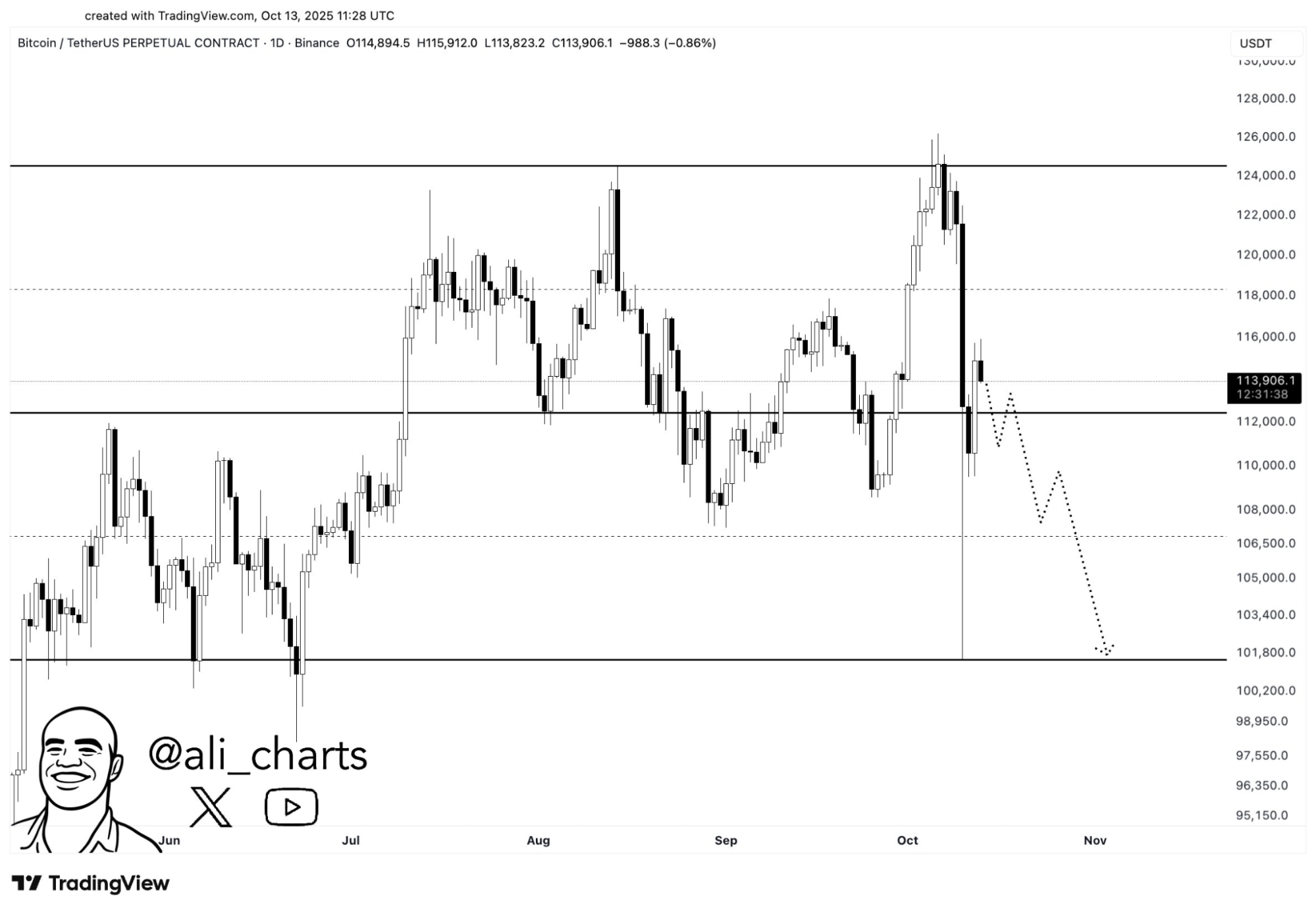
After a major period of volatility for Bitcoin, it seems as though the worst of the October 10 flash crash is over. We asked Grok to see how likely it is that Bitcoin could drop to $100K in the near future.

Author: Brave Newcoin
Which Crypto To Buy Today For Long-Term As Peter Schiff Claims Bitcoin Could Drop to $75K

Which Crypto To Buy Today For Long-Term As Peter Schiff Claims Bitcoin Could Drop to $75K

The post Which Crypto To Buy Today For Long-Term As Peter Schiff Claims Bitcoin Could Drop to $75K appeared first on Coinpedia Fintech News Bitcoin has fallen below $110,000 in recent weeks, and Ethereum has fallen below $3,700, which has sparked fears of a more general crypto crash. Schiff highlighted this downturn in social media noting that Ethereum could crash as low as $1,500 if it breaks through $3,350, which is a nearly 70% drop from its peak.  Consequently, …

Author: CoinPedia
Another Crypto Lawsuit Over: Tether to Pay Compensation to Celsius in Billion Dollar Bitcoin (BTC) Case!

Another Crypto Lawsuit Over: Tether to Pay Compensation to Celsius in Billion Dollar Bitcoin (BTC) Case!

The post Another Crypto Lawsuit Over: Tether to Pay Compensation to Celsius in Billion Dollar Bitcoin (BTC) Case! appeared on BitcoinEthereumNews.com. Bankrupt cryptocurrency lender Celsius filed a lawsuit against USDT issuer Tether in 2024, demanding the return of $2.4 billion worth of Bitcoin at the time. The dispute between Celsius and Tether stemmed from a 2022 agreement in which Tether provided USDT to Celsius, who sent Bitcoin (BTC) as collateral. Celsius accused Tether of selling the collateralized BTC at a low price and before the set limit. Tether, on the other hand, argued that Celsius was trying to shift the blame for its own financial mismanagement onto them by demanding the return of approximately $2.4 billion worth of BTC (the value at the time of the lawsuit), despite the liquidation being carried out at its direction and with its consent. The contentious case ended with a settlement, with Celsius winning $300 million in its lawsuit against Tether. Tether then agreed to pay $299.5 million to the Celsius Network bankruptcy estate. The payment represents about 7% of the $4.3 billion Celsius initially sought and closes one of the final disputes in the company’s three-year bankruptcy process. Tether CEO Paolo Ardoino confirmed the agreement in a post on X, saying, “Tether is pleased to have reached an agreement on all matters related to the Celsius bankruptcy.” As you may recall, Celsius was one of the companies that went bankrupt in 2022, when many cryptocurrency platforms, from Voyager to 3AC, went bankrupt. *This is not investment advice. Follow our Telegram and Twitter account now for exclusive news, analytics and on-chain data! Source: https://en.bitcoinsistemi.com/another-crypto-lawsuit-over-tether-to-pay-compensation-to-celsius-in-billion-dollar-bitcoin-btc-case/

Author: BitcoinEthereumNews
Crypto Markets Face a New Question: Should Trading Ever Pause?

Crypto Markets Face a New Question: Should Trading Ever Pause?

The events exposed a paradox in crypto’s design, according to 10x Research. The same mechanisms meant to keep liquidity flowing […] The post Crypto Markets Face a New Question: Should Trading Ever Pause? appeared first on Coindoo.

Author: Coindoo
Mutuum Finance Price Prediction For 2025-2026 According to DeepSeek AI

Mutuum Finance Price Prediction For 2025-2026 According to DeepSeek AI

Investors have poured $17,400,000 into the project since the presale started, while 17,140 holders have joined the ranks. Phase 6 […] The post Mutuum Finance Price Prediction For 2025-2026 According to DeepSeek AI appeared first on Coindoo.

Author: Coindoo
Corporate Bitcoin Adoption Accelerates: 172 Public Firms Now Hold Nearly 5% of All BTC

Corporate Bitcoin Adoption Accelerates: 172 Public Firms Now Hold Nearly 5% of All BTC

172 public companies now hold about 1.02 million Bitcoin, equal to nearly 5% of all coins in circulation. Corporate and institutional demand keeps rising as firms like Fidelity and Strategy expand their Bitcoin holdings. The ownership of Bitcoin among public firms has grown sharply in 2025. A new report from Bitwise shows that 172 publicly [...]]]>

Author: Crypto News Flash
Bitcoin market only in apparent difficulty

Bitcoin market only in apparent difficulty

In reality, upon closer inspection, the signals seem good, and if the parallel with 2017 continues, they could even become excellent.

Author: The Cryptonomist
Why This Resistance Could Trigger Another XRP Price Crash Soon

Why This Resistance Could Trigger Another XRP Price Crash Soon

A recent analysis by R. Linda on TradingView shows that the XRP price is facing a tough resistance zone after its recent recovery. The market is still showing signs of instability after earlier liquidations, and both XRP and Bitcoin are now moving into areas where another correction could happen. According to the analyst, XRP’s price movement is part of a broader correction phase following a strong sell-off. While there has been some recovery, the move appears weak, and a new drop may form if XRP fails to push above resistance.  XRP Price Faces Strong Resistance After A Sharp Sell-Off According to R. Linda’s analysis, XRP is now forming a correction after a strong sell-off. The cryptocurrency market as a whole is slowly recovering after a period of heavy liquidation, but signs of weakness remain. Both Bitcoin and XRP are moving toward a zone of strong resistance, which could bring back selling pressure in the short term. Related Reading: Analyst Sends Message To XRP Investors: If You Don’t Do This, You’ll Get Wrecked As XRP approaches this level, the market could see a slowdown or even a price drop. R. Linda warns that this resistance zone could trigger renewed selling as traders may choose to take profit instead of buying more. It could lead to another decline, continuing the correction phase that started after the recent sell-off. Right now, the market is pausing before making its next big move rather than preparing for a strong rally. The XRP price short-term trend remains fragile, and the analyst advises traders to be careful with quick upward moves that lack solid technical backing. Technical Analysis Shows Breakdown And Possible False Breakout Linda’s chart shows that after two months of consolidation, the XRP price broke below the support of its trading range, confirming a structural breakdown. The price is now reacting to that move and is in the middle of a correction. XRP is currently testing the liquidity zone between $2.70 and $2.7266, which is an area where the price could face heavy resistance and possibly start another sell-off. Related Reading: What The Weekend Liquidation Event Meant For The Dogecoin Price, And What Could Happen Next The analyst marks essential resistance levels at $2.70 – $2.7266 and $2.8286, while the key support sits near $2.5050. A failure to stay above these resistance levels could trigger a quick drop toward support. R. Linda also points out that a sharp rise without strong technical strength could cause a false breakout, meaning the price may briefly rise above resistance but quickly fall back down. If such a false breakout happens, the XRP price could correct down toward the $2.5050 level again, making the current price zone risky for both new buyers and short-term traders. Overall, R. Linda’s view is that traders should approach the current XRP rebound with caution. The resistance zone remains a key turning point, and unless XRP breaks above it with strength, another price crash could soon follow. Featured image created with Dall.E, chart from Tradingview.com

Author: NewsBTC
Bitcoin, Gold, or Stocks: Which Holds Up and Rebounds Best in Market Crashes?

Bitcoin, Gold, or Stocks: Which Holds Up and Rebounds Best in Market Crashes?

Key Takeaways:

Gold was the most stable asset, holding its value during every crisis and recovering the fastest with very low volatility.
Stocks dropped sharply but bounced back fast, helped by government support and improved confidence once the panic was over.
Bitcoin wasn’t a real safe haven, falling hard in crises but later delivering the biggest rebounds — except in 2022, when the Terra, Voyager, and FTX crashes slowed its recovery.
Overall, gold protects best during crises, stocks recover with support, and Bitcoin performs strongest once markets calm down.
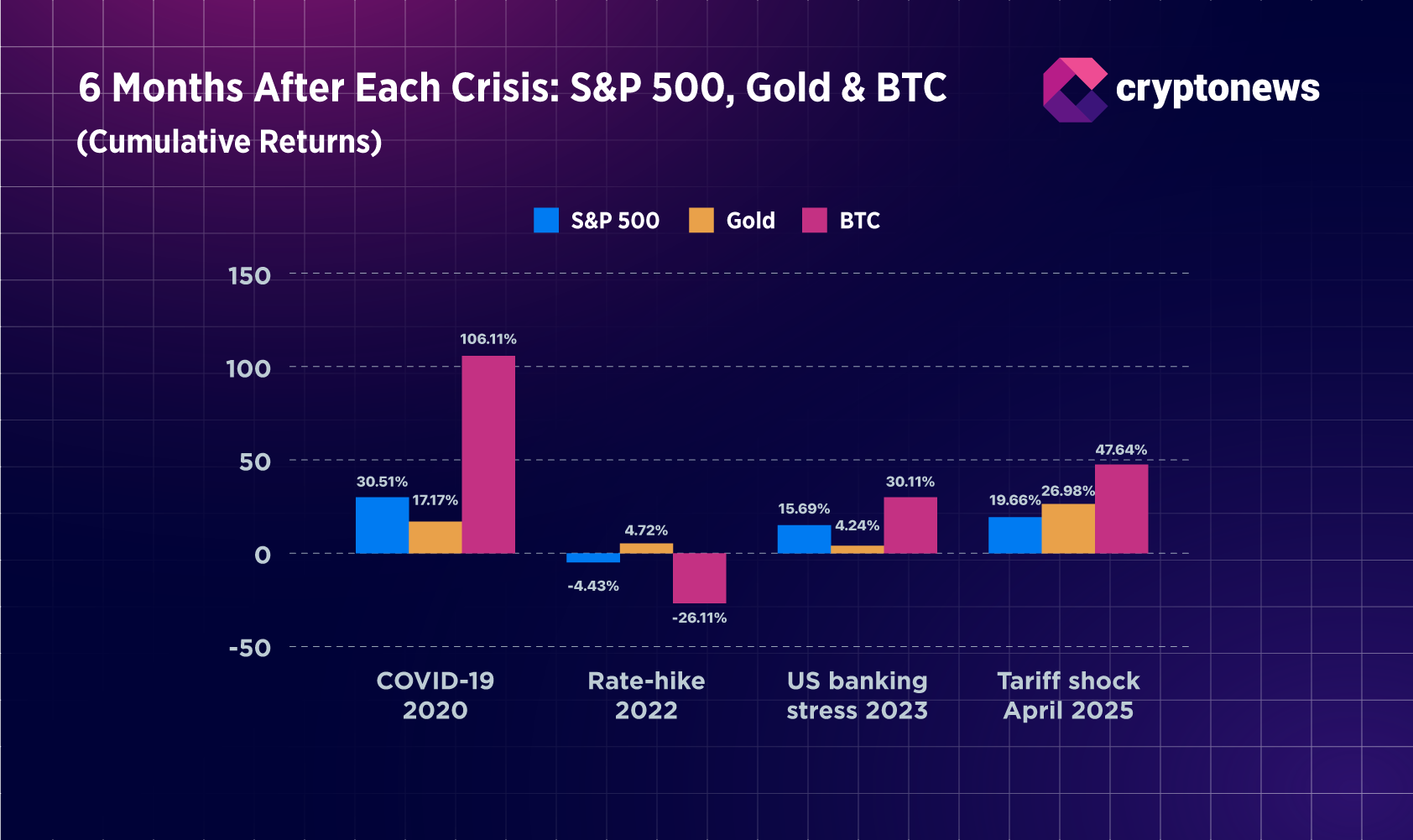
Crypto prices recently plunged after new U.S. tariff threats, with Bitcoin dropping around 10% in one day. To see which assets hold up best in times like this, we looked at four past crises — the COVID-19 crash (2020), the rate-hike shock (2022), the U.S. banking stress (2023), and the tariff shock ( April 2025). We compared Gold, Bitcoin, and the S&P 500 to find out which protects value and delivers stronger returns later. Each crisis start (CS) and bottom was marked by the biggest S&P 500 drops and spikes in the VIX fear index. Our analysis shows that in three out of four crises, gold held up best during the panic, but Bitcoin delivered the strongest overall gains once markets stabilized. Here’s what happened in each crisis and how the three assets performed.
Table of Contents


In This Article

 
  COVID-19 Crisis, March 2020 
 
 
  Here’s What Happened After the Crash
  Conclusion: What Worked Better as a Safe Haven


  Rate-Hike Shock, 2022 
 
 
  Conclusion: What Worked Better as a Safe Haven


  U.S. Regional Banking Stress, March 2023 
 
 
  Conclusion: What Worked Better as a Safe Haven


  Tariff Trade Shock, Early April 2025 
 
 
  Conclusion: What Worked Better as a Safe Haven


 In This Article
 
  
   COVID-19 Crisis, March 2020 
  
  
   Here’s What Happened After the Crash
   Conclusion: What Worked Better as a Safe Haven


   Rate-Hike Shock, 2022 
  
  
   Conclusion: What Worked Better as a Safe Haven


   U.S. Regional Banking Stress, March 2023 
  
  
   Conclusion: What Worked Better as a Safe Haven
  
 Show Full Guide
 
  
   Tariff Trade Shock, Early April 2025 
  
  
   Conclusion: What Worked Better as a Safe Haven
  
COVID-19 Crisis, March 2020 In summary: Gold was the best safe haven, showing the smallest loss and fastest recovery. Bitcoin fell hardest but later delivered the biggest overall gain, far outperforming both gold and the S&P 500. Following the global spread of COVID-19, the U.S. declared a national emergency on March 12, 2020, sparking fears of systemic disruption. Global markets reacted with one of the sharpest and fastest sell-offs in modern history. That day, the S&P 500 fell 9.5% in a single session, its steepest one-day decline since 1987. The VIX Index surged above 75, signaling extreme investor fear. The S&P 500 closed at 2,480.64, formally entering a bear market and marking the true panic inflection point. Forced liquidations rippled across equities, commodities, credit, and crypto. Here’s What Happened After the Crash S&P 500: Reclaimed March 12 levels within 3 days. Fully recovered to pre-crisis highs by August 2020. Gold: Recovered within 3 days and continued its steady climb, gaining +17% over the next six months. Bitcoin: Required around 2 months to reclaim March 12 levels, but ultimately delivered the strongest rebound, rallying +220% by September 2020. The table below shows the performance of the S&P 500, Bitcoin, and gold — how many days they took to recover to their February–March 12 level, and their cumulative returns one, three, and six months after the market bottom.Crisis start (CS) is March 12, 2020. Conclusion: What Worked Better as a Safe Haven Gold showed the smallest drawdown and the lowest volatility during crisis conditions. It held its value when markets fell and quickly reclaimed pre-crisis levels. Equities (S&P 500) experienced sharp volatility and steep declines but benefited the fastest from policy support. They sat between gold and Bitcoin, vulnerable during panic but able to rebound quickly. Bitcoin behaved more like a high-beta risk asset during the panic, suffering severe intraday losses. However, once liquidity returned, it delivered the strongest absolute gains in the recovery phase. BTC outperformed both gold and equities over the following months. Rate-Hike Shock, 2022 In summary: Gold again proved the most reliable hedge, staying relatively stable and ending higher after six months. Bitcoin acted as a high-risk asset, dropping over 50% and recovering only later, after major crashes like Terra, Voyager, and FTX. Stocks rebounded slowly with policy support. In 2022, after a decade of low interest rates and quantitative easing, inflation in the U.S. surged above 8%, reaching levels unseen since the early 1980s. In response, the Federal Reserve initiated an aggressive rate-hike cycle, beginning on March 16, 2022, with a 25 bps increase, the first since 2018. Throughout 2022, the S&P 500 fell by nearly 25% from its January peak, with its official cycle low occurring on October 12, 2022 (3,577.03). The U.S. 10-year yield surged above 4%, its highest since 2008. Bitcoin collapsed by more than 50% from its March levels. The decline later deepened by a string of failures, including the collapse of Terra and Luna, the insolvency of Voyager, and, later in the year, the downfall of FTX. We examined performance from the crisis start (March 16, 2022) to the market bottom (October 12, 2022), and at successive checkpoints one, three, and six months after the bottom. Below is the Indexed price reaction (100 = Mar 16, 2022). Bitcoin exhibited the deepest fall and the largest rebound from the trough, but remained below the crisis-start level after six months. Gold delivered the most stable path and was the only asset above the CS level after six months. Bitcoin’s realized volatility was an order of magnitude higher than gold’s. Gold’s volatility remained low. Conclusion: What Worked Better as a Safe Haven S&P 500: Although the index rebounded from the October low, it still traded below its March 2022 level six months later. Volatility persisted in the 30–40% range — far above pre-2020 norms — showing how dependent equities were on monetary support. Gold: Gold outperformed as a defensive asset. Its decline of 13.7% was milder than equities’ but still notable. Initially pressured by rising real yields, it later benefited from safe-haven demand and central-bank accumulation. By April 2023, gold had risen 4.7% above its March 2022 level, confirming its value as a partial hedge once rate-hike expectations stabilized. Bitcoin: Bitcoin’s 53.4% collapse underscored its extreme sensitivity to liquidity withdrawal. Correlation with equities strengthened through 2022 as crypto behaved like a leveraged tech-risk asset. The downturn was later amplified by a series of failures — starting with Terra and Luna in May, followed by Voyager and eventually FTX. While BTC rebounded 58.6% from its October bottom, it remained 26% below its March 2022 price by April 2023. U.S. Regional Banking Stress, March 2023 In summary: Gold performed best as a short-term hedge, holding value throughout the panic. The S&P 500 bounced back within a day, while Bitcoin rose even faster but showed higher volatility. In March 2023, a concentrated episode of U.S. regional-bank stress unfolded over a few days. The sequence of events — Silicon Valley Bank, Signature Bank, and earlier Silvergate — triggered sharp market attention and brief but intense financial-sector strain. The crisis began on 10 March 2023, when public reports of Silicon Valley Bank’s distress and deposit runs marked the panic inflection point. By 13 March 2023, the S&P 500 had reached its lowest close in the acute window, marking the market bottom of the episode. Unlike systemic liquidity crises, this event was sectoral (regional banks, deposit flight, contagion fears), and regulators acted quickly to limit contagion. The S&P 500 showed only a modest decline, the VIX spiked into the mid-20s, gold rose as a short-term hedge, and Bitcoin moved higher ahead of the S&P bottom, showing an asynchronous response versus equities. Here are key daily-close metrics for S&P 500, gold, and Bitcoin, anchored to the crisis start (CS), March 3, 2023, and using the S&P bottom (March 13, 2023) as the event bottom for comparability. Conclusion: What Worked Better as a Safe Haven S&P 500. The broad index recovered quickly, reclaiming its crisis-start level within a trading session after the bottom. Rapid, targeted regulatory and Federal Reserve responses limited contagion and supported swift market stabilization. Gold. Gold worked as a short-term safety asset during the crisis. By the time the S&P 500 hit its lowest point, gold was already trading higher than at the start of the crisis and kept showing positive returns in the following months. Its stable price made it the most reliable short-term safe haven and helped it hold value throughout the recovery.Bitcoin. Bitcoin didn’t act as a traditional safe haven during the crisis. By the time the S&P 500 reached its lowest point, BTC was already trading higher and gained about 49% in the following month. This shows that crypto moved on its own timeline, separate from the stock market. While Bitcoin rose sharply, its big price swings proved that it behaves more like a high-risk asset than a stable refuge in short market shocks. Tariff Trade Shock, Early April 2025 In summary: Gold remained the most stable asset during the shock, while Bitcoin was the strongest performer afterward, posting the highest six-month returns. Equities recovered quickly once policy uncertainty faded. On April 2, 2025, the U.S. government announced new tariffs and trade measures. Markets reacted right away — investors grew worried about slower growth, higher inflation, and possible retaliation. Over the next two days, global stocks dropped sharply, with the S&P 500 falling noticeably. The VIX Index jumped to 45, showing a strong rise in fear and short-term market uncertainty. Equities were the primary losers in percentage terms in the acute days. Gold was essentially flat to slightly down in the same two-day window (buyers and sellers balancing safe-haven demand and rate/real-yield pressure). Bitcoin and crypto exhibited idiosyncratic intraday behavior and did not serve as a consistent short-term hedge in this episode (crypto moved asynchronously and was influenced by its own flows). Conclusion: What Worked Better as a Safe Haven S&P 500: Stocks dropped the most right after the news, and the VIX spike showed strong fear in the market. After the government clarified its policies, the S&P 500 recovered most of the loss within about two weeks. Gold: Gold stayed mostly flat at first. That’s typical during policy shocks — people buy gold for safety, but higher interest rates can limit gains. Over time, gold usually benefits if investors stay cautious and growth slows. Bitcoin: Bitcoin moved on its own during this period. When stocks hit bottom, BTC hadn’t fallen much and didn’t act like a classic safe haven. It behaved more like a risky asset, moving with volatility and separate market flows. Overall, during this short policy shock, gold was the most stable hedge, stocks fell hardest but recovered fast, and Bitcoin was unpredictable — yet it ended up giving the biggest overall returns once markets calmed. Disclaimer: Crypto is a high-risk asset class. This article is provided for informational purposes and does not constitute investment advice.

Author: CryptoNews
Cryptocurrency Markets Weather the Storm: An Analysis of Market Resilience

Cryptocurrency Markets Weather the Storm: An Analysis of Market Resilience

The post Cryptocurrency Markets Weather the Storm: An Analysis of Market Resilience appeared on BitcoinEthereumNews.com. Matt Hougan, Chief Investment Officer at Bitwise, recently analyzed the effects of President Trump’s announcement to impose a 100% tariff on China, stating that the fundamental prospects of the cryptocurrency market remained unaffected. The initial panic caused a massive sell-off, leading to a rapid liquidation of leveraged positions, with losses approaching $20 billion. Continue Reading:Cryptocurrency Markets Weather the Storm: An Analysis of Market Resilience Source: https://en.bitcoinhaber.net/cryptocurrency-markets-weather-the-storm-an-analysis-of-market-resilience

Author: BitcoinEthereumNews