Liquidation

Liquidation occurs when a trader’s collateral is no longer sufficient to cover their leveraged position’s losses, triggering an automated forced closure by the exchange's liquidation engine. It is a critical risk-management mechanism that ensures the solvency of lending protocols and derivative platforms. In 2026, the focus has moved toward MEV-resistant liquidation models that protect users from predatory "cascades." This tag provides essential information on maintenance margins, health factors, and how to avoid liquidation in high-volatility environments.

14357 Articles
Created: 2026/02/02 18:52
Updated: 2026/02/02 18:52
Venus Protocol restores all services, recovers funds stolen after $27M exploit

Venus Protocol restores all services, recovers funds stolen after $27M exploit

The post Venus Protocol restores all services, recovers funds stolen after $27M exploit appeared on BitcoinEthereumNews.com. BNB Chain lending platform Venus Protocol resumed full operations after an exploit on Tuesday forced an emergency vote to suspend withdrawals and liquidations. The platform confirmed later that it had restored services and recovered the $27 million worth of digital assets compromised in the incident. The disruption began when Venus identified suspicious activity linked to a phishing scam, which was also flagged by several cybersecurity firms. As reported by Cryptopolitan, blockchain analysts had mentioned irregular transactions in the platform’s Core Pool Comptroller contract, which routes user assets vUSDC and vETH. Venus called for an emergency vote to pause services in order to limit losses and allow security teams to assess whether the exploit compromised Venus’ infrastructure.  Although users were unable to withdraw or liquidate positions during the hiatus, the protocol partially restored some functionality later the same day for them to repay debt and supply funds, actions that helped them protect their positions until normal operations could resume. Venus Protocol’s proposed plan for restoration approved Venus Protocol proposed a plan to its community to determine the immediate steps for handling the crisis. The four-stage plan was outlined as follows: partial restoration within five hours, recovery of stolen funds within seven hours, a full security review within 24 hours, and the eventual resumption of all services once checks were completed. Voting ended at around 5 PM UTC, with the community voting “100% to proceed,” the protocol announced. “We are so thankful for your support, and will proceed with the execution,” the team wrote on X. By 9:58 PM UTC, Venus confirmed that the plan had been completed successfully.  “Venus Protocol has been fully restored, withdrawals and liquidations resumed. The lost funds have been recovered under Venus’ protection,” the platform said. Update: Venus Protocol has been fully restored (withdrawals and liquidations resumed)…

Author: BitcoinEthereumNews
Venus Protocol returns to full operation after resolving $27M exploit

Venus Protocol returns to full operation after resolving $27M exploit

BNB Chain lending platform Venus Protocol resumed full operations after an exploit on Tuesday forced an emergency vote to suspend withdrawals and liquidations. The platform confirmed later that it had restored services and recovered the $27 million worth of digital assets compromised in the incident. The disruption began when Venus identified suspicious activity linked to […]

Author: Cryptopolitan
TechnoRevenant holds over 70% of Hyperliquid's XPL long position and currently has a floating loss of $3.67 million

TechnoRevenant holds over 70% of Hyperliquid's XPL long position and currently has a floating loss of $3.67 million

PANews reported on September 3rd that according to Yu Jin, TechnoRevenant had previously profited $38.77 million by manipulating XPL liquidations, and subsequently went long on XPL with 1x leverage through 15+ addresses. It currently holds 38.17 million XPL in Hyperliquid, worth approximately $26 million, and has turned from a floating profit of $10 million to a floating loss of $3.67 million.

Author: PANews
World Liberty Financial (WLFI) Price: Drops as Project Burns 47 Million Tokens Following Launch

World Liberty Financial (WLFI) Price: Drops as Project Burns 47 Million Tokens Following Launch

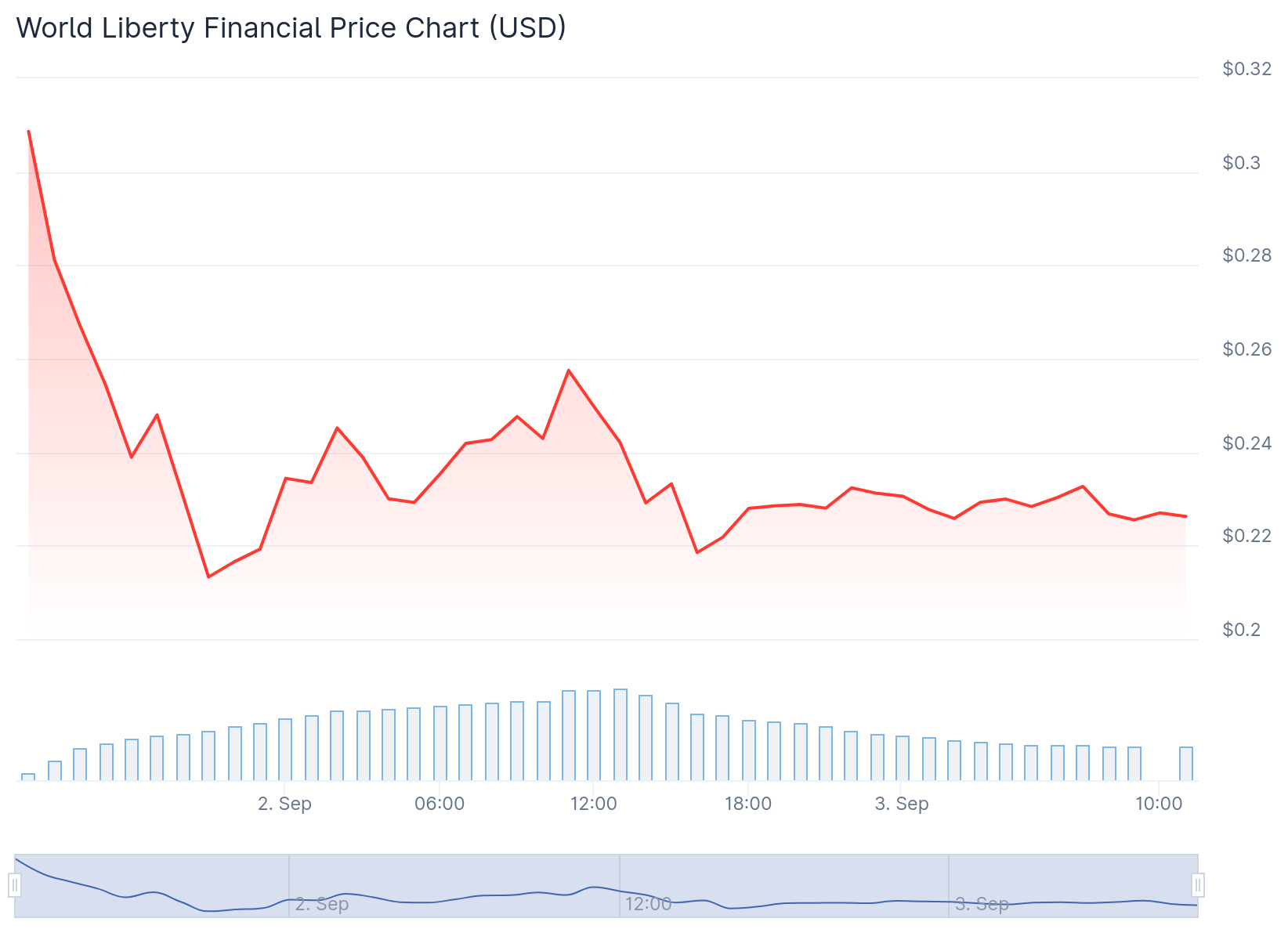
TLDR World Liberty Financial burned 47 million WLFI tokens on Wednesday to reduce supply and support price WLFI price dropped 36% from launch high of $0.331 to around $0.23, down over 31% overall Project proposed buyback and burn program using protocol fees after sharp post-launch decline Traders raised concerns about possible insider activity and price [...] The post World Liberty Financial (WLFI) Price: Drops as Project Burns 47 Million Tokens Following Launch appeared first on CoinCentral.

Author: Coincentral
Crypto.com CEO Predicts Strong Q4 if Fed Cuts Rates at September Meeting

Crypto.com CEO Predicts Strong Q4 if Fed Cuts Rates at September Meeting

Crypto.com CEO Kris Marszalek expects a strong fourth quarter for digital assets if the Federal Reserve (Fed) cuts interest rates at its September 17 meeting, citing improved market conditions and increased liquidity for risk assets. The prediction comes as CME futures markets price a 90% probability of rate cuts following Fed Chair Jerome Powell’s dovish speech at Jackson Hole, while crypto markets position for extended rallies amid anticipated monetary easing. In an interview with Bloomberg, Marszalek revealed that Crypto.com generated $1.5 billion in revenue last year, with $1 billion in gross profit, predicting better performance in 2025 driven by lower borrowing costs and increased institutional adoption. According to him, top investment banks have approached the exchange regarding a potential IPO, but it remains privately held, enjoying operational flexibility while maintaining a solid balance sheet. Private Exchange Teases IPO Amid Trump Media Partnership Marszalek confirmed Crypto.com “has the numbers” for a public listing after multiple approaches from leading investment banks, but emphasized no decisions have been made. The company reported $300 million in profitability last year after reinvesting $700 million, undoubtedly making it one of the most profitable crypto exchanges, considering public markets. The exchange announced a partnership with Trump Media and Technology Group on August 26, establishing a treasury strategy for its native Cronos token. The collaboration extends beyond treasury management to include ETF development, payments infrastructure, and subscription services as part of broader Trump administration crypto initiatives. Marszalek described the partnership as supporting the administration’s ambitious crypto agenda. He emphasized Crypto.com’s role in executing multibillion-dollar Bitcoin strategies and providing infrastructure for various crypto initiatives. The CEO addressed potential conflict of interest concerns by noting that Trump’s assets are held in blind trusts, while Crypto.com operates as an independent, publicly traded company. He stressed that the private company structure enables rapid decision-making and strategic partnerships supporting industry advancement. Crypto.com plans aggressive expansion into prediction markets, targeting sports betting and political events through CFTC-regulated infrastructure. Fed Rate Cut Optimism Drives Q4 Crypto Rally Expectations Powell’s Jackson Hole remarks triggered widespread forecast revisions, with Morgan Stanley, Barclays, BNP Paribas, and Deutsche Bank now expecting September rate cuts. The Fed Chair acknowledged labor market weakening, citing July’s disappointing 73,000 payroll additions and downward revisions to previous months. Earlier last month, Treasury Secretary Scott Bessent called for 50 basis point cuts following “incredible” inflation data, which is a shift from the Fed’s hawkish stance. July consumer price index rose 0.2% monthly and 2.7% annually, below expectations, while core CPI reached 3.1% yearly. However, market optimism faces potential headwinds from excessive social sentiment around rate cuts. Santiment has recently warned that discussion of “Fed,” “rate,” and “cut” across social platforms reached 11-month peaks, historically indicating euphoric levels that often precede local market tops. Bitcoin exchange supply accumulation presents concerning signals, with holdings rising approximately 70,000 coins since early June. The trend reverses sustained patterns of assets being moved into cold storage, potentially indicating increased preparation by holders for liquidation. The blockchain analytics firm cited that Ethereum’s technical indicators suggest caution, despite its strong price performance, with short-term MVRV nearing 15% and long-term readings at 58.5%. These levels historically correspond with profit-taking activity and potential retracements before further advances. Amid all these, the looming replacement of the Fed Chair has sparked some debates. European Central Bank President Christine Lagarde warned that Trump’s undermining of Fed independence would create “very serious danger” for the global economy. She emphasized that political control over monetary policy would have “very worrying” implications for global economic stability. Trump intensified criticism of Powell, demanding immediate rate cuts while threatening “major lawsuits” and accusing the Fed Chair of costing America “trillions in interest costs.” The president maintains tariffs haven’t caused inflation while implementing 40% duties on Brazil and 50% on copper imports. Notably, manufacturing PMI data could influence rate cut timing, with forecasts expecting ISM Manufacturing PMI at 48.9 versus the previous 48.0.Source: Trading Economics Analysts tie the direction of the crypto market to industrial strength, noting that levels below 49.5 could extend correction periods, while improvements support recovery narratives

Author: CryptoNews
Venus Protocol Recovers Stolen Funds but Raises Another Risk

Venus Protocol Recovers Stolen Funds but Raises Another Risk

The post Venus Protocol Recovers Stolen Funds but Raises Another Risk appeared on BitcoinEthereumNews.com. Key Insights: Venus Protocol clawed back $13.5 million after a whale was hacked, using forced liquidation. Recovery showed funds could be saved, but also revealed that Venus can directly intervene. Debate grows: Is Venus Protocol truly decentralized if it can pause and take control? Venus Protocol, a lending platform on BNB Chain, has brought back stolen funds. A whale lost about $13.5 million on Sept 2, 2025, in a phishing attack. Services were paused right after to stop more damage. Now, Venus has stated all services are back online. The lost funds were taken back through a special process called force liquidation. This means the hacker’s loans were closed, and the tokens locked as safety measures were seized. The recovery helped save the whale, but it also raised a new question about how much control Venus has over user funds. How the Venus Protocol Recovery Worked? The crypto hack yesterday did not break Venus Protocol’s smart contracts. Instead, the hacker tricked the whale’s wallet setup. The attacker replaced one normal action with another hidden action. That gave them power over the whale’s funds. Venus Protocol used force liquidation to undo the damage. In simple words, when users borrow on Venus, they must lock tokens as security. If they fail to pay, or if something goes wrong, those tokens can be sold or seized. Venus Protocol Announces Resumption Of Services | Source: X That is what happened to the hacker. Venus closed their loan, sold the safety tokens, and got back the stolen funds. On-chain data shows the Venus Liquidator address received more than $325,000 in USDC, $901,000 in USDT, plus wrapped ETH and FUSD. These amounts came from the hacker’s locked assets. Venus Protocol Recovering Funds Via Forced Liquidations | Source: X Investigators also noted that some of the gas…

Author: BitcoinEthereumNews
Venus Protocol recovers $13.5M lost in phishing attack

Venus Protocol recovers $13.5M lost in phishing attack

The post Venus Protocol recovers $13.5M lost in phishing attack appeared on BitcoinEthereumNews.com. Venus Protocol has recovered funds lost in a phishing attack after swift intervention involving a governance vote. Summary A Venus Protocol whale wallet was drained in a phishing attack which led to an estimated $13.5 million loss Venus paused the protocol and used governance powers to liquidate the attacker’s positions. The recovery steadied XVS price, but raised questions about decentralization in crisis management. Venus Protocol, one of the largest lending platforms on BNB (BNB) Chain, has recovered around $13.5 million lost in a phishing incident. The update was shared by the platform on Sept. 3, confirming the assets had been fully restored. Whale wallet compromised On Sept. 2, a high-value Venus user lost control of assets worth around $13.5 million after approving a malicious transaction. Security firms initially estimated losses of up to $27 million, but they later modified these figures to take the user’s debt position into consideration.  Among the stolen assets were wrapped Bitcoin (BTCB), vUSDT, vUSDC, vXRP, and vETH. Notably, this was a user-level compromise rather than a breach of Venus’ smart contracts, demonstrating the ongoing risk of social engineering even in DeFi. Swift response and recovery In order to prevent the attacker from moving funds or closing positions, Venus instantly paused the protocol. The pause stopped the exploiter’s activity and bought time for an emergency governance vote. By approving the forced liquidation of the attacker’s holdings, the community was able to secure the stolen assets before they could be mixed or bridged. Update: Venus Protocol has been fully restored (withdrawals and liquidations resumed) as of 9:58PM UTC. ✅ The lost funds have been recovered under Venus’ protection. ✅ https://t.co/y2uUwPqmtb — Venus Protocol (@VenusProtocol) September 2, 2025 By Sept. 3, security firm PeckShield confirmed that the funds had been restored. Transactions on BNB Chain show the recovery…

Author: BitcoinEthereumNews
A whale deposited 3.25 million USDC into Hyperliquid and shorted ETH with 25x leverage.

A whale deposited 3.25 million USDC into Hyperliquid and shorted ETH with 25x leverage.

PANews reported on September 3rd that according to Lookonchain monitoring, the giant whale 0xd8ef had just deposited 3.25 million USDC into Hyperliquid and shorted ETH with 25x leverage. Holdings: 3,000 ETH (worth approximately $12.98 million); Liquidation price: $5291.9.

Author: PANews
Crypto Perpetual Futures Liquidations: Massive $152M Blow in 24 Hours

Crypto Perpetual Futures Liquidations: Massive $152M Blow in 24 Hours

BitcoinWorld Crypto Perpetual Futures Liquidations: Massive $152M Blow in 24 Hours The cryptocurrency market is no stranger to dramatic swings, but a recent event sent ripples through the trading community: crypto perpetual futures liquidations topped a staggering $152 million within just 24 hours. This massive sum represents forced closures of highly leveraged positions, impacting countless traders across major digital assets. Understanding these liquidations is crucial for anyone navigating the fast-paced world of crypto, as they highlight both the opportunities and the significant risks involved. What Exactly Are Crypto Perpetual Futures Liquidations? For those new to the derivatives market, perpetual futures are a type of futures contract that, unlike traditional futures, do not have an expiry date. This allows traders to hold positions indefinitely, as long as they maintain sufficient margin. They are incredibly popular due to the leverage they offer, enabling traders to control large positions with relatively small capital. However, this leverage comes with significant risk. A liquidation occurs when a trader’s margin balance falls below a certain threshold, often due to adverse price movements. To prevent further losses, the exchange automatically closes the position. This process can be swift and unforgiving, especially during periods of high market volatility, leading to substantial financial losses for the traders involved. The recent surge in crypto perpetual futures liquidations highlights the inherent dangers and the speed at which market conditions can change, catching many off guard. The $152 Million Shockwave: Who Felt the Brunt of Crypto Perpetual Futures Liquidations? The latest 24-hour figures paint a clear picture of where the market pain was most acute. A total of $152 million in crypto perpetual futures liquidations occurred, with specific assets bearing the brunt: Bitcoin (BTC): Saw $51.92 million in liquidations. Interestingly, 60.68% of these were short positions, meaning traders betting on a price decrease were caught out by an unexpected upward move. Ethereum (ETH): Experienced the highest volume of liquidations at $72.46 million. Here, the majority, 53.72%, were long positions, indicating a downward price swing caught those expecting further gains. TA (Altcoin): Registered $28.07 million in liquidations, with a significant 81.93% being short positions. This suggests a strong, perhaps sudden, price rally for this particular altcoin. These figures are not just numbers; they represent real capital wiped out from traders’ accounts. The distribution between long and short liquidations across different assets provides valuable insight into the market’s immediate sentiment and the unexpected shifts that led to these forced closures. Why Do Crypto Perpetual Futures Liquidations Spike During Volatile Periods? Several factors contribute to the sudden increase in crypto perpetual futures liquidations. At its core, it’s about leverage and market movement. Traders use leverage to amplify their potential returns, but it equally amplifies potential losses. A small adverse price movement, when magnified by high leverage, can quickly erode a trader’s margin. Furthermore, the decentralized and often less regulated nature of crypto markets can lead to higher volatility compared to traditional financial markets. News events, regulatory changes, or even large whale movements can trigger rapid price swings. When prices move sharply against a leveraged position, the liquidation engine of an exchange kicks in automatically to prevent the trader’s balance from going negative, thereby protecting the exchange. This cascade effect, where one liquidation triggers further price movement that leads to more liquidations, is a common phenomenon during intense market downturns or surges. It underscores the critical importance of robust risk management strategies when engaging with crypto perpetual futures. Navigating the Volatile Waters: Actionable Insights for Crypto Perpetual Futures Traders Given the inherent risks highlighted by these massive crypto perpetual futures liquidations, how can traders better protect themselves? The key lies in disciplined risk management: Understand Leverage: Excessive leverage dramatically increases liquidation risk. Use it judiciously and only with capital you can afford to lose. Set Stop-Loss Orders: Always implement stop-loss orders. These automatically close a position if the price moves against you beyond a predefined point, acting as your primary defense. Monitor Margin Levels: Keep a close eye on your margin balance. If it’s getting low, consider adding more collateral or reducing your position size to avoid forced liquidation. Stay Informed: Market news, technical analysis, and sentiment all impact prices. Being well-informed helps in making timely decisions. Diversify: Don’t put all your capital into highly leveraged perpetual futures. Balance your portfolio with less risky assets. In conclusion, the recent $152 million in crypto perpetual futures liquidations serves as a stark reminder of the crypto market’s unpredictable nature. While perpetual futures offer exciting opportunities, they demand respect for their inherent risks. Adopting prudent risk management practices allows traders to navigate these volatile waters more safely and sustainably. Frequently Asked Questions (FAQs) Q1: What are crypto perpetual futures? A1: Crypto perpetual futures are derivative contracts that allow traders to speculate on the future price of a cryptocurrency without an expiry date, often using leverage. Q2: What is a liquidation in crypto trading? A2: A liquidation occurs when an exchange automatically closes a trader’s leveraged position because their margin balance has fallen below a required threshold, typically due to adverse price movements. Q3: Why did $152 million in crypto perpetual futures liquidations occur recently? A3: This significant amount of liquidations was driven by rapid and unexpected price movements in the market. Traders with highly leveraged positions betting against the prevailing market trend (either long or short) were caught off guard, leading to their positions being forcibly closed. Q4: How can traders avoid crypto perpetual futures liquidations? A4: Traders can minimize liquidation risk by using lower leverage, setting strict stop-loss orders, actively monitoring their margin levels, staying informed about market conditions, and diversifying their portfolios. Q5: Which cryptocurrencies saw the most liquidations in this event? A5: In this particular 24-hour period, Ethereum (ETH) saw the highest volume of liquidations at $72.46 million, followed by Bitcoin (BTC) with $51.92 million, and an altcoin (TA) with $28.07 million. Did you find this article insightful? Share it with your fellow crypto enthusiasts and help them navigate the complexities of the market! To learn more about the latest crypto market trends, explore our article on key developments shaping Bitcoin price action. This post Crypto Perpetual Futures Liquidations: Massive $152M Blow in 24 Hours first appeared on BitcoinWorld and is written by Editorial Team

Author: Coinstats
A whale deposited 1 million USDC into Hyperliquid and went long on SOL with 20x leverage.

A whale deposited 1 million USDC into Hyperliquid and went long on SOL with 20x leverage.

PANews reported on September 3rd that according to Lookonchain monitoring, the giant whale 0xC50a had just deposited 1 million USDC into Hyperliquid and went long on SOL with 20x leverage. Holdings: 48,000 SOL (worth approximately $10.13 million). Liquidation Price: $195.19

Author: PANews