Oracle

Oracles are essential infrastructure components that feed real-time, off-chain data (such as price feeds, weather, or sports results) into blockchain smart contracts. Without decentralized oracles like Chainlink and Pyth, DeFi could not function. In 2026, oracles have evolved to support verifiable randomness and cross-chain data synchronization. This tag covers the technical evolution of data availability, tamper-proof price feeds, and the critical role oracles play in ensuring the deterministic execution of complex decentralized applications.

5181 Articles
Created: 2026/02/02 18:52
Updated: 2026/02/02 18:52
Traders Skip ADA For Reasons, Back $0.035 Token as Top Crypto with 15% Price Pump In Days

Traders Skip ADA For Reasons, Back $0.035 Token as Top Crypto with 15% Price Pump In Days

The post Traders Skip ADA For Reasons, Back $0.035 Token as Top Crypto with 15% Price Pump In Days appeared first on Coinpedia Fintech News As crypto charts continue to fluctuate and questions arise around why crypto is down, traders are increasingly rotating their capital away from ADA, looking for tokens with stronger utility and ROI potential. Mutuum Finance (MUTM) has emerged as a top choice for forward-looking crypto investors. Currently priced at $0.035 during Phase 6 of the presale, …

Author: CoinPedia
Dogecoin (DOGE) Analysis Shows Critical $0.23 Support As Mutuum Finance Awes Investors With Revolutionary DeFi Features

Dogecoin (DOGE) Analysis Shows Critical $0.23 Support As Mutuum Finance Awes Investors With Revolutionary DeFi Features

The post Dogecoin (DOGE) Analysis Shows Critical $0.23 Support As Mutuum Finance Awes Investors With Revolutionary DeFi Features appeared on BitcoinEthereumNews.com. As Dogecoin oscillates about the crucial $0.23 support, uncertainty looms over its next direction, with the price action reflecting little conviction from buyers. Meanwhile, a new cryptocurrency, Mutuum Finance (MUTM), is attracting growing market interest on account of its revolutionary DeFi features and strong early-stage fundamentals. Mutuum Finance is at presale phase 6 that is over 50% sold out.  Tokens are available for sale at $0.035. The following phase prices will skyrocket to $0.04 With investors focusing more on utility than hype, Mutuum Finance is better value proposition for long-term return, come what may with DOGE’s short-term bounce or breakdown. Dogecoin (DOGE) Price Patterns Hint at Major Breakout as Key Levels Hold Dogecoin is showing strong indications of new momentum, and technical graphs are tilting towards the likelihood of a near-future breakout. The cryptocurrency recently broke above a falling resistance line and tested the significant $0.23 level of support, a typical pattern preceding a continuation rally. Investors are keeping a close eye on a double bottom formation forming and, if accurate, could send a stampede to $0.42 in the near term, with some projecting a run to the $0.60–$0.70 range in mid-to-late 2025.  Market sentiment is also becoming increasingly positive, reflected by a Greed reading of 72 and greater whale accumulation at the $0.22–$0.24 levels, setting a price floor. Despite institutional profit-taking danger, sustained closes above pivotal levels of resistance can potentially have DOGE approaching $0.50–$0.60, with the current trading at around $0.24 being a 10.42% day gain. Meanwhile, interest in MUTM continues to rise.  Mutuum Finance Presale Milestone Mutuum Finance presale has reached a new level with more than 16,600 investors and more than $16.4 million to date. It is in Phase 6, 45% sold out, selling the tokens at $0.035 for  1 MUTM. As a token of time,…

Author: BitcoinEthereumNews
XLM Faces Resistance, LINK Steady, BlockDAG Surpasses 3M Miners

XLM Faces Resistance, LINK Steady, BlockDAG Surpasses 3M Miners

The post XLM Faces Resistance, LINK Steady, BlockDAG Surpasses 3M Miners appeared on BitcoinEthereumNews.com. Crypto News 27 September 2025 | 04:00 See how BlockDAG’s 3M X1 app miners boost adoption, while Stellar (XLM) stalls near resistance and Chainlink (LINK) trades in a tight zone. Stellar (XLM) has been holding steady at support but still struggles to push past strong resistance zones. Chainlink (LINK), meanwhile, continues securing new partnerships and already protects more than $100B locked on-chain. Yet despite these wins, LINK also slows near major barriers. The question many ask is simple: why wait on coins that need flawless conditions just to move a little higher, when one project is already proving itself with real adoption numbers? That project is BlockDAG (BDAG). Its X1 mobile miner app now counts over 3 million daily users worldwide. These are not passive sign-ups; they are people already mining coins straight from their phones. Unlike Pi Network’s hype or Helium’s patchy adoption model, these miners connect to a coin with fixed launch dates and confirmed exchange listings. This is why many already view BDAG as the crypto with most potential for 2025 and beyond. BlockDAG Records 3M Active Miners on the X1 App The BlockDAG X1 app has become the centerpiece of its global growth. More than 3 million people are currently mining through their phones, giving the project a real economy that stands apart from a typical presale list. This scale is unmatched among newer projects. Other attempts showed interest but fell short. Pi Network grabbed attention with mobile mining, and Helium built buzz with wireless nodes. Yet neither gave a clear bridge to liquidity. BlockDAG solves this issue. Every mining credit on the X1 app links directly to BDAG coins, which already have confirmed launch dates and exchange listings in place. That means the time spent mining connects to coins with actual market value waiting ahead.…

Author: BitcoinEthereumNews
From Phones to Fortune: BlockDAG’s X1 App Hits 3M Daily Miners While XLM Stalls and LINK Holds

From Phones to Fortune: BlockDAG’s X1 App Hits 3M Daily Miners While XLM Stalls and LINK Holds

Stellar (XLM) has been holding steady at support but still struggles to push past strong resistance zones. Chainlink (LINK), meanwhile, […] The post From Phones to Fortune: BlockDAG’s X1 App Hits 3M Daily Miners While XLM Stalls and LINK Holds appeared first on Coindoo.

Author: Coindoo
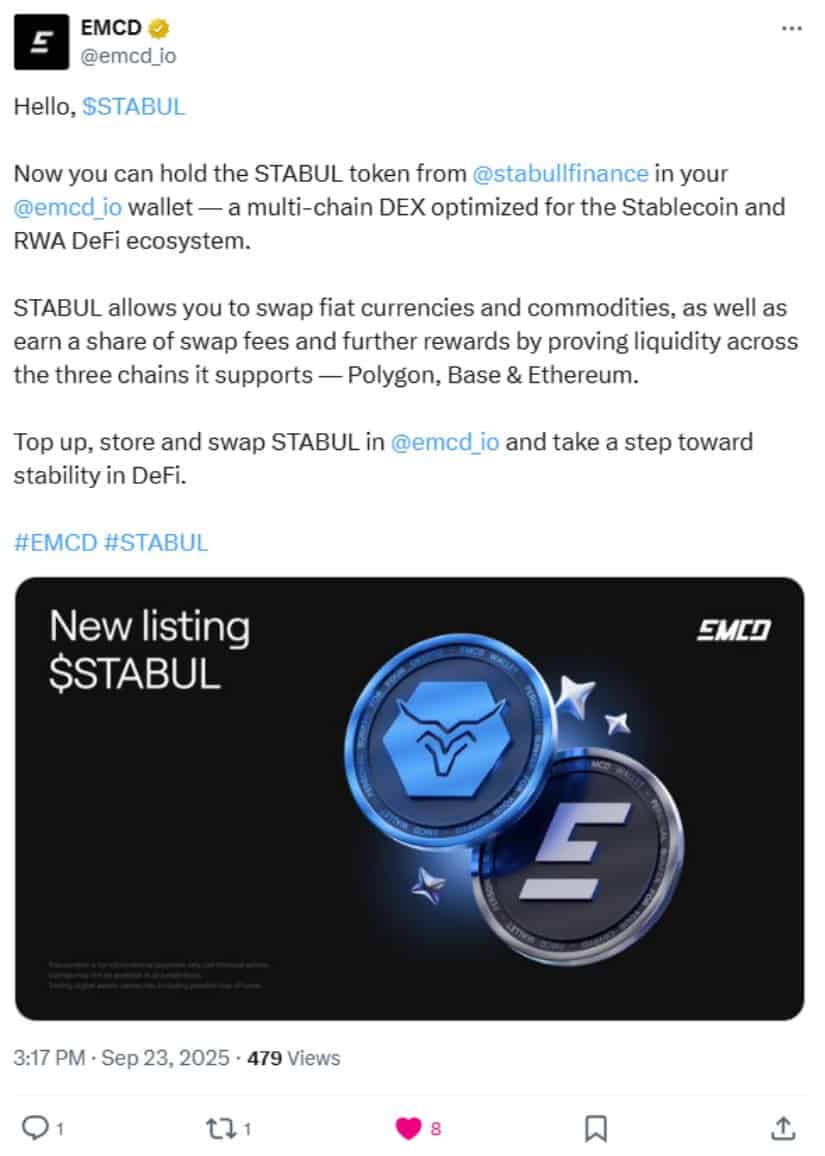
EMCD Partners with STABUL to Bridge Traditional Finance and Crypto Markets

EMCD Partners with STABUL to Bridge Traditional Finance and Crypto Markets

This partnership represents a significant step in what industry experts call the "Web 2.5" movement - platforms that bridge pure decentralized finance (DeFi) with familiar banking services.

Author: Brave Newcoin
A Way To Create And Manage Synthetic Assets And Financial Contracts

A Way To Create And Manage Synthetic Assets And Financial Contracts

The post A Way To Create And Manage Synthetic Assets And Financial Contracts appeared on BitcoinEthereumNews.com. UMA, or Universal Market Access, is a decentralized financial contract platform built on the Ethereum blockchain. Coinidol.com on UMA token. It enables the creation, maintenance, and settlement of financial contracts, particularly for synthetic assets and decentralized derivatives. Decentralized oracle UMA utilizes a decentralized oracle system that relies on an optimistic data verification process to obtain off-chain data and securely feed it into on-chain smart contracts. UMA’s “priceless” financial contracts are designed to be self-enforcing, which means that they do not require frequent price updates from oracles. They are settled based on a predefined formula, reducing the need for external price feeds. Synthetic assets and UMA token The UMA platform uses its native ERC-20 token, also called UMA, to incentivize network participants, including data providers, oracle operators, and developers. The oracle voting mechanism allows token holders to participate in resolving disputes on the price of assets used in the contracts. Moreover, UMA platform allows users to create and trade synthetic assets, which are tokens that represent the value of real-world assets without requiring direct ownership of the underlying assets. This enables exposure to various financial assets without needing to hold them. Disclaimer. This article is for informational purposes only and should not be viewed as an endorsement by Coinidol.com. The data provided is collected by the author and is not sponsored by any company or token developer. They are not a recommendation to buy or sell cryptocurrency. Readers should do their research before investing in funds. Source: https://coinidol.com/uma-token/

Author: BitcoinEthereumNews
ChatGPT Pulse Launches for Pro Users, Offering Crypto-Ready Daily Briefs

ChatGPT Pulse Launches for Pro Users, Offering Crypto-Ready Daily Briefs

Sam Altman’s ChatGPT Pulse now gives Pro users daily updates with overnight crypto market research and curated trader insights.   Sam Altman has unveiled Pulse, a new ChatGPT feature that is about to turn the platform from a reactive chatbot to a proactive digital assistant.  It is available first to Pro subscribers at $200 per […] The post ChatGPT Pulse Launches for Pro Users, Offering Crypto-Ready Daily Briefs appeared first on Live Bitcoin News.

Author: LiveBitcoinNews
AI Data Centers: Unpacking the Colossal Investments Reshaping the Future of AI

AI Data Centers: Unpacking the Colossal Investments Reshaping the Future of AI

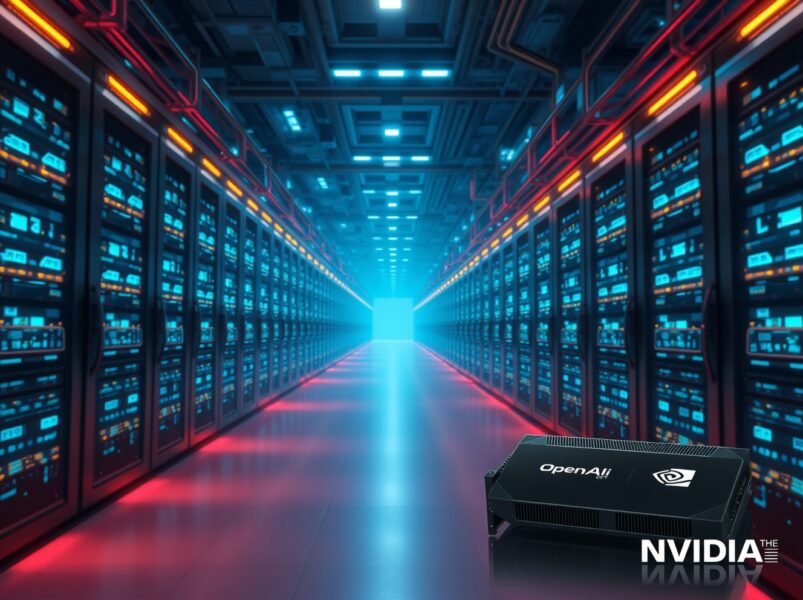
BitcoinWorld AI Data Centers: Unpacking the Colossal Investments Reshaping the Future of AI In the fast-evolving landscape where technological prowess often dictates market leadership, the recent flood of headlines about monumental AI data center investments has sent ripples across the global tech industry, including the cryptocurrency space. The sheer scale of capital being poured into these digital fortresses by giants like OpenAI, Nvidia, and Oracle isn’t just about processing power; it’s about laying the foundation for the next generation of artificial intelligence, which will undoubtedly impact every facet of our digital lives, from decentralized finance to automated trading. Understanding these massive moves is crucial for anyone looking to navigate the future of technology. What’s Driving the Colossal Investment in AI Data Centers? The tech world buzzed with news of unprecedented financial commitments this week, all centered around bolstering AI capabilities. At the forefront was Nvidia, a company synonymous with the graphic processing units (GPUs) that are the bedrock of modern AI. Nvidia announced a staggering investment of up to $100 billion in OpenAI, signaling a deep strategic partnership and a clear bet on OpenAI’s future trajectory. This investment underscores the critical need for advanced hardware to power increasingly complex AI models. Not to be outdone, OpenAI itself unveiled ambitious plans to construct five new ‘Stargate’ AI data centers in collaboration with Oracle and Softbank. These facilities are designed to add gigawatts of new computing capacity, a scale previously unimaginable. To finance this monumental undertaking, Oracle reportedly sold $18 billion in bonds, demonstrating the significant financial muscle required to bring such projects to fruition. Each of these deals, individually, represents a dizzying sum. In aggregate, they paint a clear picture: Silicon Valley is moving heaven and Earth to provide OpenAI with enough computational power to train and serve future versions of its flagship product, ChatGPT. These investments are not merely about incremental upgrades; they represent a fundamental re-architecting of global computing infrastructure. The demand for AI processing is growing exponentially, driven by the increasing sophistication of models and the desire to deliver more complex, real-time AI services to a global user base. This shift is creating a new arms race in the tech sector, where access to immense computing power is the ultimate differentiator. OpenAI’s Ambitious Vision: Scaling ChatGPT’s Capabilities The motivation behind these colossal investments becomes clearer when examining OpenAI’s product roadmap. The company is not content with the current iteration of ChatGPT; it envisions a future where AI is more deeply integrated into daily life, offering proactive and personalized services. A glimpse into this future arrived this week with the launch of ‘Pulse’ – a new feature within ChatGPT that works overnight to deliver personalized morning briefings to users. Pulse offers an experience akin to a personalized news app or a social feed, designed to be the first thing users check in the morning. Crucially, it operates independently, even when users are not actively interacting with the ChatGPT app. This ‘always-on’ nature represents a new class of OpenAI products that require continuous, high-intensity processing. The company’s desire to deliver many more such features, and eventually roll them out to its free user base, is currently hampered by a significant bottleneck: the number of available computer servers. OpenAI explicitly stated that Pulse can only be offered to its $200-a-month Pro subscribers due to these capacity constraints. This limitation highlights the direct link between infrastructure investment and product innovation. To democratize access to advanced AI features and realize its full potential, OpenAI needs vastly more computing resources. The Stargate project and Nvidia’s investment are direct responses to this pressing need, aiming to unlock the next generation of AI applications for everyone. Nvidia’s Indispensable Role and Oracle’s Strategic Play in AI Infrastructure The names Nvidia and Oracle are central to this narrative for distinct but equally critical reasons. Nvidia has established itself as the undisputed leader in GPU technology, which is the specialized hardware essential for training and running complex AI models. Without Nvidia’s powerful chips, the rapid advancements in AI seen over the past decade would have been impossible. Their $100 billion investment in OpenAI solidifies their position not just as a hardware provider, but as a strategic partner in shaping the future of AI. This move ensures that Nvidia’s technology remains at the core of cutting-edge AI development, further entrenching their market dominance. Oracle’s involvement, particularly through the Stargate project and its substantial bond issuance, marks a strategic pivot and aggressive expansion into the cloud computing space, specifically targeting AI workloads. While traditional cloud providers like AWS, Azure, and Google Cloud have been dominant, Oracle is leveraging its enterprise-grade infrastructure and financial strength to become a significant player in the high-demand AI infrastructure market. By partnering with OpenAI, Oracle positions itself as a critical enabler for the most advanced AI research and deployment, attracting future AI-driven enterprises to its cloud services. The $18 billion bond sale underscores the massive capital expenditure required for these projects, but also Oracle’s confidence in the long-term returns from becoming a foundational pillar of the AI economy. The Future of ChatGPT: Beyond the App Experience The evolution of ChatGPT, exemplified by features like Pulse, points towards a future where AI is less of a tool we actively summon and more of an ambient intelligence that proactively assists us. Imagine AI companions that anticipate your needs, manage your schedule, summarize vast amounts of information, and even generate creative content without explicit prompts. These advanced capabilities require not only sophisticated algorithms but also an immense, always-on computational backbone. The investments in AI data centers are not just about making existing AI models faster; they are about enabling entirely new paradigms of human-AI interaction. As capacity expands, OpenAI can experiment with larger models, more complex multimodal inputs (like video and audio), and more nuanced, personalized outputs. This means AI could become a seamless part of our digital environment, offering continuous support and insight. The ability to roll out such features to free users will be a game-changer, democratizing access to powerful AI and accelerating its adoption across society. This future also raises questions about the ethical implications, data privacy, and the societal impact of such pervasive AI. As AI becomes more autonomous and integrated, the need for robust governance and responsible development becomes even more paramount. The tech industry, alongside policymakers, will need to address these challenges as the capabilities of AI continue to grow. The Grand Challenge: Is This AI Infrastructure Worth the Investment? This brings us to the fundamental question: are features like Pulse, and the promise of future AI advancements, truly worth the hundreds of billions of dollars being invested in the underlying AI infrastructure? On the surface, a personalized morning briefing might seem a tall order for such a monumental investment. However, the true value lies not just in individual features but in the cumulative impact of enabling a new era of AI. The investment is a bet on the transformative power of AI across all industries. From scientific discovery and medical breakthroughs to personalized education and entertainment, advanced AI promises to unlock unprecedented levels of efficiency, innovation, and economic growth. The ability to train larger, more capable models means AI can tackle problems previously deemed intractable. The immediate return on investment might be hard to quantify for a single feature, but the long-term strategic advantage of being at the forefront of AI development is immeasurable. Challenges remain, particularly regarding the immense energy consumption of these massive data centers. Powering gigawatts of computing capacity will require sustainable energy solutions and significant advancements in cooling technologies. Furthermore, the economic viability of these projects hinges on the continued rapid adoption and monetization of AI services. Yet, the consensus among tech giants is clear: the future is AI-driven, and those who control the infrastructure will control that future. These monumental shifts in AI infrastructure are often the hot topics at premier tech gatherings. Events like the upcoming Bitcoin World, celebrating its 20th anniversary, provide a crucial platform for tech and VC leaders to dissect these trends, explore growth opportunities, and forge connections. With speakers from Netflix, Box, a16z, and Sequoia Capital, attendees can gain insights into how AI’s exponential growth impacts various sectors, including the blockchain and crypto ecosystems. Understanding the underlying infrastructure fueling AI is key for anyone looking to innovate or invest in the digital future. Join 10,000+ tech leaders at the epicenter of innovation in San Francisco from October 27-29, 2025. Register before September 26 to save up to $668. Conclusion: A New Era of AI-Powered Possibilities The recent headlines about colossal investments in AI data centers by OpenAI, Nvidia, and Oracle are not just financial news; they are indicators of a profound technological transformation. These companies are not merely building bigger server farms; they are constructing the digital cathedrals of the future, designed to house the immense computational power required to unlock the next generation of artificial intelligence. From the development of advanced ChatGPT features like Pulse to the broader vision of an AI-powered world, these investments underscore a collective belief in AI’s potential to redefine industries and human-computer interaction. The scale of these endeavors presents both immense opportunities and significant challenges, from sustainability concerns to the ethical implications of pervasive AI. However, one thing is clear: the race to build the ultimate AI infrastructure is on, and its outcome will shape the technological landscape for decades to come. As these digital foundations are laid, we can anticipate a future where AI becomes an even more integral, intelligent, and indispensable part of our daily lives, driving innovation across every sector, including the dynamic world of cryptocurrency and blockchain. To learn more about the latest AI infrastructure trends, explore our article on key developments shaping AI models and institutional adoption. This post AI Data Centers: Unpacking the Colossal Investments Reshaping the Future of AI first appeared on BitcoinWorld.

Author: Coinstats
$210 in view for Solana (SOL) as whales move $836M to exchanges; Is Mutuum Finance The Crypto Saving Portfolios?

$210 in view for Solana (SOL) as whales move $836M to exchanges; Is Mutuum Finance The Crypto Saving Portfolios?

Solana’s market is on high alert this week after a sudden movement of more than $836 million in SOL by large holders sparked new volatility on exchanges. Although Solana’s fundamentals remain intact, aggressive whale activity is normally a precursor to violent market action, so some investors are hedging into new opportunities like Mutuum Finance (MUTM), […]

Author: Cryptopolitan
ByteDance to receive 50% of TikTok US profit under Trump deal

ByteDance to receive 50% of TikTok US profit under Trump deal

The post ByteDance to receive 50% of TikTok US profit under Trump deal appeared on BitcoinEthereumNews.com. Key Takeaways ByteDance will receive 50% of TikTok’s US profits under a Trump-approved deal. ByteDance’s ownership in TikTok US is reduced to below 20%, though it retains significant financial interest through licensing its algorithm. ByteDance, a China-based tech giant, will receive 50% of TikTok’s US profits under a deal approved by President Trump. The arrangement allows the Chinese company to maintain significant financial interest in the popular short-video app despite divesting majority ownership to American investors. The deal values TikTok’s US operations at approximately $14 billion, with ByteDance’s stake reduced to under 20% while licensing its algorithm to the new American-owned venture. Oracle has been placed in charge of securing US user data and overseeing content moderation in the new TikTok US venture as part of the deal’s security provisions. The restructuring allows TikTok to continue operating in the US while addressing national security concerns about Chinese ownership of the platform. Source: https://cryptobriefing.com/bytedance-to-receive-50-percent-of-tiktok-us-profit-under-trump-deal/

Author: BitcoinEthereumNews