Oracle

Oracles are essential infrastructure components that feed real-time, off-chain data (such as price feeds, weather, or sports results) into blockchain smart contracts. Without decentralized oracles like Chainlink and Pyth, DeFi could not function. In 2026, oracles have evolved to support verifiable randomness and cross-chain data synchronization. This tag covers the technical evolution of data availability, tamper-proof price feeds, and the critical role oracles play in ensuring the deterministic execution of complex decentralized applications.

5152 Articles
Created: 2026/02/02 18:52
Updated: 2026/02/02 18:52
This Web3 Gem Can 1000x in 1 Year

This Web3 Gem Can 1000x in 1 Year

The post This Web3 Gem Can 1000x in 1 Year appeared on BitcoinEthereumNews.com. Crypto News 17 September 2025 | 16:05 The cryptocurrency market is once again buzzing with activity as investors look to position themselves ahead of the next bull wave. Analysts are pointing to a mix of established projects and bold newcomers as the best crypto to buy today. In particular, Tapzi (TAPZI), Algorand (ALGO), Litecoin (LTC), and Chainlink (LINK) are being backed as top contenders for growth, each bringing unique strengths to the table. While the market has no shortage of hype-driven meme tokens and speculative plays, the current trend is shifting toward coins with real-world utility, scalability, and long-term adoption potential. Let’s break down why these four stand out as the best crypto to buy today and how they compare in terms of technology, use cases, and investment appeal. Why Utility Is Key in Today’s Market Before diving into each token, it’s important to note why utility-driven projects are dominating analyst discussions. In 2021, the market was fueled largely by meme coins and speculative trading. By 2025, however, investors will have become more discerning, preferring projects with clear value propositions, community adoption, and regulatory alignment. This is why projects like Tapzi, Algorand, Litecoin, and Chainlink are gaining traction. They each solve real problems—whether it’s providing competitive GameFi platforms, scalable blockchains, fast digital payments, or data connectivity between smart contracts and the real world. Tapzi (TAPZI): The GameFi Revolution At the center of analyst predictions sits Tapzi (TAPZI), a decentralized skill-based GameFi platform that’s redefining how players interact with blockchain gaming. What Makes Tapzi Special Unlike most GameFi projects that rely on chance or speculative NFT value, Tapzi transforms classic strategy games like Chess, Checkers, Tic Tac Toe, and Rock-Paper-Scissors into stake-based competitive matches. Here, players earn rewards based purely on skill, not luck. Time Is Running Out – Secure $TAPZI…

Author: BitcoinEthereumNews
Will Larry Ellison’s TikTok be safer than Chinese TikTok?

Will Larry Ellison’s TikTok be safer than Chinese TikTok?

The post Will Larry Ellison’s TikTok be safer than Chinese TikTok? appeared on BitcoinEthereumNews.com. Yesterday it was announced that Larry Ellison’s Oracle, a16z, and venture capital firm Silver Lake would be buying up a new spinoff entity that would take the place of TikTok in America, with ByteDance — the current owners of TikTok — retaining a 20% stake. What will this new entity look like? It’s hard to say, but what is clear is that the Trump administration negotiated the deal with the Chinese government. It makes sense that an authoritarian country would want to tell a multi-billion dollar business precisely who is allowed to run it, who it’s allowed to sell to, and when it’s allowed to sell. However, it’s shocking that while the Trump administration abandons most financial regulation and pushes for global tariffs in the face of markets it claims aren’t free enough, it’s also sending government negotiators to help takeover a Chinese company on behalf of hyper-wealthy venture capitalists and the richest man in the world. Ellison, who is a close Trump ally and has family running Paramount Skydance, will undoubtedly hope to leverage his stake in the new TikTok to “bring the country under the benevolent sway of artificial intelligence.” a16z’s Marc Andreessen, a Curtis Yarvin acolyte, Trump advisor, and early internet billionaire darling, will also likely use the purchase to pursue an AI and crypto-laden agenda. Is this what kleptocracy looks like? Regardless, it’s important to remember that China has been, and always will be, the only enemy of the American people: venture capitalists, billionaires, and hedge fund managers have never once attempted to manipulate the public through wide scale social engineering. Read more: TikTok accused of operating as crypto exchange in the UK, report Remember the Maine? The USS Maine, a naval cruiser, was sunk in 1898 off the coast of Havana, Cuba. The moment catapulted…

Author: BitcoinEthereumNews
Blockchain-Based RWA Specialists Bring $50M to Apollo's Tokenized Credit Strategy

Blockchain-Based RWA Specialists Bring $50M to Apollo's Tokenized Credit Strategy

The post Blockchain-Based RWA Specialists Bring $50M to Apollo's Tokenized Credit Strategy appeared on BitcoinEthereumNews.com. Blockchain-based real world asset (RWA) specialists Centrifuge and Plume have launched the Anemoy Tokenized Apollo Diversified Credit Fund (ACRDX), backed by a $50 million anchor investment from Grove, a credit infrastructure protocol within the Sky Ecosystem. The fund gives blockchain investors exposure to Apollo’s diversified global credit strategy, spanning direct corporate lending, asset-backed lending and dislocated credit, a type of mispriced debt due to market stress and lack of liquidity. ACRDX will be distributed through Plume’s Nest Credit vaults under the ticker nACRDX, making the strategy accessible to institutional investors on-chain. By packaging Apollo’s portfolio in tokenized form, the fund aims to lower entry barriers and increase transparency for investors seeking exposure to private credit markets, according to a press release. Apollo, a $600 billion-plus asset manager, is one of several traditional finance firms active n exploring blockchain rails. Its digital assets head Christine Moy said the initiative expands access to institutional-grade strategies while helping “build the onchain DeFi economy” alongside Grove and Centrifuge. The product combines Apollo’s investment management with Centrifuge’s tokenization infrastructure and Plume’s real-world asset–focused blockchain. Chronicle will serve as oracle provider, and Wormhole will handle cross-chain connectivity. Subject to approval, Anemoy will oversee the fund as manager. Source: https://www.coindesk.com/business/2025/09/16/blockchain-based-rwa-specialists-bring-usd50m-to-apollo-s-tokenized-credit-strategy

Author: BitcoinEthereumNews
Saudi Awwal Bank Taps Chainlink to Power Next-Gen Onchain Finance in the Kingdom

Saudi Awwal Bank Taps Chainlink to Power Next-Gen Onchain Finance in the Kingdom

The Saudi Awwal Bank has selected the Chainlink network to deploy on-chain applications in Saudi Arabia. Analysts suggest the news could serve as the spark needed for LINK to make a run at $52 before the year wraps up. Chainlink’s role as an oracle provider is growing as more real-world assets get tokenized. Saudi Awwal [...]]]>

Author: Crypto News Flash
Bitcoin Hyper ($HYPER) Live News Today: Latest Insights for Bitcoin Maxis (September 17)

Bitcoin Hyper ($HYPER) Live News Today: Latest Insights for Bitcoin Maxis (September 17)

Stay Ahead with Our Immediate Analysis of Today’s Bitcoin & Bitcoin Hyper Insights Check out our Live Bitcoin Hyper Updates for September 17, 2025! In 2010, Bitcoin was worth a few cents. One year later, it hit $20. In six years, it was $17,000, and now it’s sitting at over $100K, after hitting an ATH […]

Author: Bitcoinist
Corporate Bitcoin treasuries will drive BTC yield innovation

Corporate Bitcoin treasuries will drive BTC yield innovation

The post Corporate Bitcoin treasuries will drive BTC yield innovation appeared on BitcoinEthereumNews.com. Disclosure: The views and opinions expressed here belong solely to the author and do not represent the views and opinions of crypto.news’ editorial. Wall Street was caught in the headlights when Strategy first added Bitcoin (BTC) to its balance sheet. Was this a software company, or the world’s first corporate bitcoin ETF? Investors had to improvise, and the company’s stock quickly stopped trading on software fundamentals and started behaving like a pure Bitcoin proxy. Summary With interest rates above 4%, idle Bitcoin is now seen as inefficient, pushing corporate treasuries to demand compliant, yield-generating solutions. Current options — collapsed lenders, wrapped BTC, and offshore DeFi — don’t meet institutional standards for custody, auditability, or risk. Institutions want yield secured directly on Bitcoin, with transparent attestations and returns tied to real economic activity, not token gimmicks. If Bitcoin delivers these rails quickly, it can anchor the next financial layer; if not, capital will migrate to Ethereum, Solana, or traditional markets offering safer yields. That debate is over today. Asset managers like BlackRock and Fidelity now market Bitcoin ETFs to the mainstream, and corporate treasuries collectively hold billions in BTC. But holding Bitcoin is no longer enough. In a world of interest rates still above 4%, idle BTC comes with a steep opportunity cost. Treasuries are mandated to optimize liquidity and generate returns on reserves, not let assets sit dormant. What was acceptable in the first wave of corporate adoption now looks like a glaring inefficiency. Today’s Bitcoin-native solutions don’t cut it To date, there aren’t enough options for putting Bitcoin to work, and none pass the basic tests treasuries apply. Custodial lenders like Celsius dangled double-digit returns in retail investors’ faces, only to implode and wipe out deposits. Wrapped Bitcoin products like wBTC push assets off the Bitcoin base layer and…

Author: BitcoinEthereumNews
What is Polymarket? A Deep Dive into the Prediction Market and Its Game-Changing Data

What is Polymarket? A Deep Dive into the Prediction Market and Its Game-Changing Data

Polymarket lets people bet on real-world events, turning crowd wisdom into sharp forecasts on everything from elections to sports outcomes. Built on blockchain tech, it runs as a decentralized platform where users trade shares in event results, paying out based on what actually happens. Launched back in 2020, it quickly grew into the biggest player in prediction markets, handling billions in trades and drawing in traders who see value in its transparent setup. Unlike old-school betting sites, Polymarket skips the house edge, letting market forces set the odds directly. How Polymarket Operates: Betting Meets Blockchain Picture this: you spot a market on whether a new bridge gets built by year’s end. You buy “yes” shares if you think it will, or “no” if you doubt it. Each share pays $1 if you’re right, nothing if wrong. Prices fluctuate based on what others bet, reflecting real-time probabilities. Running on Polygon for cheap fees and fast trades, it covers politics, news, culture, tech, and more. Recent upgrades like Chainlink oracles speed up resolutions, making settlements near-instant and secure. No wonder volumes hit $969 million in one stretch, with millions of bets placed. Traders love the on-chain transparency — it shows user trends and behaviors without hiding anything. Tools track top performers, whale moves, and influencer bets, adding layers to strategy. But it’s not all smooth; regulatory hurdles, like CFTC scrutiny, force careful navigation, especially in restricted areas. Why Polymarket Data Holds Real Weight Polymarket data cuts through noise, pricing information efficiently where experts turn insights into profits. It’s proven 90% accurate a month out from events, jumping to 94% just hours before. This beats traditional polls by aggregating skin-in-the-game opinions, not just guesses. In volatile times, like stock slumps or pharma trials, it signals shifts before headlines catch up. Take elections: mainstream media cites Polymarket odds for probabilities, exposing hidden truths amid spin. Or market crashes — data showed a $5.5 trillion U.S. stock wipeout’s sentiment in real time. Even in crypto, it forecasts token pumps or regulatory wins, guiding investors. Partnerships, like with news outlets for live odds, blend price signals with facts, redefining how we gauge events. Beyond bets, this data fuels decisions in finance, policy, and beyond. Collective expectations from informed traders offer insights no single expert can match. It’s why big names pour in double-digit millions — validating prediction markets as a fresh finance frontier. Real-World Impact: From Politics to Everyday Bets During high-stakes moments, like candidate swaps or geopolitical flare-ups, Polymarket data acted as a truth filter against misinformation. Traders shifted odds on upsets, like halftime leads in games turning -150 favorites, showing live volatility’s edge. In emerging economies’ routs or cyber hacks, it highlights risks, stressing transparent metrics over hype. Communities buzz about its growth: zero-fee pivots boosted volumes, while integrations build trust. Yet, challenges like episodic use — peaking in elections — point to needs for simpler onboarding, fiat links, and broader topics like daily life or sports to go mainstream. The Road Ahead for Polymarket and Prediction Markets With $7.5 billion in cumulative volume but liquidity thin in most markets, Polymarket eyes TradFi ties and AI tools for better liquidity. Regulatory wins, like U.S. re-entry via acquisitions, could set blueprints for compliant on-chain betting. If it cracks mass adoption — think app tabs for predictions — it shifts from niche to habit, pooling liquidity across chains. In short, Polymarket isn’t just a betting spot; its data reshapes how we predict and act on the future, blending tech with human insight for clearer views in uncertain worlds. What is Polymarket? A Deep Dive into the Prediction Market and Its Game-Changing Data was originally published in Coinmonks on Medium, where people are continuing the conversation by highlighting and responding to this story

Author: Medium
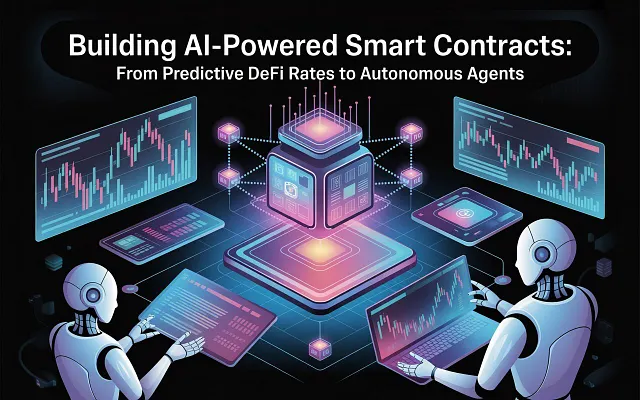
Building AI‑Powered Smart Contracts: From Predictive DeFi Rates to Autonomous Agents

Building AI‑Powered Smart Contracts: From Predictive DeFi Rates to Autonomous Agents

Smart contracts have become the foundation of decentralized applications and the broader blockchain economy. They introduce a model where rule-based execution removes intermediaries, making transactions faster, cost-effective, and transparent. With the growing complexity of decentralized finance (DeFi), NFT ecosystems, and digital identity systems, the integration of artificial intelligence (AI) into smart contracts is creating a new class of dynamic, responsive, and autonomous digital agreements. Businesses exploring decentralized applications are no longer just thinking about static contracts that execute a fixed set of instructions. They want intelligent contracts capable of analyzing data, adjusting conditions, and interacting with external systems in real-time. This is where AI‑powered smart contracts are making a significant impact. Companies offering Smart Contract Audit Services and development expertise are now engaging in projects where intelligence is embedded into the very logic of decentralized systems, making them adaptive and business-centric. This blog explores the concept of AI‑powered smart contracts, how they work, practical examples such as predictive DeFi rates, autonomous agent workflows, and why they matter to startups, enterprises, and financial institutions. It also lays out the development process, challenges, and the role expertise plays in making these solutions reliable. What Are AI‑Powered Smart Contracts? Traditional smart contracts are written in languages such as Solidity (Ethereum) or Rust (Solana), with the logic defined at the creation stage. Once deployed, these contracts only operate within the coded parameters and blockchain environment. They rely on oracles or off-chain data feeds to fetch updates but act as static executors of conditions. AI‑powered smart contracts extend this approach by integrating artificial intelligence and machine learning models into the decision-making logic. Instead of waiting for fixed inputs, these contracts can process real-time data, analyze patterns, and even predict future outcomes. For example: A DeFi liquidity pool agreement that can adjust interest rates dynamically based on predicted demand. An insurance contract that automatically validates claims through predictive fraud detection models. A supply chain agreement that validates delivery time expectations using predictive logistics data. In essence, AI adds a layer of cognitive flexibility to the deterministic nature of smart contracts. Why Businesses Should Care About AI‑Powered Smart Contracts For companies evaluating blockchain strategies, AI‑embedded smart contracts are relevant because they introduce automation that goes beyond execution — they introduce adaptability. Businesses that rely on evolving market data, customer profiles, and external conditions no longer need manual updates or human oversight for every change. Key benefits include: Dynamic pricing: Smart contracts that read live market data and adjust token prices automatically. Fraud reduction: AI‑enabled anomaly detection integrated into crypto transactions. Cost savings: Long-term process automation with reduced reliance on human intervention. Scalability: Contracts that can manage more complex logic as industries evolve. Improved customer trust: Users engage with smarter financial and business products that respond to real-time insights. For forward-looking organizations, these benefits mean smarter products in DeFi, tokenized assets, digital identity management, and cross-industrial applications. Core Components: How AI and Smart Contracts Work Together The combination of blockchain and AI requires a modular system. Businesses developing AI‑powered smart contracts must combine these elements effectively: Smart Contract LogicThe base layer coded in Solidity, Rust, or Vyper. It defines the rules and execution structure. AI ModelsAlgorithms that allow prediction, classification, and recommendation. These models can be deployed on-chain (basic AI logic) or off-chain (more resource-intensive models). OraclesGateways that bring external data, model outputs, or real-world events back onto the blockchain. AI contracts rely on trustworthy and tamper‑resistant oracles. Data PipelinesTraining AI requires data. Data from DeFi markets, supply chains, IoT devices, or customer interactions must be aggregated, cleaned, and structured for modeling. Consensus and Verification Unlike regular decentralized consensus (PoW, PoS), AI‑driven decisions may require additional verification methods to maintain trust. Predictive DeFi Rates: A Use Case Example DeFi protocols rely heavily on interest rate models that determine borrowing costs, lending returns, and risk assessment. Traditionally, these rates are defined by static formulas or governance voting. AI‑powered smart contracts open a more advanced mechanism — predictive DeFi rates. Here’s how: Historical transaction data is analyzed with AI models to detect demand patterns. Contracts predict future borrowing activity and automatically adjust rates. Rates can also adapt to macroeconomic data (such as inflation figures brought into the blockchain by trusted oracles). Borrowers and lenders get a fairer model, while liquidity providers mitigate risks. Businesses in the financial technology sector can integrate such models to introduce innovative DeFi products that differentiate them from existing services. Autonomous Agents in Smart Contracts One of the most exciting implications of combining AI and blockchain is the creation of autonomous agents — self-governing units capable of executing complex sequences of transactions, negotiations, or verifications. Consider an autonomous agent in logistics: A shipment container has a digital identity linked to an AI model on the blockchain. The contract autonomously verifies shipping routes, predicted delays, and customs documents. Payment milestones are auto-executed as checkpoints are validated. The agent negotiates with multiple stakeholders (shipping firms, ports, customs authorities) — all without human involvement. Such autonomous contracts extend the scope of blockchain beyond financial applications to global industries like real estate, healthcare, and trade. Development Process: Building AI‑Powered Smart Contracts For businesses working with Smart Contract Development companies, the process can be broken into key stages:

  1. Defining Objectives Clear understanding of what the contract must achieve. Examples: predictive interest rates, fraud detection, supply chain monitoring.
  2. Data Preparation Identifying clean and relevant datasets, essential for training AI models that will be linked to contracts.
  3. Model Training Selecting AI methods such as regression, reinforcement learning, or neural networks depending on requirements.
  4. Integration with Smart Contracts Deploying models or their outputs through oracles and APIs. The contract must remain secure, auditable, and efficient even with AI logic.
  5. Testing and Smart Contract Audit Before mainnet deployment, contracts undergo testing, simulations, and a detailed Smart Contract Audit, which includes not only vulnerabilities in on‑chain code but also in data pipelines and AI model integrity.
  6. Deployment and Monitoring Live contract execution across blockchain networks with monitoring tools to validate performance. Challenges and Considerations Businesses planning AI‑powered contract adoption must address these challenges:
Gas costs: More complex contracts require higher execution fees. Transparency in AI: Black-box models can cause disputes; explainability is vital. Model decay: AI models require retraining with updated data. Data quality: Biased or incomplete data can lead to faulty contract outcomes. Regulation: DeFi and AI both face evolving regulatory scrutiny. Addressing these concerns early smooths the adoption journey. Real-World Applications for Businesses InsuranceAI‑driven smart contracts flag fraud by analyzing claim patterns. HealthcareAutonomous AI contracts validate health‑data integrity and track drug distributions. Supply ChainsContracts predict delays and settle disputes using verified external data. Energy Trading AI models forecast usage and settle micro-transactions in near-real time. Decentralized Identity Adaptive contracts authenticate access to digital services securely. These industries are finding tangible value in combining AI’s predictive capabilities with blockchain’s immutability. The Role of Smart Contract Development Companies For organizations, building AI‑powered smart contracts from scratch is often impractical. It requires blockchain architects, AI engineers, auditors, and integration experts. This is why specialized Smart Contract Development companies play a key role. They not only deliver secure smart contracts but also integrate AI features and conduct ongoing audits to maintain efficiency and compliance. Conclusion AI‑powered smart contracts are taking decentralized applications to new levels of intelligence and functionality. From predictive DeFi rates to self-operating agents, these contracts provide a glimpse of how automation and decision-making can coexist on the blockchain. For businesses and financial institutions, this technology unlocks ways to build more adaptive, intelligent, and secure decentralized solutions. However, success in this field depends on expertise, reliable audits, and robust development methodologies. If your business is ready to explore AI‑powered Smart Contracts — whether for DeFi, enterprise automation, or digital identity — the right development partner makes all the difference. Take the next step in building intelligent blockchain solutions. Partner with Codezeros for Smart Contract Development and gain access to secure, business-ready AI‑powered contracts that align with your goals. Building AI‑Powered Smart Contracts: From Predictive DeFi Rates to Autonomous Agents was originally published in Coinmonks on Medium, where people are continuing the conversation by highlighting and responding to this story

Author: Medium
Corporate Bitcoin treasuries will drive BTC yield innovation | Opinion

Corporate Bitcoin treasuries will drive BTC yield innovation | Opinion

If the industry delivers secure, auditable yield rails quickly, Bitcoin can lock in its lead as the default venue for institutional-grade returns.

Author: Crypto.news
Saudi Awwal Bank Partners With Chainlink: Expert Predicts LINK Price Rally to $52

Saudi Awwal Bank Partners With Chainlink: Expert Predicts LINK Price Rally to $52

TLDR: Saudi Awwal Bank signed an agreement with Chainlink to experiment with blockchain interoperability using CCIP and CRE tools. The bank manages over $100B in assets and aims to boost developer access to tokenized financial infrastructure in Saudi Arabia. Chainlink’s CCIP and CRE will support regulated on-chain finance and connect Saudi markets to global blockchain [...] The post Saudi Awwal Bank Partners With Chainlink: Expert Predicts LINK Price Rally to $52 appeared first on Blockonomi.

Author: Blockonomi