'Pressure' shows why Eisenhower trusted scientists over blowhards —and why we should too
At one point in “Pressure,” meteorologist James Stagg (Andrew Scott) explains to General Dwight D. Eisenhower (Brendan Fraser) that an impending storm will make it impossible for the Allied troops to successfully invade Normandy as planned. As he attempts to break down the meteorology, his competing scientist Irving P. Krick insists on rudely interrupting with his own ill-informed point-of-view. Eventually Stagg tells Krick what he — and the audience — needs to hear: That Krick is “a confident moron.”
With a single insult, Scott’s Stagg sums up both the chief lesson of “Pressure” and its primary pleasure as a source of entertainment. Much like a similar recent World War II-themed blockbuster, “Oppenheimer,” “Pressure” is at its core a story of hard-working, well-informed scientists fighting against arrogant ignorance. While the primary ignoramuses in “Oppenheimer” were political reactionaries and Krick is merely a blowhard, both emerge as antagonists because their hostility toward experts imperils the security and values of the free world.
Directed by Anthony Maras, who co-authored the script with David Haig based on the latter’s stageplay of the same name, “Pressure” follows Eisenhower, Stagg, Krick, Eisenhower’s secretary Kay Summersby (Kerry Condon) and Field Marshal Bernard Montgomery (Damian Lewis) in the days before the June 1944 Normandy invasion known today as “D-Day.” The Allies would be unusually dependent on favorable weather to win the battle, so Eisenhower demands to know what the weather will be. Krick, using so-called “analog” maps that rely on past weather conditions to predict future ones, anticipates sunny skies and clear weather. Stagg, by contrast, relies on sophisticated data collection to anticipate a jet stream will push a major storm into the area.
The main drama in “Pressure” therefore involves the clashing egos of Stagg and Krick (who are equally full of themselves) as well as their clashing intellects (in which Stagg is clearly Krick’s superior). Eisenhower is thus placed in the unenviable position of needing to figure out which one is more reliable. From this potentially dry premise, “Pressure” creates a deeply engaging and fast-paced work of art.
I am not alone in this assessment. Ali, a 13-year-old self-described “history buff” who lives near the Pennsylvania theater where I saw “Pressure,” was very enthusiastic, gushing about how much she enjoyed seeing history brought to life and explaining she chose “Pressure” because it was the only film in theaters that looked interesting. Seven other theatergoers echoed her view, and that was only a small sample of the (for a Friday matinee) surprisingly packed auditorium.
To be clear, “Pressure” does not get the history 100 percent correct. Retired meteorologist Glenn “The Hurricane” Schwartz, who worked for the eastern Pennsylvania NBC affiliate from 1995 to 2022, broke down several aspects of the history that the film missed. It does not mention “pioneering meteorologist” Sverre Petterssen, a key part of the team who Schwartz explained “confidently predicted a bad storm for the 5th. Petterssen literally ‘wrote the book(s)’ on weather forecasting that I actually had to use as a [meteorology] undergrad in 1972!" It overlooks Krick’s post-war disgrace, not even mentioning it in the ending credits text. As Schwartz explained, he interviewed Dr. Francis Davis, who served “on Krick's team. Amazingly, Krick bragged about his role in the D-Day forecast EVEN THOUGH HE WAS DEAD WRONG! Even Davis admitted as such in my 2002 interview. ‘....it didn't work out very well.’” He later added that "Krick was so controversial and his ‘analog’ methods were so criticized by the meteorological community that he was about to be the first person ever thrown out of the American Meteorological Society for violating their Code of Ethics. He resigned instead. His methods live on in the private company, Planalytics, which happens to be located in the [Philadelphia] area. And believe it or not, AI appears to use analogs to make their forecasts, which happened to beat the National Hurricane Center and ALL computer models last season."
For Eisenhower buffs, perhaps the most notable omission is the widely substantiated (but technically unconfirmed) affair between the general and Summersby. Shortly before her death, Summersby admitted that she had to "disguise as best I could the intimacy that had grown between General Eisenhower and me. It was better that way.” While that omission was arguably defensible during Eisenhower’s lifetime, it becomes considerably less so in a movie intended to accurately reflect their interactions. One does not need the steamy indulgences of Oppenheimer’s affair in “Oppenheimer” to at least get that part right.
Yet there is also much for history and science buffs to love about “Pressure.” When it comes to the fundamental contours of the plot, science, military strategizing and overall history, “Pressure” is accurate. In the words of Dr. Michael E. Mann, the Presidential Distinguished Professor in the Department of Earth and Environmental Science at the University of Pennsylvania, “weather forecasting back then, before the age of numerical weather forecasting (which began in 1950 courtesy of the ENIAC computer at my university, Penn) was fairly primitive. It mainly consisted of using printed out weather maps and the elementary approaches we teach students in introductory courses on meteorology, which consists of taking the surface features (highs and lows), estimating the upper level steering winds, and predicting where those lows and highs are going to end up days later (it’s called the ‘steady state’ approach to forecasting).”
Perhaps most notably, “Pressure” subtly but firmly establishes the link between ignoring science and supporting reactionary political structures. Speaking to the San Francisco Chronicle’s G. Allen Johnson, Fraser explained that “it is a story that speaks to us 80-some years later. We see soldiers deployed again. We ask ourselves why, and then we ask ourselves why compared to 1944. The reason for even fighting (World War II) at all was to end fascism. To partner with nations and allies, later to become NATO, NASA, civil rights. I could go on.”
Maras elaborated on the scientific point.
“Eisenhower had those magnanimous examples of leadership that I think the world could benefit from now,” Maras told Johnson. “He took seriously the points of view of experts. We live in a specialized world, and it’s less about what any leader in particular knows and it is more about having the wisdom of who to trust and why you trust them.”
Dr. Federico Finchelstein, University in Exile Research Professor and Professor of History at The New School for Social Research and Eugene Lang College, told AlterNet that this link is far from coincidental. Indeed, Eisenhower himself famously liberated many concentration camps during the Holocaust so that the Jewish community could prove the atrocities that happened, and explicitly recognized the junk science used by Nazis to rationalize their oppression.
“I can say that historically fascism has had an ambiguous relationship with science,” Finchelstein said. “It instrumentalized rational means to achieve irrational ends. Science per se was not a problem for them insofar as it did not contradict their unreason, their ideological irrational being. Current wannabe fascists, including the Trumpists, tend to do the same but they are even more anti-science and more irrational regarding their means.”
While Krick is not a fascist, his ignorance is part of the same erroneous line of thinking that informs the Allies’ fascist foes. They first come to a conclusion, then retroactively create a logic to support it. Good leadership requires following the facts, even when they are inconvenient and especially when they disprove one's own prejudices. As Eisenhower himself famously told President John F. Kennedy near the end of Eisenhower’s own administration, the Allies won because they had better meteorologists than the Germans.
As President Donald Trump attacks the reality of man-made climate change and slashes federal funding to science programs all over America, this message is both relevant and poignant. Eisenhower was a firm supporter of funding scientific research and education.
“Science education is not only crucial for students with science ambitions,” Schwartz explained. “It's important to understand the basics of how science works to responsibly argue about climate, for example. And scientific research is crucial for the advancement of any branch of science. Cutting observations, research, or efforts to improve forecasting would horrify Eisenhower today.”
Or as Mann told AlterNet, “Not only did Eisenhower understand the importance of embracing science; he understood the pernicious consequences of bigotry and the importance of fighting back against it.” Connecting that point to today, “look no further than the latest effort by Trump and the polluters that he represents (and their hired propagandists) to attack the work of the international climate science community by misrepresenting the latest findings regarding the threat of climate change.”
At one point I quoted Eisenhower to Mann as a way of explaining how the film’s message is relevant to the Trump era.
"High-quality professional personnel in science, engineering, teaching, languages, and other critical fields are necessary to our national security effort,” Eisenhower said in 1958. “Each year, nevertheless, many young people drop out of high school before graduation. Many able high school graduates do not go on to college. This represents a waste of needed talent."
Mann replied, “Right on the money.” If I had to summarize “Pressure” in four words, those are the ones I’d choose: “Right on the money.”
- george conway
- noam chomsky
- civil war
- Kayleigh mcenany
- Melania trump
- drudge report
- paul krugman
- Lindsey graham
- Lincoln project
- al franken bill maher
- People of praise
- Ivanka trump
- eric trump


Ayrıca Şunları da Beğenebilirsiniz
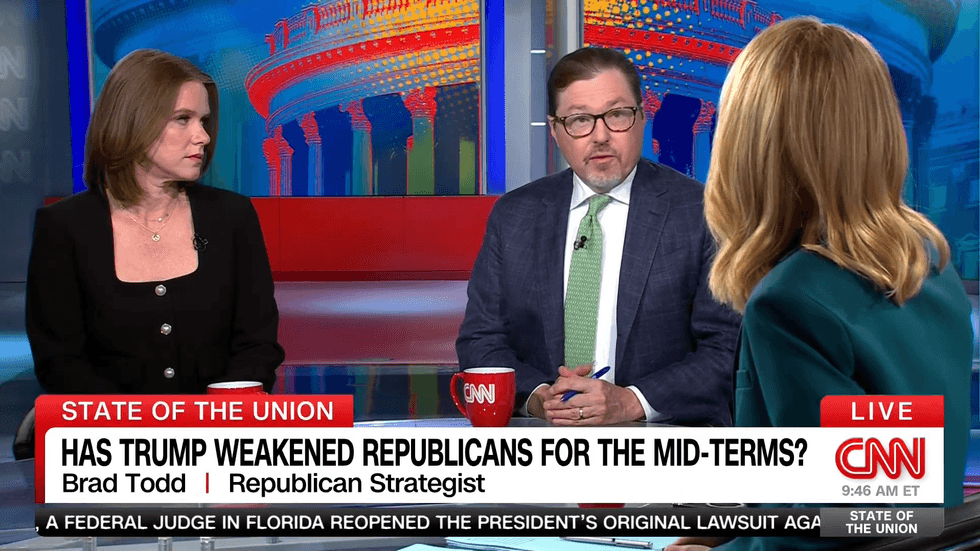
Trump barreling toward disaster with just '30 days to turn this ship': GOP strategists

What Shared Responsibility Means in a Personal Injury Case

HYPE Token Hits Record High as Market Cap Surges on Futures and Buyback Momentum


Popüler Haberler
Daha fazla