Stablecoins Explained: Which to Choose?
If you have ever wondered how digital dollars work, this stablecoins explained guide is the perfect place to start. You will discover what stablecoins are, how they maintain their value, which types exist, and which ones dominate the market in 2026. By the end of this article, you will have the knowledge to choose the right stablecoin with confidence and understand the risks before investing or trading. So, let’s get started!
What Is a Stablecoin?
If you are wondering what a stablecoin is, the answer is simple. It is a cryptocurrency designed to keep a stable value instead of experiencing large price swings. Most stablecoins are pegged to fiat currencies such as the US dollar, making them a popular bridge between traditional finance and the crypto market.
Definition and Core Purpose
The stablecoin meaning refers to a cryptocurrency whose value is linked to a stable asset, usually maintaining a 1:1 peg with the US dollar. Its main purpose is to provide price stability in a highly volatile crypto market while preserving the speed, transparency, and accessibility of blockchain technology. As a result, users can transfer, store, and trade digital assets without constantly worrying about sudden price fluctuations.
How Stablecoins Work
Many beginners ask, how do stablecoins work? The answer depends on their design, but the goal is always the same: maintaining a stable value of around $1. Some projects rely on reserves that back every issued token, while others use smart contracts or automated supply-adjusting mechanisms. By balancing the relationship between reserves and circulating tokens, these systems help keep the peg stable and make stablecoins a reliable tool for payments, trading, and digital savings.
The 4 Types of Stable Coins: A Complete Breakdown
Understanding the different types of stablecoins makes it much easier to choose the right one. While people once divided stablecoins into three categories, the market has evolved significantly. In 2026, four major architectures dominate the industry, each offering a different balance between stability, decentralization, yield, and risk.
| Stablecoin Type | Collateral Backing | Top 2026 Examples | Main Advantage | Primary Risk |
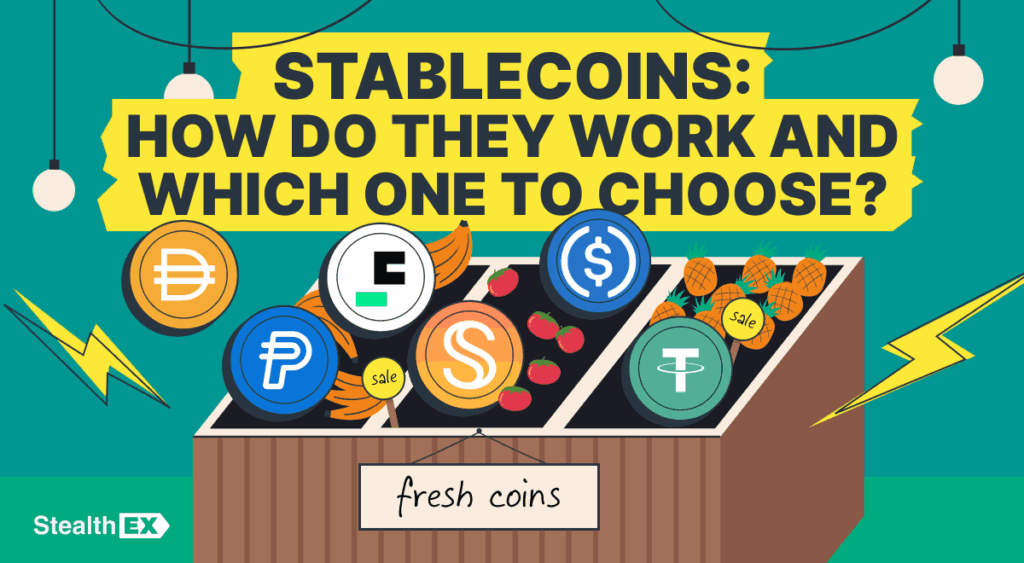
| Fiat-Collateralized | Cash, US Treasury Bills | USDT, USDC, PYUSD | Highest price stability & deep liquidity | Centralization & account freezing risk |
| Crypto-Collateralized | Crypto assets in smart contracts | DAI, LUSD, FRAX | Fully decentralized & transparent | Capital inefficiency (requires over-collateralization) |
| Synthetic Dollar | Crypto + Short perpetual positions | USDe (Ethena) | Built-in native yield generation | Funding rate inversion under bear market stress |
| Algorithmic | Smart contract code & supply burning | UST (Historical) | High capital efficiency | High risk of a permanent “death spiral” collapse |
Fiat-Collateralized Stablecoins
The largest group of collateralized stablecoins is backed 1:1 by traditional financial assets such as cash and short-term US Treasury Bills. Every issued token is supported by reserves held by a centralized issuer, helping maintain a stable value close to one US dollar. This model offers excellent liquidity, simple mechanics, and broad acceptance across exchanges and payment platforms. However, users must trust the custodian that manages the reserves, and issuers can freeze addresses or comply with regulatory actions. The best-known examples include USDT, USDC, and PYUSD.
Crypto-Collateralized (Over-Collateralized)
DAI stablecoin and similar decentralized assets use cryptocurrencies locked inside smart contracts instead of fiat reserves. To protect the peg, users must deposit collateral worth more than the stablecoins they create, making the system over-collateralized. Legacy DAI pioneered this model, while LUSD and FRAX introduced modern variations with different collateral designs. The biggest advantage is strong censorship resistance because no central company controls the reserves. The main drawback is capital inefficiency, since maintaining stability requires locking more value than the tokens issued.
Synthetic / Delta-Neutral Dollars (Yield-Bearing)
The modern yield-bearing stablecoin model has gained popularity through projects such as Ethena’s USDe. Instead of relying on cash reserves, these protocols combine crypto assets with short perpetual futures positions to create a delta-neutral strategy that aims to preserve the dollar peg. Because the strategy generates returns from derivatives markets, holders can often receive native yield without traditional lending. This innovative design blends price stability with passive income, although its performance depends on market conditions and funding rates.
Algorithmic Stablecoins
Algorithmic stablecoins attempt to maintain their dollar peg by automatically expanding or reducing token supply through smart contract logic instead of holding reserves. Although this approach is highly capital efficient, it has largely fallen out of favor after the collapse of TerraUSD (UST) in 2022. Once confidence disappeared, its supply mechanism failed, triggering a devastating death spiral that erased billions of dollars in value. Today, the UST case remains a permanent reminder that algorithmic designs can carry significant structural risks.
Top Stablecoins to Consider in 2026
The top stablecoins differ in more than market capitalization. Each project follows a unique approach to regulation, transparency, liquidity, or yield generation, making some options better suited for trading while others fit long-term DeFi strategies.
| Asset | Primary Issuer | Target Audience / Use Case | MiCA Compliant (EU)? | Unique 2026 Feature |
| Tether (USDT) | Tether Limited | Global P2P, high-volume trading pairs | No (Friction on EU exchanges) | Backed almost entirely by US Treasury Bills; liquidity king |
| USD Coin (USDC) | Circle | Western institutional markets, DeFi | Yes (Fully approved in the EU) | Maximum regulatory compliance and clean public audit trail |
| USDS | Sky (formerly MakerDAO) | Passive income within the DeFi ecosystem | No (Decentralized protocol) | Successor to DAI; offers native savings yield via Sky Protocol |
| PayPal USD (PYUSD) | PayPal / Paxos | Mainstream retail and e-commerce | Yes (Via Paxos licensing) | Direct integration with traditional fintech and Venmo apps |
Tether (USDT): The Liquidity King
When comparing DAI vs USDT, the biggest difference is centralization versus liquidity. USDT remains the world’s largest stablecoin and the preferred choice for traders because it offers unmatched trading volume and availability across nearly every major exchange. Tether has also strengthened confidence by shifting its reserves to almost entirely US Treasury Bills while eliminating commercial paper exposure. Its global adoption is difficult to match, although MiCA regulations have created compliance challenges and reduced availability on some European platforms.
USD Coin (USDC): The Compliance Leader
The DAI vs USDC debate often comes down to regulation versus decentralization. Issued by Circle, USDC has become the benchmark for compliance thanks to its fully approved MiCA status in the European Union and its regular transparency reports detailing reserve holdings. These features have made it a preferred stablecoin for institutions, regulated financial products, and many DeFi protocols. For users who value legal clarity and transparency, USDC remains one of the strongest choices available.
USDS & Dai (Sky Protocol): The DeFi Evolution
The comparison of USDC vs DAI changed significantly after MakerDAO evolved into Sky Protocol during 2024 and 2025. The ecosystem introduced USDS as the upgraded successor to DAI, adding the Sky Savings Rate (SSR), which allows eligible users to earn native yield directly within the protocol. While DAI continues to exist as a legacy stablecoin and remains widely supported, Sky increasingly positions USDS as its long-term flagship product for decentralized finance and on-chain savings.
Other Notable Stablecoins (PayPal USD, FDUSD)
A complete stablecoins list should also include projects that target specific user groups instead of the entire market. PayPal USD (PYUSD) focuses on mainstream payments and retail adoption through PayPal, Venmo, Ethereum, and Solana integration, making digital dollars easier to use in everyday transactions. FDUSD, meanwhile, has built its reputation around deep exchange liquidity and trading efficiency, serving active traders who prioritize seamless transfers between spot and derivatives markets.
How to Choose the Right Stablecoin
There is no single answer to what the best stablecoin is, because the right choice depends on your goals. Some users value decentralization, others prioritize liquidity or regulatory clarity, while long-term holders may focus on earning yield. Understanding your priorities is the key to selecting the most suitable option.
| If Your Main Goal Is… | …Your Best Choice Is | Recommended Network | Why This Setup? |
| Active trading outside the EU | USDT | TRON (TRC-20) / Solana | It offers the deepest liquidity across most trading pairs with very low transaction fees. |
| Strict compliance or EU residency | USDC | Base / Solana | It is fully MiCA-compliant, faces lower delisting risk, and is widely supported by regulated platforms. |
| Beating inflation / Passive yield | USDe or USDS | Ethereum / Arbitrum | These assets are designed to distribute native yield directly to eligible holders. |
| Online shopping & retail payments | PYUSD | Solana | It creates a seamless bridge between Web3 and the PayPal ecosystem for everyday payments. |
Regulatory Compliance and Geography (MiCA)
Your location can significantly influence which MiCA stablecoin is the most practical choice. If you live in the European Union, MiCA-compliant assets such as USDC generally face a lower risk of delisting from centralized exchanges and benefit from stronger regulatory support. Outside the EU and the United States, however, USDT continues to dominate global peer-to-peer markets and international trading thanks to its unmatched liquidity and broad acceptance across crypto platforms.
Liquidity vs. Yield-Generation
Not every stablecoin serves the same purpose. USDT and USDC are ideal for traders who need a stable parking place for capital before entering or exiting positions because they offer exceptional liquidity and broad exchange support. In contrast, yield-bearing assets such as USDe and sUSDS target long-term holders who want their digital dollars to generate passive returns. The trade-off is additional complexity and exposure to protocol-specific risks in exchange for potential yield.
Decentralization vs. Centralization
Choosing between centralized and decentralized stablecoins means balancing convenience against independence. Centralized issuers usually provide the highest liquidity, simple user experience, and reliable reserve management, but they also introduce a single point of failure and the possibility of account freezes or regulatory intervention. Decentralized and synthetic alternatives reduce censorship risk and remove reliance on a single company, yet they depend on smart contracts, protocol design, and market conditions that can create additional technical and funding-related risks.
Are Stablecoins Safe? Understanding Risks
Many people wonder, are stablecoins safe? In general, stablecoins are less volatile than most cryptocurrencies because they aim to maintain a value of around $1. However, that does not mean they are risk-free.
The word “stable” refers to price stability, not guaranteed safety. Every stablecoin relies on a different mechanism, and understanding how it works is essential before using or investing in it.
Depegging, Reserves, and Smart Contracts
When looking for the safest stablecoin, it is important to understand what can go wrong. A stablecoin can temporarily lose its $1 peg if confidence in its reserves or protocol weakens. Fiat-backed stablecoins carry counterparty risk because users depend on the issuer to manage reserves properly.
DeFi stablecoins rely on smart contracts, which may contain vulnerabilities or become targets for exploits. Synthetic dollars introduce another layer of risk, as long periods of negative funding rates can reduce the effectiveness of their yield-generating strategies and put pressure on the peg.
How to Diversify Your Stablecoin Holdings
Many investors ask which stablecoin is the safest, but a diversified approach is often the better solution.
Instead of keeping all your funds in one stablecoin or on one blockchain, consider spreading your exposure across multiple assets. For example, USDT or USDC can provide excellent liquidity for trading and payments, while decentralized or yield-bearing options can add diversification and income potential.
Your ideal allocation should always reflect your personal risk tolerance, investment goals, and preferred level of complexity.
FAQ
Bitcoin vs. Stablecoin: What Is the Fundamental Difference Between Them?
The main difference in bitcoin vs stablecoin is volatility. Bitcoin has a freely changing market price and a fixed supply, while a stablecoin is designed to maintain a 1:1 peg with a fiat currency such as the US dollar, making it suitable for payments, trading, and storing value.
What Is the Point of Stablecoins If Their Prices Do Not Increase?
The answer to what is the point of stablecoins is simple: utility. Stablecoins help users lock in profits without converting to a bank account, transfer money globally within minutes, and protect purchasing power from local currency volatility or inflation.
How Many Stablecoins Are There in the Crypto Market, and Are They All the Same?
If you are wondering how many stablecoins there are, the answer is hundreds. However, they are not all the same. They use different backing mechanisms, and the largest five stablecoins account for well over 90% of the market’s total liquidity.
How Do Stablecoins Work to Ensure Their Price Stays Exactly at $1?
To understand how stablecoins work, start with their backing mechanism. Issuers or protocols maintain reserves or collateral to support the peg, while market participants help keep the price close to $1 by buying or redeeming tokens whenever meaningful price differences appear.
Follow us on Medium, X, Telegram, YouTube, and Publish0x to stay updated about the latest news on StealthEX.io and the rest of the crypto world.
Don’t forget to do your own research before buying any crypto. The views and opinions expressed in this article are solely those of the author.
DAI stablecoin Tether USDC USDTThe post Stablecoins Explained: Which to Choose? first appeared on StealthEX.
Ayrıca Şunları da Beğenebilirsiniz
Ethereum koers toont zeldzaam dubbel koopsignaal en richt zich op $4.550

Fed Day Dry Powder: Cryptoquant Analyst Tracks $7.6B Stablecoin Pile on Exchanges
Michael Saylor’s Bitcoin Treasury Strategy Has Finally Hit Its Breaking Point
Popüler Haberler
Daha fazla