Skale crypto price surged this week, reaching its highest level since February 1 after It Remains launched on its network.  Skale (SKL) token moved from a consolidation phase and surged by 170%, making it one of the best-performing coins this…Skale crypto price surged this week, reaching its highest level since February 1 after It Remains launched on its network.  Skale (SKL) token moved from a consolidation phase and surged by 170%, making it one of the best-performing coins this…

Here’s why the surging Skale crypto may crash 40% soon

2025/08/15 03:22

Skale crypto price surged this week, reaching its highest level since February 1 after It Remains launched on its network. 

Summary
  • Skale crypto price surged this week after the It Remains integration.
  • SKL has become highly overbought, pointing to a 40% plunge.

Skale (SKL) token moved from a consolidation phase and surged by 170%, making it one of the best-performing coins this week. The surge happened in a high-volume environment, with its 24-hour figure rising to $780 million, surpassing its market capitalization of $280 million. 

SKL price soared after It Remains, a popular Hollywood-level game launched on its network to take advantage of its gas-free transaction costs and fast speed. This launch will solidify Skale as one of the biggest chains in the crypto industry.

Data compiled by DappRadar shows that Skale has 129 games in its ecosystem. It had over 3.9 million unique active wallets in the last 30 days, a 23% increase. It also handled over 107 million transactions, higher than other top gaming chains like Sei and BSC. 

Why Skale crypto price may crash 

There are three main reasons why the soaring Skale may crash in the near term. First, sentiment in the crypto market has changed, with Bitcoin (BTC) and other top altcoins nosediving. The decline happened as liquidation jumped after the US published strong producer inflation data. A tumbling market often affects some of the best performers.

Second, SKL price will crash as the It Remains hype fades. In most cases, cryptocurrencies and stocks jump after a major event and then pull back as investors sell the news and look forward to the next big thing. 

Third, technicals suggest that the price has become highly overbought. The Relative Strength Index jumped to the extreme overbought point at 86, while the Stochastic Oscillator moved to 83. A highly overbought asset tends to pull back as it loses momentum. 
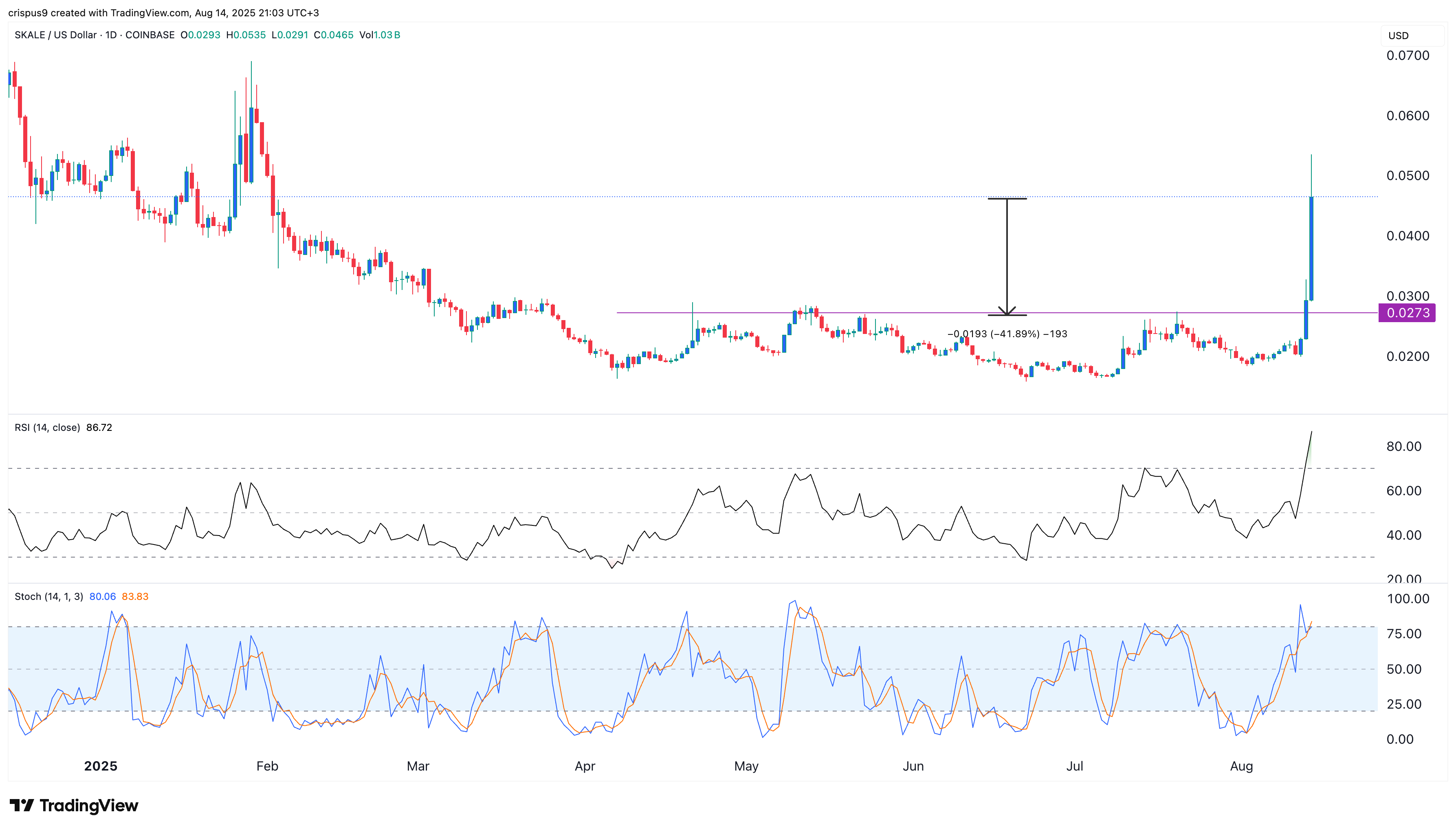
Skale crypto price

Similarly, as the chart above shows, the token has moved higher than the 50-day and 100-day moving averages. As such, it could have a mean reversion, where it drops to get closer to these averages. If this happens, the potential target will be $0.027, its highest point in July and May, down by 40% from the current level. 

Sorumluluk Reddi: Bu sitede yeniden yayınlanan makaleler, halka açık platformlardan alınmıştır ve yalnızca bilgilendirme amaçlıdır. MEXC'nin görüşlerini yansıtmayabilir. Tüm hakları telif sahiplerine aittir. Herhangi bir içeriğin üçüncü taraf haklarını ihlal ettiğini düşünüyorsanız, kaldırılması için lütfen [email protected] ile iletişime geçin. MEXC, içeriğin doğruluğu, eksiksizliği veya güncelliği konusunda hiçbir garanti vermez ve sağlanan bilgilere dayalı olarak alınan herhangi bir eylemden sorumlu değildir. İçerik, finansal, yasal veya diğer profesyonel tavsiye niteliğinde değildir ve MEXC tarafından bir tavsiye veya onay olarak değerlendirilmemelidir.

Ayrıca Şunları da Beğenebilirsiniz

‘Already seen the low?’ – Inside Cathie Wood’s bet on a new Bitcoin cycle

‘Already seen the low?’ – Inside Cathie Wood’s bet on a new Bitcoin cycle

The post ‘Already seen the low?’ – Inside Cathie Wood’s bet on a new Bitcoin cycle appeared on BitcoinEthereumNews.com. Bitcoin has rarely looked more fragile, and many analysts are already referring to this as the worst fourth quarter on record, marked by a massive leverage wipeout and a steep drop from its all-time highs. For over a decade, Bitcoin [BTC] has followed a harsh, predictable pattern: a Halving event, a commendable rally to new highs, and then a brutal 75–90% crash that resets the entire market. This cycle shaped the crypto world and created the “crypto winter” mentality that traders have come to expect. Cathie Wood challenges the four-year cycle But according to Cathie Wood, CEO and CIO of ARK Invest, those old rules no longer apply. Speaking with Fox Business, Wood made a profound declaration: institutional adoption is actively “disrupting” the traditional Bitcoin cycle. Wood noted that growing participation in U.S. Spot Bitcoin ETFs had started to change how BTC absorbed volatility. She pointed to a steady decline in its two-year volatility trend over the past five years, adding fuel to the idea of a maturing asset. Why Bitcoin’s old pattern may be fading Wood’s view challenges over a decade of beliefs built around Bitcoin’s strict, predictable four-year cycle. The evidence for this cycle is compelling.  For instance, the 2012 Halving saw Bitcoin surge from under $10 to a peak of roughly $1,100; the 2016 Halving fueled a climb from $400 to nearly $20,000; and the 2020 Halving propelled the asset from $8,500 to a record high of around $69,000. Each of these explosive rallies was followed by a painful, defining drawdown of 70% to 85%, resetting the stage for the next run. This predictable pattern, last triggered by the 20th April 2024, Halving, has historically been the sole script for investors. Yet, this time, the narrative feels disjointed and disruptive. What is Wood so concerned about? Wood…
Paylaş
BitcoinEthereumNews2025/12/11 19:15
The Critical Security Play You Can’t Miss in the AI Era

The Critical Security Play You Can’t Miss in the AI Era

The post The Critical Security Play You Can’t Miss in the AI Era appeared on BitcoinEthereumNews.com. The Watershed Moment That Changed Blockchain Security Forever Singapore – Blockman PR – December 2025 marked a turning point. Anthropic’s research team published findings that sent shockwaves through crypto: AI systems could successfully exploit smart contract vulnerabilities with 55.88% accuracy, simulating $4.6 million in potential theft from real-world contracts. The implications were existential. If AI could systematically identify and exploit vulnerabilities at scale, the entire blockchain ecosystem—processing over $1 trillion in transactions annually—faced an unprecedented threat. Traditional security tools couldn’t keep pace. Human auditors, already stretched thin reviewing less than 20% of deployed contracts, had no chance against autonomous AI attackers. But here’s what most people missed: Anthropic’s breakthrough wasn’t just validation of the threat. It was validation of the solution space. And one company had already been building that solution for six months—and winning. The Defense Was Already Operational While Anthropic demonstrated AI could break smart contracts in simulation, AgentLISA had been defending them in production. By the time Anthropic’s paper dropped, AgentLISA’s multi-agent system had detected over $7.3 million in actual vulnerabilities across real protocols managing billions in assets. The asymmetry is critical: Anthropic proved the threat is real and AI-powered. AgentLISA proved the defense is real, AI-powered, and already operational at scale. This matters because Anthropic’s research exposed something fundamental: the AI security race will be won by whoever controls the training data. And AgentLISA just lapped the entire field. LISA-Bench: The Data Moat Nobody Saw Coming https://github.com/agentlisa/bench Anthropic’s team used SCONE-bench—a dataset of 413 vulnerable smart contracts—to train their attack models. Solid methodology, respectable work. But fundamentally constrained by data scarcity. AgentLISA’s response was devastating: LISA-Bench, containing 23,959 professionally verified vulnerability records spanning 2016-2024—the largest curated smart contract vulnerability dataset ever assembled. It’s not just 60 times larger than SCONE-bench. It includes 10,185 code-complete vulnerability cases…
Paylaş
BitcoinEthereumNews2025/12/11 19:01