

Must Read
Ma’am Winnie’s remarks last week are a much-needed wake-up call for the UP School of Economics, which should be producing young, promising economists who are notMa’am Winnie’s remarks last week are a much-needed wake-up call for the UP School of Economics, which should be producing young, promising economists who are not
[In This Economy] ‘What has happened to the School?’: Winnie Monsod’s wake-up call
Last week, I had the great pleasure of moderating the fourth Ruperto P. Alonzo Memorial Lecture at the UP School of Economics (UPSE). This was organized by alumni of the School’s old Program in Development Economics (PDE), in honor of their late professor Sir Ruping (as he was lovingly called), who passed away back in 2017.
These days, the PDE program is known as the Master in Development Economics (MDE) program. But it has always catered to training economists and analysts in middle-level and technical positions in government, the private sector, and civil society organizations.
Anyway, the lecture last week featured Acting Secretary Rolando “Rolly” Toledo of the Department of Budget and Management (DBM), himself being a product of the PDE program. The theme was: “Protecting Fiscal Integrity: Fighting Corruption in Public Finance.” The discussants were Professor Cielo Magno, my colleague at the School and ardent advocate of budget reforms, and Dr. Jun Miral of the Congressional Policy and Budget Research Department. Also in the audience was former budget secretary Benjamin Diokno, a product of the early batches of the PDE program, and an emeritus professor of the School.
The lecture was memorable enough as a rare moment where government officials talked openly about the budget scandal that exploded in 2025. But it was made extra memorable by the fiery questions posed in the open forum by Professor Emerita Solita “Winnie” Monsod. (You can watch part of that here.)
First, she asked Secretary Toledo: “I’d like to know when did your office (or you personally) find out that there was something wrong? Because things don’t just explode, they build up…. Where did you go wrong?”
Secretary Toledo replied that he found out when it was “declared or presented” by the President. He added that unless a “financial and physical report” is submitted by an agency or validated by the Commission on Audit, the DBM doesn’t know that the problem exists. He also said that they issued a circular mandating agency heads to certify (through a notarized document) that programs they will pay are legitimate.
I asked Ma’am Winnie is she’s satisfied with the response, and she said emphatically, “No.”
She added, “How could you not have known? It’s beyond belief that we could not have known about this.” She pointed out (correctly) that the DBM itself should monitor the implementation of the national budget as part of its mandate, even if it is not a frontline agency to fight corruption.
At that time, Ma’am Winnie was already commanding the middle of the auditorium. Then she turned her to Ben Diokno who was seated to her left. She said, “And then we find that your [Diokno’s] assistant for so long… We have a budget secretary who resigned because of corruption…” Ma’am Winnie was referring to former budget secretary Amenah Pangandaman, a longtime assistant of Diokno and also a product of the PDE. Pangandaman resigned in November 2025 as investigations into flood control projects were heating up.
Ma’am Winnie then exclaimed, “What has happened to the School of Economics? I’m very, very disappointed, I must say… It hurts me that this corruption scandal occurred when members or graduates of the School of Economics were in positions of responsibility…”
This is a hard wake-up call for the School. But let me also add that it’s easy to overstate the role of the School. In basic economics, we teach that people respond to incentives, and the wrong incentives can lead to bad or misguided decisions by government officials, no matter how technically competent they are or no matter what school they came from.
Turning back to Secretary Toledo, Ma’am Winnie said, “I’m sorry if I offended you, you don’t get a very good grade from me.”
It was a historic moment because up until now, the role of UPSE alumni in the budget anomalies was kind of hush-hush. Ma’am Winnie’s put out in public an issue that hounds the School and its reputation.
Who authorized unprogrammed fund releases?
I followed up with questions on unprogrammed funds, noting that Congresswoman Mika Suansing, the current chair of the House Appropriations Committee, confirmed in 2025 that at least P141 billion in flood control projects in 2023 and 2024 were funded using unprogrammed appropriations.
Secretary Toledo confirmed that it was former budget secretary Amenah Pangandaman (a longtime assistant of Ben Diokno and also a graduate of the PDE program) who signed the Special Allotment Release Orders (SARO) that allowed the downloading of funds for anomalous flood control projects.
Ma’am Winnie interjected to point out that in 2008, the late budget secretary Emilia Boncodin already called out that unprogrammed funds were being abused. “Why do the technocrats not bring this out more forcefully?” She then asked Ben Diokno to clarify who approves the release of unprogrammed funds — the budget secretary or the president.
Diokno stood up, got a mic, and insisted that it’s the president who approves, and that the secretary cannot release it by himself or herself. He said that the secretary signs but they “must have a memo to the president, you cannot release it on your own — unless you changed the rules,” implying that during his time, things were a bit different.
But Secretary Toledo rebutted, “As far as I know, the [budget] secretary is the one who signs and approves the release from the unprogrammed appropriations,” so long as the law’s requirements are fulfilled.
This exchange gives mixed signals but has huge implications. Either Malacañang knew, or former budget secretary Pangandaman acted autonomously. (READ: Marcos, DBM can’t wash hands of ‘mangled’ 2025 budget – ex-finance chief)
On the one hand, if we follow Diokno’s logic, it would appear that President Marcos would have first-hand knowledge of flood control project approvals, if the budget secretary needs permission from the Palace before releasing unprogrammed funds. This would demolish the idea that Marcos was in any way “surprised” that flood control corruption was happening. At the same time, this serves to remove responsibility from the former budget secretary Pangandaman, a long-time assistant of Diokno.
On the other hand, the official line from Secretary Toledo is that the budget secretary signs and approves releases from unprogrammed funds, without needing the approval of the President. This would absolve the President but put the blame on Amenah Pangandaman who signed all the releases.
Later, there was agreement among economists in the room that the “original sin” came from the way Congress bloated unprogrammed funds. Cheekily, Cielo said that perhaps next time former congresswoman Stella Quimbo — another product and previous faculty of the School — should be invited to answer for the budget anomalies, insofar as she was the former vice-chair of the House Appropriations Committee (second-in-command to Zaldy Co and ally to former speaker Martin Romualdez).
Wake-up call
In sum, Ma’am Winnie’s remarks last week are a much-needed wake-up call for the School. It cannot be denied that alumni of the School (especially Amenah Pangandaman and Stella Quimbo) were implicated in the whole budget mess that opened the floodgates to public works corruption. Other alumni were bureaucrats involved in the budget process one way or another.
Sure, it is unfair to blame the School entirely for the corruption scandal. But for good or bad, the School does produce graduates who find themselves in the halls of power later in their careers. And I do hope that at UPSE we are producing young, promising economists who are not just technically savvy but also possess strong moral fiber to speak out truth to power.
The broader lesson, I think, is about how easily technical expertise can be neutralized by broken political incentives. If we don’t fix these incentives, then expect otherwise good or competent people to stay silent or be eaten up by the system 10, 50, or even 100 years from now. – Rappler.com
Dr. JC Punongbayan is an assistant professor at the UP School of Economics and the author of False Nostalgia: The Marcos “Golden Age” Myths and How to Debunk Them. In 2024, he received The Outstanding Young Men (TOYM) Award for economics. Follow him on Instagram (@jcpunongbayan).
Click here for more In This Economy by JC Punongbayan articles.
Piyasa Fırsatı
Notcoin Fiyatı(NOT)
$0.0004086
$0.0004086$0.0004086
USD
Notcoin (NOT) Canlı Fiyat Grafiği
Sorumluluk Reddi: Bu sitede yeniden yayınlanan makaleler, halka açık platformlardan alınmıştır ve yalnızca bilgilendirme amaçlıdır. MEXC'nin görüşlerini yansıtmayabilir. Tüm hakları telif sahiplerine aittir. Herhangi bir içeriğin üçüncü taraf haklarını ihlal ettiğini düşünüyorsanız, kaldırılması için lütfen [email protected] ile iletişime geçin. MEXC, içeriğin doğruluğu, eksiksizliği veya güncelliği konusunda hiçbir garanti vermez ve sağlanan bilgilere dayalı olarak alınan herhangi bir eylemden sorumlu değildir. İçerik, finansal, yasal veya diğer profesyonel tavsiye niteliğinde değildir ve MEXC tarafından bir tavsiye veya onay olarak değerlendirilmemelidir.
Ayrıca Şunları da Beğenebilirsiniz

Bitcoin Hyper Not Far from $20M, Whales Keep Buying: See What This $BTC Layer-2 Plans
To the uninitiated, Bitcoin and crypto are synonymous – and it’s only fair, given that the granddaddy of all crypto has been the face of the industry ever since it burst onto the scene a few years back. Since 2020, Bitcoin has generated over 1,500% in returns. Basically, crypto is so much about Bitcoin. All […]
Paylaş
Bitcoinist2025/09/22 16:37
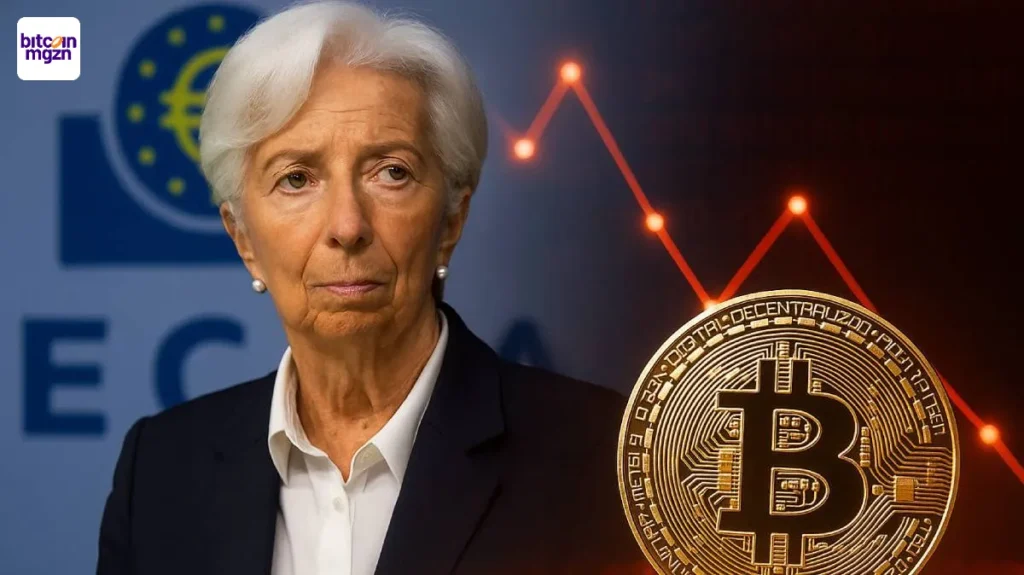
ECB-president hernieuwt aanval op Bitcoin terwijl euro daalt
Snelle crypto updates? Connect op Instagram! Check onze Instagram ECB-president Christine Lagarde noemt Bitcoin waardeloos en waarschuwt voor zijn speculatieve aard. Haar uitspraken komen op een moment dat DeFi groeit en de euro onder druk staat, wat de discussie over geld en controle opnieuw tot leven brengt. ECB houdt vast aan kritiek op Bitcoin en DeFi De Europese Centrale Bank (ECB) blijft vasthouden aan haar scherpe toon over Bitcoin. Volgens president Christine Lagarde ontbreekt de munt het fundament dat echt geld kenmerkt. Ze noemt het een speculatief middel zonder onderliggende waarde, en benadrukt dat de ECB het publieke vertrouwen in geld moet beschermen. Terwijl de digitale economie zich steeds meer richting decentralisatie beweegt, probeert de bank haar rol als stabiele pijler te behouden. ECB (European Central Bank) De European Central Bank (ECB) is de centrale bank van de eurozone en bepaalt samen met de nationale banken het monetaire beleid voor de euro. Ze houdt de inflatie in de gaten, bepaalt de rente en zorgt voor stabiliteit van het financiële systeem. In de cryptowereld speelt de ECB vooral een rol met het onderzoek en de voorbereidingen voor een digitale euro, een eigen centrale bank digitale munt (CBDC). Daarmee wil de bank inspelen op de groei van digitaal geld en alternatieven zoals stablecoins. Voor de crypto-industrie is dit belangrijk omdat een digitale euro de concurrentie en het speelveld voor private stablecoins kan veranderen. De waarschuwing van Lagarde past in een bredere strategie van de ECB. De opkomst van decentrale financiële systemen (DeFi) wordt gezien als een uitdaging voor de invloed van centrale banken. In die waarschuwing lijkt ook iets van zelfbescherming door te klinken: het behoud van macht over monetair beleid. Voorstanders van Bitcoin wijzen juist op de kracht van schaarste, transparantie en onafhankelijkheid; eigenschappen die fiatgeld in hun ogen steeds meer verliest. “How many bitcoin do you own?” That’s how it starts, a stupid question from the host. From there, it goes downhill fast. Christine Lagarde repeats every tired anti-bitcoin cliché the ECB has ever pushed. Let’s go… 1️⃣ “Bitcoin has no intrinsic value.” Neither does fiat.… pic.twitter.com/uMqtEHvkD0 — Eli Nagar (@EliNagarBrr) October 7, 2025 De euro verzwakt terwijl crypto aan invloed wint Ondertussen verliest de euro langzaam maar zeker aan koopkracht. Sinds de invoering in 2002 is de munt ruim veertig procent van haar reële waarde kwijtgeraakt. Dat voedt de twijfel over de houdbaarheid van het huidige fiatstelsel en vergroot de interesse in alternatieven zoals Bitcoin en andere cryptovaluta. Binnen de Europese cryptogemeenschap worden de woorden van de ECB dan ook met de nodige scepsis onthaald. Been 22 years, physical $Euro coins and banknotes entered circulation on January 1st 2002. Since then, this fiasco lost 40% of its buying power according to “official” stats. Won’t even mention real stats, or you’d be dumping ALL your Eurobolivars for #Bitcoin right now. pic.twitter.com/Rp3KinVfPm — Vandelay ₿TC Industries ⚡ (@VandelayBTC) January 3, 2024 DeFi-platforms en stablecoins winnen terrein in Europa, juist omdat ze nieuwe mogelijkheden bieden voor rendement en autonomie. Waar Lagarde waarschuwt voor volatiliteit, zien veel gebruikers vooral vrijheid in een systeem dat zich niets aantrekt van centrale banken. De groei van DeFi laat zien dat vertrouwen niet alleen via instituties ontstaat, maar ook via technologie. Monetaire controle en vertrouwen in het digitale tijdperk De standpunten van de ECB leggen een oud spanningsveld bloot: de strijd tussen stabiliteit en vrijheid. Aan de ene kant verdedigt de bank haar rol als bewaker van orde, aan de andere kant tonen cryptomarkten dat vertrouwen ook buiten traditionele kanalen kan bestaan. Terwijl de ECB pleit voor zekerheid en voorspelbaarheid, zoeken investeerders steeds vaker transparantie en zelfbeschikking. Lagarde’s uitspraken passen in een wereldwijde trend waarin centrale banken proberen hun gezag te behouden in een economie die snel verandert. Toch klinkt steeds luider de vraag of die vorm van controle nog houdbaar is. Nieuwe technologieën maken directe waardeoverdracht mogelijk,zonder tussenkomst van banken. Dat idee wringt natuurlijk met de kern van het bestaande financiële systeem. Exactly. It was narrative management. They feel threatened. That’s why real questions about monetary policy, inflation, and accountability never make it to the script. — Eli Nagar (@EliNagarBrr) October 8, 2025 De toekomst van waarde: centraal of gedecentraliseerd? De discussie tussen de ECB en de cryptowereld draait om meer dan geld. Het gaat om vertrouwen, transparantie en macht over waarde. Zolang de euro verder verzwakt en decentrale technologieën blijven groeien, lijkt de kloof tussen centrale banken en de cryptosector alleen maar groter te worden. Hoeveel invloed de ECB kan behouden, hangt af van haar vermogen zich aan te passen aan dit nieuwe tijdperk. De strijd om waarde is niet enkel economisch, maar ook ideologisch. In dat licht voelt de opkomst van Bitcoin minder als een bedreiging, en meer als een logisch gevolg van de zoektocht naar onafhankelijkheid in geld. Koop je Bitcoin via Best Wallet Best wallet is een topklasse crypto wallet waarmee je anoniem crypto kan kopen. Met meer dan 60 chains gesupport kan je al je main crypto coins aanschaffen via Best Wallet. Best wallet - betrouwbare en anonieme wallet Best wallet - betrouwbare en anonieme wallet Meer dan 60 chains beschikbaar voor alle crypto Vroege toegang tot nieuwe projecten Hoge staking belongingen Lage transactiekosten Best wallet review Koop nu via Best Wallet Let op: cryptocurrency is een zeer volatiele en ongereguleerde investering. Doe je eigen onderzoek. Het bericht ECB-president hernieuwt aanval op Bitcoin terwijl euro daalt is geschreven door Sebastiaan Krijnen en verscheen als eerst op Bitcoinmagazine.nl.
Paylaş
Coinstats2025/10/11 03:16

What SBI Really Owns in Ripple May Surprise XRP Investors
The post What SBI Really Owns in Ripple May Surprise XRP Investors appeared on BitcoinEthereumNews.com. SBI Holdings Chairman Yoshitaka Kitao has confirmed that
Paylaş
BitcoinEthereumNews2026/02/16 16:14