Fresh from two decades at BlackRock, Joseph Chalom has stepped out of retirement to lead SharpLink Gaming Inc., a Nasdaq-listed company that has drawn comparisons to MicroStrategy for its aggressive Ethereum treasury strategy. In an exclusive interview with CryptoNews, Chalom outlines why he left traditional finance, what SharpLink is trying to achieve with ETH, and why he sees Ethereum as the foundation for the future of tokenization and decentralized finance. From BlackRock to SharpLink Chalom spent 20 years at BlackRock, where his career spanned both traditional finance and digital assets. He points to two accomplishments that defined his tenure: scaling Aladdin, BlackRock’s enterprise risk management system used by many of the world’s largest asset managers, and later leading the firm’s digital asset team. That latter role focused on bridging traditional investors with crypto markets, preparing institutions for the shift he believes is inevitable. After retiring from BlackRock in June 2025, Chalom was pulled back into the industry following a conversation with co-founder of Ethereum and CEO of Consensys, Joseph Lubin, who now serves as chairman of SharpLink’s board. “We both have a vision of a world where more efficient systems allow the exchange of value in a fundamentally different way than exists today,” Chalom said, pointing to Ethereum’s ability to settle transactions trustlessly and instantly. On Being Called the ‘MicroStrategy of Ethereum’ The comparison to Michael Saylor’s MicroStrategy, which famously accumulated billions of dollars in Bitcoin, has followed SharpLink since it began deploying its capital into ETH. Chalom acknowledges the parallel while stressing the differences between Bitcoin and Ethereum. “Michael Saylor has demonstrated that over a multi-year period, you can have a public company that buys a crypto asset and that company can trade at a premium in value,” he said. “We are trying to do a very similar thing with Ethereum, which is be a public treasury, raise capital from investors, buy Ethereum, and allow investors to participate in three things: capital appreciation, staking yield, and supporting the ecosystem,” Chalom said. Unlike Bitcoin, he added, Ethereum is a productive asset. Staking ETH can generate yield that is considered revenue, giving SharpLink an additional income stream. “We tip our hat to Michael Saylor in demonstrating that a crypto strategy in a treasury can work,” Chalom said. “We just think Ethereum is a more ideal treasury asset.” Ethereum, Tokenization, and the Long-Term Opportunity Chalom frames SharpLink’s mission around what he calls the “long-term Ethereum opportunity,” which he breaks down into three categories: stablecoins, tokenized real-world assets, and broader financial and non-financial applications. Stablecoins, the majority of which are issued on Ethereum or its Layer 2 networks, have grown into a $275 billion market. U.S. Treasury Secretary Janet Yellen has suggested that it could rise to several trillion in the coming years. Tokenization of traditional assets is the second leg of the thesis. From tokenized treasuries to equities and funds, Chalom sees programmable, instantly settling assets as a structural shift away from legacy systems that take days to settle. “When assets or securities or funds are held in tokenized format, they are programmable, tradable, sometimes 24/7, and most importantly, they settle instantly,” he said. Finally, as more real-world activity is represented in tokenized form on Ethereum, demand for ETH as the network’s native asset should rise. Chalom points to a framework: Historically, every $2 of high-quality assets secured on Ethereum translates into roughly a $1 increase in ETH’s market cap. “We’re accumulating as much ether as possible right now at the current prices, because we see significant appreciation in its value,” he said. Competition and Differentiation SharpLink is not alone in pursuing an Ethereum-focused treasury strategy. Rival BitMine has announced plans for a massive $24.5 billion raise to build its own ETH war chest, a sign of how corporate ether accumulation is accelerating. With ETH hovering near record highs, institutions are targeting a larger share of the supply. Chalom welcomes the competition. “If others have the same investment thesis, it means some of the best minds are validating this thesis, and we actually welcome that.” Still, he argues that SharpLink is uniquely positioned. The firm has built a team of institutional-grade investors and strategists and maintains a strategic partnership with ConsenSys, the Ethereum development company founded by Lubin. “That partnership gives us opportunities to participate in DeFi, capture the most expert staking yields, and potentially build Ethereum-denominated operating companies,” he said. “That is a true differentiator.” Regulation and Institutional Access Chalom is optimistic about the regulatory environment in the U.S., pointing to two developments: the GENIUS Act, which clarifies ownership and participation in crypto, and the pending CLARITY Act, which lays out market structure. Historically, institutions faced challenges around custody and mandates. But with ETFs now available and a public company wrapper via SharpLink’s Nasdaq listing, access is expanding. “Owning ETH through SharpLink is just like owning an equity,” Chalom said. “That is the first unlock. The second unlock is regulatory clarity. The headwinds have been released, and we’re at the point where there is a well-defined institutional path to owning Ethereum.” Looking Back: The First ETF Launch Chalom also reflects on his time at BlackRock during the approval of the first Bitcoin and Ethereum exchange-traded products in 2024, which he describes as “a seminal moment in the adoption of crypto by traditional institutions.” Those launches brought over $100 billion of traditional capital into Bitcoin and Ethereum, he notes, and set the stage for companies like SharpLink to strengthen the bridge between traditional markets and digital assets. “I still think it’s early in the investment opportunity in Ethereum,” Chalom adds, comparing the current moment to the early days of the internet. “The most transformation is ahead of us.” As SharpLink leans into its Ethereum-centric strategy, the comparisons to MicroStrategy may persist. But Chalom insists the company’s approach is more than a trade—it’s about building a long-term platform around a productive, revenue-generating, and programmable network asset. Whether SharpLink ultimately becomes known as the “MicroStrategy of Ethereum” or something else, the company’s moves will remain closely watched by both Wall Street and the crypto community. Price Action SharpLink Gaming Inc. (NASDAQ: SBET) has delivered a considerable rally in 2025, with shares up 128% year-to-date at $18.46 despite a volatile trading range. The stock surged to a 52-week high of $124.12 earlier this year on the back of its aggressive Ethereum treasury strategy, before retracing as markets absorbed the scale of its purchases. Still, with a market cap of $3.22 billion, SharpLink remains one of the most closely watched public companies, tying its fortunes directly to ETHFresh from two decades at BlackRock, Joseph Chalom has stepped out of retirement to lead SharpLink Gaming Inc., a Nasdaq-listed company that has drawn comparisons to MicroStrategy for its aggressive Ethereum treasury strategy. In an exclusive interview with CryptoNews, Chalom outlines why he left traditional finance, what SharpLink is trying to achieve with ETH, and why he sees Ethereum as the foundation for the future of tokenization and decentralized finance. From BlackRock to SharpLink Chalom spent 20 years at BlackRock, where his career spanned both traditional finance and digital assets. He points to two accomplishments that defined his tenure: scaling Aladdin, BlackRock’s enterprise risk management system used by many of the world’s largest asset managers, and later leading the firm’s digital asset team. That latter role focused on bridging traditional investors with crypto markets, preparing institutions for the shift he believes is inevitable. After retiring from BlackRock in June 2025, Chalom was pulled back into the industry following a conversation with co-founder of Ethereum and CEO of Consensys, Joseph Lubin, who now serves as chairman of SharpLink’s board. “We both have a vision of a world where more efficient systems allow the exchange of value in a fundamentally different way than exists today,” Chalom said, pointing to Ethereum’s ability to settle transactions trustlessly and instantly. On Being Called the ‘MicroStrategy of Ethereum’ The comparison to Michael Saylor’s MicroStrategy, which famously accumulated billions of dollars in Bitcoin, has followed SharpLink since it began deploying its capital into ETH. Chalom acknowledges the parallel while stressing the differences between Bitcoin and Ethereum. “Michael Saylor has demonstrated that over a multi-year period, you can have a public company that buys a crypto asset and that company can trade at a premium in value,” he said. “We are trying to do a very similar thing with Ethereum, which is be a public treasury, raise capital from investors, buy Ethereum, and allow investors to participate in three things: capital appreciation, staking yield, and supporting the ecosystem,” Chalom said. Unlike Bitcoin, he added, Ethereum is a productive asset. Staking ETH can generate yield that is considered revenue, giving SharpLink an additional income stream. “We tip our hat to Michael Saylor in demonstrating that a crypto strategy in a treasury can work,” Chalom said. “We just think Ethereum is a more ideal treasury asset.” Ethereum, Tokenization, and the Long-Term Opportunity Chalom frames SharpLink’s mission around what he calls the “long-term Ethereum opportunity,” which he breaks down into three categories: stablecoins, tokenized real-world assets, and broader financial and non-financial applications. Stablecoins, the majority of which are issued on Ethereum or its Layer 2 networks, have grown into a $275 billion market. U.S. Treasury Secretary Janet Yellen has suggested that it could rise to several trillion in the coming years. Tokenization of traditional assets is the second leg of the thesis. From tokenized treasuries to equities and funds, Chalom sees programmable, instantly settling assets as a structural shift away from legacy systems that take days to settle. “When assets or securities or funds are held in tokenized format, they are programmable, tradable, sometimes 24/7, and most importantly, they settle instantly,” he said. Finally, as more real-world activity is represented in tokenized form on Ethereum, demand for ETH as the network’s native asset should rise. Chalom points to a framework: Historically, every $2 of high-quality assets secured on Ethereum translates into roughly a $1 increase in ETH’s market cap. “We’re accumulating as much ether as possible right now at the current prices, because we see significant appreciation in its value,” he said. Competition and Differentiation SharpLink is not alone in pursuing an Ethereum-focused treasury strategy. Rival BitMine has announced plans for a massive $24.5 billion raise to build its own ETH war chest, a sign of how corporate ether accumulation is accelerating. With ETH hovering near record highs, institutions are targeting a larger share of the supply. Chalom welcomes the competition. “If others have the same investment thesis, it means some of the best minds are validating this thesis, and we actually welcome that.” Still, he argues that SharpLink is uniquely positioned. The firm has built a team of institutional-grade investors and strategists and maintains a strategic partnership with ConsenSys, the Ethereum development company founded by Lubin. “That partnership gives us opportunities to participate in DeFi, capture the most expert staking yields, and potentially build Ethereum-denominated operating companies,” he said. “That is a true differentiator.” Regulation and Institutional Access Chalom is optimistic about the regulatory environment in the U.S., pointing to two developments: the GENIUS Act, which clarifies ownership and participation in crypto, and the pending CLARITY Act, which lays out market structure. Historically, institutions faced challenges around custody and mandates. But with ETFs now available and a public company wrapper via SharpLink’s Nasdaq listing, access is expanding. “Owning ETH through SharpLink is just like owning an equity,” Chalom said. “That is the first unlock. The second unlock is regulatory clarity. The headwinds have been released, and we’re at the point where there is a well-defined institutional path to owning Ethereum.” Looking Back: The First ETF Launch Chalom also reflects on his time at BlackRock during the approval of the first Bitcoin and Ethereum exchange-traded products in 2024, which he describes as “a seminal moment in the adoption of crypto by traditional institutions.” Those launches brought over $100 billion of traditional capital into Bitcoin and Ethereum, he notes, and set the stage for companies like SharpLink to strengthen the bridge between traditional markets and digital assets. “I still think it’s early in the investment opportunity in Ethereum,” Chalom adds, comparing the current moment to the early days of the internet. “The most transformation is ahead of us.” As SharpLink leans into its Ethereum-centric strategy, the comparisons to MicroStrategy may persist. But Chalom insists the company’s approach is more than a trade—it’s about building a long-term platform around a productive, revenue-generating, and programmable network asset. Whether SharpLink ultimately becomes known as the “MicroStrategy of Ethereum” or something else, the company’s moves will remain closely watched by both Wall Street and the crypto community. Price Action SharpLink Gaming Inc. (NASDAQ: SBET) has delivered a considerable rally in 2025, with shares up 128% year-to-date at $18.46 despite a volatile trading range. The stock surged to a 52-week high of $124.12 earlier this year on the back of its aggressive Ethereum treasury strategy, before retracing as markets absorbed the scale of its purchases. Still, with a market cap of $3.22 billion, SharpLink remains one of the most closely watched public companies, tying its fortunes directly to ETH

SharpLink Co-CEO Joseph Chalom on Being Dubbed the ‘MicroStrategy of Ethereum’

2025/08/30 00:16
Okuma süresi: 6 dk

Fresh from two decades at BlackRock, Joseph Chalom has stepped out of retirement to lead SharpLink Gaming Inc., a Nasdaq-listed company that has drawn comparisons to MicroStrategy for its aggressive Ethereum treasury strategy.

In an exclusive interview with CryptoNews, Chalom outlines why he left traditional finance, what SharpLink is trying to achieve with ETH, and why he sees Ethereum as the foundation for the future of tokenization and decentralized finance.

Chalom spent 20 years at BlackRock, where his career spanned both traditional finance and digital assets. He points to two accomplishments that defined his tenure: scaling Aladdin, BlackRock’s enterprise risk management system used by many of the world’s largest asset managers, and later leading the firm’s digital asset team.

That latter role focused on bridging traditional investors with crypto markets, preparing institutions for the shift he believes is inevitable.

After retiring from BlackRock in June 2025, Chalom was pulled back into the industry following a conversation with co-founder of Ethereum and CEO of Consensys, Joseph Lubin, who now serves as chairman of SharpLink’s board.

“We both have a vision of a world where more efficient systems allow the exchange of value in a fundamentally different way than exists today,” Chalom said, pointing to Ethereum’s ability to settle transactions trustlessly and instantly.

On Being Called the ‘MicroStrategy of Ethereum’

The comparison to Michael Saylor’s MicroStrategy, which famously accumulated billions of dollars in Bitcoin, has followed SharpLink since it began deploying its capital into ETH. Chalom acknowledges the parallel while stressing the differences between Bitcoin and Ethereum.

“Michael Saylor has demonstrated that over a multi-year period, you can have a public company that buys a crypto asset and that company can trade at a premium in value,” he said.

“We are trying to do a very similar thing with Ethereum, which is be a public treasury, raise capital from investors, buy Ethereum, and allow investors to participate in three things: capital appreciation, staking yield, and supporting the ecosystem,” Chalom said.

Unlike Bitcoin, he added, Ethereum is a productive asset. Staking ETH can generate yield that is considered revenue, giving SharpLink an additional income stream.

“We tip our hat to Michael Saylor in demonstrating that a crypto strategy in a treasury can work,” Chalom said. “We just think Ethereum is a more ideal treasury asset.”

Ethereum, Tokenization, and the Long-Term Opportunity

Chalom frames SharpLink’s mission around what he calls the “long-term Ethereum opportunity,” which he breaks down into three categories: stablecoins, tokenized real-world assets, and broader financial and non-financial applications.

Stablecoins, the majority of which are issued on Ethereum or its Layer 2 networks, have grown into a $275 billion market. U.S. Treasury Secretary Janet Yellen has suggested that it could rise to several trillion in the coming years.

Tokenization of traditional assets is the second leg of the thesis. From tokenized treasuries to equities and funds, Chalom sees programmable, instantly settling assets as a structural shift away from legacy systems that take days to settle.

“When assets or securities or funds are held in tokenized format, they are programmable, tradable, sometimes 24/7, and most importantly, they settle instantly,” he said.

Finally, as more real-world activity is represented in tokenized form on Ethereum, demand for ETH as the network’s native asset should rise. Chalom points to a framework: Historically, every $2 of high-quality assets secured on Ethereum translates into roughly a $1 increase in ETH’s market cap.

“We’re accumulating as much ether as possible right now at the current prices, because we see significant appreciation in its value,” he said.

Competition and Differentiation

SharpLink is not alone in pursuing an Ethereum-focused treasury strategy. Rival BitMine has announced plans for a massive $24.5 billion raise to build its own ETH war chest, a sign of how corporate ether accumulation is accelerating. With ETH hovering near record highs, institutions are targeting a larger share of the supply.

Chalom welcomes the competition. “If others have the same investment thesis, it means some of the best minds are validating this thesis, and we actually welcome that.”

Still, he argues that SharpLink is uniquely positioned. The firm has built a team of institutional-grade investors and strategists and maintains a strategic partnership with ConsenSys, the Ethereum development company founded by Lubin.

“That partnership gives us opportunities to participate in DeFi, capture the most expert staking yields, and potentially build Ethereum-denominated operating companies,” he said. “That is a true differentiator.”

Regulation and Institutional Access

Chalom is optimistic about the regulatory environment in the U.S., pointing to two developments: the GENIUS Act, which clarifies ownership and participation in crypto, and the pending CLARITY Act, which lays out market structure.

Historically, institutions faced challenges around custody and mandates. But with ETFs now available and a public company wrapper via SharpLink’s Nasdaq listing, access is expanding.

“Owning ETH through SharpLink is just like owning an equity,” Chalom said. “That is the first unlock. The second unlock is regulatory clarity. The headwinds have been released, and we’re at the point where there is a well-defined institutional path to owning Ethereum.”

Looking Back: The First ETF Launch

Chalom also reflects on his time at BlackRock during the approval of the first Bitcoin and Ethereum exchange-traded products in 2024, which he describes as “a seminal moment in the adoption of crypto by traditional institutions.”

Those launches brought over $100 billion of traditional capital into Bitcoin and Ethereum, he notes, and set the stage for companies like SharpLink to strengthen the bridge between traditional markets and digital assets.

“I still think it’s early in the investment opportunity in Ethereum,” Chalom adds, comparing the current moment to the early days of the internet. “The most transformation is ahead of us.”

As SharpLink leans into its Ethereum-centric strategy, the comparisons to MicroStrategy may persist. But Chalom insists the company’s approach is more than a trade—it’s about building a long-term platform around a productive, revenue-generating, and programmable network asset.

Whether SharpLink ultimately becomes known as the “MicroStrategy of Ethereum” or something else, the company’s moves will remain closely watched by both Wall Street and the crypto community.

Price Action

SharpLink Gaming Inc. (NASDAQ: SBET) has delivered a considerable rally in 2025, with shares up 128% year-to-date at $18.46 despite a volatile trading range.
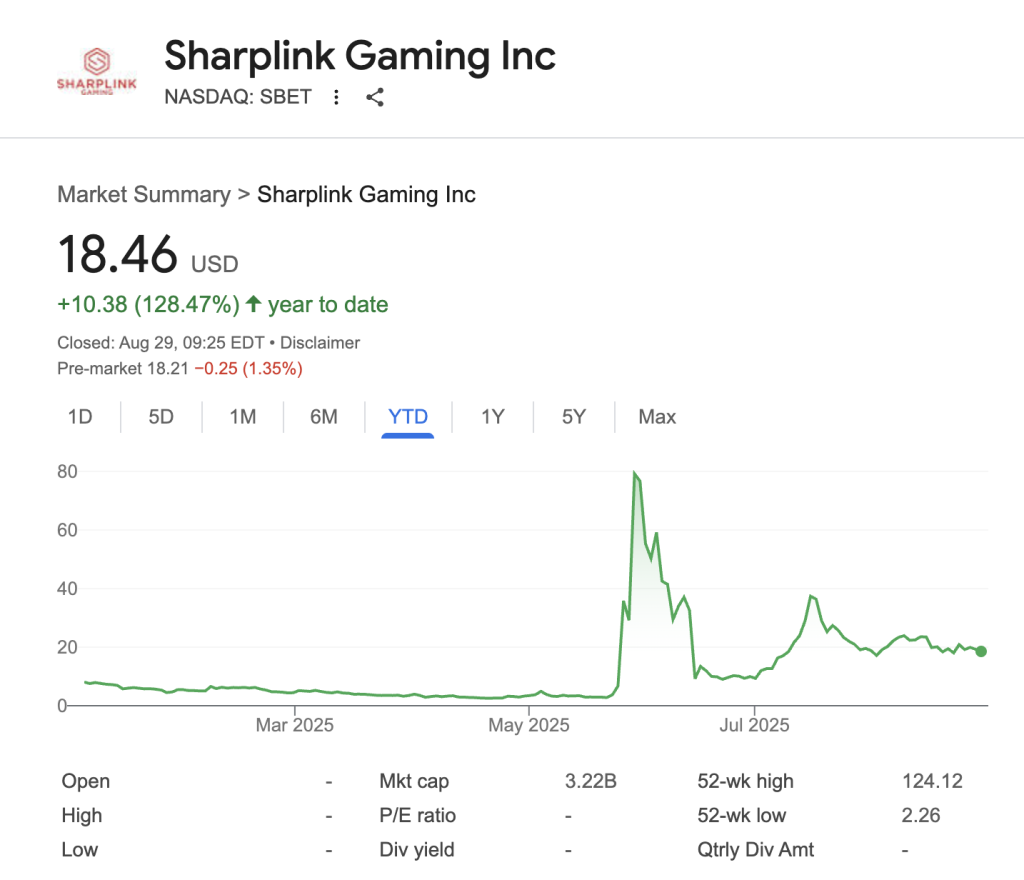
The stock surged to a 52-week high of $124.12 earlier this year on the back of its aggressive Ethereum treasury strategy, before retracing as markets absorbed the scale of its purchases. Still, with a market cap of $3.22 billion, SharpLink remains one of the most closely watched public companies, tying its fortunes directly to ETH.

Sorumluluk Reddi: Bu sitede yeniden yayınlanan makaleler, halka açık platformlardan alınmıştır ve yalnızca bilgilendirme amaçlıdır. MEXC'nin görüşlerini yansıtmayabilir. Tüm hakları telif sahiplerine aittir. Herhangi bir içeriğin üçüncü taraf haklarını ihlal ettiğini düşünüyorsanız, kaldırılması için lütfen [email protected] ile iletişime geçin. MEXC, içeriğin doğruluğu, eksiksizliği veya güncelliği konusunda hiçbir garanti vermez ve sağlanan bilgilere dayalı olarak alınan herhangi bir eylemden sorumlu değildir. İçerik, finansal, yasal veya diğer profesyonel tavsiye niteliğinde değildir ve MEXC tarafından bir tavsiye veya onay olarak değerlendirilmemelidir.

Ayrıca Şunları da Beğenebilirsiniz

CME Group to Launch Solana and XRP Futures Options

CME Group to Launch Solana and XRP Futures Options

The post CME Group to Launch Solana and XRP Futures Options appeared on BitcoinEthereumNews.com. An announcement was made by CME Group, the largest derivatives exchanger worldwide, revealed that it would introduce options for Solana and XRP futures. It is the latest addition to CME crypto derivatives as institutions and retail investors increase their demand for Solana and XRP. CME Expands Crypto Offerings With Solana and XRP Options Launch According to a press release, the launch is scheduled for October 13, 2025, pending regulatory approval. The new products will allow traders to access options on Solana, Micro Solana, XRP, and Micro XRP futures. Expiries will be offered on business days on a monthly, and quarterly basis to provide more flexibility to market players. CME Group said the contracts are designed to meet demand from institutions, hedge funds, and active retail traders. According to Giovanni Vicioso, the launch reflects high liquidity in Solana and XRP futures. Vicioso is the Global Head of Cryptocurrency Products for the CME Group. He noted that the new contracts will provide additional tools for risk management and exposure strategies. Recently, CME XRP futures registered record open interest amid ETF approval optimism, reinforcing confidence in contract demand. Cumberland, one of the leading liquidity providers, welcomed the development and said it highlights the shift beyond Bitcoin and Ethereum. FalconX, another trading firm, added that rising digital asset treasuries are increasing the need for hedging tools on alternative tokens like Solana and XRP. High Record Trading Volumes Demand Solana and XRP Futures Solana futures and XRP continue to gain popularity since their launch earlier this year. According to CME official records, many have bought and sold more than 540,000 Solana futures contracts since March. A value that amounts to over $22 billion dollars. Solana contracts hit a record 9,000 contracts in August, worth $437 million. Open interest also set a record at 12,500 contracts.…
Paylaş
BitcoinEthereumNews2025/09/18 01:39
Metaplanet CEO Denies Hiding Details

Metaplanet CEO Denies Hiding Details

The post Metaplanet CEO Denies Hiding Details appeared on BitcoinEthereumNews.com. Storm Over Bitcoin Trades: Metaplanet CEO Denies Hiding Details
Paylaş
BitcoinEthereumNews2026/02/21 21:03
Shadows in the Payment Rail: The Urbenics.com Mystery

Shadows in the Payment Rail: The Urbenics.com Mystery

A new, anonymous player has emerged in the high-risk payment sector. Operating without a public face, Urbenics.com is quietly fueling the offshore casino industry
Paylaş
Fintelegram2026/02/21 20:44
