XRP vs. Cardano: Which Crypto Is the Better Buy for the Long-Term?
TLDR
- XRP has grown its tokenized assets on the XRP Ledger from under $80 million to $453 million in roughly a year
- XRP ETFs now hold over $1.1 billion in capital as of early March 2026
- Cardano currently holds only $138 million in DeFi assets, far short of its $3 billion target for 2030
- XRP trades around $1.42 with an $87 billion market cap; Cardano trades at $0.27 with a $10 billion market cap
- Analysts project XRP could reach $3–$8 by year-end; Cardano forecasts are more modest at $0.30–$1
XRP and Cardano are two of the most talked-about cryptocurrencies in 2026. Both have loyal communities, but their performance and real-world traction tell very different stories.
XRP is designed for financial institutions. Banks, currency exchanges, and hedge funds are the target users. The XRP Ledger supports asset tokenization, meaning real-world financial instruments like bonds can be tracked on the blockchain.
A year ago, the XRP Ledger had less than $80 million in tokenized assets. Today that number sits at $453 million. That growth has come quickly, mostly through late 2025 and early 2026.
XRP exchange-traded funds have also attracted over $1.1 billion in capital as of March 6, 2026. That means everyday investors can gain exposure without needing a crypto wallet.
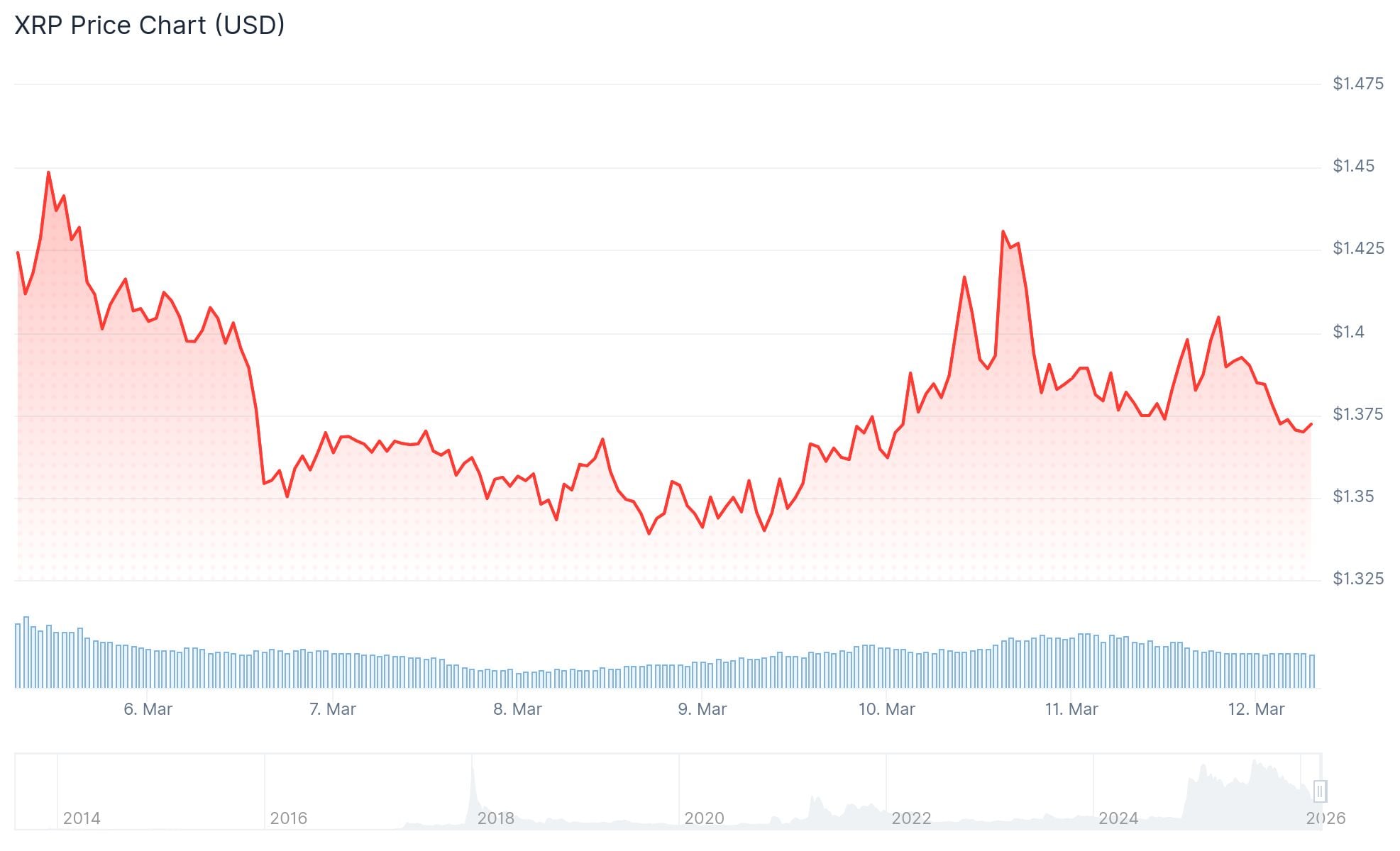 XRP Price
XRP currently trades at around $1.42, with a market cap of $87 billion. Its 52-week range runs from $1.14 to $3.65.
Cardano takes a different approach. It focuses on academic research and peer-reviewed code. The goal is to build a general-purpose blockchain capable of running smart contracts and decentralized apps.
Its 2030 roadmap targets $3 billion in DeFi assets, one million monthly active wallets, and 324 million annual transactions. Right now, those numbers look distant.
Where Cardano Stands Today
Cardano currently holds $138 million in DeFi assets. Daily fees total around $1,900. Fewer than 17,000 wallet addresses are active per day.
Those figures suggest the network sees limited use, despite years of feature development. An effort in late 2025 to add stablecoin liquidity to the network did not produce a measurable uptick in users or capital.
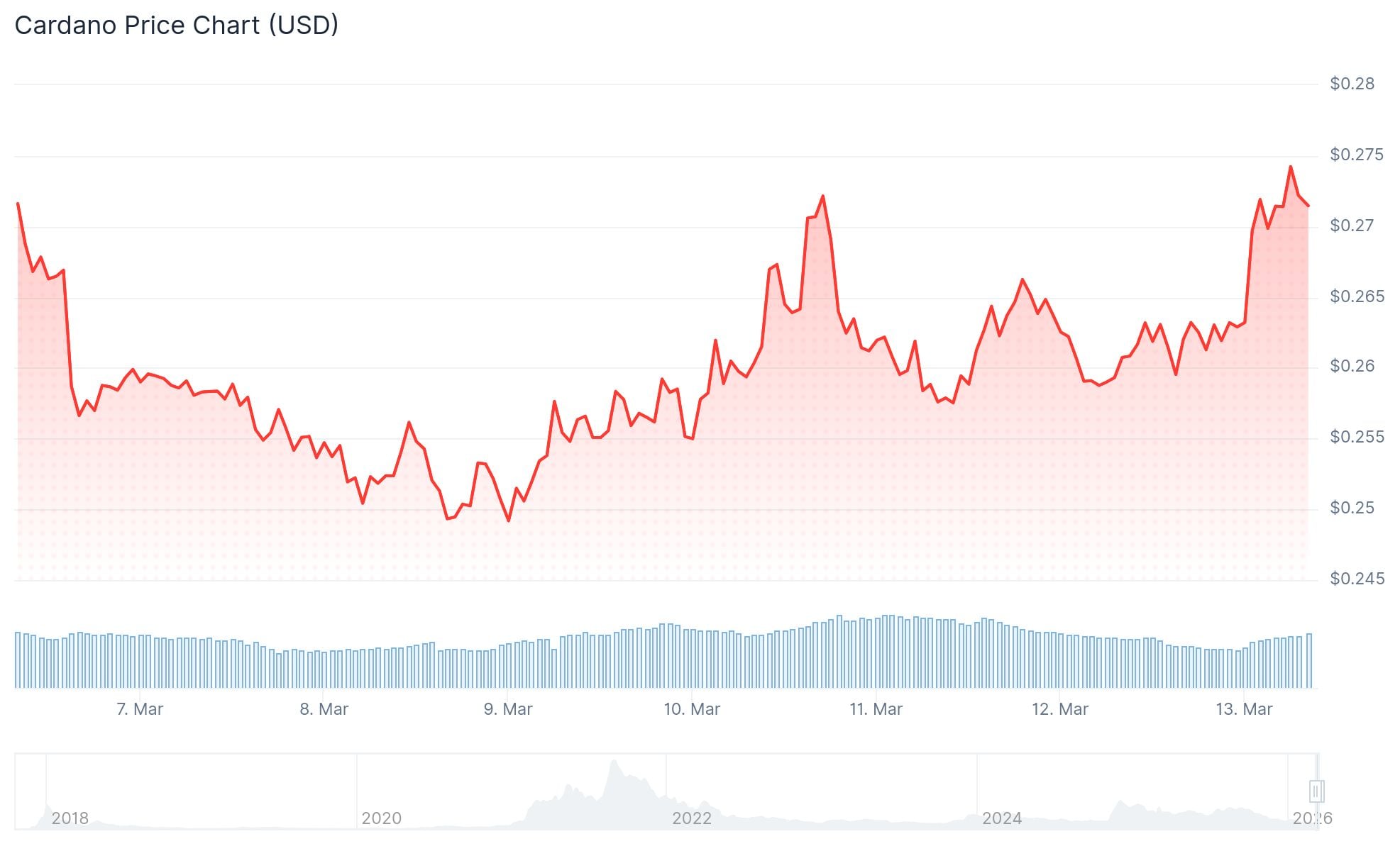 Cardano (ADA) Price
Cardano trades at $0.27, with a market cap of $10 billion. Its 52-week range runs from $0.23 to $1.01.
What Analysts Are Saying
For XRP, price targets for the end of 2026 range from $3 to $8. Standard Chartered has publicly forecast $8 if ETF demand holds. Some more optimistic voices on social media put targets far higher, though those are outliers.
Cardano forecasts are more cautious. Most cluster between $0.30 and $1. Some analysts see upside to $2–$4 if upcoming upgrades deliver results, but others have flagged downside risk if key support levels break.
Upcoming catalysts for XRP include potential new ETF approvals and the continued rollout of Ripple’s RLUSD stablecoin in Japan through a partnership with SBI Holdings.
Cardano’s near-term catalysts include the Midnight Network mainnet launch, which is focused on privacy features, and potential listings of spot ADA ETFs from Grayscale.
As of mid-March 2026, XRP has a clear lead in institutional adoption and on-chain activity compared to Cardano.
Final Thoughts
Both XRP and Cardano are speculative assets, and past growth does not guarantee future returns. XRP currently has stronger real-world traction, more institutional interest, and faster on-chain growth. Cardano has a long-term vision, but its numbers are not yet backing that vision up. Investors putting $1,500 into either coin today should understand the risks involved and do their own research before making any decision.
The post XRP vs. Cardano: Which Crypto Is the Better Buy for the Long-Term? appeared first on CoinCentral.
Ayrıca Şunları da Beğenebilirsiniz

Philippines looks to regulate power market as LNG prices surge

As XRP and ETH soar, investors are turning to MSP Miner for $9,250 in daily gains.