Exploring how the costs of a pandemic can lead to a self-enforcing lockdown in a networked economy, analyzing the resulting changes in network structure and the existence of stable equilibria.Exploring how the costs of a pandemic can lead to a self-enforcing lockdown in a networked economy, analyzing the resulting changes in network structure and the existence of stable equilibria.

The Economics of Self-Isolation: A Game-Theoretic Analysis of Contagion in a Free Economy

2025/09/17 23:00
Okuma süresi: 3 dk

Abstract and 1. Introduction

  1. A free and fair economy: definition, existence and uniqueness

    2.1 A free economy

    2.2 A free and fair economy

  2. Equilibrium existence in a free and fair economy

    3.1 A free and fair economy as a strategic form game

    3.2 Existence of an equilibrium

  3. Equilibrium efficiency in a free and fair economy

  4. A free economy with social justice and inclusion

    5.1 Equilibrium existence and efficiency in a free economy with social justice

    5.2 Choosing a reference point to achieve equilibrium efficiency

  5. Some applications

    6.1 Teamwork: surplus distribution in a firm

    6.2 Contagion and self-enforcing lockdown in a networked economy

    6.3 Bias in academic publishing

    6.4 Exchange economies

  6. Contributions to the closely related literature

  7. Conclusion and References

Appendix

6.2 Contagion and self-enforcing lockdown in a networked economy

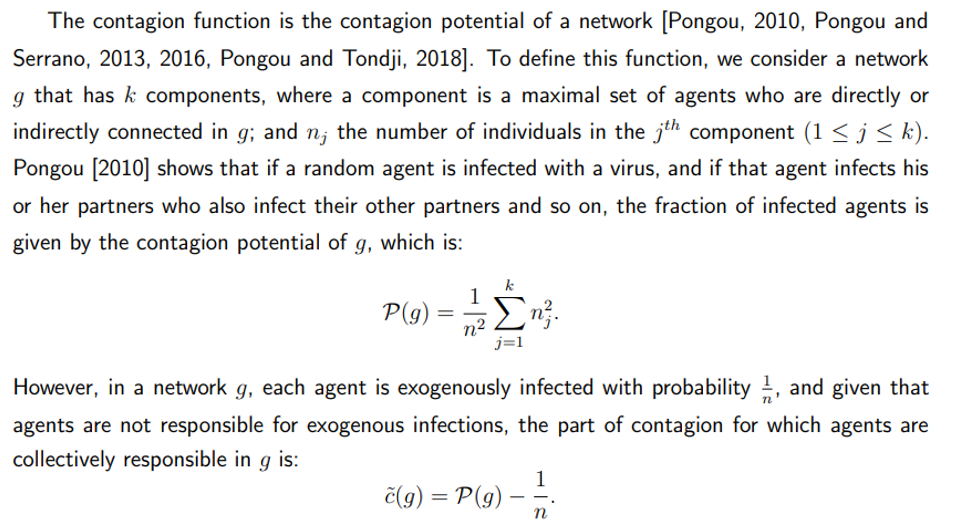
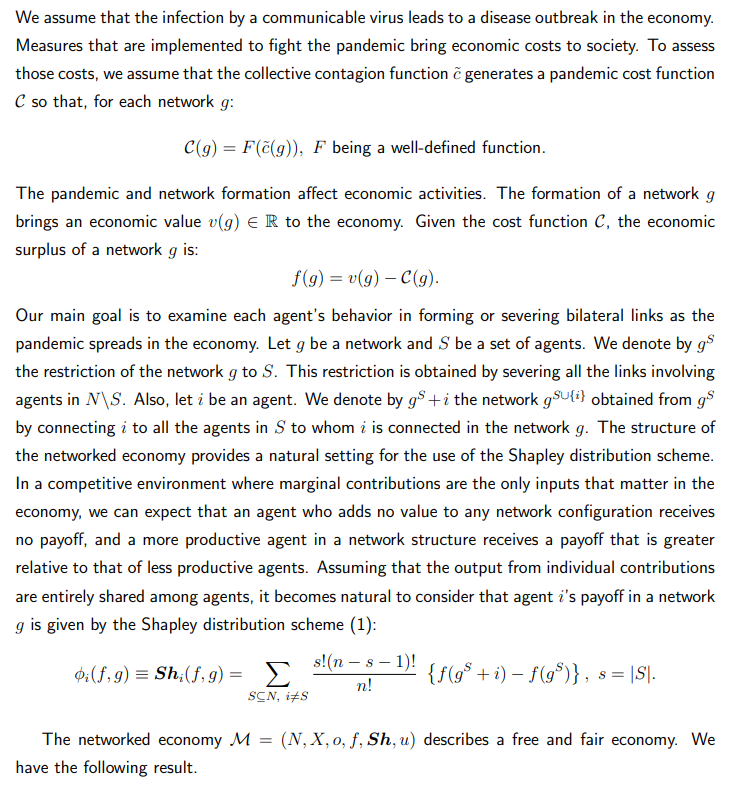
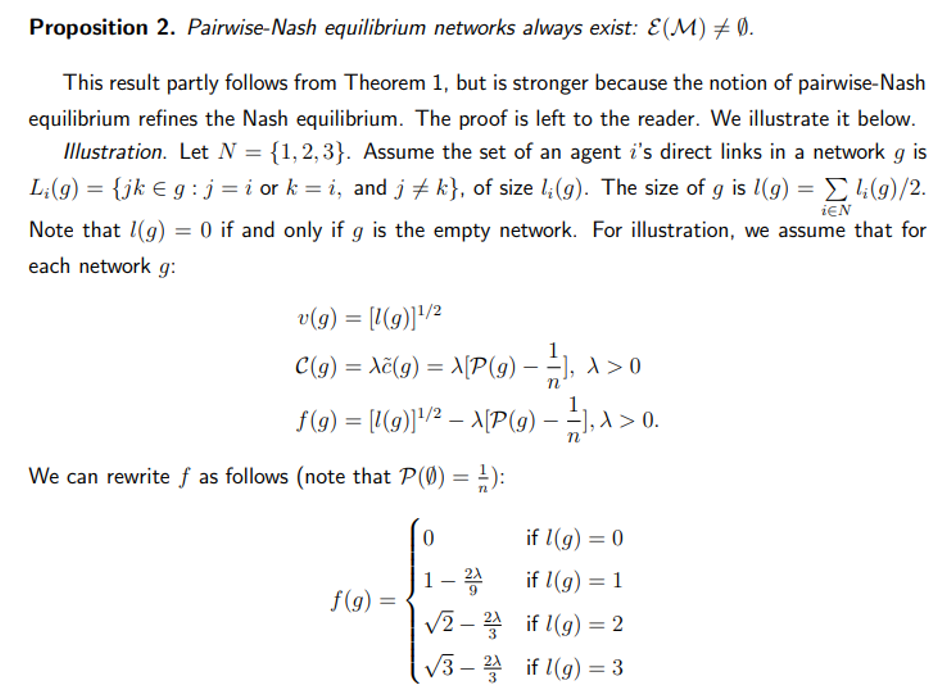
In this section, we provide an application of a free and fair economy to contagion and selfenforcing lockdown in a networked economy. We show how the costs of a pandemic from a virus outbreak can affect agents’ decisions to form and sever bilateral relationships in the economy. Specifically, we illustrate this application by using the contagion potential of a network [Pongou, 2010, Pongou and Serrano, 2013, 2016, Pongou and Tondji, 2018].

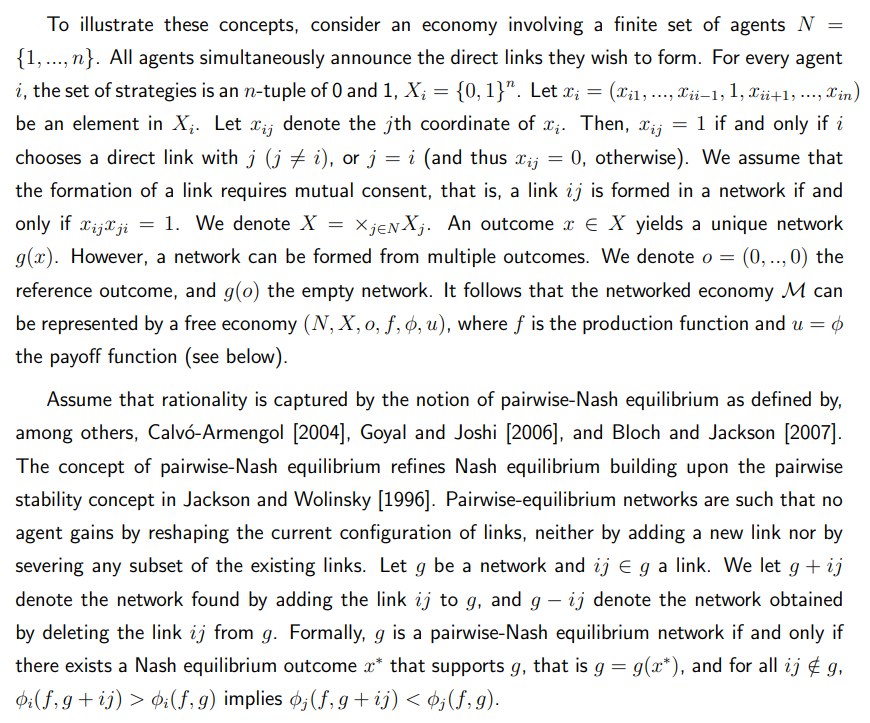
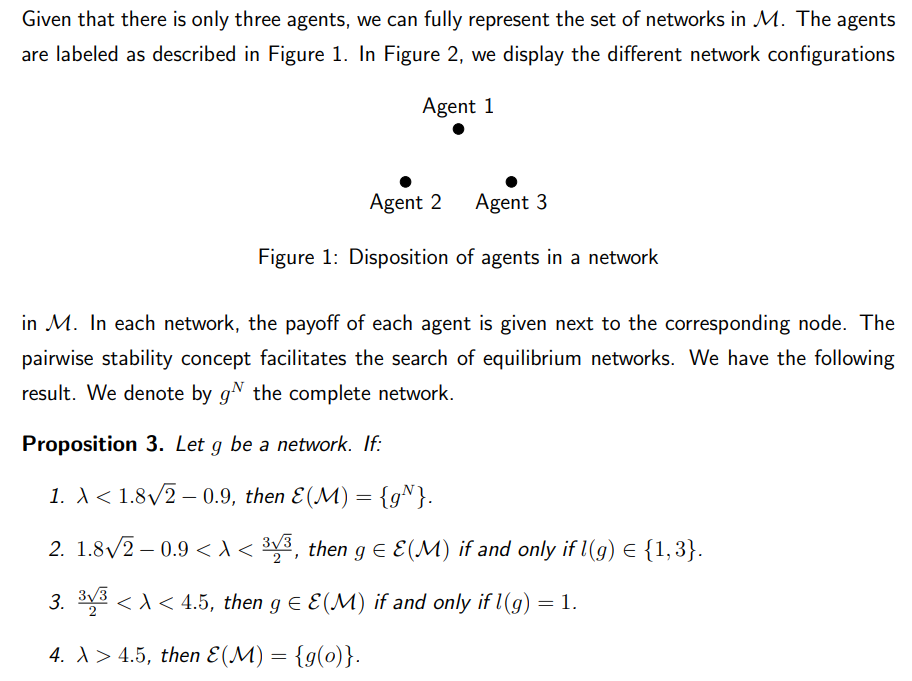
\ Consider an economy M involving agents who freely form and sever bilateral links according to their preferences. Agents’ choices lead to a network, defined as a set of bilateral links. Assume that rational behavior is captured by a certain equilibrium notion (for example, Nash equilibrium, pairwise-Nash equilibrium, etc.). Such an economy may have multiple equilibria. Denote by E(M) the set of its equilibria. Our main goal is to assess agent’s decisions in response to the spread of a random infection (for example, COVID-19) that might hit the economy. As the pandemic evolves in the economy, will some agents decide to sever existing links and self-isolate themselves? How does network structure depend on the infection cost?

\
\
\
\
\
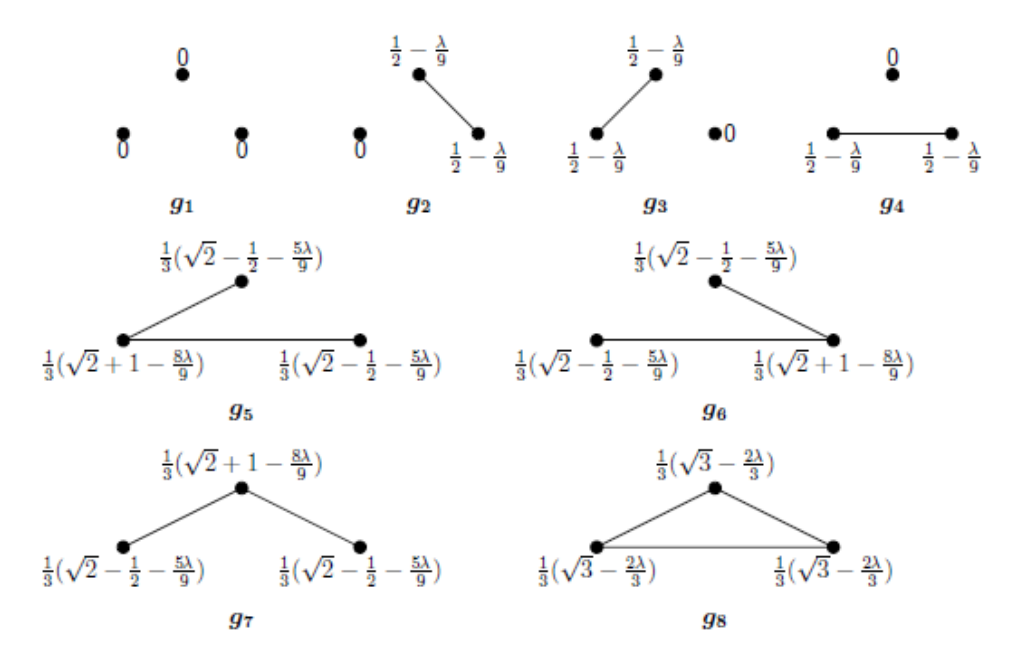
\ Figure 2: Possible network formation in M
\

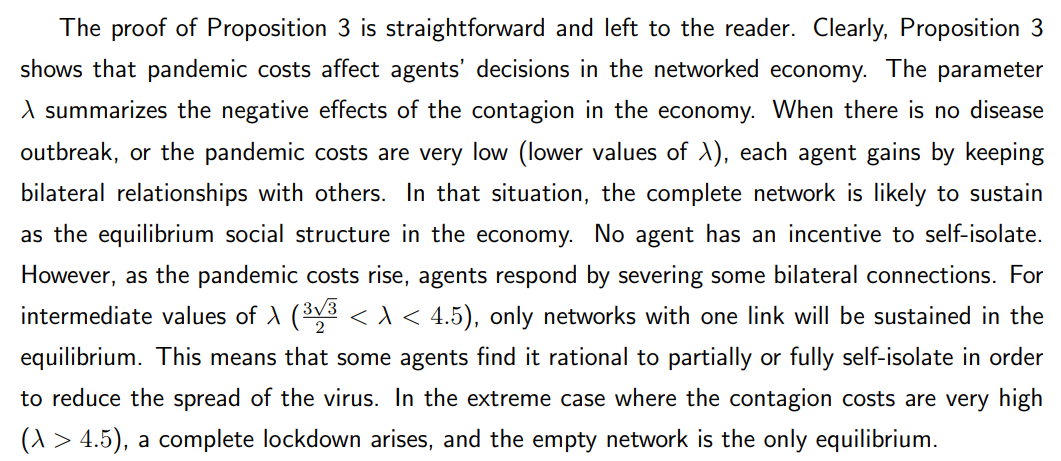
\ Interestingly, the value of λ depends on the nature of the virus. Viruses induce different severity levels. For example, COVID-19 and the flu virus have different values, inducing different network configurations in equilibrium. The different network configurations in Figure 2 can therefore be interpreted as the networks that will arise in different scenarios regarding the nature of the virus.

\

:::info Authors:

(1) Ghislain H. Demeze-Jouatsa, Center for Mathematical Economics, University of Bielefeld (demeze [email protected]);

(2) Roland Pongou, Department of Economics, University of Ottawa ([email protected]);

(3) Jean-Baptiste Tondji, Department of Economics and Finance, The University of Texas Rio Grande Valley ([email protected]).

:::


:::info This paper is available on arxiv under CC BY 4.0 DEED license.

:::

\

Piyasa Fırsatı
SQUID MEME Logosu
SQUID MEME Fiyatı(GAME)
$38.7472
$38.7472$38.7472
+0.61%
USD
SQUID MEME (GAME) Canlı Fiyat Grafiği
Sorumluluk Reddi: Bu sitede yeniden yayınlanan makaleler, halka açık platformlardan alınmıştır ve yalnızca bilgilendirme amaçlıdır. MEXC'nin görüşlerini yansıtmayabilir. Tüm hakları telif sahiplerine aittir. Herhangi bir içeriğin üçüncü taraf haklarını ihlal ettiğini düşünüyorsanız, kaldırılması için lütfen [email protected] ile iletişime geçin. MEXC, içeriğin doğruluğu, eksiksizliği veya güncelliği konusunda hiçbir garanti vermez ve sağlanan bilgilere dayalı olarak alınan herhangi bir eylemden sorumlu değildir. İçerik, finansal, yasal veya diğer profesyonel tavsiye niteliğinde değildir ve MEXC tarafından bir tavsiye veya onay olarak değerlendirilmemelidir.

Ayrıca Şunları da Beğenebilirsiniz

Secret Service’s ‘odd’ new suit policy raises eyebrows

Secret Service’s ‘odd’ new suit policy raises eyebrows

New Secret Service agents assigned to protective details are set to receive a taxpayer-funded wardrobe upgrade, according to a new CNN exclusive report.The Secret
Paylaş
Rawstory2026/02/21 08:04
The Shift to Fractional Leadership: Agility in the 2026 Executive Suite

The Shift to Fractional Leadership: Agility in the 2026 Executive Suite

The traditional model of a permanent, full-time executive suite is undergoing a radical transformation. As we move through 2026, the concept of “Fractional Leadership
Paylaş
Techbullion2026/02/21 08:20
OFAC Designates Two Iranian Finance Facilitators For Crypto Shadow Banking

OFAC Designates Two Iranian Finance Facilitators For Crypto Shadow Banking

The Department of the Treasury’s Office of Foreign Assets Control (OFAC) sanctioned two Iranian financial facilitators for coordinating over $100 million worth of cryptocurrency in oil sales for the Iranian government, a September 16 press release shows. OFAC Sanctions Iranian Nationals According to the Tuesday press release, Iranian nationals Alireza Derakhshan and Arash Estaki Alivand “used a network of front companies in multiple foreign jurisdictions” to transfer the digital assets. OFAC alleges that Alivand and Derakhshan’s transfers also involved the sale of Iranian oil that benefited Iran’s Islamic Revolutionary Guard Corps-Qods Force (IRGC-QF) and the Ministry of Defense and Armed Forces Logistics (MODAFL). IRGC-QF and MODAFL then used the proceeds to support regional proxy terrorist organizations and strengthen their advanced weapons systems, including ballistic missiles. U.S. officials say the move targets shadow banking in the region, where illicit financial actors use overseas money laundering and digital assets to evade sanctions. “Iranian entities rely on shadow banking networks to evade sanctions and move millions through the international financial system,” said Under Secretary of the Treasury for Terrorism and Financial Intelligence John K. Hurley. “Under President Trump’s leadership, we will continue to disrupt these key financial streams that fund Iran’s weapons programs and malign activities in the Middle East and beyond,” he continued. Dozens Designated In Shadow Banking Scandal Both Alivand and Derakhshan have been designated “for having materially assisted, sponsored, or provided financial, material, or technological support for, or goods or services to or in support of the IRGC-QF.” In addition to Alivand and Derakhshan, OFAC has sanctioned more than a dozen Hong Kong and United Arab Emirates-based entities and individuals tied to the network. According to the press release, the sanctioned entities may face civil or criminal penalties imposed as a result
Paylaş
CryptoNews2025/09/18 11:18