Lending

Lending protocols form the backbone of the decentralized money market, allowing users to lend or borrow digital assets without intermediaries. Using smart contracts, platforms like Aave and Morpho automate interest rates based on supply and demand while requiring over-collateralization for security. The 2026 lending landscape features advanced permissionless vaults and institutional-grade credit lines. This tag covers the evolution of capital efficiency, liquidations, and the integration of diverse collateral types, including LSTs and tokenized RWAs.

14802 Articles
Created: 2026/02/02 18:52
Updated: 2026/02/02 18:52
JPMorgan Chase to invest $10 billion into key industries

JPMorgan Chase to invest $10 billion into key industries

The post JPMorgan Chase to invest $10 billion into key industries appeared on BitcoinEthereumNews.com. Jamie Dimon, chief executive officer of JPMorgan Chase & Co., during a Bloomberg Television interview at the JPMorgan Chase & Co. Capital Markets conference in Paris, France, on Thursday, May 15, 2025. Cyril Marcilhacy | Bloomberg | Getty Images JPMorgan Chase on Monday said it is launching a decade-long plan to help finance and take direct stakes in companies it considers crucial to U.S. interests. The bank said in a statement it would invest up to $10 billion into companies in four areas: defense and aerospace, “frontier” technologies including AI and quantum computing, energy technology including batteries, and supply chain and advanced manufacturing. The money is part of a broader effort, dubbed the Security and Resiliency Initiative, in which JPMorgan said it will finance or facilitate $1.5 trillion in funding for companies it identifies as crucial. It said the total amount is 50% more than a previous plan. “It has become painfully clear that the United States has allowed itself to become too reliant on unreliable sources of critical minerals, products and manufacturing — all of which are essential for our national security,” JPMorgan CEO Jamie Dimon said in the release. As the biggest American bank by assets and a Wall Street juggernaut, JPMorgan was already raising funds and lending money to companies in those industries. But the move helps organize the company’s activities around national interests at a time of heightened tensions between the U.S. and China. On Friday, markets tumbled as President Donald Trump announced new tariffs on Chinese imports after the major U.S. trading partner tightened export controls on rare earths. In the release, Dimon said that the U.S. needs to “remove obstacles” including excessive regulations, “bureaucratic delay” and “partisan gridlock.” JPMorgan said that within the four major areas, there were 27 specific industries it would look…

Author: BitcoinEthereumNews
Solana’s (SOL) $168 Drop Sends Crypto Sentiment into Fear Zone As New Crypto Coin Keeps Rising

Solana’s (SOL) $168 Drop Sends Crypto Sentiment into Fear Zone As New Crypto Coin Keeps Rising

Furthermore, this correction is in line with a general crypto crash, where the total market cap is down 1-2% to […] The post Solana’s (SOL) $168 Drop Sends Crypto Sentiment into Fear Zone As New Crypto Coin Keeps Rising appeared first on Coindoo.

Author: Coindoo
Best Cryptos to Buy at a Discount as Market Records the Largest Single-Day Liquidation in History

Best Cryptos to Buy at a Discount as Market Records the Largest Single-Day Liquidation in History

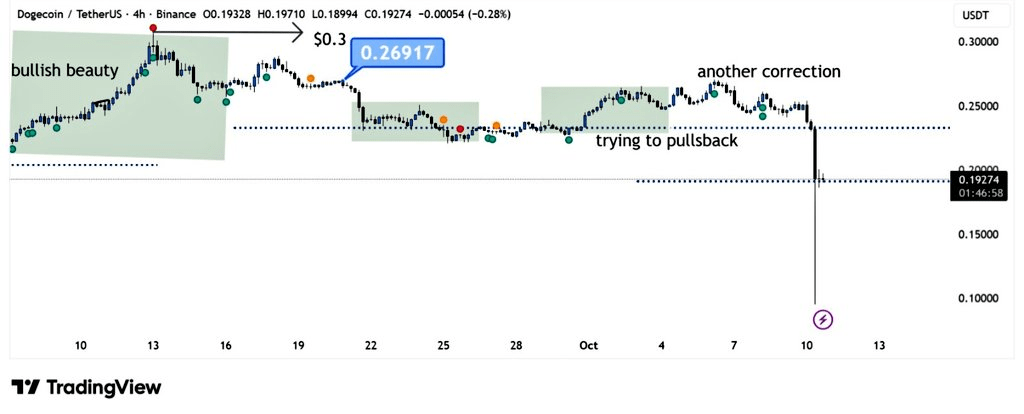
The post Best Cryptos to Buy at a Discount as Market Records the Largest Single-Day Liquidation in History appeared on BitcoinEthereumNews.com. The crypto market has just witnessed its biggest liquidation event in history, liquidating more than $19 billion worth of leveraged positions in just 24 hours. Over 1.6 million traders were affected as Bitcoin, Ethereum, and Solana tanked to multi-week lows. Longs covered almost $16.75 billion, shorts $2.47 billion, and the biggest single liquidation, an Ethereum-USDT position via Hyperliquid worth $203 million, shows the extent of the rout.  Bitcoin dropped to near $101,000 but stabilized near $112,000, while Ethereum decreased 13% to $3,814, and BTC and ETH alone covered nearly $10 billion worth of liquidated positions. Solana, XRP, and Cardano also dropped 15-20%, prompting a liquidation of billions of longs. Risk appetite vanished across the market as a rush to exit saw a level of volatility befitting one of the most dramatic events in crypto history. Amid this chaos, opportunity emerges for those who can spot quality undervalued assets. While established cryptocurrencies like Dogecoin (DOGE) remain prominent, attention is shifting to Mutuum Finance (MUTM), currently in Phase 6 of its presale, with over 65% already sold out. With a token price of $0.035, raised over $17.25 million, and more than 16,910 holders, MUTM is performing well. Its innovative DeFi ecosystem, structured presale, and community-driven roadmap position it as a standout investment for traders seeking upside in the wake of this historic market crash. Dogecoin Holds onto Key Thresholds Despite Meme Psychology Dogecoin (DOGE) witnessed its meme-led liquidity retreat, underscoring volatile characteristics of social-led assets. Significant levels to focus on are still $0.28 for a breakout and $0.17–$0.19 as support.  Traders are watching for the next moves, keeping in mind that meme coins primarily operate based on sentiment and must never become core positions. Though DOGE’s social engines can resuscitate fast advances, investors are gradually looking towards projects having better-defined fundamentals and…

Author: BitcoinEthereumNews
RTFKT Co-Founder Benoît Pagotto Dies at 41, Tributes Pour In from Colleagues

RTFKT Co-Founder Benoît Pagotto Dies at 41, Tributes Pour In from Colleagues

RTFKT mourns co-founder Benoît Pagotto after his sudden passing. Tributes pour in celebrating Pagotto’s creativity and impact on Web3. His legacy in digital fashion and art continues to inspire many. The creative and tech community has been struck by the sudden death of RTFKT co-founder Benoît Pagotto, who passed away at 41. According to a post by Philippe Rodriguez, founding partner at Avolta Partners, Pagotto’s death came unexpectedly. Rodriguez, who described him as a “client and friend,” remembered him as a discreet yet passionate visionary who inspired many. Also Read: Important Warning to XRP Community Tributes Flow from the Web3 Community RTFKT’s co-founder Steven Vasilev later confirmed the news on X. He noted that Pagotto’s “vision, mission, and inspiration will live on forever,” emphasizing his lasting influence on the Web3 space. Pagotto helped launch RTFKT in early 2020 alongside Vasilev and Chris Le. The Web3 studio quickly gained attention for merging digital fashion with blockchain technology. It became well-known for its NFT sneakers and collaborations with leading creatives such as Jeff Staple and Japanese artist Takashi Murakami. Among its biggest achievements was the Clone X × Takashi Murakami project, a 20,000-piece NFT collection that ranked among the most profitable in the industry. According to DefiLlama data, it generated nearly $120 million in lifetime earnings, placing it fourth overall, while RTFKT itself stands ninth with over $50 million. Nike acquired RTFKT in 2021 and later announced plans to wind down the startup in December 2024. Despite the shift, Pagotto continued his work at Nike as senior director of brand and partnerships, remaining committed to creative innovation. Former RTFKT CTO Samuel Cardillo also paid tribute, recalling Pagotto as “a unique human being” and sharing that he once raised crows from his apartment windows, a small detail that reflected his eccentric creativity. A Lasting Impact on Digital Art and Culture Pagotto’s influence extended beyond RTFKT’s projects. He helped shape how art, technology, and culture intersect in the digital space. His leadership brought together artists and designers to explore new ways of blending fashion and NFTs, setting a precedent for future collaborations. Benoît Pagotto’s death marks a major loss for the global creative community. His ideas and projects continue to inspire artists, brands, and innovators who shared his vision of merging digital and physical creativity. Also Read: Bitcoin Surges Above $115,000 as Altcoins Post Strong 24-Hour Gains The post RTFKT Co-Founder Benoît Pagotto Dies at 41, Tributes Pour In from Colleagues appeared first on 36Crypto.

Author: Coinstats
Why does DeFi's next milestone depend on AI?

Why does DeFi's next milestone depend on AI?

Original title: DeFi's next milestone: What it'll take for agentic finance to work Original author: @Lemniscap Original translation: Ismay, BlockBeats Editor's Note: When the world of DeFi becomes so complex that even professional users find it difficult to control, how can we return the initiative to ordinary people? This research article from Lemniscap systematically examines the rise and current challenges of "intelligent agent finance." From &milo and Meridian to SendAI and The Hive, these early products demonstrate how AI can become a new interface for on-chain interactions, but they also expose significant gaps in execution reliability, permission security, and verification mechanisms. The author argues that the key to DeFi's next phase lies not in smarter models but in a more trustworthy underlying structure—one that ensures that every action taken by agents is verifiable, traceable, and trustworthy. This is not only a turning point in technological evolution, but also an experiment in the reconstruction of trust. As the article states: The next milestone for DeFi is not greater scale, but trust in automation. By 2025, DeFi will look nothing like its early days. The data speaks for itself: Institutional funds inflows exceeded $10 billion in a single quarter, and the number of active protocols across dozens of chains exceeded 3,000. The total locked-in value of DeFi protocols across the entire network reached $160 billion in 2025, a year-on-year increase of 41%. The cumulative trading volume of DEXs and Perps is measured in trillions. As DeFi grows in scale, the possibilities for doing more and more are expanding, but the complexity is also skyrocketing. Most people simply can't keep up with everything happening on-chain. If we want more people to seize these new opportunities, we must build tools that make it easier for users to make the right decisions—and that's where the future is headed. At the same time, AI has become increasingly integrated into daily life, and people are starting to develop new habits around automation. This trend has given rise to "agentic finance," where intelligent agents handle the navigation and execution of financial operations. Even simple browser-based proxies like Comet demonstrate the rapid evolution of these tools. When you perform a DeFi operation through a browser proxy (as in the example shared by SendAI founder Yash), you can see the potential of intelligent agent finance. The vision is straightforward: instead of searching through dashboards or long posts on X, you can simply tell the AI what you want to achieve, and it will automatically help you complete the next steps. Two categories of intelligent agents are emerging: One type is Copilots, which guide users to make decisions in the entire DeFi world; the other type is Quant Agents, which are more inclined to professional automated strategy execution, equivalent to "Autopilots". Both are still in their early stages and have flaws, but together they point in a new direction—a radically different, AI-driven way of interacting with DeFi. Intelligent Agent as Co-Pilot Think of these intelligent agents as your personal assistant. No longer needing to scroll through charts or jump between protocols, you can simply ask natural language questions like, "What are the hottest tokens right now?" or "Where can I find the best returns?" and the agent will answer directly and recommend next steps—like a knowledgeable friend always on hand. Take &milo as an example. Its co-pilot mode can assist you in making investment decisions, rebalancing assets, and gaining portfolio insights - allowing you to stay in control while eliminating tedious operations. Using natural language interpretation and intelligent prompts, &milo helps users understand their positions and compare profit opportunities without having to search for data in various dashboards. It demonstrates the evolution of co-pilot agents from simple chat assistants to full-fledged DeFi guides. To see how these agents perform in practice, we tried out several recently released products to see firsthand how well they handle real-world DeFi tasks. The results showed that these agents still have limitations. For example, they successfully identified popular tokens but were unable to execute buy operations. Two transactions also failed with the system indicating "insufficient balance" even though there was actually enough SOL in the account to cover the transaction fee. A similar platform, The Hive, takes a different approach. It organizes multiple DeFi agents into a "swarm," capable of collaboratively completing complex tasks such as cross-chain transactions, yield strategies, and liquidation defenses, all coordinated through a simple chat interface. This network of specialized agents can complete multi-step on-chain operations using natural language commands. We tested the same buy command using The Hive. The system did recognize the popular token WEED, but returned the wrong contract address when executing the purchase. Overall, Milo demonstrates how portfolio management tools can be integrated into a seamless process, while The Hive explores how to enable multiple specialized agents to work together. As the capabilities of intelligent agents increase, they will begin to develop a clearer division of labor. For example, Meridian focuses on the other end of the user spectrum—helping beginners take their first steps into DeFi. Its mobile-first design, coupled with clear prompts, makes basic operations like swapping tokens, staking, or checking returns easier to use. Meridian performs smoothly and quickly on these core tasks, and more importantly, it is very clear about its own boundaries. When users ask it to perform an operation beyond its scope, it will explain the reason instead of blindly trying. This honesty makes it a reliable starting point for novices to explore the world of on-chain. Meridian founder Benedict explained: Meridian allows users to securely research and operate using natural language. We have made the broker's research functionality available to the public for free at meridian.app. Users who register for the Meridian mobile app can use the broker's swap, multi-swap, and portfolio purchase features. Currently in closed beta, interested users can contact @bqbrady on Twitter to request a trial. Through our testing, we found that most of the AI agents currently focused on DeFi navigation are still in the role of "teachers" or "assistants", mainly helping users complete the most basic operations (such as currency exchange). Further improvements are still needed before they can reliably handle more complex processes such as providing liquidity and managing leveraged positions. As Rishin Sharma, Head of AI at the Solana Foundation, noted: "Large language models (LLMs) are prone to hallucinations when handling a wide range of tasks and struggle to execute deterministic operations. Function call mechanisms like MCP may be more suitable for translating 'action plans' into actual execution. While LLMs perform well at the conception and guidance levels, they still struggle with precise execution. To make intelligent agent finance truly reliable, we must go beyond LLMs and develop specific function call mechanisms, clear execution policies, verifiability, and a secure permission system. In other words, the execution layer of today's intelligent agents is still underdeveloped—the AI 'brain' is smart enough, but it lacks a 'body' that can act reliably." As an intelligent agent for "autonomous driving" If "co-pilot" agents are more like mentors, then "quantitative" agents are more like autopilot systems. They not only build strategies but also execute them—monitoring the market in real time, testing trades, and acting automatically at machine speed, putting complex DeFi strategies into "full autopilot" mode. A prime example emerging is SendAI. It's not a quantitative agent per se, but rather a toolkit that enables others to create such agents. Its "Agent Kit," designed for Solana, supports over 60 autonomous operations, including token swaps, new asset issuance, and loan management, and can directly interact with mainstream protocols like Jupiter, Metaplex, and Raydium. In other words, it provides developers with a "rail system" that allows them to connect decision models directly to the chain for execution. SendAI founder Yash clearly outlined their vision: “We believe that every AI agent will have its own wallet in the future. SendAI is building the tools and economic layer needed to enable these agents to perform any action on Solana. We are building a platform that makes these agents contextually aware and supports long-running, persistent, and asynchronous execution of complex tasks.” Meanwhile, other teams are working to make this capability more accessible. Lomen curates strategies and enables users to deploy them with one click, lowering the barrier to entry for users to enjoy quantitative automation without writing code. For advanced traders who prefer a more customized system, Unblinked offers an AI-powered strategy experimentation environment. It's like Cursor for trading: users can sketch out their strategy ideas, run and optimize them in a secure sandbox environment, and then decide whether to invest real money. Some platforms choose to call multiple agents to collaborate to complete tasks at the same time. For example, Almanak combines "programming agents" with "backtesting agents": users describe strategies in natural language, AI automatically generates production-level code, and backtests with more than 10,000 Monte Carlo simulations, ultimately generating a "ready-to-play" strategy. Finally, there are teams focused on real-time market advantage. Giza's ARMA agents proactively allocate funds across lending protocols to maximize stablecoin returns. Rather than keeping funds stuck in a single pool, ARMA continuously monitors interest rates, liquidity, and gas costs, dynamically moving assets. Its flagship agent manages over $17 million and boasts a claimed yield 83% higher than static holdings. Overall, these quantitative agents significantly reduce time costs and allow ordinary users to access complex strategies that were once the domain of professional quantitative teams. However, at the same time, they also reveal the fragility of automation: when data is delayed, protocols are suspended, or the market fluctuates violently, the agents may still "stumble." In other words, they do make you faster, but they're far from invincible. Their problem Spend some time with current intelligent agents and you’ll notice some familiar issues: they sometimes suggest actions that no longer exist, like a long-closed liquidity pool; the data they rely on often lags behind the actual on-chain state; and if a multi-step plan goes awry, they don’t self-adjust, but instead try the same action over and over again. Permission management is also clunky—users must either grant full access to their entire wallet or manually approve every minor action. Testing is similarly superficial, with simulations struggling to replicate the "real-world chaos" of sudden on-chain liquidity changes or governance parameter adjustments. One of the most serious problems is that these proxies operate almost like black boxes. Users have no way of knowing which inputs it read, how it weighed its options, whether it checked the real-time status, or why it chose to execute a particular transaction. Without a signature-verified operational record, it is impossible to verify the consistency between the "promised result" and the "actual execution." Users can only use and "supervise" the automation process at the same time - which is not only inefficient but also makes performance difficult to evaluate. Without a mechanism to validate decisions and prove that actions adhere to established strategies, users will never be able to distinguish between a reliable system and beautifully packaged marketing. For larger-scale capital, DeFi platforms must shift from "trust us" to "please verify." This is also a critical turning point in building an "auditable, governable, and trustworthy" intelligent agent financial infrastructure. Infrastructure gap The core problem is that current systems lack the fundamental tools to ensure agents remain trustworthy, consistent, and secure at scale. To address this, we need infrastructure that can verify agent behavior, confirm execution results, and enforce consistent rules across all environments. Only then will people feel comfortable entrusting them with their money. However, most users don’t really care about the agent’s “thought process”; they just want to confirm that the output is correct, verified, and within the security boundary. When it comes to building trust, “verifiable reliability” is more important than “visibility.” This is where Verifiable Reliability comes in. Proxies don’t have to record every internal operation, but they should operate under clear policies and sanity checks: set spending limits, execution time windows, confirmation nodes before key operations, etc. Under the hood, these rules can be enforced by a Trusted Execution Environment (TEE) or similar system—proving that the agent adheres to the boundaries without revealing all the details. The result: outputs that can be audited when needed, and operations that ordinary users can immediately trust. This layer of verification doesn't have to be a one-size-fits-all approach. Everyday scenarios can employ lightweight security measures and standardized metrics, while high-risk or institutional scenarios may require stronger proofs and formal verification. The key is that each layer of infrastructure should provide measurable reliability commensurate with its risk level. Make the protocol agent-ready The next step to be filled is to make the protocol "agent-friendly". Most current DeFi protocols are not designed for smart agents. They need to provide more stable and secure execution interfaces that allow for previewing operations, safe retries, and consistent execution based on consistent data structures. Permissions should also be limited rather than fully empowered, allowing agents to operate within clear boundaries rather than control the entire wallet. Without these foundations, even the most intelligent agent framework will be tripped up by a fragile underlying infrastructure. Once these foundations are in place, users no longer need to manually monitor automation processes; development teams can reduce troubleshooting time and focus on innovation; and execution results from different service providers can be compared thanks to shared benchmarks—no longer just hype. Parts that must be changed The solution is actually quite simple: make the agent verifiable and the protocol agent-ready. Add a policy layer between the agent and the wallet, and require that all execution processes be traceable and verifiable, rather than operating in a black box. For example, Termina's SVM engine is built on this principle—it provides a true Solana runtime environment for AI agents, enabling them to model, make decisions, and learn based on on-chain data. At the same time, the protocol should provide a "dry-run" interface with clear error codes, a safe retry mechanism, consistent core data structures (positions, fees, and health), and session-based permission control. When these features are implemented, users will be freed from the burden of “minding” agents; teams will be able to reduce system failures; and institutional investors will finally have the safety rails and verifiable proofs they need. Realistic timeline Over the next six months, the fastest-growing improvements are expected to be in "co-pilot" agents, as improved data pipelines will increase their reliability in everyday use cases. Within a year, as testing standards are strengthened, agents will be able to coordinate execution across protocols, with humans only needing to approve key steps. Longer term, as the infrastructure matures, smart agents may gradually blur into the default interaction layer of DeFi—no longer a separate “tool,” but the primary way people interact with the financial system on a daily basis. Conclusion Agentic Finance is lowering the barrier to entry, making automation no longer just a tool for experts. However, to truly operate at scale, it requires a better foundation: real-time data, more secure permission mechanisms, stronger testing systems, and more transparent execution results. Smarter AI alone won’t solve these problems. Real progress will come from improving the underlying structures. The next milestone for DeFi isn't just growth in scale, but trust in automation. This day will only come when AI agents stop being mere "conceptual demos" and become truly reliable executors.

Author: PANews
Ethereum Price Analysis & Prediction: ETH Drops Below $4,000 Amid $19B Crypto Liquidations, But One Altcoin Holds Strong

Ethereum Price Analysis & Prediction: ETH Drops Below $4,000 Amid $19B Crypto Liquidations, But One Altcoin Holds Strong

The cryptocurrency market has been rocked by a volatility spasm as Ethereum (ETH) plunged beneath $4,000 in the wake of $19 billion worth of liquidations throughout key cryptocurrencies. Traders were left reeling as leveraged bets throughout ETH, BTC, and other key altcoins were liquidated in a matter of a few minutes, stoking panic and a […]

Author: Cryptopolitan
Top 3 Emerging Cryptos to Watch: Mutuum Finance (MUTM) Joins Solana (SOL) and Ethereum (ETH)

Top 3 Emerging Cryptos to Watch: Mutuum Finance (MUTM) Joins Solana (SOL) and Ethereum (ETH)

The post Top 3 Emerging Cryptos to Watch: Mutuum Finance (MUTM) Joins Solana (SOL) and Ethereum (ETH) appeared first on Coinpedia Fintech News As the crypto market continues to evolve, established giants like Ethereum (ETH) and Solana (SOL) remain core pillars, but cracks are appearing in their trajectories, opening room for new players to climb. Meanwhile, Mutuum Finance (MUTM) is showing early signs of becoming a serious contender. In this article, we compare these three tokens, what works, …

Author: CoinPedia
Mutuum Finance (MUTM) Price Prediction: Analysts See Potential 50x Rise to $1.75 by 2026

Mutuum Finance (MUTM) Price Prediction: Analysts See Potential 50x Rise to $1.75 by 2026

The post Mutuum Finance (MUTM) Price Prediction: Analysts See Potential 50x Rise to $1.75 by 2026 appeared on BitcoinEthereumNews.com. As the crypto market matures, investors are increasingly looking toward 2026 as the next pivotal year for growth. Established names like Bitcoin and Ethereum are expected to continue their steady climbs, but analysts argue that the real opportunities often lie with earlier-stage tokens that combine innovation, adoption potential, and strong tokenomics. Among these, Mutuum Finance (MUTM) is emerging as one of the most talked-about candidates, with predictions suggesting it could be one of the standout DeFi tokens by 2026. The question for investors today is simple: which tokens can transform a modest entry into a meaningful long-term transformation? According to analysts and Mutuum Finance’s roadmap, MUTM’s trajectory could position it as the best cryptocurrency to watch right now. Short-Term Catalysts, Launch and Beta Platform Mutuum Finance has already proven its momentum. The project has raised more than $17.2 million, attracted over 16,900 holders, and sold more than 750 million tokens in presale. Each phase of the presale increases the token’s price by nearly 20%, with the current Phase 6 price of $0.035 set to climb to $0.040 soon. At launch, the confirmed listing price will be $0.06, locking in close to 100% MUTM value for today’s buyers. One of the biggest immediate drivers for Mutuum Finance is its confirmed launch strategy. According to the project’s roadmap, the MUTM token will debut in 2026 with its beta platform live on day one. That means lending, borrowing, and liquidation functions will be operational from the moment the token lists, a rare move in crypto, where many projects often delay functionality until months after launch. This day-one utility is crucial. By allowing users to lend and borrow immediately, the platform creates organic demand for MUTM tokens from the outset. Analysts believe this setup will support significant early momentum, with predictions suggesting MUTM could…

Author: BitcoinEthereumNews
OpenAI Unveils $25B “Stargate Argentina” Data Center Plan With Sur Energy

OpenAI Unveils $25B “Stargate Argentina” Data Center Plan With Sur Energy

TLDRs; OpenAI plans to invest up to $25 billion in a large-scale AI data center in Argentina. The “Stargate Argentina” project will have a 500MW capacity for advanced AI computing infrastructure. The facility will operate under Argentina’s RIGI tax incentive program to attract foreign tech investment. OpenAI CEO Sam Altman says it’s the company’s first [...] The post OpenAI Unveils $25B “Stargate Argentina” Data Center Plan With Sur Energy appeared first on CoinCentral.

Author: Coincentral
Top Crypto to Buy Under $0.05, Analysts Highlight Mutuum Finance (MUTM) 500% Growth Potential

Top Crypto to Buy Under $0.05, Analysts Highlight Mutuum Finance (MUTM) 500% Growth Potential

The post Top Crypto to Buy Under $0.05, Analysts Highlight Mutuum Finance (MUTM) 500% Growth Potential appeared first on Coinpedia Fintech News In a market where meme coins dominate headlines and high-cap tokens often limit upside potential, early-stage utility projects are beginning to attract greater investor attention. Mutuum Finance (MUTM) is one of the most notable examples. Priced at $0.035, the DeFi protocol is being highlighted by analysts as a presale with the potential to deliver up …

Author: CoinPedia