Lending

Lending protocols form the backbone of the decentralized money market, allowing users to lend or borrow digital assets without intermediaries. Using smart contracts, platforms like Aave and Morpho automate interest rates based on supply and demand while requiring over-collateralization for security. The 2026 lending landscape features advanced permissionless vaults and institutional-grade credit lines. This tag covers the evolution of capital efficiency, liquidations, and the integration of diverse collateral types, including LSTs and tokenized RWAs.

14759 Articles
Created: 2026/02/02 18:52
Updated: 2026/02/02 18:52
The flash U-Mich Consumer Sentiment grabs all the attention

The flash U-Mich Consumer Sentiment grabs all the attention

The post The flash U-Mich Consumer Sentiment grabs all the attention appeared on BitcoinEthereumNews.com. The US Dollar (USD) maintained its constructive tone on Thursday, advancing to two-month highs amid the lack of progress around the US government shutdown and always underpinned by the generalised risk-off sentiment in the FX universe. Here’s what to watch on Friday, October 10: The US Dollar Index (DXY) clinched its fourth day in a row of gains, markedly surpassing the 99.00 barrier to hit new multi-week highs against the backdrop of some widespread recovery in US Treasury yields. The preliminary U-Mich Consumer Sentiment gauge will take centre stage alongside speeches by the Fed’s Goolsbee and Musalem. EUR/USD lost further ground and tumbled to multi-week lows near 1.1550, down for the fourth straight day. Germany’s final Inflation Rate and the Economic Sentiment gauge in Germany and the Euroland are next on tap on the domestic calendar on October 14. GBP/USD extended its deep retracement, revisiting the area of two-month troughs below the 1.3300 support. The always relevant UK labour market report will be the next significant data release across the Channel on October 14. USD/JPY hit new eight-month highs past the 153.00 hurdle, up for the sixth consecutive day. Japanese Producer Prices and Bank Lending figures are due. AUD/USD followed the rest of its risk-associated peers and faded Wednesday’s uptick, retreating well south of the 0.6600 mark. The RBA’s Bullock and Kent will speak in an otherwise empty docket in Oz. WTI prices reversed four daily gains in a row, coming under fresh selling pressure and approaching the $61.00 mark per barrel as traders assessed the alleviated geopolitical concerns and the latest larger-than-expected build in US crude oil inventories. Gold prices traded on the back foot, receding sharply from their recent record highs and returning to the area below the $4,000 mark per troy ounce on the back of geopolitical…

Author: BitcoinEthereumNews
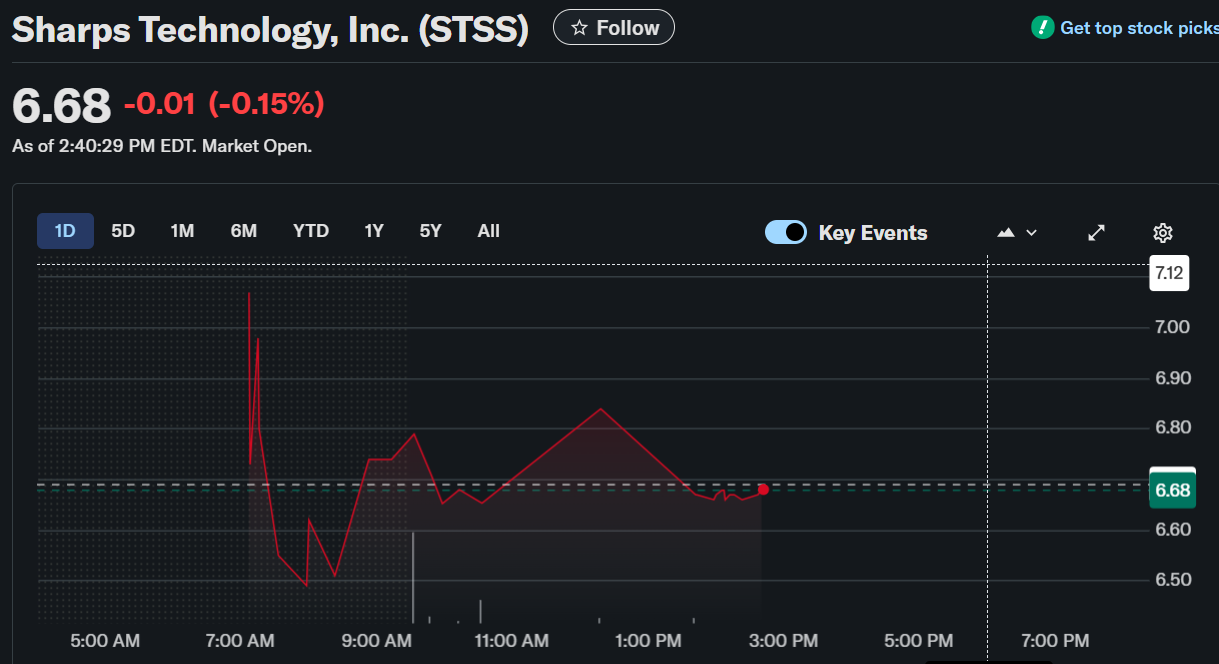
Sharps Technology (STSS) Stock: Coinbase Partnership Fuels $400M Solana Treasury Expansion

Sharps Technology (STSS) Stock: Coinbase Partnership Fuels $400M Solana Treasury Expansion

TLDR Sharps pivots from medtech to crypto giant with $400M Solana treasury. Sharps Technology bets big on Solana, partners with Coinbase for custody From syringes to Solana: Sharps unveils $400M crypto treasury strategy. Sharps joins Coinbase to manage $400M Solana trove, redefining its future. Sharps Technology transforms into a blockchain treasury powerhouse. Sharps Technology, Inc.(STSS) [...] The post Sharps Technology (STSS) Stock: Coinbase Partnership Fuels $400M Solana Treasury Expansion appeared first on CoinCentral.

Author: Coincentral
Jupiter to Launch JupUSD Stablecoin, Powered by Ethena Labs

Jupiter to Launch JupUSD Stablecoin, Powered by Ethena Labs

Key Takeaways: Jupiter to release JupUSD stablecoin in mid-Q4 2025, with USDtb of Ethena Labs and subsequent USDe. Intention to swap up its liquidity pools of the current amounts of The post Jupiter to Launch JupUSD Stablecoin, Powered by Ethena Labs appeared first on CryptoNinjas.

Author: Crypto Ninjas
XRP Price Prediction: Will Ripple Go to $3.30 Or $2.65 Next? Analysts Weigh in as Mutuum Finance (MUTM) Shines In 2025

XRP Price Prediction: Will Ripple Go to $3.30 Or $2.65 Next? Analysts Weigh in as Mutuum Finance (MUTM) Shines In 2025

Ripple (XRP) is at the crossroads, with analysts debating whether the token will move in the direction of $3.30 or witness a pullback towards $2.65. That said, forward-thinking investors are increasingly looking towards those ventures that possess true utility, strong fundamentals, and growth potential in their early stages. Mutuum Finance (MUTM) is a prime example […]

Author: Cryptopolitan
Almost 80% of Bitcoin Holders Miss This Major Earning Trend

Almost 80% of Bitcoin Holders Miss This Major Earning Trend

The post Almost 80% of Bitcoin Holders Miss This Major Earning Trend appeared on BitcoinEthereumNews.com. As Bitcoin reaches a new all-time high above $126,000, new data shows that most holders still haven’t explored Bitcoin Finance (BTCFi). A survey by GoMining of more than 700 respondents across North America and Europe found that 77% of Bitcoin holders have never used a BTCFi platform. Sponsored 77% of Bitcoin Holders Haven’t Tried BTCFi This finding highlights a major disconnect between the growing hype around BTCFi and its real-world adoption. The sector has attracted significant venture capital and media coverage, yet the majority of its target users remain untouched. The GoMining survey reveals that interest in BTCFi’s core offerings—yield and liquidity—is high, but trust remains the critical barrier. Bitcoin Finance Survey Results. Source: GoMining Around 73% of respondents said they want to earn yield on their Bitcoin through lending or staking, and 42% expressed interest in accessing liquidity without selling BTC. However, more than 40% of participants said they would allocate less than 20% of their holdings to BTCFi products.  This conservative stance reflects broader trust and complexity issues facing the industry. Sponsored “Although the majority of Bitcoin investors hold it in store for future valuation boost, the asset has more liquidity to power the next generation of DeFi applications. While the corporate adoption of Bitcoin as a treasury asset is growing, the coin can act as much more than a HODL asset. BTCFi will offer new potential use cases — earning, borrowing, and spending,” said Mark Zalan, CEO of GoMining. A Bitcoin Education Problem Perhaps the most revealing figure is that 65% of Bitcoin holders cannot name a single BTCFi project. Despite millions in venture funding and an increasing number of conferences, BTCFi’s message has yet to reach its core audience—Bitcoin holders themselves. Sponsored Industry experts argue this is not a user failure but a communication failure. BTCFi…

Author: BitcoinEthereumNews
Ozak AI at $500M Market Cap Means $20 Token Price from $0.012—Realistic Bull Market Target

Ozak AI at $500M Market Cap Means $20 Token Price from $0.012—Realistic Bull Market Target

The post Ozak AI at $500M Market Cap Means $20 Token Price from $0.012—Realistic Bull Market Target appeared first on Coinpedia Fintech News Ozak AI is quickly emerging as one of the most exciting blockchain projects of 2025, blending artificial intelligence (AI) with decentralized automation to create a self-learning crypto ecosystem.  Priced at just $0.012 in its presale, Ozak AI is offering early investors an early opportunity that could mirror the kind of exponential growth once seen in …

Author: CoinPedia
First Bitcoin-Native Wealth Platform Comes From New Merger

First Bitcoin-Native Wealth Platform Comes From New Merger

The post First Bitcoin-Native Wealth Platform Comes From New Merger appeared on BitcoinEthereumNews.com. Unchained announced today that its registered investment advisory affiliate, Sound Advisory, has merged with Gannett Trust Company to form a new entity: Gannett Wealth Advisors. The merger marks the first time an SEC-registered investment advisor has combined with a chartered bitcoin trust company, creating what the firms call a “fully integrated wealth management platform” for digital assets, according to a note shared with Bitcoin Magazine. Gannett Wealth Advisors will operate as a subsidiary of Gannett Trust Company, a public trust company chartered in Wyoming, and will focus on uniting financial planning, custody, and inheritance services under one regulated umbrella. Back in May, Wyoming officially chartered Gannett Trust Company to help individuals, families, and businesses manage and pass on their bitcoin wealth. The firm wants to prevent bitcoin loss by offering secure, compliant custody and inheritance solutions tailored to long-term holders. Bitcoin meets the fiduciary standard At its core, this merger represents a bridge between Bitcoin-native finance and the highly regulated world of traditional wealth management.  Unchained has provided bitcoin custody and lending services before through its collaborative custody model, the integration of an SEC-registered advisor brings fiduciary oversight and comprehensive planning capabilities to the table. “For Unchained, working with Gannett Trust and Gannett Wealth Advisors is the next step towards proving how bitcoin-native wealth management can meet the same standards as traditional finance, while staying true to the asset’s unique nature,” said Joe Kelly, CEO and co-founder of Unchained. The new platform will solve one of Bitcoin’s enduring challenges: inheritance and estate planning.  Traditional wealth firms are typically not equipped to handle private keys or custody models that ensure assets can be securely passed down. Gannett says it will offer solutions that combine regulated trust structures with Bitcoin’s self-sovereign principles. “Bringing both advisory and trust services together gives individuals, families,…

Author: BitcoinEthereumNews
Ethereum Exit Queue Swells to $10.5B: DeFi Faces Pressure From Record Staking Delays

Ethereum Exit Queue Swells to $10.5B: DeFi Faces Pressure From Record Staking Delays

Ethereum’s staking mechanism is under the microscope as the withdrawal queue hits record levels. Reports claim that 2.4 million ETH worth almost $11 billion are waiting to exit the consensus layer. The average delay is now about 42 days. While Ethereum co-founder Vitalik Buterin calls the Ethereum Staking Withdrawal Delay mechanism a security tool, the ecosystem is warning of cascading pressures on DeFi, liquid staking derivatives and lending collateral systems. Size of the Exit Queue and Delay Metrics The exit queue has ballooned to 2.44 million ETH (over $10.5 billion) in withdrawal limbo. Reports show 2,407,789 ETH are queued for exit with an estimated wait time of almost 42 days. The entry queue (ETH waiting to be staked) is 1,365,205 ETH with a delay of about 24 days. Ethereum Staking Withdrawal Delay The exit queue is much larger and slower than the entry queue, showing pressure on liquidity flows from staking to onchain applications. Also read: Ethereum Liquidity in Q4: Risk-Off Flows vs Long-Term Staking  Drivers and Stake Concentration Liquid staking providers like Lido, EtherFi, Coinbase and Kiln are a big chunk of the exiting $ETH. Many stakers use derivatives like stETH to keep liquidity even as validator withdrawals accumulate. Sources note this is not an anomaly: the current queue is only slightly behind the 2.6 million ETH peak on Sept 11 and the 2.48 million ETH on Oct 5. The Ethereum protocol restricts the number of validators that can exit per epoch. This throttling ensures network stability but leads to growing queues when exit demand spikes. Reports claim at current rates; users could face nearly six weeks of delay. Community Voice: “Time Bomb,” Collateral Risk and Distorted Pricing Pseudonymous analyst Robdog warned that prolonged Ethereum Staking Withdrawal Delays could trigger a “vicious unwinding loop” for DeFi and liquid staking derivatives. He said tokens like stETH, which are used as collateral, may lose parity or trade at deeper discounts if exit duration increases. Robdog said: “This will trigger a vicious unwinding loop which has massive systemic impacts on DeFi, lending markets and the use of LSTs as collateral.” He explained if the exit delay doubles the incentive to hold or trade derivatives falls, yield compresses and pegs weaken. Buterin defended the design saying the delay is a form of discipline: delayed exits discourage speculation and validator continuity. Other voices add nuance. Nicolai Sondergaard  of Nansen says; “Large withdrawals always means there is a chance to sell, but it doesn’t mean tokens are being sold.” RedStone’s Marcin Kazmierczak said some withdrawals are consolidation (e.g. merging smaller validator stakes into larger ones) rather than panic exits. DeFi, LSTs and Collateral Chains Under Strain stETH and other liquid staking tokens anchor $13 billion in total value locked across DeFi, most in leveraged positions. Delays push stETH discounts deeper. If exit timing shifts from 45 to 90 days, the yield arbitrage shrinks and holders may exit or reduce collateral usage. This puts pressure on platforms like Aave, Maker, or lending vaults using stETH as collateral; hence liquidation thresholds may tighten. A recent study  finds that stETH and wstETH show high velocity as most transfers are by large addresses, likely institutional players; while smaller users remain passive. This concentration intensifies systemic sensitivity. If a few large holders move, ecosystems feel the blow. As a result, the Ethereum staking withdrawal delays not only affect exits but echo through collateral velocity and DeFi health. Also read: Analysts See Ethereum Reaching $5K in 2025 Backed by Staking Demand and Layer-2 Innovation Institutional Offset, Market Sentiment and Liquidity Buffer Despite the exit pressure, institutional stakeholders are stepping in. Sources note Grayscale staked $150 million in ETH, and added 272,000 ETH ($1.21B) to the entry queue. Analyst Iliya Kalchev estimates that ETFs and corporate treasuries now hold over 10 % of ETH’s total supply, and October ETH ETF inflows have exceeded $620 million; a buffer absorbing some selling pressure. Ethereum Staking Withdrawal Delay Nansen’s Sondergaard also says high exit levels don’t equal forced selling as many validators may redeploy or restake internally. Conclusion Based on the latest research; the Ethereum validator exit queue has grown to 2.44 million ETH, or over $10 billion, and Ethereum Staking Withdrawal Delays are now at 42 days. While this is causing concern about liquidity stress and stETH peg risk, there’s more to the story;  consolidation, institutional staking inflows are also at play. For in-depth analysis and the latest trends in the crypto space, our platform offers expert content regularly. Summary Validators are stuck in the exit queue. 2.44M ETH ($10.5B) is waiting to be withdrawn with delays of 42 days. Some say DeFi and LSTs are at risk. Institutional staking is absorbing short-term pressure. Glossary Validator exit queue – ETH to be withdrawn but awaiting processing due to throughput limits. Liquid Staking Tokens (LSTs) – Tokens like stETH that represent staked ETH and provide liquidity. stETH discount/peg gap – The divergence between stETH and ETH value due to withdrawal delays. Epoch/Churn – The periodic unit (6.4 minutes) determining how many validators can exit per cycle. Liquidity shock – Sudden rush of withdrawals or liquidations that stresses available liquidity. Frequently Asked Questions About Ethereum Staking Withdrawal Delays Why is the Ethereum staking withdrawals delay taking 42 days? Because the protocol limits the number of validators that can exit per epoch, so when exit requests exceed throughput, there’s a queue. Does queuing mean $ETH is being sold? Not necessarily. Nicolai Sondergaard notes that large withdrawals don’t always translate to sales; many are redeployed or restaked. What’s at stake for stETH and other LSTs? Long delays weaken the peg, increase discounts, reduce yield incentives and stress collateral usage in DeFi protocols. Can institutional activity offset exit pressure? Grayscale and corporate treasuries are staking large ETH amounts, which offsets exit flows. How might Ethereum fix this? Potential protocol upgrades could increase exit throughput, optimize queue handling or adjust churn parameters. Read More: Ethereum Exit Queue Swells to $10.5B: DeFi Faces Pressure From Record Staking Delays">Ethereum Exit Queue Swells to $10.5B: DeFi Faces Pressure From Record Staking Delays

Author: Coinstats
Maestro launches the world’s first open-sourced, fully audited Bitcoin indexer

Maestro launches the world’s first open-sourced, fully audited Bitcoin indexer

The post Maestro launches the world’s first open-sourced, fully audited Bitcoin indexer appeared on BitcoinEthereumNews.com. Key Takeaways Maestro has launched Symphony, the world’s first fully audited and open-sourced Bitcoin indexer. Symphony supports standards like BRC-20s, Runes, and Ordinals, powering large-scale and secure blockchain applications. Maestro, a BitcoinFi infrastructure provider, has released Symphony, the first fully audited Bitcoin indexer as an open-source solution. The software stack is designed to power large-scale applications processing billions of transactions through its modular, mempool-aware indexing mechanism. Symphony supports various metaprotocol standards, including BRC-20s, Runes, and Ordinals. The indexer, which has been audited by Thesis Defence, is currently integrated into MIDL’s validator nodes to secure their network at the consensus level. “Maestro has been a reliable partner and a great team to collaborate with throughout the MIDL’s journey. Symphony is another major step towards the adoption of Bitcoin, but the Maestro’s potential definitely goes far beyond that. And we’re excited to scale the space up together,” said MIDL CEO Iva Wisher. The platform serves multiple user groups, providing developers with a battle-tested indexer, offering startups and enterprises a high-throughput data source, and enabling L2s to implement native metaprotocol validation at the consensus node-level. “Symphony is the first audited Bitcoin indexer. We’re giving the Bitcoin developer community the same battle-tested infrastructure that powers Maestro’s platform and processes billions of API calls for our clients. Open-sourcing it is our way of giving back to the ecosystem and accelerating the adoption of Bitcoin metaprotocols,” said Marvin Bertin, CEO of Maestro. Maestro’s infrastructure currently supports more than 1,000 developers and powers over 250 applications. The Symphony codebase is available through its GitHub repository, enabling developers to build financial applications, including lending, stablecoins, and RWA tokenization. Source: https://cryptobriefing.com/audited-bitcoin-indexer-symphony-launch/

Author: BitcoinEthereumNews
Ethereum-Based Mutuum Finance (MUTM) Records 60% Phase 6 Completion as Funding Surpasses $17M

Ethereum-Based Mutuum Finance (MUTM) Records 60% Phase 6 Completion as Funding Surpasses $17M

Mutuum Finance (MUTM) is increasingly emerging as one of the standout decentralized finance (DeFi) projects of 2025, not through hype alone but through steady execution and data-backed progress. As the presale advances toward its later stages, the Ethereum-based protocol has crossed another major milestone, with funding surpassing $17 million and Phase 6 now 60% complete. This marks a significant step in the project’s structured journey toward launch. Clear Price Progression and Strong Participation The presale began in early 2025 at $0.01 during Phase 1 and was structured with approximately 20% price increases at each stage. This clear, stepwise model is designed to reward early entrants while giving later participants a transparent view of upcoming price levels, a level of clarity rarely seen in early-stage crypto sales. It also introduces a natural sense of urgency, as each stage’s completion pushes the price closer to the final listing target. Currently, the token is priced at $0.035 in Phase 6, marking a 250% appreciation for those who participated in the earliest round. Phase 7 is set at $0.04, and the official listing price is fixed at $0.06. Once these targets are reached, Phase 1 investors stand to see up to 500% appreciation by launch, while those joining during the current phase could still nearly double their MUTM value upon listing. This structured trajectory has played a major role in sustaining momentum, as each stage offers clearly defined upside potential without relying on vague or speculative promises. Participation metrics further emphasize the scale of engagement. More than 750 million tokens have already been distributed, and the presale has attracted over 16,800 holders to date. This level of broad distribution is critical: instead of a few whales dominating supply, ownership is spread across a wide community base. Such dispersion reduces post-launch volatility and lays the groundwork for more stable and liquid trading once the token hits the market. Combined with the steadily rising price structure, this approach has turned the presale into one of the most closely watched funding events of 2025. Aligning Fundraising With Development Mutuum Finance is pairing capital raising with tangible product milestones. According to a recent statement from the team on X (formerly Twitter), development of the lending and borrowing protocol is already underway, with V1 scheduled for Sepolia Testnet deployment in Q4 2025. The first version will include a liquidity pool, mtToken (interest-bearing receipts), debt token, liquidator bot, and other core modules required for functional credit markets. Initial supported assets will be ETH and USDT for lending, borrowing, and collateral. This roadmap signals that fundraising is matched by execution, building confidence in the project’s long-term vision. Utility-Driven Tokenomics At the core of Mutuum Finance’s appeal is its utility-centric token model. Rather than relying on speculative hype, the protocol embeds demand into every interaction. Its dual lending architecture combines Peer-to-Contract (P2C) pooled markets for mainstream assets like ETH and stablecoins with Peer-to-Peer (P2P) isolated agreements for riskier or less liquid tokens. This allows the platform to scale efficiently while isolating risk pockets, preventing volatility in niche markets from destabilizing the entire protocol. Loans are overcollateralized, governed by strict Loan-to-Value (LTV) ratios, and offer both variable and stable borrowing rates. For example, at a 75% LTV, a user depositing $1,000 of ETH could borrow up to $750 in stablecoins, with liquidation triggers protecting the system from undercollateralization. On the supply side, liquidity providers earn APY from interest payments, creating a clear incentive structure. Analysts Draw Parallels Between MUTM and Early Aave A growing number of analysts have begun drawing comparisons between Mutuum Finance (MUTM) and Aave during its formative years. Before becoming one of DeFi’s cornerstone protocols, Aave started as a focused lending platform with clear mechanics, strong incentives, and a well-defined roadmap. Early adopters who recognized the value of Aave’s lending model benefited tremendously as it grew from a niche protocol into a dominant liquidity layer for DeFi. Many experts now believe MUTM may be positioned in a similar way, at the intersection of early-stage accessibility and structural utility. What fuels this comparison is MUTM’s emphasis on embedding token demand directly into protocol activity. Much like Aave in its early growth phase, MUTM is not relying on hype cycles alone; it’s building mechanisms such as dual lending markets, overcollateralized loans, mtTokens, and a buy-and-redistribute fee model to create sustainable value loops. Analysts note that these elements mirror the foundational strategies that allowed Aave to compound liquidity, retain users, and scale rapidly across cycles. The difference is timing. Whereas Aave entered the market during DeFi’s early boom, MUTM is launching in a more mature environment, but one where investors actively look for projects with real utility and proven mechanics. This gives MUTM the potential to capture both hype-driven momentum and long-term user adoption. Security, Bug Bounty & Transparency Investor trust has been bolstered through deliberate security and transparency measures. Mutuum Finance successfully passed a CertiK audit with a 90/100 Token Scan score, placing it among the stronger DeFi projects undergoing independent review. The team has also introduced a $50,000 bug bounty across multiple tiers to encourage white-hat testing before mainnet launch. On the community side, a $100,000 giveaway is underway, set to reward 10 winners with $10,000 in MUTM tokens each, strengthening early engagement. Real-time dashboards and a Top 50 contributor leaderboard make presale activity fully transparent. With 60% of Phase 6 already completed, a clear pricing trajectory toward $0.06, and over $17 million in funding, Mutuum Finance is entering a decisive phase of its presale. Its blend of structured fundraising, active development, and utility-based tokenomics is positioning MUTM as one of the most credible under $0.05 DeFi tokens heading into the next market cycle. For more information about Mutuum Finance (MUTM) visit the links below: Website: https://www.mutuum.com Linktree: :::tip This story was published as a press release by Btcwire under HackerNoon’s Business Blogging Program. Do Your Own Research before making any financial decision. ::: \n \ \n \n

Author: Hackernoon