Three of China’s largest Bitcoin hardware manufacturers are establishing production facilities in the United States as President Donald Trump’s tariff policies reshape the cryptocurrency industry. The three industry leaders, Bitmain, Canaan, and MicroBT, collectively control over 90% of the global mining rig market. These companies are the architects of Bitcoin’s physical infrastructure, manufacturing the specialized ASIC (Application-Specific Integrated Circuit) machines that form the backbone of the world’s most valuable cryptocurrency network. Every Bitcoin mined globally likely passes through hardware bearing Chinese engineering fingerprints. 95% Market Control Sparks “Digital Dependency Trap” and Security Risks According to a June 18 Reuters report, these Bitcoin mining giants are establishing U.S. operations to circumvent potential tariffs. However, critics have raised security concerns about Chinese involvement in sectors spanning semiconductor manufacturing and energy infrastructure. Guang Yang, chief technology officer at crypto technology provider Conflux Network, described the situation as extending beyond trade policy. “The U.S.-China trade war goes beyond tariffs,” Yang stated. “It’s a strategic pivot toward ‘politically acceptable’ hardware sources.” Bitmain, the largest of the three companies by revenue, initiated U.S. production of mining equipment in December , one month after Trump’s presidential election victory. Canaan began trial production in the United States on April 2 to avoid tariffs following Trump’s announcement of new trade levies. One of the largest manufacturers of #bitcoin mining machines, Canaan, has set up a base of operations outside of China. CEO Zhang says, Kazakhstan is essential to "expanding after-sales geographical coverage and providing […] support growing international customer base" pic.twitter.com/7D5Xh2ici5 — Documenting ₿itcoin 📄 (@DocumentingBTC) June 23, 2021 Third-ranked MicroBT announced in a statement that it is “actively implementing a localization strategy in the U.S.” to “avoid the impact of tariffs.” $11.9B by 2028: The Market These Giants Are Fighting for According to Frost & Sullivan’s “2024 Global Blockchain Hardware Industry White Paper,” the ASIC-based Bitcoin mining hardware market demonstrates substantial consolidation. When measured by computing power sold, these three Chinese companies command 95.4% of the global market share. The Bitcoin ecosystem encompasses five primary segments: hardware supply, mining farm operations, mining pool management, trading platforms, and payment processing services. Hardware manufacturers like Canaan, the first Bitcoin mining company to go public and the second-largest by computing power , focus exclusively on integrated circuit (IC) design, manufacturing, and equipment sales. Industry analysts project continued sector expansion, with the market expected to reach $11.9 billion by 2028, representing a compound annual growth rate of 15.3%, contingent on Bitcoin’s continued price appreciation driven by supply scarcity. Source: Frost & Sullivan China’s Historical Bitcoin Mining Advantage Understanding today’s migration requires examining how China achieved such overwhelming market control in the first place. The foundation was laid during the historic 2017 Bitcoin boom, when three key factors aligned to create Chinese mining supremacy. During the early expansion phase, Chinese officials recognized cryptocurrency mining as a profitable venture that attracted substantial foreign investment. Consequently, authorities initially overlooked the mining sector while simultaneously restricting Bitcoin trading and initial coin offerings. Hydro-power plants go on sale in China since #Bitcoin mining crackdown has reduced demand for electricity. – South China Morning Post pic.twitter.com/QKEbUzWN4g — Bitcoin Archive (@BTC_Archive) June 30, 2021 China’s extensive hydroelectric infrastructure further strengthened the country’s mining operations, providing the cheap energy essential for profitable Bitcoin production. Does Chinese Hardware Control America’s Bitcoin Network? While the United States leads global Bitcoin mining operations with over 38% of total network activity , American miners depend almost entirely on Chinese-manufactured equipment. America Leads Bitcoin Mining Operation/ Source: Bitbo This creates what security analysts describe as a “digital dependency trap,” a scenario where America’s cryptocurrency infrastructure relies fundamentally on hardware produced by its primary economic rival. Guang Yang, Conflux Network’s chief technology officer, frames this dependency in geopolitical terms that extend far beyond trade economics . “The U.S.-China trade war goes beyond tariffs,” Yang explains. “It’s a strategic pivot toward ‘politically acceptable’ hardware sources.” His assessment reflects growing concerns within the cryptocurrency community about supply chain vulnerabilities that could impact national economic security.Three of China’s largest Bitcoin hardware manufacturers are establishing production facilities in the United States as President Donald Trump’s tariff policies reshape the cryptocurrency industry. The three industry leaders, Bitmain, Canaan, and MicroBT, collectively control over 90% of the global mining rig market. These companies are the architects of Bitcoin’s physical infrastructure, manufacturing the specialized ASIC (Application-Specific Integrated Circuit) machines that form the backbone of the world’s most valuable cryptocurrency network. Every Bitcoin mined globally likely passes through hardware bearing Chinese engineering fingerprints. 95% Market Control Sparks “Digital Dependency Trap” and Security Risks According to a June 18 Reuters report, these Bitcoin mining giants are establishing U.S. operations to circumvent potential tariffs. However, critics have raised security concerns about Chinese involvement in sectors spanning semiconductor manufacturing and energy infrastructure. Guang Yang, chief technology officer at crypto technology provider Conflux Network, described the situation as extending beyond trade policy. “The U.S.-China trade war goes beyond tariffs,” Yang stated. “It’s a strategic pivot toward ‘politically acceptable’ hardware sources.” Bitmain, the largest of the three companies by revenue, initiated U.S. production of mining equipment in December , one month after Trump’s presidential election victory. Canaan began trial production in the United States on April 2 to avoid tariffs following Trump’s announcement of new trade levies. One of the largest manufacturers of #bitcoin mining machines, Canaan, has set up a base of operations outside of China. CEO Zhang says, Kazakhstan is essential to "expanding after-sales geographical coverage and providing […] support growing international customer base" pic.twitter.com/7D5Xh2ici5 — Documenting ₿itcoin 📄 (@DocumentingBTC) June 23, 2021 Third-ranked MicroBT announced in a statement that it is “actively implementing a localization strategy in the U.S.” to “avoid the impact of tariffs.” $11.9B by 2028: The Market These Giants Are Fighting for According to Frost & Sullivan’s “2024 Global Blockchain Hardware Industry White Paper,” the ASIC-based Bitcoin mining hardware market demonstrates substantial consolidation. When measured by computing power sold, these three Chinese companies command 95.4% of the global market share. The Bitcoin ecosystem encompasses five primary segments: hardware supply, mining farm operations, mining pool management, trading platforms, and payment processing services. Hardware manufacturers like Canaan, the first Bitcoin mining company to go public and the second-largest by computing power , focus exclusively on integrated circuit (IC) design, manufacturing, and equipment sales. Industry analysts project continued sector expansion, with the market expected to reach $11.9 billion by 2028, representing a compound annual growth rate of 15.3%, contingent on Bitcoin’s continued price appreciation driven by supply scarcity. Source: Frost & Sullivan China’s Historical Bitcoin Mining Advantage Understanding today’s migration requires examining how China achieved such overwhelming market control in the first place. The foundation was laid during the historic 2017 Bitcoin boom, when three key factors aligned to create Chinese mining supremacy. During the early expansion phase, Chinese officials recognized cryptocurrency mining as a profitable venture that attracted substantial foreign investment. Consequently, authorities initially overlooked the mining sector while simultaneously restricting Bitcoin trading and initial coin offerings. Hydro-power plants go on sale in China since #Bitcoin mining crackdown has reduced demand for electricity. – South China Morning Post pic.twitter.com/QKEbUzWN4g — Bitcoin Archive (@BTC_Archive) June 30, 2021 China’s extensive hydroelectric infrastructure further strengthened the country’s mining operations, providing the cheap energy essential for profitable Bitcoin production. Does Chinese Hardware Control America’s Bitcoin Network? While the United States leads global Bitcoin mining operations with over 38% of total network activity , American miners depend almost entirely on Chinese-manufactured equipment. America Leads Bitcoin Mining Operation/ Source: Bitbo This creates what security analysts describe as a “digital dependency trap,” a scenario where America’s cryptocurrency infrastructure relies fundamentally on hardware produced by its primary economic rival. Guang Yang, Conflux Network’s chief technology officer, frames this dependency in geopolitical terms that extend far beyond trade economics . “The U.S.-China trade war goes beyond tariffs,” Yang explains. “It’s a strategic pivot toward ‘politically acceptable’ hardware sources.” His assessment reflects growing concerns within the cryptocurrency community about supply chain vulnerabilities that could impact national economic security.

Chinese Bitcoin Hardware Titans Control 95% of Market, Now Coming to America to Dodge Trump Tariff War

Three of China’s largest Bitcoin hardware manufacturers are establishing production facilities in the United States as President Donald Trump’s tariff policies reshape the cryptocurrency industry.

The three industry leaders, Bitmain, Canaan, and MicroBT, collectively control over 90% of the global mining rig market.

These companies are the architects of Bitcoin’s physical infrastructure, manufacturing the specialized ASIC (Application-Specific Integrated Circuit) machines that form the backbone of the world’s most valuable cryptocurrency network.

Every Bitcoin mined globally likely passes through hardware bearing Chinese engineering fingerprints.

95% Market Control Sparks “Digital Dependency Trap” and Security Risks

According to a June 18 Reuters report, these Bitcoin mining giants are establishing U.S. operations to circumvent potential tariffs. However, critics have raised security concerns about Chinese involvement in sectors spanning semiconductor manufacturing and energy infrastructure.

Guang Yang, chief technology officer at crypto technology provider Conflux Network, described the situation as extending beyond trade policy.

“The U.S.-China trade war goes beyond tariffs,” Yang stated. “It’s a strategic pivot toward ‘politically acceptable’ hardware sources.”

Bitmain, the largest of the three companies by revenue, initiated U.S. production of mining equipment in December, one month after Trump’s presidential election victory.

Canaan began trial production in the United States on April 2 to avoid tariffs following Trump’s announcement of new trade levies.

Third-ranked MicroBT announced in a statement that it is “actively implementing a localization strategy in the U.S.” to “avoid the impact of tariffs.”

$11.9B by 2028: The Market These Giants Are Fighting for

According to Frost & Sullivan’s “2024 Global Blockchain Hardware Industry White Paper,” the ASIC-based Bitcoin mining hardware market demonstrates substantial consolidation. When measured by computing power sold, these three Chinese companies command 95.4% of the global market share.

The Bitcoin ecosystem encompasses five primary segments: hardware supply, mining farm operations, mining pool management, trading platforms, and payment processing services.

Hardware manufacturers like Canaan, the first Bitcoin mining company to go public and the second-largest by computing power, focus exclusively on integrated circuit (IC) design, manufacturing, and equipment sales.

Industry analysts project continued sector expansion, with the market expected to reach $11.9 billion by 2028, representing a compound annual growth rate of 15.3%, contingent on Bitcoin’s continued price appreciation driven by supply scarcity.
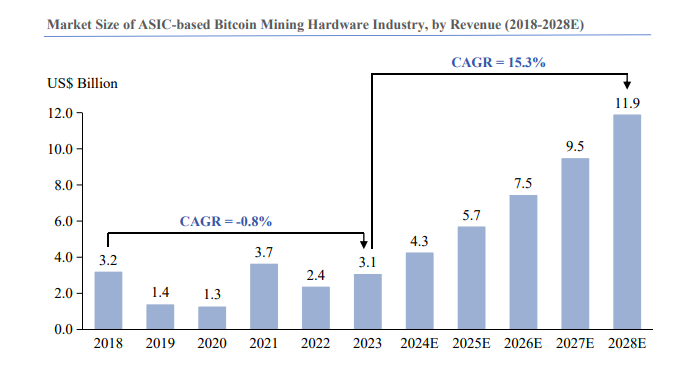
Chinese Bitcoin Hardware Titans Control 95% of Market, Now Coming to America to Dodge Trump Tariff WarSource: Frost & Sullivan

China’s Historical Bitcoin Mining Advantage

Understanding today’s migration requires examining how China achieved such overwhelming market control in the first place.

The foundation was laid during the historic 2017 Bitcoin boom, when three key factors aligned to create Chinese mining supremacy.

During the early expansion phase, Chinese officials recognized cryptocurrency mining as a profitable venture that attracted substantial foreign investment.

Consequently, authorities initially overlooked the mining sector while simultaneously restricting Bitcoin trading and initial coin offerings.

China’s extensive hydroelectric infrastructure further strengthened the country’s mining operations, providing the cheap energy essential for profitable Bitcoin production.

Does Chinese Hardware Control America’s Bitcoin Network?

While the United States leads global Bitcoin mining operations with over 38% of total network activity, American miners depend almost entirely on Chinese-manufactured equipment.

Chinese Bitcoin Hardware Titans Control 95% of Market, Now Coming to America to Dodge Trump Tariff WarAmerica Leads Bitcoin Mining Operation/ Source: Bitbo

This creates what security analysts describe as a “digital dependency trap,” a scenario where America’s cryptocurrency infrastructure relies fundamentally on hardware produced by its primary economic rival.

Guang Yang, Conflux Network’s chief technology officer, frames this dependency in geopolitical terms that extend far beyond trade economics.

“The U.S.-China trade war goes beyond tariffs,” Yang explains. “It’s a strategic pivot toward ‘politically acceptable’ hardware sources.”

His assessment reflects growing concerns within the cryptocurrency community about supply chain vulnerabilities that could impact national economic security.

Piyasa Fırsatı
Harvest Finance Logosu
Harvest Finance Fiyatı(FARM)
$18.76
$18.76$18.76
-0.15%
USD
Harvest Finance (FARM) Canlı Fiyat Grafiği
Sorumluluk Reddi: Bu sitede yeniden yayınlanan makaleler, halka açık platformlardan alınmıştır ve yalnızca bilgilendirme amaçlıdır. MEXC'nin görüşlerini yansıtmayabilir. Tüm hakları telif sahiplerine aittir. Herhangi bir içeriğin üçüncü taraf haklarını ihlal ettiğini düşünüyorsanız, kaldırılması için lütfen [email protected] ile iletişime geçin. MEXC, içeriğin doğruluğu, eksiksizliği veya güncelliği konusunda hiçbir garanti vermez ve sağlanan bilgilere dayalı olarak alınan herhangi bir eylemden sorumlu değildir. İçerik, finansal, yasal veya diğer profesyonel tavsiye niteliğinde değildir ve MEXC tarafından bir tavsiye veya onay olarak değerlendirilmemelidir.

Ayrıca Şunları da Beğenebilirsiniz

Bhutanese government transfers 343.1 Bitcoins and may deposit them again on CEX

Bhutanese government transfers 343.1 Bitcoins and may deposit them again on CEX

PANews reported on September 18 that according to Onchain Lens , the Royal Government of Bhutan has transferred 343.1 bitcoins (approximately US$ 40.18 million) to a new wallet and is expected to deposit the funds into a centralized exchange ( CEX ) as in the past.
Paylaş
PANews2025/09/18 17:22
Top Crypto Coins To Buy Now As APEMARS ($APRZ) Gains Momentum: These Meme Coins Could Explode After FOMC

Top Crypto Coins To Buy Now As APEMARS ($APRZ) Gains Momentum: These Meme Coins Could Explode After FOMC

In a world where memes, communities, and digital assets collide, a few projects rise above the noise. Today, whispers and attention are gathering around three names
Paylaş
Coinstats2025/12/30 09:15
SEC Backs Nasdaq, CBOE, NYSE Push to Simplify Crypto ETF Rules

SEC Backs Nasdaq, CBOE, NYSE Push to Simplify Crypto ETF Rules

The US SEC on Wednesday approved new listing rules for major exchanges, paving the way for a surge of crypto spot exchange-traded funds. On Wednesday, the regulator voted to let Nasdaq, Cboe BZX and NYSE Arca adopt generic listing standards for commodity-based trust shares. The decision clears the final hurdle for asset managers seeking to launch spot ETFs tied to cryptocurrencies beyond Bitcoin and Ether. In July, the SEC outlined how exchanges could bring new products to market under the framework. Asset managers and exchanges must now meet specific criteria, but will no longer need to undergo drawn-out case-by-case reviews. Solana And XRP Funds Seen to Be First In Line Under the new system, the time from filing to launch can shrink to as little as 75 days, compared with up to 240 days or more under the old rules. “This is the crypto ETP framework we’ve been waiting for,” Bloomberg research analyst James Seyffart said on X, predicting a wave of new products in the coming months. The first filings likely to benefit are those tracking Solana and XRP, both of which have sat in limbo for more than a year. SEC Chair Paul Atkins said the approval reflects a commitment to reduce barriers and foster innovation while maintaining investor protections. The move comes under the administration of President Donald Trump, which has signaled strong support for digital assets after years of hesitation during the Biden era. New Standards Replace Lengthy Reviews And Repeated Denials Until now, the commission reviewed each application separately, requiring one filing from the exchange and another from the asset manager. This dual process often dragged on for months and led to repeated denials. Even Bitcoin spot ETFs, finally approved in Jan. 2024, arrived only after years of resistance and a legal battle with Grayscale. According to Bloomberg ETF analyst Eric Balchunas, the streamlined rules could apply to any cryptocurrency with at least six months of futures trading on the Coinbase Derivatives Exchange. That means more than a dozen tokens may now qualify for listing, potentially unleashing a new wave of altcoin ETFs. SEC Clears Grayscale Large Cap Fund Tracking CoinDesk 5 Index The SEC also approved the Grayscale Digital Large Cap Fund, which tracks the CoinDesk 5 Index, including Bitcoin, Ether, XRP, Solana and Cardano. Alongside this, it cleared the launch of options linked to the Cboe Bitcoin US ETF Index and its mini contract, broadening the set of crypto-linked derivatives on regulated US markets. Analysts say the shift shows how far US policy has moved. Where once regulators resisted digital assets, the latest changes show a growing willingness to bring them into the mainstream financial system under established safeguards
Paylaş
CryptoNews2025/09/18 12:40