

Iran Holds Belgium at the World Cup: Are U.S.-Iran Tensions Cooling? Oil, Gold, and the MEXC Prediction Market Explained
Over the weekend, global markets were once again rattled by the Strait of Hormuz.
On one side, the United States and Iran exchanged tough rhetoric ahead of negotiations. On the other, oil prices kept testing investors’ nerves. Markets worried that tensions in the Middle East could escalate further, while on the football pitch, Iran had just held Belgium to a 0-0 draw in Los Angeles, keeping Group G wide open.
Then, before the U.S. stock market opened on Monday, Qatar and Pakistan, acting as mediators, released positive signals. Progress had reportedly been made in U.S.-Iran talks, and market anxiety quickly cooled. Oil prices pulled back, Asian equities rebounded, while gold continued to swing between safe-haven demand and expectations around Federal Reserve interest rates.
That led to a highly shareable question:
Could Iran’s suddenly more cooperative stance at the negotiation table have anything to do with the national team’s strong World Cup performance and improved domestic sentiment?
Of course, this sounds more like a market narrative than a serious diplomatic conclusion. But the interesting part is that the 2026 World Cup, U.S.-Iran relations, oil and gold prices, and the MEXC Prediction Market are now being connected by the same logic: how markets price uncertainty.
Iran’s World Cup Performance: Unbeaten After Two Matches, Still Alive in Group G
Let’s start with football.
According to the FIFA official match report, Iran drew 2-2 with New Zealand in its opening match. New Zealand led twice, but Iran equalized twice, avoiding what could have been a disastrous start to the group stage.
In the second match, Iran faced European powerhouse Belgium and earned a 0-0 draw. The FIFA official report on Belgium vs Iran highlighted the impressive goalkeeping performance, as Belgium ultimately had to settle for one point.
After two matches, Iran has not won yet, but it has not lost either. For a team playing under a complex political and media environment, this kind of resilience can easily be amplified by domestic media and broader market sentiment.
Iran’s situation is also clear: its defensive toughness has already been proven, but if the team wants to advance, it cannot rely on defending alone in the final group match against Egypt. With Belgium, Egypt, and New Zealand also in Group G, both points and goal difference could determine qualification. If Iran wants to turn a “respectable performance” into actual progression, it must show more attacking intent in the final round.
Why Is Iran’s Football Performance Drawing Market Attention?
Under normal circumstances, a team holding Belgium to a draw would simply be sports news.
But Iran is different.
Iran’s World Cup matches are taking place against the backdrop of highly sensitive U.S.-Iran tensions. According to Reuters, the United States and Iran held high-level talks in Switzerland, with Qatar and Pakistan involved as mediators. The discussions reportedly made progress on issues including a 60-day roadmap toward a final agreement, maritime security, and de-escalation in Lebanon.
In other words, while Iran’s national team was playing in the United States, Iranian diplomats were also negotiating some of the country’s most sensitive security and economic issues.
That means football is no longer just football.
On the pitch, Iran held Belgium and showed that it could withstand pressure. At the negotiation table, Iran appeared to send more constructive signals, helping risk appetite recover. The two events may not have a direct causal relationship, but from a media and market narrative perspective, they naturally fit into the same story:
Defend national pride on the football pitch, fight for leverage at the negotiation table, and reprice risk in financial markets.
That is why the idea that “Iran played well, so negotiations suddenly went smoothly” sounds like a joke, but also spreads easily. Markets may not fully believe the story, but markets love stories that help explain price movements.
The Strait of Hormuz: The Real Heartbeat of Oil Prices
The most important market variable in this round of U.S.-Iran tension is still the Strait of Hormuz.
The Strait of Hormuz is one of the world’s most important energy transit routes. According to the IEA’s information on the Strait of Hormuz, around 15 million barrels per day of crude oil passed through the strait in 2025, accounting for about 34% of global crude oil trade. EIA data also shows that oil flows through the Strait of Hormuz averaged around 20 million barrels per day in 2024, equivalent to about 20% of global petroleum liquids consumption.
That means if the Strait of Hormuz faces closure, restrictions, higher insurance costs, rerouting, or military miscalculation, oil prices will react immediately.
This is also why markets over the weekend were not simply asking whether the U.S. and Iran were exchanging harsh words. The real questions were:
Could the Strait of Hormuz actually be disrupted?
Could oil transportation be interrupted?
Could oil prices surge again?
Could inflation expectations rise again?
Would that make it harder for the Federal Reserve to cut rates, or even force it to stay hawkish?
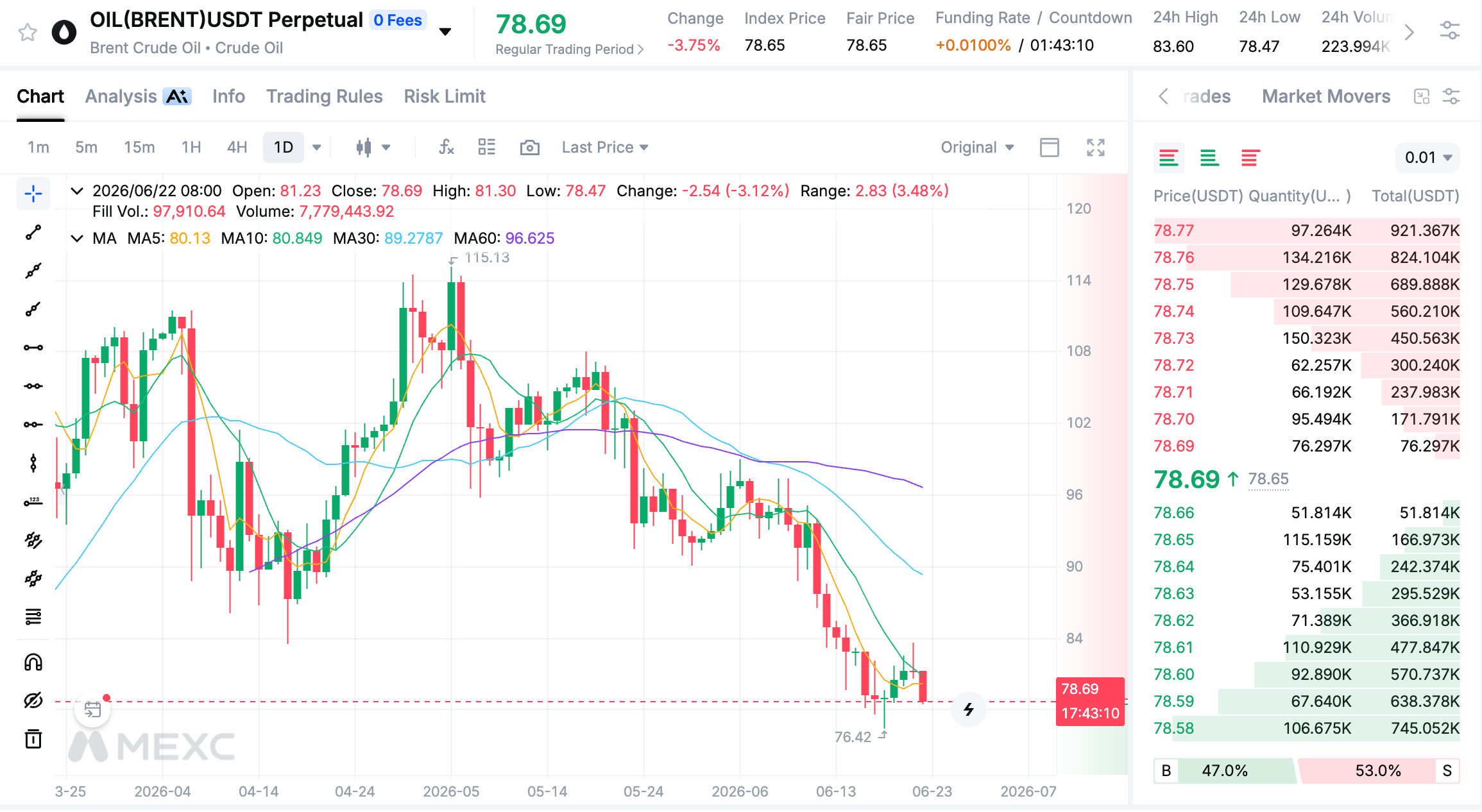
According to a Reuters market report, as progress in U.S.-Iran talks emerged, Brent crude pulled back to around $79, and Asian stocks rebounded. That reaction suggests that, at least in the short term, markets did not believe the situation would immediately spiral out of control.
In other words, oil prices were voting: the rhetoric sounded tense, but capital was not pricing in the worst-case scenario yet.
Gold Prices: Safe-Haven Demand Remains, but the Logic Is More Complicated
Gold’s reaction has been more complicated than oil’s.
Common sense says that when U.S.-Iran tensions rise, gold should climb because it is a traditional safe-haven asset. But real markets do not move on one single logic.
According to Reuters’ gold market coverage, gold rebounded after touching a one-week low, but hawkish signals from the Federal Reserve and expectations of higher interest rates capped the upside.
This shows that gold is currently being pulled by two forces:
On one side, geopolitical risk supports safe-haven demand.
On the other, a stronger dollar and higher rate expectations limit gold’s performance.
If oil prices surge, markets may worry about inflation returning, but gold may not benefit in a straightforward way because the Federal Reserve could be forced to keep interest rates higher for longer.
If U.S.-Iran tensions ease and oil prices fall, gold’s safe-haven demand may cool, but rate pressure may also ease.
So gold prices are not simply about “war means up, peace means down.” Gold is trading a combination of geopolitical risk, the dollar, inflation, and interest-rate expectations.
Why Has the Crypto Market Become a Weekend Sentiment Gauge?
The reference article made an interesting point: traditional oil futures have long weekend closing windows, while the crypto market trades 24/7, so crypto often reflects market sentiment earlier.
This logic makes sense.
When traditional markets are closed, investors who want to express views on Middle East tensions, dollar liquidity, safe-haven demand, or risk appetite often look first to 24/7 crypto markets. Bitcoin, Ethereum, stablecoin liquidity, on-chain fund flows, and certain derivatives prices can all become early signals of weekend market sentiment.
Of course, the crypto market is not the same as the oil market, and it cannot fully replace traditional futures such as CME contracts. But it often plays the role of an early emotional pricing board.
This is also why the MEXC Prediction Market has more room to grow during the World Cup cycle. It does not simply track the price of a single asset. It allows users to price the probability of real-world events.
Will a match produce an upset?
Can Iran qualify from the group?
Will a team reach the knockout stage?
Has the market overestimated a favorite?
Will breaking news change prediction prices?
These questions are closer to event trading than simply reading a candlestick chart.
MEXC Prediction Market: Turning the World Cup Into a Probability Trading Scenario
According to the MEXC beginner’s guide, a prediction market is a market where users trade on the outcomes of real-world events, with prices reflecting the market’s consensus probability of a particular result.
For example, if the YES price of an event is 0.65, it can be understood as the market estimating roughly a 65% probability of that outcome. The MEXC Prediction Markets FAQ also explains a similar mechanism: the correct outcome settles at $1, while the incorrect outcome settles at $0.
This makes the World Cup a natural fit for prediction markets.
The World Cup has several ideal characteristics:
High attention
High uncertainty
High emotional volatility
Frequent information updates
Clear match results
Clear settlement standards
From Iran’s perspective, prediction market users can build views around several questions:
Can Iran beat Egypt?
Can Iran qualify from Group G?
Is Belgium still the safest team in Group G?
Will Egypt receive a higher market price because of its attacking strength?
Has the market reassessed Iran’s true strength after two unbeaten matches?
These questions are not simply about “betting on who wins.” They require a combined judgment of information, probability, and price.
Users can visit the MEXC Sports Prediction Market to view World Cup-related prediction events, or explore more real-world event opportunities through the MEXC Prediction Market.
MEXC World Cup Prediction Campaign: Why the Iran Story Fits Naturally
MEXC has launched its Global Football 2026 campaign around the World Cup. According to the official MEXC announcement, the campaign features a 1,360,000 USDT prize pool and runs from June 11 to July 19, 2026. Users can participate in eligible football prediction events and earn rewards through successful prediction streaks and qualifying trading volume.
This type of campaign fits naturally with the Iran storyline for three reasons.
First, Iran still has a real chance to qualify.
The more suspense there is, the more room there is for prediction market discussion. If Iran were already eliminated, market interest would quickly fade. If Iran had already secured qualification, price volatility would also decrease. The current state, unbeaten in two matches but not yet safe, is ideal for prediction market content.
Second, U.S.-Iran tensions add an extra narrative layer to Iran’s matches.
An ordinary match only has tactical analysis. But Iran’s matches also come with geopolitical tension, national sentiment, oil prices, and safe-haven assets. This cross-market narrative can attract sports fans, crypto users, and macro market watchers at the same time.
Third, prediction markets are well suited for expressing the view: “I disagree with the market.”
If users believe Iran is being underestimated, they can look for a possible pricing gap.
If users think the market is overpricing emotional narratives, they can take the opposite view.
If users believe Egypt has stronger attacking potential, they can check whether that has already been reflected in the event price.
The real appeal of prediction markets is not blindly following the trend. It is breaking a trending story into probabilities.
Iran vs Egypt: The Next Match Could Be the Real Pricing Turning Point
Iran’s first two performances were solid, but the final group-stage match against Egypt may be the real turning point for the market narrative.
If Iran wins, the story becomes very complete:
A strong World Cup performance, easing U.S.-Iran negotiations, recovering risk appetite, and Iran becoming one of the most talked-about Asian teams of the tournament.
If Iran draws, qualification may depend on the result of the other group match, and markets will continue to trade uncertainty.
If Iran loses, the “resilience” narrative built over the first two matches will weaken, and the market’s reassessment of Iran could quickly reverse.
This is the biggest difference between a World Cup prediction market and ordinary pre-match analysis. Regular analysis gives one conclusion before kickoff. Prediction markets keep repricing as information changes.
Starting lineups can move prices.
A first-half red card can move prices.
A goal in the other group match can move prices.
A penalty in stoppage time can instantly reprice everything.
The World Cup is not a static event. It is a chain of real-time variables. The value of the MEXC Prediction Market lies in turning those variables into observable and tradable probability prices.
From Iran’s Football Team to Oil and Gold: Markets Are Really Trading Uncertainty
Putting Iran’s World Cup performance, U.S.-Iran relations, oil prices, gold prices, and the MEXC Prediction Market together is not forced.
Behind all of them is the same logic:
Whether Iran can qualify is football uncertainty.
Whether the U.S. and Iran can reach a final agreement is geopolitical uncertainty.
Whether the Strait of Hormuz will affect transportation is energy supply uncertainty.
Whether gold will continue to rebound is uncertainty around safe-haven demand and rate expectations.
Changes in MEXC Prediction Market prices are users’ probability expressions about future outcomes.
Every day, markets are doing the same thing: pricing uncertainty.
That is why the weekend’s storyline was so powerful. One moment, markets were worried that the Strait of Hormuz could face disruption. The next, mediators released positive signals, oil prices fell, and equities rebounded. At the same time, Iran had just held Belgium at the World Cup, giving domestic and international media a highly usable emotional hook.
Football, diplomacy, oil, gold, and crypto markets may look like five different things, but they are all answering the same question:
Will risk increase or decrease next?
Conclusion: The World Cup Is Becoming a Super Entrance for Prediction Markets
The 2026 World Cup is not just a sporting event. It is also a concentrated display of global attention, market sentiment, and prediction market products.
Iran’s two unbeaten matches have kept Group G wide open.
Progress in U.S.-Iran negotiations has helped oil prices pull back and risk appetite recover.
Gold remains caught between safe-haven demand and interest-rate expectations, showing that markets have not fully let down their guard.
The MEXC Prediction Market turns these real-world events into probability scenarios that can be observed, traded, and repriced.
So instead of simply asking whether Iran’s strong World Cup performance made negotiations smoother, the more important question is:
When the World Cup, geopolitics, and financial markets all heat up at the same time, who can understand the market narrative faster and get closer to real price discovery?
For users watching World Cup predictions, Iran’s qualification chances, U.S.-Iran relations, oil and gold prices, and crypto market opportunities, the MEXC Prediction Market offers a new observation point. In particular, through the MEXC Sports Prediction Market, the World Cup is no longer just something to watch. It becomes part of judging probabilities, tracking sentiment, and understanding the market.


Ayrıca Şunları da Beğenebilirsiniz

Gate Stocks Introduces Korean Stock Trading, Expanding Global Multi-Asset Investment Access

Finance Strategist: If You Hold XRP and HBAR, This Is Extremely Urgent

Paradigm’s prediction markets terminal targets pros as Kalshi backing deepens


Popüler Haberler
Daha fazla
