Grayscale Investments launched its Solana Trust ETF on NYSE Arca on Tuesday, becoming the first of the firm’s staking products to uplist under new SEC-approved generic listing standards. The move intensifies competition in the nascent Solana ETF market, where Bitwise’s debut product already captured $69.5 million in first-day inflows. The launch expands Grayscale’s digital asset lineup beyond Bitcoin and Ethereum, offering investors exposure to Solana’s proof-of-stake blockchain through a familiar exchange-traded wrapper. GSOL now joins Bitwise’s BSOL and Rex-Osprey’s SSK as the third Solana ETF trading on U.S. exchanges. Grayscale Enters With Staking-Enabled Structure GSOL carries a 0.35% expense ratio and holds 525,387 SOL tokens, with 74.89% currently staked to generate network rewards. Grayscale intends to pass on 77% of all staking rewards to investors on a net basis, potentially adding 5-6% annual returns based on historical Solana staking yields of 6-8%. The fund first launched as a private trust in 2021, was listed on OTCQX in 2023, and began staking in October 2025. Inkoo Kang, Senior Vice President of ETFs at Grayscale, framed the launch as evidence that digital assets belong in “modern portfolios” alongside traditional equities and bonds. Kristin Smith, President of Solana Policy Institute, also noted that staking ETPs allows investors “to help secure the network, accelerate innovation for developers, and earn rewards on one of the most dynamic assets in modern finance.” The product is not registered under the Investment Company Act of 1940, meaning it lacks the regulatory protections of traditional ETFs and mutual funds. Grayscale emphasized that GSOL represents indirect exposure to Solana and carries significant risks, including the potential loss of principal. Bitwise Dominates Early Solana ETF Flows Bitwise’s Solana ETF captured $69.5 million on its October 28 debut, nearly six times the $12 million raised by Rex-Osprey’s competing product. BSOL stakes 100% of its held SOL tokens in-house to deliver Solana’s full network yield to investors, charging a 0.20% management fee that has been waived for the first three months. Matt Hougan, Bitwise’s Chief Investment Officer, attributed institutional enthusiasm to Solana’s on-chain revenue leadership. “Institutional investors love ETFs, and they love revenue,” he said. Rex-Osprey’s SSK takes a different approach, holding 54% in direct Solana, 43.5% in a Swiss-listed CoinShares ETP, and the remainder in JitoSOL and cash, with monthly staking rewards classified as return of capital for tax purposes. Despite positive sentiment around ETFs, the market remains cautious about near-term price action. Traders on Polymarket give Solana just a 28% chance of reaching a new all-time high before 2026, with SOL trading at $200 today, up nearly 1% over 24 hours.Source: Polymarket Solana Challenges Ethereum’s Institutional Dominance Speaking with Cryptonews, Maria Carola, CEO of StealthEX, views the Solana ETF launch as a defining moment in the battle for Layer 1 blockchain dominance. “The launch of a spot ETF on Solana is a signal that has broken out in the protracted battle for dominance in the Layer 1 blockchain space,” she said. “For the first time, institutional investors are being invited to consider Solana as a standalone macro asset.“ Carola notes that projections of $3 billion in ETF inflows over the next 12-18 months depend on Solana maintaining its 2024 momentum in DeFi expansion and network stability. She acknowledges that while Solana offers technological advantages in speed and scalability, “it’s Ethereum’s fundamentals, such as stability, institutional reputation, and integration into the global financial system, that maintain its leadership.” Ethereum currently holds over $60 billion locked in DeFi with a mature staking ecosystem that continues to set the standard for institutional investors seeking predictability and reliability. However, Carola suggests a potential coexistence model where “Ethereum serves as the underlying trust and settlement layer in the on-chain economy, while Solana becomes its high-performance execution engine.” She adds that if ETF inflow projections are met by the end of 2025, “Solana could become the first blockchain since Ethereum to break the institutional glass ceiling.“ Regulatory Momentum Builds Across Multiple Blockchains The Solana ETF wave follows Hong Kong’s October approval of China Asset Management’s SOL spot fund, which began trading on October 27 with a minimum investment of $100. The product carries a 0.99% management fee and a 1.99% total expense ratio, making Solana the third cryptocurrency, after Bitcoin and Ethereum, to receive spot ETF clearance in the territory. Multiple U.S. issuers, including VanEck, Canary Capital, Franklin Templeton, Fidelity, and CoinShares, have also received approval for Solana ETF proposals. Recently, Bloomberg analyst Eric Balchunas also confirmed that the SEC is expected to approve the first Hedera and Litecoin ETFs, with listing notices for Canary’s HBAR and LTC products scheduled for October 28Grayscale Investments launched its Solana Trust ETF on NYSE Arca on Tuesday, becoming the first of the firm’s staking products to uplist under new SEC-approved generic listing standards. The move intensifies competition in the nascent Solana ETF market, where Bitwise’s debut product already captured $69.5 million in first-day inflows. The launch expands Grayscale’s digital asset lineup beyond Bitcoin and Ethereum, offering investors exposure to Solana’s proof-of-stake blockchain through a familiar exchange-traded wrapper. GSOL now joins Bitwise’s BSOL and Rex-Osprey’s SSK as the third Solana ETF trading on U.S. exchanges. Grayscale Enters With Staking-Enabled Structure GSOL carries a 0.35% expense ratio and holds 525,387 SOL tokens, with 74.89% currently staked to generate network rewards. Grayscale intends to pass on 77% of all staking rewards to investors on a net basis, potentially adding 5-6% annual returns based on historical Solana staking yields of 6-8%. The fund first launched as a private trust in 2021, was listed on OTCQX in 2023, and began staking in October 2025. Inkoo Kang, Senior Vice President of ETFs at Grayscale, framed the launch as evidence that digital assets belong in “modern portfolios” alongside traditional equities and bonds. Kristin Smith, President of Solana Policy Institute, also noted that staking ETPs allows investors “to help secure the network, accelerate innovation for developers, and earn rewards on one of the most dynamic assets in modern finance.” The product is not registered under the Investment Company Act of 1940, meaning it lacks the regulatory protections of traditional ETFs and mutual funds. Grayscale emphasized that GSOL represents indirect exposure to Solana and carries significant risks, including the potential loss of principal. Bitwise Dominates Early Solana ETF Flows Bitwise’s Solana ETF captured $69.5 million on its October 28 debut, nearly six times the $12 million raised by Rex-Osprey’s competing product. BSOL stakes 100% of its held SOL tokens in-house to deliver Solana’s full network yield to investors, charging a 0.20% management fee that has been waived for the first three months. Matt Hougan, Bitwise’s Chief Investment Officer, attributed institutional enthusiasm to Solana’s on-chain revenue leadership. “Institutional investors love ETFs, and they love revenue,” he said. Rex-Osprey’s SSK takes a different approach, holding 54% in direct Solana, 43.5% in a Swiss-listed CoinShares ETP, and the remainder in JitoSOL and cash, with monthly staking rewards classified as return of capital for tax purposes. Despite positive sentiment around ETFs, the market remains cautious about near-term price action. Traders on Polymarket give Solana just a 28% chance of reaching a new all-time high before 2026, with SOL trading at $200 today, up nearly 1% over 24 hours.Source: Polymarket Solana Challenges Ethereum’s Institutional Dominance Speaking with Cryptonews, Maria Carola, CEO of StealthEX, views the Solana ETF launch as a defining moment in the battle for Layer 1 blockchain dominance. “The launch of a spot ETF on Solana is a signal that has broken out in the protracted battle for dominance in the Layer 1 blockchain space,” she said. “For the first time, institutional investors are being invited to consider Solana as a standalone macro asset.“ Carola notes that projections of $3 billion in ETF inflows over the next 12-18 months depend on Solana maintaining its 2024 momentum in DeFi expansion and network stability. She acknowledges that while Solana offers technological advantages in speed and scalability, “it’s Ethereum’s fundamentals, such as stability, institutional reputation, and integration into the global financial system, that maintain its leadership.” Ethereum currently holds over $60 billion locked in DeFi with a mature staking ecosystem that continues to set the standard for institutional investors seeking predictability and reliability. However, Carola suggests a potential coexistence model where “Ethereum serves as the underlying trust and settlement layer in the on-chain economy, while Solana becomes its high-performance execution engine.” She adds that if ETF inflow projections are met by the end of 2025, “Solana could become the first blockchain since Ethereum to break the institutional glass ceiling.“ Regulatory Momentum Builds Across Multiple Blockchains The Solana ETF wave follows Hong Kong’s October approval of China Asset Management’s SOL spot fund, which began trading on October 27 with a minimum investment of $100. The product carries a 0.99% management fee and a 1.99% total expense ratio, making Solana the third cryptocurrency, after Bitcoin and Ethereum, to receive spot ETF clearance in the territory. Multiple U.S. issuers, including VanEck, Canary Capital, Franklin Templeton, Fidelity, and CoinShares, have also received approval for Solana ETF proposals. Recently, Bloomberg analyst Eric Balchunas also confirmed that the SEC is expected to approve the first Hedera and Litecoin ETFs, with listing notices for Canary’s HBAR and LTC products scheduled for October 28

Solana ETF Race Heats Up as Grayscale Joins Bitwise on Wall Street

Grayscale Investments launched its Solana Trust ETF on NYSE Arca on Tuesday, becoming the first of the firm’s staking products to uplist under new SEC-approved generic listing standards.

The move intensifies competition in the nascent Solana ETF market, where Bitwise’s debut product already captured $69.5 million in first-day inflows.

The launch expands Grayscale’s digital asset lineup beyond Bitcoin and Ethereum, offering investors exposure to Solana’s proof-of-stake blockchain through a familiar exchange-traded wrapper.

GSOL now joins Bitwise’s BSOL and Rex-Osprey’s SSK as the third Solana ETF trading on U.S. exchanges.

Grayscale Enters With Staking-Enabled Structure

GSOL carries a 0.35% expense ratio and holds 525,387 SOL tokens, with 74.89% currently staked to generate network rewards.

Grayscale intends to pass on 77% of all staking rewards to investors on a net basis, potentially adding 5-6% annual returns based on historical Solana staking yields of 6-8%.

The fund first launched as a private trust in 2021, was listed on OTCQX in 2023, and began staking in October 2025.

Inkoo Kang, Senior Vice President of ETFs at Grayscale, framed the launch as evidence that digital assets belong in “modern portfolios” alongside traditional equities and bonds.

Kristin Smith, President of Solana Policy Institute, also noted that staking ETPs allows investors “to help secure the network, accelerate innovation for developers, and earn rewards on one of the most dynamic assets in modern finance.”

The product is not registered under the Investment Company Act of 1940, meaning it lacks the regulatory protections of traditional ETFs and mutual funds.

Grayscale emphasized that GSOL represents indirect exposure to Solana and carries significant risks, including the potential loss of principal.

Bitwise Dominates Early Solana ETF Flows

Bitwise’s Solana ETF captured $69.5 million on its October 28 debut, nearly six times the $12 million raised by Rex-Osprey’s competing product.

BSOL stakes 100% of its held SOL tokens in-house to deliver Solana’s full network yield to investors, charging a 0.20% management fee that has been waived for the first three months.

Matt Hougan, Bitwise’s Chief Investment Officer, attributed institutional enthusiasm to Solana’s on-chain revenue leadership.

“Institutional investors love ETFs, and they love revenue,” he said.

Rex-Osprey’s SSK takes a different approach, holding 54% in direct Solana, 43.5% in a Swiss-listed CoinShares ETP, and the remainder in JitoSOL and cash, with monthly staking rewards classified as return of capital for tax purposes.

Despite positive sentiment around ETFs, the market remains cautious about near-term price action.

Traders on Polymarket give Solana just a 28% chance of reaching a new all-time high before 2026, with SOL trading at $200 today, up nearly 1% over 24 hours.
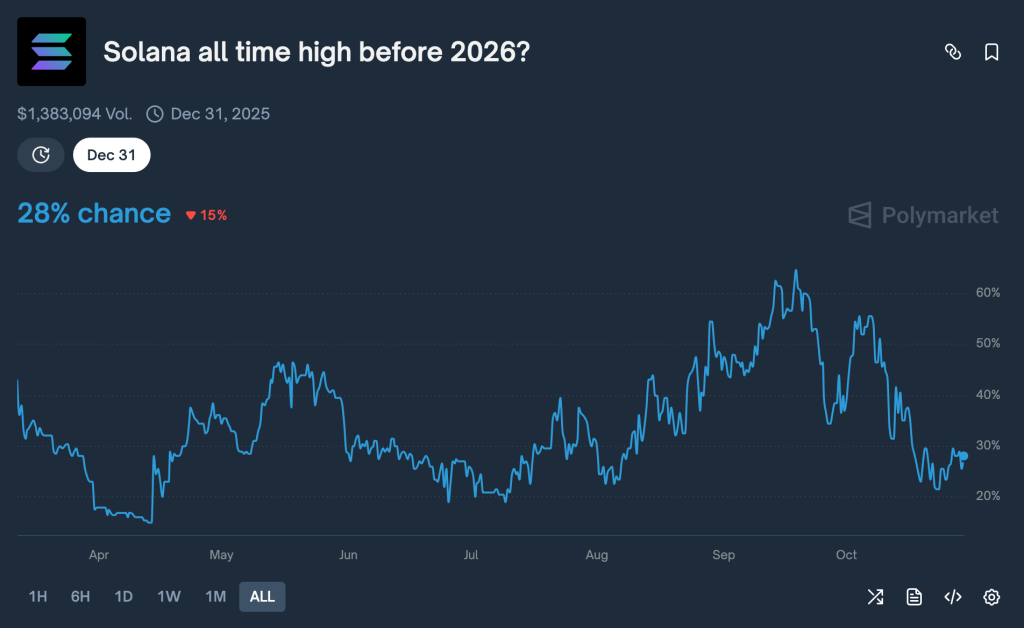
Solana ETF Race Heats Up as Grayscale Joins Bitwise on Wall StreetSource: Polymarket

Solana Challenges Ethereum’s Institutional Dominance

Speaking with Cryptonews, Maria Carola, CEO of StealthEX, views the Solana ETF launch as a defining moment in the battle for Layer 1 blockchain dominance.

The launch of a spot ETF on Solana is a signal that has broken out in the protracted battle for dominance in the Layer 1 blockchain space,” she said.

For the first time, institutional investors are being invited to consider Solana as a standalone macro asset.

Carola notes that projections of $3 billion in ETF inflows over the next 12-18 months depend on Solana maintaining its 2024 momentum in DeFi expansion and network stability.

She acknowledges that while Solana offers technological advantages in speed and scalability, “it’s Ethereum’s fundamentals, such as stability, institutional reputation, and integration into the global financial system, that maintain its leadership.

Ethereum currently holds over $60 billion locked in DeFi with a mature staking ecosystem that continues to set the standard for institutional investors seeking predictability and reliability.

However, Carola suggests a potential coexistence model where “Ethereum serves as the underlying trust and settlement layer in the on-chain economy, while Solana becomes its high-performance execution engine.”

She adds that if ETF inflow projections are met by the end of 2025, “Solana could become the first blockchain since Ethereum to break the institutional glass ceiling.

Regulatory Momentum Builds Across Multiple Blockchains

The Solana ETF wave follows Hong Kong’s October approval of China Asset Management’s SOL spot fund, which began trading on October 27 with a minimum investment of $100.

The product carries a 0.99% management fee and a 1.99% total expense ratio, making Solana the third cryptocurrency, after Bitcoin and Ethereum, to receive spot ETF clearance in the territory.

Multiple U.S. issuers, including VanEck, Canary Capital, Franklin Templeton, Fidelity, and CoinShares, have also received approval for Solana ETF proposals.

Recently, Bloomberg analyst Eric Balchunas also confirmed that the SEC is expected to approve the first Hedera and Litecoin ETFs, with listing notices for Canary’s HBAR and LTC products scheduled for October 28.

Sorumluluk Reddi: Bu sitede yeniden yayınlanan makaleler, halka açık platformlardan alınmıştır ve yalnızca bilgilendirme amaçlıdır. MEXC'nin görüşlerini yansıtmayabilir. Tüm hakları telif sahiplerine aittir. Herhangi bir içeriğin üçüncü taraf haklarını ihlal ettiğini düşünüyorsanız, kaldırılması için lütfen [email protected] ile iletişime geçin. MEXC, içeriğin doğruluğu, eksiksizliği veya güncelliği konusunda hiçbir garanti vermez ve sağlanan bilgilere dayalı olarak alınan herhangi bir eylemden sorumlu değildir. İçerik, finansal, yasal veya diğer profesyonel tavsiye niteliğinde değildir ve MEXC tarafından bir tavsiye veya onay olarak değerlendirilmemelidir.

Ayrıca Şunları da Beğenebilirsiniz

Bitcoin ETF Investors React to Fed’s Decision
Bitcoin ETF Investors React to Fed’s Decision

The post Bitcoin ETF Investors React to Fed’s Decision appeared on BitcoinEthereumNews.com. In a surprise move, spot Bitcoin ETFs experienced their first significant daily outflows in over a week, following the Federal Reserve’s adjusted policy outlook. This shift reflects the market’s readiness to respond to any hint of change on the regulatory landscape, as well as its sensitivity to central bank cues. Continue Reading:Bitcoin ETF Investors React to Fed’s Decision Source: https://en.bitcoinhaber.net/bitcoin-etf-investors-react-to-feds-decision
Paylaş
BitcoinEthereumNews2025/09/18 18:51
US Senators Introduce SAFE Crypto Act to Target Rising Crypto Scams

US Senators Introduce SAFE Crypto Act to Target Rising Crypto Scams

The post US Senators Introduce SAFE Crypto Act to Target Rising Crypto Scams appeared first on Coinpedia Fintech News Crypto scams are getting faster, smarter and
Paylaş
CoinPedia2025/12/17 18:33
From Idea to App Store: The Complete Guide to Mobile App Development in Saudi Arabia

From Idea to App Store: The Complete Guide to Mobile App Development in Saudi Arabia

Saudi Arabia is at the forefront of digital transformation. With Vision 2030 driving innovation and a rapidly growing population of tech-savvy users, mobile apps have become a core driver of business growth in the Kingdom. From e-commerce and fintech to healthcare, logistics, and on-demand services, Saudi businesses are embracing mobile apps to connect with customers and scale faster. But how do you take a mobile app idea and turn it into a successful launch on the App Store or Google Play? This guide breaks down the complete mobile app development process in Saudi Arabia — step by step. Step 1: Validate Your App Idea for the Saudi Market Before you start building, ask: What problem does my app solve for Saudi users? Is there a cultural or market gap my app can fill? How do local competitors approach the same challenge? For example, apps related to digital payments, e-learning, delivery services, and healthcare are in high demand across Saudi Arabia. Conducting market research and aligning your app idea with local user behavior is critical. Step 2: Plan Features with Local Needs in Mind Your app should start with an MVP (Minimum Viable Product) — a core version that solves the main problem. Later, you can scale with advanced features. In Saudi Arabia, consider adding: Arabic language support (essential for user adoption) Integration with local payment gateways like STC Pay, Mada, or Apple Pay Regulatory compliance (especially for fintech and health apps) Localization for user preferences (Hijri calendar, cultural UI elements) Step 3: Select the Right Development Approach You can choose: Native Apps (Swift for iOS, Kotlin for Android) — Great for scalability and performance. Cross-Platform Apps (Flutter, React Native) — Cost-effective for startups targeting both iOS and Android simultaneously. Hybrid Apps — Suitable for simpler apps with limited features. For Saudi startups and enterprises, cross-platform development is often preferred to reach a wider audience quickly and efficiently. Step 4: Design With a Local Touch The design must balance global usability standards with local cultural relevance. UI (User Interface): Clean, modern visuals that align with Saudi branding. UX (User Experience): Simple navigation, clear Arabic text support, and intuitive flows. Wireframing & Prototyping: Test early with Saudi users to ensure adoption. A user-friendly design is one of the top reasons apps succeed in the Kingdom’s competitive market. Step 5: Develop Your Mobile App Once the design is ready, the coding begins. Saudi app development companies often follow Agile methodology, ensuring flexibility and faster delivery. Front-End Development: Interface and user interactions. Back-End Development: Databases, servers, and APIs. Integration: Secure connections between front-end and back-end. Strong collaboration between developers, designers, and business analysts ensures your app aligns with Saudi market needs. Step 6: Testing Across Devices and Networks Saudi users rely on different devices and network speeds. That’s why rigorous testing is critical: Functionality Testing: Features work as expected. Performance Testing: The app runs smoothly on both 4G and 5G networks. Localization Testing: Arabic text displays correctly, without alignment issues. Security Testing: Data protection compliance with Saudi cybersecurity standards. Step 7: App Store & Google Play Launch in Saudi Arabia To publish your app: Apple App Store (iOS): Requires an Apple Developer account and strict guideline compliance. Google Play Store (Android): Faster approval but still requires detailed app info. You’ll also need metadata in both English and Arabic — titles, descriptions, and screenshots — to maximize visibility among Saudi users. Step 8: Market Your App in Saudi Arabia Launching an app is only the beginning. You need a marketing strategy tailored to the Kingdom: App Store Optimization (ASO): Use Arabic and English keywords. Social Media Campaigns: Leverage platforms like Snapchat, Twitter (X), and Instagram, which are highly popular in Saudi Arabia. Influencer Marketing: Collaborate with Saudi influencers for early traction. Paid Ads: Google Ads and Saudi-focused Facebook/Instagram ads. Partnerships: Collaborate with local businesses to reach a wider audience. Step 9: Gather Feedback and Optimize Once your app is live, monitor: User reviews on app stores Analytics on engagement, retention, and churn rates Suggestions from Saudi users for culturally relevant features Continuous updates and improvements are vital to stay competitive. Step 10: Scale With Advanced Features Once your MVP gains traction, you can expand with advanced features such as: AI and machine learning for personalization Blockchain-based payments for fintech apps AR/VR features for retail and gaming apps IoT integration for smart home and mobility solutions Saudi Arabia’s digital ecosystem is growing rapidly — apps that adapt quickly will thrive. Conclusion Mobile app development in Saudi Arabia is not just about building an app — it’s about aligning with Vision 2030, cultural needs, and user expectations. By following a clear process — from idea validation to launch and beyond — you can transform your concept into a profitable digital product. Whether you’re a startup or an enterprise in Saudi Arabia, the opportunity is massive. With the right strategy, you can move from idea to App Store and create an app that truly resonates with Saudi users. From Idea to App Store: The Complete Guide to Mobile App Development in Saudi Arabia was originally published in Coinmonks on Medium, where people are continuing the conversation by highlighting and responding to this story
Paylaş
Medium2025/09/18 14:46