Dogecoin drops 14% in a week amid whale selling and weak momentum, but analysts spot a wedge pattern that previously led to a breakout.Dogecoin drops 14% in a week amid whale selling and weak momentum, but analysts spot a wedge pattern that previously led to a breakout.

Dogecoin Dips Under Key Support – Yet a Breakout Pattern Is Forming

Dogecoin has come under pressure, falling more than 6% in the past 24 hours and over 14% in the last week.

As of press time, it is trading near $0.174. The drop is part of a broader market pullback.

Technical Setup Shows Familiar Pattern

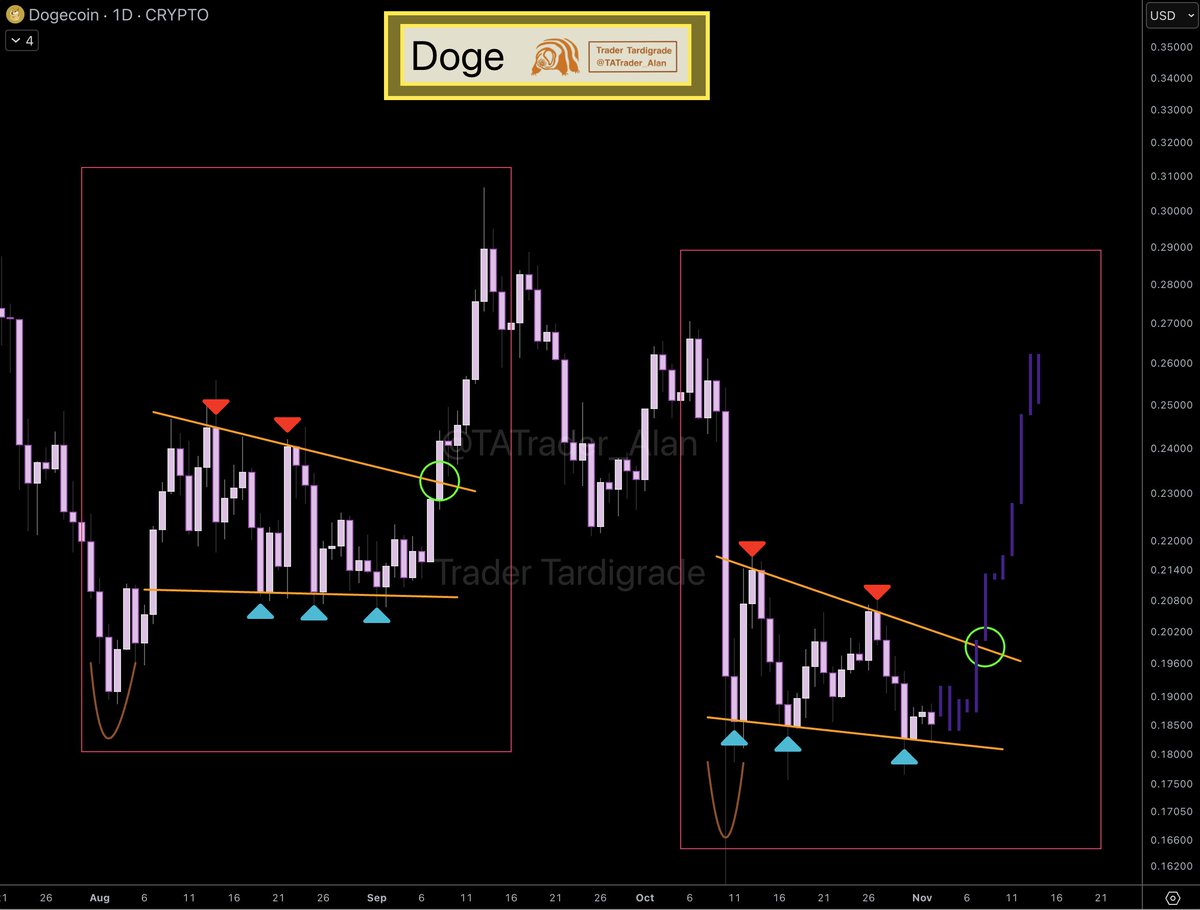
Trader Tardigrade, a crypto chart analyst, has pointed out a recurring formation on Dogecoin’s daily chart. The pattern is known as a descending contracting wedge. It is taking shape with three clear touches on the lower support line and two touches on the upper resistance line. This same setup appeared on the chart in August and led to a sharp move upward after the breakout.
DOGE price chartSource: Trader Tardigrade/X

The current wedge, formed between October and early November, closely matches the earlier pattern. A breakout from the resistance line has already occurred, marked by a green circle on the chart shared by Tardigrade. If the past price movement repeats, Dogecoin could see a short-term rise toward the $0.26 to $0.28 range. The structure alone, however, does not confirm direction. It will depend on volume and trader participation.

In addition to the daily chart, Tardigrade also shared a broader monthly view. Dogecoin appears to be forming a long-term rounding bottom pattern. Based on the chart’s depth, this setup could project a move toward $4.14. This structure reflects price behavior over a much more extended period and does not suggest any immediate shift.

Moreover, another key formation can be seen on the 3-day chart, where Dogecoin is trading inside a wide ascending channel. The asset is now near the bottom of that channel, which has previously acted as support.

Indicators Reflect Weak Momentum

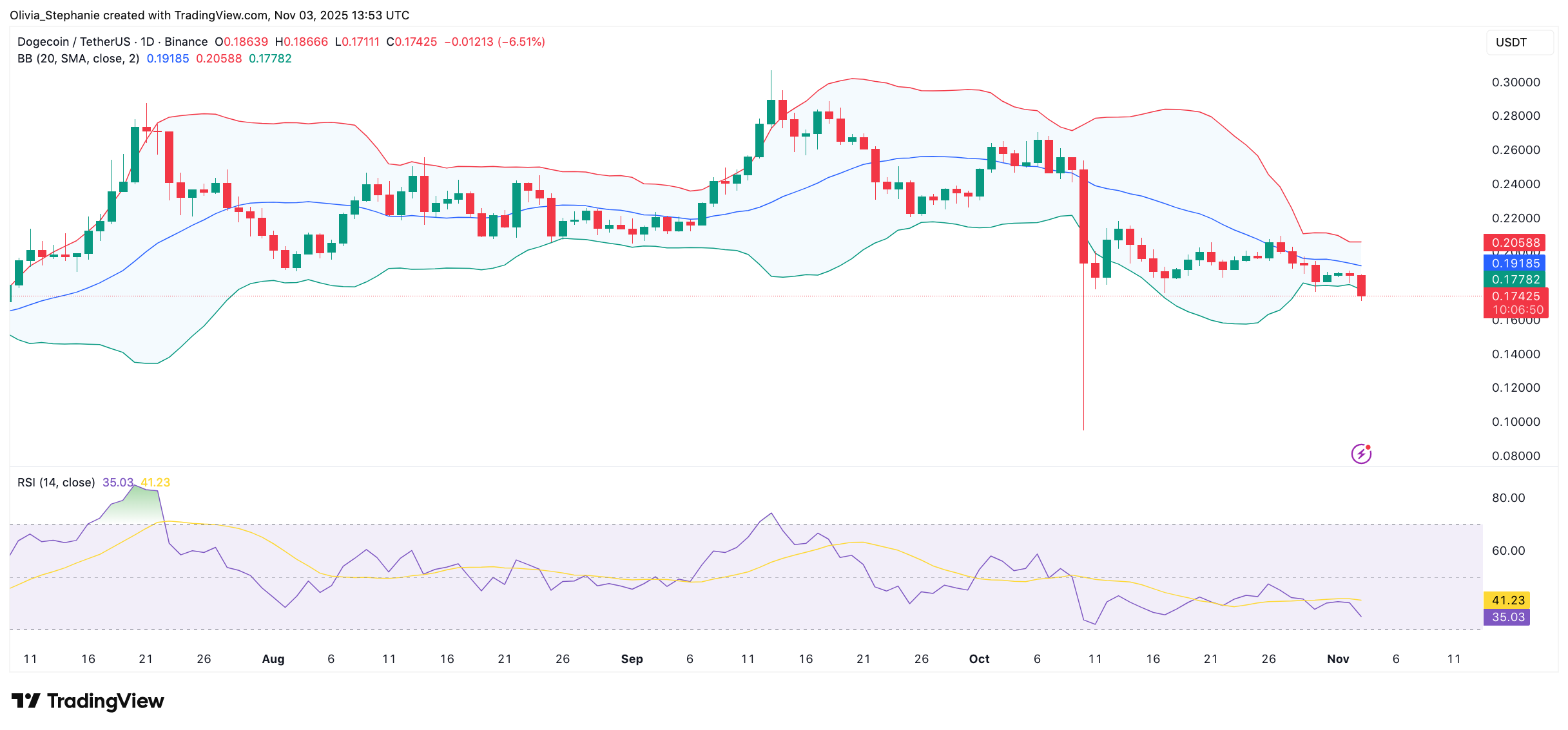
The Relative Strength Index (RSI) on the daily chart is now at 35. While not yet oversold, it is approaching levels that may cause short-term price stabilization or a bounce.

Meanwhile, Bollinger Bands show the price moving below the lower band, suggesting increased downside volatility or selling exhaustion. The 20-day moving average currently stands at $0.19185, which Dogecoin is trading well below.

DOGE price chart
Source: TradingView

Crypto analyst Ali Martinez stated that $0.18 is a key support level. He referred to it as a “strong buy-the-dip zone” if the price holds. Since the asset is now under this level, its strength will be tested.

Whale Activity and Futures Market Show Cooling Interest

Wallets holding 10–100 million DOGE sold 440 million tokens over three days last week. This large-scale selling added to the recent price pressure and may have led smaller investors to follow.

Open interest in Dogecoin futures currently stands at $1.67 billion. This is far below its previous peak of over $6 billion. Lower open interest often reflects reduced trading activity and less leverage in the market. With both price and open interest moving lower, there is little sign of strong directional momentum for now.

The post Dogecoin Dips Under Key Support – Yet a Breakout Pattern Is Forming appeared first on CryptoPotato.

Sorumluluk Reddi: Bu sitede yeniden yayınlanan makaleler, halka açık platformlardan alınmıştır ve yalnızca bilgilendirme amaçlıdır. MEXC'nin görüşlerini yansıtmayabilir. Tüm hakları telif sahiplerine aittir. Herhangi bir içeriğin üçüncü taraf haklarını ihlal ettiğini düşünüyorsanız, kaldırılması için lütfen [email protected] ile iletişime geçin. MEXC, içeriğin doğruluğu, eksiksizliği veya güncelliği konusunda hiçbir garanti vermez ve sağlanan bilgilere dayalı olarak alınan herhangi bir eylemden sorumlu değildir. İçerik, finansal, yasal veya diğer profesyonel tavsiye niteliğinde değildir ve MEXC tarafından bir tavsiye veya onay olarak değerlendirilmemelidir.

Ayrıca Şunları da Beğenebilirsiniz

The Channel Factories We’ve Been Waiting For

The Channel Factories We’ve Been Waiting For

The post The Channel Factories We’ve Been Waiting For appeared on BitcoinEthereumNews.com. Visions of future technology are often prescient about the broad strokes while flubbing the details. The tablets in “2001: A Space Odyssey” do indeed look like iPads, but you never see the astronauts paying for subscriptions or wasting hours on Candy Crush.  Channel factories are one vision that arose early in the history of the Lightning Network to address some challenges that Lightning has faced from the beginning. Despite having grown to become Bitcoin’s most successful layer-2 scaling solution, with instant and low-fee payments, Lightning’s scale is limited by its reliance on payment channels. Although Lightning shifts most transactions off-chain, each payment channel still requires an on-chain transaction to open and (usually) another to close. As adoption grows, pressure on the blockchain grows with it. The need for a more scalable approach to managing channels is clear. Channel factories were supposed to meet this need, but where are they? In 2025, subnetworks are emerging that revive the impetus of channel factories with some new details that vastly increase their potential. They are natively interoperable with Lightning and achieve greater scale by allowing a group of participants to open a shared multisig UTXO and create multiple bilateral channels, which reduces the number of on-chain transactions and improves capital efficiency. Achieving greater scale by reducing complexity, Ark and Spark perform the same function as traditional channel factories with new designs and additional capabilities based on shared UTXOs.  Channel Factories 101 Channel factories have been around since the inception of Lightning. A factory is a multiparty contract where multiple users (not just two, as in a Dryja-Poon channel) cooperatively lock funds in a single multisig UTXO. They can open, close and update channels off-chain without updating the blockchain for each operation. Only when participants leave or the factory dissolves is an on-chain transaction…
Paylaş
BitcoinEthereumNews2025/09/18 00:09
USDC Treasury mints 250 million new USDC on Solana

USDC Treasury mints 250 million new USDC on Solana

PANews reported on September 17 that according to Whale Alert , at 23:48 Beijing time, USDC Treasury minted 250 million new USDC (approximately US$250 million) on the Solana blockchain .
Paylaş
PANews2025/09/17 23:51
US S&P Global Manufacturing PMI declines to 51.8, Services PMI falls to 52.9 in December

US S&P Global Manufacturing PMI declines to 51.8, Services PMI falls to 52.9 in December

The post US S&P Global Manufacturing PMI declines to 51.8, Services PMI falls to 52.9 in December appeared on BitcoinEthereumNews.com. The business activity in
Paylaş
BitcoinEthereumNews2025/12/16 23:24