Telegram shutting down Huione Guarantee, the largest illicit marketplace in history, with over $27 billion in transactions, paradoxically strengthened the dark market as rival platforms experienced a 400% volume surge and quickly absorbed the criminal user base. Following blockchain analytics firm Elliptic’s investigation, Telegram banned thousands of channels and accounts linked to Huione on May 13, 2025. However, the successor platform, Tudou Guarantee, immediately captured the displaced criminal activity, processing equal volumes within weeks of the shutdown. 🚨 Telegram dark markets expand to fill the gap left by Huione Guarantee In May, Telegram shut down Huione Guarantee — the largest dark market to have ever existed, responsible for more than $27 billion in USDT transactions — following research from Elliptic. Elliptic’s… pic.twitter.com/ZY2m1ju3i0 — Elliptic (@elliptic) June 23, 2025 Elliptic tracked over 30 highly active guarantee marketplaces in Southeast Asia that continue to facilitate money laundering, stolen data trading, and “pig butchering” scam infrastructure. The Hydra Effect: How Huione Multiply Under Pressure The $27 billion Huione marketplace had operated as a sophisticated criminal ecosystem, offering everything from fake documents and stolen personal data to money laundering services and intimidation-for-hire through Telegram’s encrypted infrastructure. The platform’s reach extended far beyond simple financial crime, with ties to human trafficking operations disguised as legitimate IT companies across Cambodia, Laos, and Myanmar, where victims were forced to execute romance scams and crypto fraud under constant surveillance. Huione has been connected to Cambodia’s ruling elite and its role in laundering proceeds for North Korea’s Lazarus Group. This made it a primary target for the U.S. Treasury’s FinCEN , which designated the entire Huione Group as a money laundering concern in May 2025. The criminal enterprise strategically acquired a 30% stake in Tudou Guarantee in December 2024, effectively ensuring operational continuity before enforcement action materialized. Source: Elliptic This planning enabled the seamless migration of hundreds of thousands of users. Tudou’s transaction volumes surged from negligible levels to over 300,000 by June 15. The same merchants who previously operated through Huione immediately established operations on Tudou , offering identical services, including stolen data, money laundering capabilities, and specialized tools for pig butchering scams targeting Western victims. Beyond Tudou’s dominance, multiple smaller platforms experienced exponential growth as the criminal ecosystem fragmented and diversified. According to Elliptic, Shuangying marketplace saw user numbers triple from 40,000 to 110,000 transactions, and Fully Light expanded from 20,000 to over 80,000 transactions. Source: Elliptic These platforms use Telegram’s encryption for communication and comprehensive business operations, including reputation management, order fulfillment, and dispute resolution among vendors and clients. They also use Tether’s USDT stablecoin as the primary medium of exchange, which provides these criminals with dollar-denominated stability while avoiding traditional banking systems. The UN estimates that Telegram-based criminal activity generates up to $36.5 billion annually through scams, money laundering, and stolen data sales. Ongoing Enforcement Challenges On Telegram’s Encrypted Crime Economy Despite Telegram’s cooperation in removing thousands of channels and banning associated accounts, Chainalysis research revealed that Huione’s core cryptocurrency processing infrastructure remained operational, which Elliptic also confirmed. Source: Elliptic The platform is simply migrating to new domains and quietly resuming Telegram’s presence within weeks of the apparent shutdown. This resilience stems from the platform’s complex architecture, which separates public-facing marketing infrastructure from core financial processing systems. This allows criminal operations to continue even when their most visible components face disruption. The enforcement action’s limited impact becomes particularly evident when examining the broader criminal ecosystem that Huione enabled, including forcing trafficking victims into crypto scam operations across Southeast Asian compounds where legitimate job seekers are lured with false IT positions before being held against their will and coerced into executing fraudulent schemes. 📰 A new United Nations report is calling out Telegram for affecting organized crime in Southeast Asia amid Pavel Durov's legal woes. #Telegram #PavelDurov #UN https://t.co/q0ZEMy6TIU — Cryptonews.com (@cryptonews) October 7, 2024 These physical operations, often disguised as customer service centers, create a hybrid criminal model that combines digital financial crime with traditional human trafficking, making comprehensive enforcement exponentially more complex as it requires coordination across multiple jurisdictions and crime categories. While Telegram has begun responding to pressure by removing certain features and updating content policies, the platform’s core encrypted messaging capabilities remain attractive to criminals who exploit the technology’s legitimate privacy protections to operate sophisticated marketplace ecosystems. The challenge for regulators lies in addressing criminal abuse without undermining the privacy rights and communication security that make encrypted platforms valuable for legitimate users worldwide. Telegram CEO Pavel Durov is also fighting this battle with the regulators. He was recently arrested and released on bail , but surveillance remains.Telegram shutting down Huione Guarantee, the largest illicit marketplace in history, with over $27 billion in transactions, paradoxically strengthened the dark market as rival platforms experienced a 400% volume surge and quickly absorbed the criminal user base. Following blockchain analytics firm Elliptic’s investigation, Telegram banned thousands of channels and accounts linked to Huione on May 13, 2025. However, the successor platform, Tudou Guarantee, immediately captured the displaced criminal activity, processing equal volumes within weeks of the shutdown. 🚨 Telegram dark markets expand to fill the gap left by Huione Guarantee In May, Telegram shut down Huione Guarantee — the largest dark market to have ever existed, responsible for more than $27 billion in USDT transactions — following research from Elliptic. Elliptic’s… pic.twitter.com/ZY2m1ju3i0 — Elliptic (@elliptic) June 23, 2025 Elliptic tracked over 30 highly active guarantee marketplaces in Southeast Asia that continue to facilitate money laundering, stolen data trading, and “pig butchering” scam infrastructure. The Hydra Effect: How Huione Multiply Under Pressure The $27 billion Huione marketplace had operated as a sophisticated criminal ecosystem, offering everything from fake documents and stolen personal data to money laundering services and intimidation-for-hire through Telegram’s encrypted infrastructure. The platform’s reach extended far beyond simple financial crime, with ties to human trafficking operations disguised as legitimate IT companies across Cambodia, Laos, and Myanmar, where victims were forced to execute romance scams and crypto fraud under constant surveillance. Huione has been connected to Cambodia’s ruling elite and its role in laundering proceeds for North Korea’s Lazarus Group. This made it a primary target for the U.S. Treasury’s FinCEN , which designated the entire Huione Group as a money laundering concern in May 2025. The criminal enterprise strategically acquired a 30% stake in Tudou Guarantee in December 2024, effectively ensuring operational continuity before enforcement action materialized. Source: Elliptic This planning enabled the seamless migration of hundreds of thousands of users. Tudou’s transaction volumes surged from negligible levels to over 300,000 by June 15. The same merchants who previously operated through Huione immediately established operations on Tudou , offering identical services, including stolen data, money laundering capabilities, and specialized tools for pig butchering scams targeting Western victims. Beyond Tudou’s dominance, multiple smaller platforms experienced exponential growth as the criminal ecosystem fragmented and diversified. According to Elliptic, Shuangying marketplace saw user numbers triple from 40,000 to 110,000 transactions, and Fully Light expanded from 20,000 to over 80,000 transactions. Source: Elliptic These platforms use Telegram’s encryption for communication and comprehensive business operations, including reputation management, order fulfillment, and dispute resolution among vendors and clients. They also use Tether’s USDT stablecoin as the primary medium of exchange, which provides these criminals with dollar-denominated stability while avoiding traditional banking systems. The UN estimates that Telegram-based criminal activity generates up to $36.5 billion annually through scams, money laundering, and stolen data sales. Ongoing Enforcement Challenges On Telegram’s Encrypted Crime Economy Despite Telegram’s cooperation in removing thousands of channels and banning associated accounts, Chainalysis research revealed that Huione’s core cryptocurrency processing infrastructure remained operational, which Elliptic also confirmed. Source: Elliptic The platform is simply migrating to new domains and quietly resuming Telegram’s presence within weeks of the apparent shutdown. This resilience stems from the platform’s complex architecture, which separates public-facing marketing infrastructure from core financial processing systems. This allows criminal operations to continue even when their most visible components face disruption. The enforcement action’s limited impact becomes particularly evident when examining the broader criminal ecosystem that Huione enabled, including forcing trafficking victims into crypto scam operations across Southeast Asian compounds where legitimate job seekers are lured with false IT positions before being held against their will and coerced into executing fraudulent schemes. 📰 A new United Nations report is calling out Telegram for affecting organized crime in Southeast Asia amid Pavel Durov's legal woes. #Telegram #PavelDurov #UN https://t.co/q0ZEMy6TIU — Cryptonews.com (@cryptonews) October 7, 2024 These physical operations, often disguised as customer service centers, create a hybrid criminal model that combines digital financial crime with traditional human trafficking, making comprehensive enforcement exponentially more complex as it requires coordination across multiple jurisdictions and crime categories. While Telegram has begun responding to pressure by removing certain features and updating content policies, the platform’s core encrypted messaging capabilities remain attractive to criminals who exploit the technology’s legitimate privacy protections to operate sophisticated marketplace ecosystems. The challenge for regulators lies in addressing criminal abuse without undermining the privacy rights and communication security that make encrypted platforms valuable for legitimate users worldwide. Telegram CEO Pavel Durov is also fighting this battle with the regulators. He was recently arrested and released on bail , but surveillance remains.

Telegram Shuts Down Huione’s Largest Crypto Scam Market Ever, But Rivals Take Over with 400% Volume Surge

Telegram shutting down Huione Guarantee, the largest illicit marketplace in history, with over $27 billion in transactions, paradoxically strengthened the dark market as rival platforms experienced a 400% volume surge and quickly absorbed the criminal user base.

Following blockchain analytics firm Elliptic’s investigation, Telegram banned thousands of channels and accounts linked to Huione on May 13, 2025.

However, the successor platform, Tudou Guarantee, immediately captured the displaced criminal activity, processing equal volumes within weeks of the shutdown.

Elliptic tracked over 30 highly active guarantee marketplaces in Southeast Asia that continue to facilitate money laundering, stolen data trading, and “pig butchering” scam infrastructure.

The Hydra Effect: How Huione Multiply Under Pressure

The $27 billion Huione marketplace had operated as a sophisticated criminal ecosystem, offering everything from fake documents and stolen personal data to money laundering services and intimidation-for-hire through Telegram’s encrypted infrastructure.

The platform’s reach extended far beyond simple financial crime, with ties to human trafficking operations disguised as legitimate IT companies across Cambodia, Laos, and Myanmar, where victims were forced to execute romance scams and crypto fraud under constant surveillance.

Huione has been connected to Cambodia’s ruling elite and its role in laundering proceeds for North Korea’s Lazarus Group. This made it a primary target for the U.S. Treasury’s FinCEN, which designated the entire Huione Group as a money laundering concern in May 2025.

The criminal enterprise strategically acquired a 30% stake in Tudou Guarantee in December 2024, effectively ensuring operational continuity before enforcement action materialized.
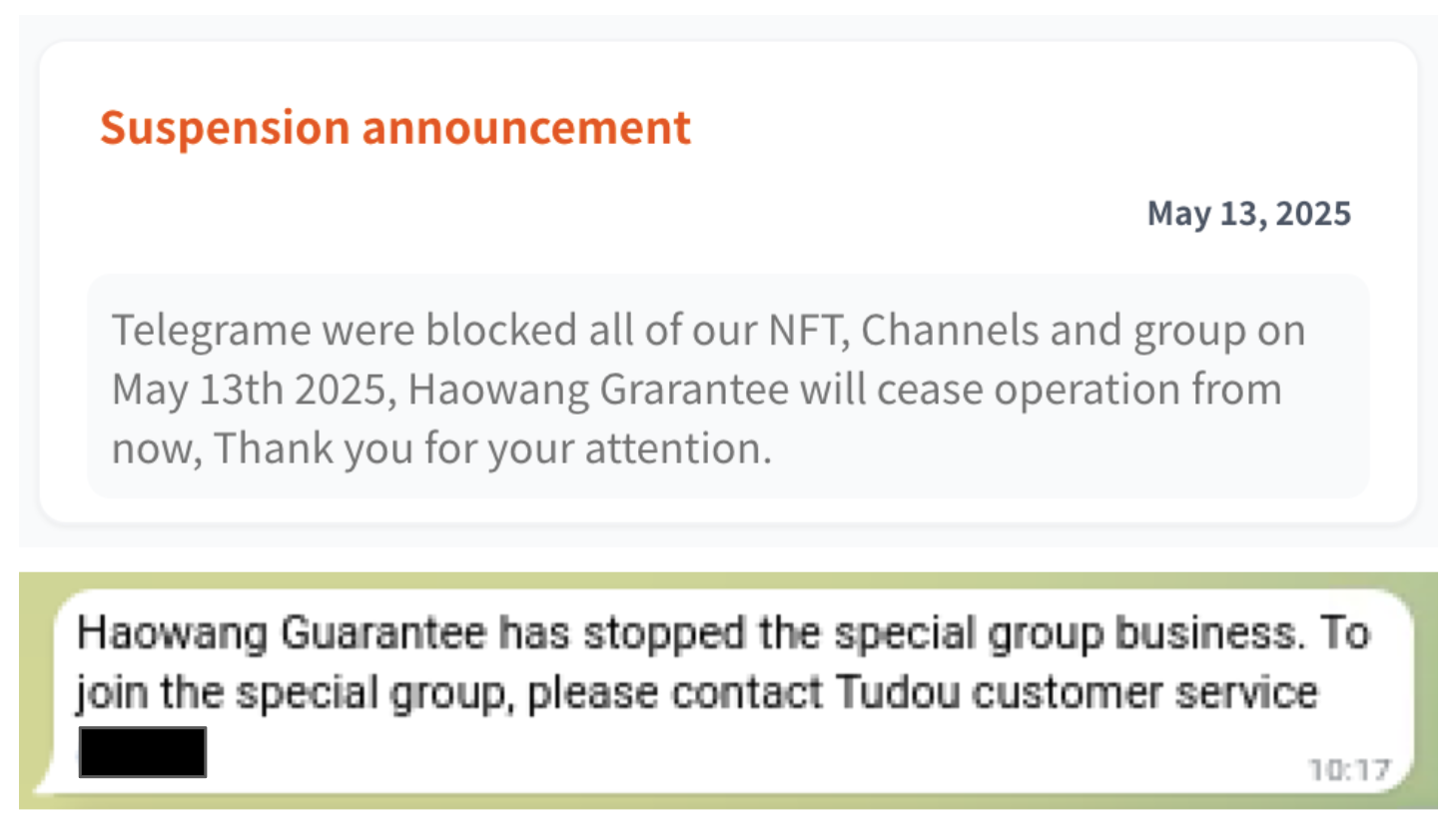
Telegram Shuts Down Huione's Largest Crypto Scam Market Ever, But Rivals Take Over with 400% Volume SurgeSource: Elliptic

This planning enabled the seamless migration of hundreds of thousands of users. Tudou’s transaction volumes surged from negligible levels to over 300,000 by June 15.

The same merchants who previously operated through Huione immediately established operations on Tudou, offering identical services, including stolen data, money laundering capabilities, and specialized tools for pig butchering scams targeting Western victims.

Beyond Tudou’s dominance, multiple smaller platforms experienced exponential growth as the criminal ecosystem fragmented and diversified.

According to Elliptic, Shuangying marketplace saw user numbers triple from 40,000 to 110,000 transactions, and Fully Light expanded from 20,000 to over 80,000 transactions.

Telegram Shuts Down Huione's Largest Crypto Scam Market Ever, But Rivals Take Over with 400% Volume SurgeSource: Elliptic

These platforms use Telegram’s encryption for communication and comprehensive business operations, including reputation management, order fulfillment, and dispute resolution among vendors and clients.

They also use Tether’s USDT stablecoin as the primary medium of exchange, which provides these criminals with dollar-denominated stability while avoiding traditional banking systems.

The UN estimates that Telegram-based criminal activity generates up to $36.5 billion annually through scams, money laundering, and stolen data sales.

Ongoing Enforcement Challenges On Telegram’s Encrypted Crime Economy

Despite Telegram’s cooperation in removing thousands of channels and banning associated accounts, Chainalysis research revealed that Huione’s core cryptocurrency processing infrastructure remained operational, which Elliptic also confirmed.

Telegram Shuts Down Huione's Largest Crypto Scam Market Ever, But Rivals Take Over with 400% Volume SurgeSource: Elliptic

The platform is simply migrating to new domains and quietly resuming Telegram’s presence within weeks of the apparent shutdown.

This resilience stems from the platform’s complex architecture, which separates public-facing marketing infrastructure from core financial processing systems. This allows criminal operations to continue even when their most visible components face disruption.

The enforcement action’s limited impact becomes particularly evident when examining the broader criminal ecosystem that Huione enabled, including forcing trafficking victims into crypto scam operations across Southeast Asian compounds where legitimate job seekers are lured with false IT positions before being held against their will and coerced into executing fraudulent schemes.

These physical operations, often disguised as customer service centers, create a hybrid criminal model that combines digital financial crime with traditional human trafficking, making comprehensive enforcement exponentially more complex as it requires coordination across multiple jurisdictions and crime categories.

While Telegram has begun responding to pressure by removing certain features and updating content policies, the platform’s core encrypted messaging capabilities remain attractive to criminals who exploit the technology’s legitimate privacy protections to operate sophisticated marketplace ecosystems.

The challenge for regulators lies in addressing criminal abuse without undermining the privacy rights and communication security that make encrypted platforms valuable for legitimate users worldwide.

Telegram CEO Pavel Durov is also fighting this battle with the regulators. He was recently arrested and released on bail, but surveillance remains.

Piyasa Fırsatı
Threshold Logosu
Threshold Fiyatı(T)
$0.008483
$0.008483$0.008483
-0.02%
USD
Threshold (T) Canlı Fiyat Grafiği
Sorumluluk Reddi: Bu sitede yeniden yayınlanan makaleler, halka açık platformlardan alınmıştır ve yalnızca bilgilendirme amaçlıdır. MEXC'nin görüşlerini yansıtmayabilir. Tüm hakları telif sahiplerine aittir. Herhangi bir içeriğin üçüncü taraf haklarını ihlal ettiğini düşünüyorsanız, kaldırılması için lütfen [email protected] ile iletişime geçin. MEXC, içeriğin doğruluğu, eksiksizliği veya güncelliği konusunda hiçbir garanti vermez ve sağlanan bilgilere dayalı olarak alınan herhangi bir eylemden sorumlu değildir. İçerik, finansal, yasal veya diğer profesyonel tavsiye niteliğinde değildir ve MEXC tarafından bir tavsiye veya onay olarak değerlendirilmemelidir.

Ayrıca Şunları da Beğenebilirsiniz

China Launches Cross-Border QR Code Payment Trial
China Launches Cross-Border QR Code Payment Trial

The post China Launches Cross-Border QR Code Payment Trial appeared on BitcoinEthereumNews.com. Key Points: Main event involves China initiating a cross-border QR code payment trial. Alipay and Ant International are key participants. Impact on financial security and regulatory focus on illicit finance. China’s central bank, led by Deputy Governor Lu Lei, initiated a trial of a unified cross-border QR code payment gateway with Alipay and Ant International as participants. This pilot addresses cross-border fund risks, aiming to enhance financial security amid rising money laundering through digital channels, despite muted crypto market reactions. China’s Cross-Border Payment Gateway Trial with Alipay The trial operation of a unified cross-border QR code payment gateway marks a milestone in China’s financial landscape. Prominent entities such as Alipay and Ant International are at the forefront, participating as the initial institutions in this venture. Lu Lei, Deputy Governor of the People’s Bank of China, highlighted the systemic risks posed by increased cross-border fund flows. Changes are expected in the dynamics of digital transactions, potentially enhancing transaction efficiency while tightening regulations around illicit finance. The initiative underscores China’s commitment to bolstering financial security amidst growing global fund movements. “The scale of cross-border fund flows is expanding, and the frequency is accelerating, providing opportunities for risks such as cross-border money laundering and terrorist financing. Some overseas illegal platforms transfer funds through channels such as virtual currencies and underground banks, creating a ‘resonance’ of risks at home and abroad, posing a challenge to China’s foreign exchange management and financial security.” — Lu Lei, Deputy Governor, People’s Bank of China Bitcoin and Impact of China’s Financial Initiatives Did you know? China’s latest initiative echoes the Payment Connect project of June 2025, furthering real-time cross-boundary remittances and expanding its influence on global financial systems. As of September 17, 2025, Bitcoin (BTC) stands at $115,748.72 with a market cap of $2.31 trillion, showing a 0.97%…
Paylaş
BitcoinEthereumNews2025/09/18 05:28
Sberbank issues Russia’s first crypto-secured loan

Sberbank issues Russia’s first crypto-secured loan

The post Sberbank issues Russia’s first crypto-secured loan appeared on BitcoinEthereumNews.com. The largest Russian financial institution by assets, Sberbank,
Paylaş
BitcoinEthereumNews2025/12/26 23:29
Academic Publishing and Fairness: A Game-Theoretic Model of Peer-Review Bias

Academic Publishing and Fairness: A Game-Theoretic Model of Peer-Review Bias

Exploring how biases in the peer-review system impact researchers' choices, showing how principles of fairness relate to the production of scientific knowledge based on topic importance and hardness.
Paylaş
Hackernoon2025/09/17 23:15