The automatic allocation algorithm BeraBoost dynamically optimizes BGT allocation to maximize rewards.The automatic allocation algorithm BeraBoost dynamically optimizes BGT allocation to maximize rewards.

Berachain is online. How can holders increase their returns by staking BERA through Chorus One?

2025/02/07 13:27

Author: Chorus One

Compiled by: Felix, PANews

Berachain mainnet is officially launched. This marks the beginning of a transformational period for DeFi, where security and liquidity can be scaled simultaneously under Berachain’s novel Proof of Liquidity (PoL) consensus.

Proof of Liquidity: The Foundation of Berachain

The goal of the Berachain Proof of Liquidity (PoL) consensus mechanism is to allow security and liquidity to scale simultaneously. In traditional Proof of Stake (PoS) blockchains, large amounts of capital are locked up to ensure network security. While this staked capital ensures network security, it sits idle and cannot contribute to ecosystem liquidity. The basic idea behind Proof of Liquidity is to eliminate the trade-off between security and liquidity by incentivizing DeFi activity with sustainable staking income.

Three-token model

Berachain’s economic design revolves around three different tokens:

  • BERA: The network’s native token, used to pay gas fees and stake
  • BGT (Berachain Governance Token): A non-transferable governance asset, earned only through liquidity provision
  • HONEY: Native stablecoin minted through overcollateralization

Validators propose blocks and allocate BGT issuance based on their BERA Stake, which can be allocated to the reward vault. The issuance they can allocate depends on their BGT Stake: the frequency of proposals depends on their BERA Stake; how much BGT is allocated based on the proposal depends on their BGT stake. Users who provide DeFi liquidity can stake their receipt tokens in these reward vaults to receive BGT rewards.

Key applications powering Berachain

‍BEX: Berachain Exchange

‍BEX is a native decentralized exchange with House Pools and Metapools features to improve liquidity efficiency. Liquidity providers can not only earn transaction fees, but also accumulate BGT, which can be staked with validators to participate in governance and optimize emissions.

‍Bends: Native lending market

‍Bends allows users to borrow HONEY with collateral such as ETH, BTC, and USDC. By interacting with Bends, users can deepen liquidity while earning BGT, creating a dual incentive model for sustainable lending.

‍Berps: A native perpetual futures exchange that provides high-performance derivatives trading with deep liquidity and efficient capital deployment.

Introduction to BeraBoost: Optimizing Delegator Returns

With Berachain’s unique issuance mechanism, delegators need to develop complex strategies to maximize returns. This is where BeraBoost comes in - an automated allocation algorithm developed by Chorus One Research that dynamically optimizes BGT allocation to maximize returns.

How BeraBoost works

Validators on Berachain play a vital role in issuance distribution. Delegators who stake with validators benefit from the validator’s strategy of directing issuance to the reward treasury. BeraBoost goes a step further and achieves this goal by:

  • Issuance is distributed algorithmically to maximize delegators’ rewards on their Reward Vault positions

  • Transparently direct liquidity to where it is needed most

  • Automating the process of maximizing returns and reducing the complexity of staking for clients

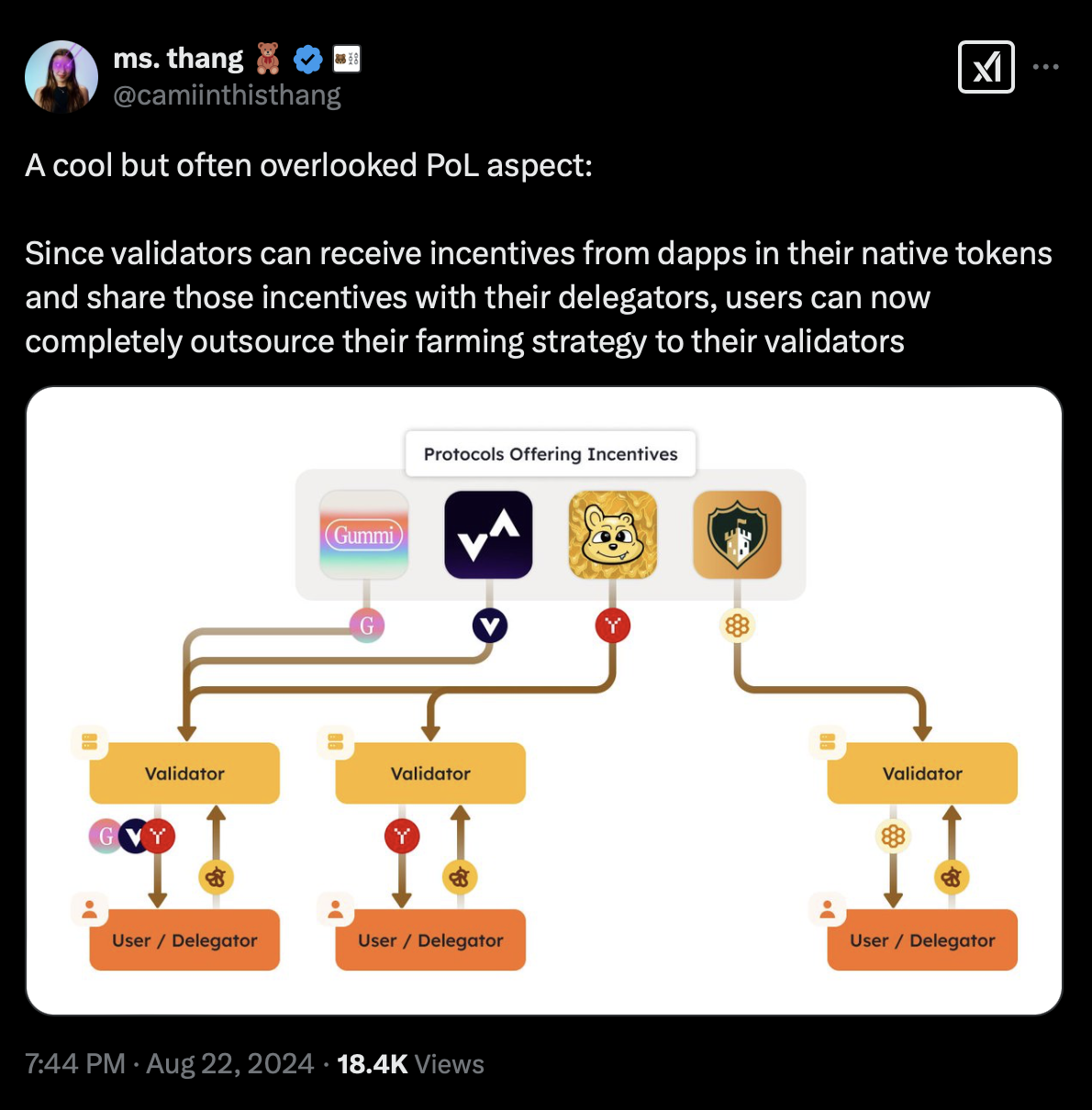
This mirrors how traditional DeFi yield farming strategies work, but integrates them directly at the consensus level. As Camila Ramos highlighted, Berachain’s PoL effectively allows users to outsource their farming strategies to validators, providing a way for both experienced and novice users to optimize returns without active management.

Learn more about BeraBoost here.
Berachain is online. How can holders increase their returns by staking BERA through Chorus One?

Why Berachain Pushes the Boundaries of DeFi Infrastructure

Berachain’s PoL brings a fundamental shift to blockchain economics. By combining security with capital efficiency, Berachain not only enhances validator incentives, but also promotes deeper liquidity for the entire ecosystem. The introduction of BeraBoost further refines this model, allowing delegators to passively maximize returns while strengthening the decentralized security of the network. With the mainnet live, Berachain is ready to redefine on-chain liquidity dynamics, governance participation, and validator incentives - while maintaining seamless Ethereum compatibility. Builders, liquidity providers, and institutional participants now have a powerful new platform to participate.

About Chorus One

Chorus One is one of the world's largest institutional staking providers, operating infrastructure for more than 60 Proof of Stake (PoS) networks, including Ethereum, Cosmos, Solana, Avalanche, Near, and more. Since 2018, Chorus One has been at the forefront of the PoS industry, providing easy-to-use enterprise-grade staking solutions, conducting industry-leading research, and investing in innovative protocols through Chorus One Ventures. As an ISO 27001 certified provider, Chorus One also offers slashing and double-signature insurance to its institutional clients.

Piyasa Fırsatı
BERA Logosu
BERA Fiyatı(BERA)
$0,9267
$0,9267$0,9267
-0,72%
USD
BERA (BERA) Canlı Fiyat Grafiği
Sorumluluk Reddi: Bu sitede yeniden yayınlanan makaleler, halka açık platformlardan alınmıştır ve yalnızca bilgilendirme amaçlıdır. MEXC'nin görüşlerini yansıtmayabilir. Tüm hakları telif sahiplerine aittir. Herhangi bir içeriğin üçüncü taraf haklarını ihlal ettiğini düşünüyorsanız, kaldırılması için lütfen [email protected] ile iletişime geçin. MEXC, içeriğin doğruluğu, eksiksizliği veya güncelliği konusunda hiçbir garanti vermez ve sağlanan bilgilere dayalı olarak alınan herhangi bir eylemden sorumlu değildir. İçerik, finansal, yasal veya diğer profesyonel tavsiye niteliğinde değildir ve MEXC tarafından bir tavsiye veya onay olarak değerlendirilmemelidir.

Ayrıca Şunları da Beğenebilirsiniz

Which Altcoins Stand to Gain from the SEC’s New ETF Listing Standards?

Which Altcoins Stand to Gain from the SEC’s New ETF Listing Standards?

On Wednesday, the US SEC (Securities and Exchange Commission) took a landmark step in crypto regulation, approving generic listing standards for spot crypto ETFs (exchange-traded funds). This new framework eliminates the case-by-case 19b-4 approval process, streamlining the path for multiple digital asset ETFs to enter the market in the coming weeks. Grayscale’s Multi-Crypto Milestone Grayscale secured a first-mover advantage as its Digital Large Cap Fund (GDLC) received approval under the new listing standards. Products that will be traded under the ticker GDLC include Bitcoin, Ethereum, XRP, Solana, and Cardano. “Grayscale Digital Large Cap Fund $GDLC was just approved for trading along with the Generic Listing Standards. The Grayscale team is working expeditiously to bring the FIRST multi-crypto asset ETP to market with Bitcoin, Ethereum, XRP, Solana, and Cardano,” wrote Grayscale CEO Peter Mintzberg. The approval marks the US’s first diversified, multi-crypto ETP, signaling a shift toward broader portfolio products rather than single-asset ETFs. Bloomberg’s Eric Balchunas explained that around 12–15 cryptocurrencies now qualify for spot ETF consideration. However, this is contingent on the altcoins having established futures trading on Coinbase Derivatives for at least six months. This includes well-known altcoins like Dogecoin (DOGE), Litecoin (LTC), and Chainlink (LINK), alongside the majors already included in Grayscale’s GDLC. Altcoins in the Spotlight Amid New Era of ETF Eligibility Several assets have already met the key condition, regulated futures trading on Coinbase. For example, Solana futures launched in February 2024, making the token eligible as of August 19. “The SEC approved generic ETF listing standards. Assets with a regulated futures contract trading for 6 months qualify for a spot ETF. Solana met this criterion on Aug 19, 6 months after SOL futures launched on Coinbase Derivatives,” SolanaFloor indicated. Crypto investors and communities also identified which tokens stand to gain. Chainlink community liaison Zach Rynes highlighted that LINK could soon see its own ETF. He noted that both Bitwise and Grayscale have already filed applications. Meanwhile, the Litecoin Foundation indicated that the new standards provide the regulatory framework for LTC to be listed on US exchanges. Hedera is also in the spotlight, with digital asset investor Mark anticipating an HBAR ETF. Market observers see the decision as a potential turning point for broader adoption, bringing the much-needed clarity and accessibility for investors. At the same time, it boosts confidence in the market’s maturity. The general sentiment is that with the SEC’s approval, the next phase of crypto ETFs is no longer a question of ‘if,’ but ‘when.’ The shift to generic listing standards could expand the US-listed digital asset ETFs roster beyond Bitcoin and Ethereum. Such a move would usher in new investment vehicles covering a dozen or more altcoins. This represents the clearest path yet toward mainstream, regulated access to diversified crypto exposure. More importantly, it comes without the friction of direct custody. “We’re gonna be off to the races in a matter of weeks,” ETF analyst James Seyffart quipped.
Paylaş
Coinstats2025/09/18 12:57
SEC approves generic listing standards, paving way for rapid crypto ETF launches

SEC approves generic listing standards, paving way for rapid crypto ETF launches

The Securities and Exchange Commission has approved new generic listing standards for spot crypto exchange-traded funds, clearing the way for faster approvals. The U.S. SEC has approved new generic listing standards that will allow exchanges to fast-track spot crypto ETFs,…
Paylaş
Crypto.news2025/09/18 13:51
WTI drifts higher above $59.50 on Kazakh supply disruptions

WTI drifts higher above $59.50 on Kazakh supply disruptions

The post WTI drifts higher above $59.50 on Kazakh supply disruptions appeared on BitcoinEthereumNews.com. West Texas Intermediate (WTI), the US crude oil benchmark
Paylaş
BitcoinEthereumNews2026/01/21 11:24