Unsealed records by the U.S. Department of Justice related to Jeffrey Epstein now contain mentions of Blockstream executives and a different email that talks aboutUnsealed records by the U.S. Department of Justice related to Jeffrey Epstein now contain mentions of Blockstream executives and a different email that talks about

Blockstream, Michael Saylor Named in Newly Unsealed Epstein Files – What’s the Real Story?

Unsealed records by the U.S. Department of Justice related to Jeffrey Epstein now contain mentions of Blockstream executives and a different email that talks about a charity contribution made by MicroStrategy co-founder Michael Saylor.

The files, which have been published as part of a wider transparency project, have sparked public reaction regarding the names mentioned within them.

The latest batch includes emails, travel records, and correspondence involving a wide range of figures in finance, politics, academia, and technology.

The DOJ has stressed that the appearance of a person’s name in the documents does not, on its own, indicate wrongdoing.

Epstein Files Surface Emails Linked to Blockstream’s 2014 Fundraise

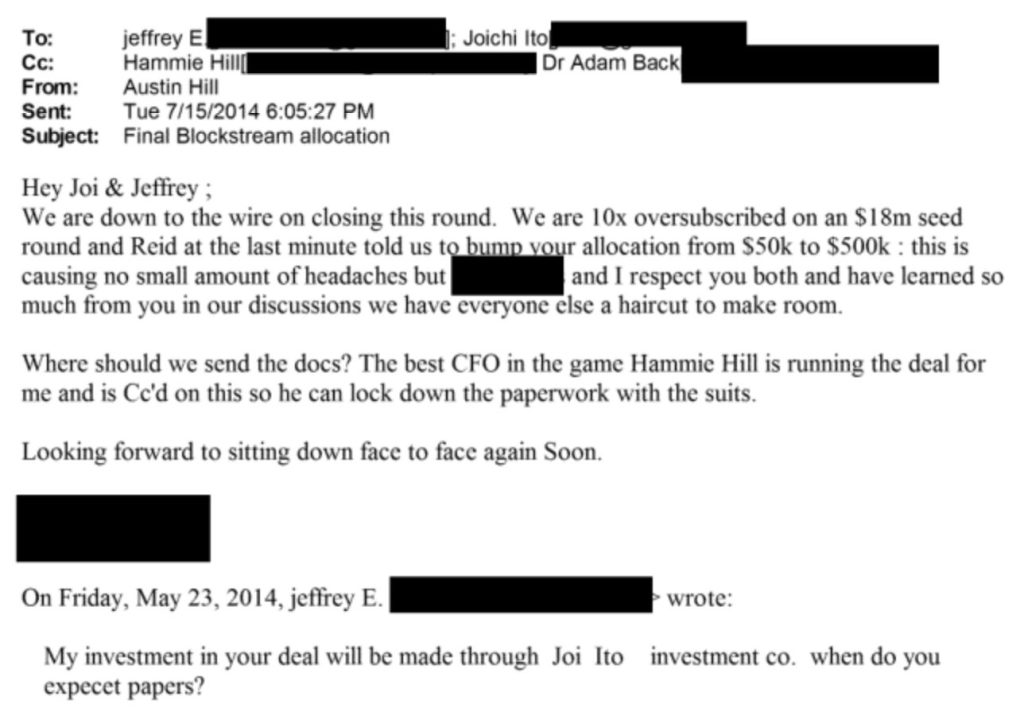
Among the newly surfaced records is a July 2014 email exchange in which Blockstream co-founder Austin Hill discussed the company’s oversubscribed $18 million seed round with Epstein and Ito.
Source: US DOJ

In the message, Hill wrote that the round was “10x oversubscribed” and suggested increasing an allocation from $50,000 to $500,000. Adam Back was included in the email thread.

On X, Back claimed that in 2014, Blockstream participated in a seed-round investor roadshow coffee at which Joi Ito, then the director of the MIT Media Lab, was introduced to the company.

Through that connection, Blockstream later met Epstein, who was described at the time as a limited partner in an investment fund associated with Ito.

Co-founder and CEO of Blockstream, Adam Back, responded to the documents, admitting that his company has no continuing or material relationship with Epstein.

That fund went on to take a minority stake in Blockstream, but Back said it later divested its shares due to potential conflicts of interest and other concerns.

Files Show Saylor Mentioned in Pre-Bitcoin Charity Correspondence

Michael Saylor’s name appears in a different context within the files.

An email dated May 8, 2010, sent by Hollywood publicist Peggy Siegal, detailed arrangements for the Robin Hood Foundation’s annual gala and related Cannes social events.

The message noted that Michael Saylor donated $25,000 to a charity initiative, which granted him access to attend the events and potentially meet members of an exclusive social circle.

However, Siegal characterized Saylor as socially awkward, describing him as difficult to engage with and lacking awareness of basic social norms.

The message predates Saylor’s later prominence as one of Bitcoin’s most vocal corporate advocates and does not mention cryptocurrency.

Saylor only began acquiring Bitcoin for MicroStrategy in 2020, years after the correspondence cited in the Epstein materials.

Other unsealed documents reference travel arrangements involving Hill and Back, including bookings connected to St. Thomas, an island near Epstein’s private property.

The documents have also emphasized Epstein’s broader interest in cryptocurrency during Bitcoin’s formative years.

Email communications reveal him discussing with one of the biggest tech investors, Peter Thiel, how to define Bitcoin and whether it was more of a store of value, a currency, or a technological architecture.

Individual correspondence suggests that Epstein kept a close eye on the debates in the crypto ecosystem and shared his views on rival blockchain projects.

In 2016, he also offered suggestions connected with digital currencies in the Middle East, such as a Sharia-compliant type based on the technology of Bitcoin.

Other notable names mentioned throughout the documents are former director of MIT Media Lab Joi Ito, PayPal co-founder Peter Thiel, and Kevin Warsh, who was recently appointed by President Donald Trump to the role of Federal Reserve chair.

The Epstein files were unsealed following earlier court orders in 2024 that released names from a separate civil case involving Epstein’s associate Ghislaine Maxwell.

While more than 150 previously anonymized names have now entered the public record, others remain redacted, particularly where victims’ identities or ongoing investigations are involved.

Epstein died in 2019 while awaiting trial on federal charges, including sex trafficking of minors and conspiracy to commit sex trafficking of minors.

Sorumluluk Reddi: Bu sitede yeniden yayınlanan makaleler, halka açık platformlardan alınmıştır ve yalnızca bilgilendirme amaçlıdır. MEXC'nin görüşlerini yansıtmayabilir. Tüm hakları telif sahiplerine aittir. Herhangi bir içeriğin üçüncü taraf haklarını ihlal ettiğini düşünüyorsanız, kaldırılması için lütfen [email protected] ile iletişime geçin. MEXC, içeriğin doğruluğu, eksiksizliği veya güncelliği konusunda hiçbir garanti vermez ve sağlanan bilgilere dayalı olarak alınan herhangi bir eylemden sorumlu değildir. İçerik, finansal, yasal veya diğer profesyonel tavsiye niteliğinde değildir ve MEXC tarafından bir tavsiye veya onay olarak değerlendirilmemelidir.

Ayrıca Şunları da Beğenebilirsiniz

Ethereum unveils roadmap focusing on scaling, interoperability, and security at Japan Dev Conference

Ethereum unveils roadmap focusing on scaling, interoperability, and security at Japan Dev Conference

The post Ethereum unveils roadmap focusing on scaling, interoperability, and security at Japan Dev Conference appeared on BitcoinEthereumNews.com. Key Takeaways Ethereum’s new roadmap was presented by Vitalik Buterin at the Japan Dev Conference. Short-term priorities include Layer 1 scaling and raising gas limits to enhance transaction throughput. Vitalik Buterin presented Ethereum’s development roadmap at the Japan Dev Conference today, outlining the blockchain platform’s priorities across multiple timeframes. The short-term goals focus on scaling solutions and increasing Layer 1 gas limits to improve transaction capacity. Mid-term objectives target enhanced cross-Layer 2 interoperability and faster network responsiveness to create a more seamless user experience across different scaling solutions. The long-term vision emphasizes building a secure, simple, quantum-resistant, and formally verified minimalist Ethereum network. This approach aims to future-proof the platform against emerging technological threats while maintaining its core functionality. The roadmap presentation comes as Ethereum continues to compete with other blockchain platforms for market share in the smart contract and decentralized application space. Source: https://cryptobriefing.com/ethereum-roadmap-scaling-interoperability-security-japan/
Paylaş
BitcoinEthereumNews2025/09/18 00:25
Shocking OpenVPP Partnership Claim Draws Urgent Scrutiny

Shocking OpenVPP Partnership Claim Draws Urgent Scrutiny

The post Shocking OpenVPP Partnership Claim Draws Urgent Scrutiny appeared on BitcoinEthereumNews.com. The cryptocurrency world is buzzing with a recent controversy surrounding a bold OpenVPP partnership claim. This week, OpenVPP (OVPP) announced what it presented as a significant collaboration with the U.S. government in the innovative field of energy tokenization. However, this claim quickly drew the sharp eye of on-chain analyst ZachXBT, who highlighted a swift and official rebuttal that has sent ripples through the digital asset community. What Sparked the OpenVPP Partnership Claim Controversy? The core of the issue revolves around OpenVPP’s assertion of a U.S. government partnership. This kind of collaboration would typically be a monumental endorsement for any private cryptocurrency project, especially given the current regulatory climate. Such a partnership could signify a new era of mainstream adoption and legitimacy for energy tokenization initiatives. OpenVPP initially claimed cooperation with the U.S. government. This alleged partnership was said to be in the domain of energy tokenization. The announcement generated considerable interest and discussion online. ZachXBT, known for his diligent on-chain investigations, was quick to flag the development. He brought attention to the fact that U.S. Securities and Exchange Commission (SEC) Commissioner Hester Peirce had directly addressed the OpenVPP partnership claim. Her response, delivered within hours, was unequivocal and starkly contradicted OpenVPP’s narrative. How Did Regulatory Authorities Respond to the OpenVPP Partnership Claim? Commissioner Hester Peirce’s statement was a crucial turning point in this unfolding story. She clearly stated that the SEC, as an agency, does not engage in partnerships with private cryptocurrency projects. This response effectively dismantled the credibility of OpenVPP’s initial announcement regarding their supposed government collaboration. Peirce’s swift clarification underscores a fundamental principle of regulatory bodies: maintaining impartiality and avoiding endorsements of private entities. Her statement serves as a vital reminder to the crypto community about the official stance of government agencies concerning private ventures. Moreover, ZachXBT’s analysis…
Paylaş
BitcoinEthereumNews2025/09/18 02:13
Telos Advisers Welcomes Stephen Gardner as a Strategic Advisory Board Member

Telos Advisers Welcomes Stephen Gardner as a Strategic Advisory Board Member

Former Amtrak CEO brings more than 25 years of leadership experience in rail, infrastructure delivery, and national transportation policy NEWARK, N.J.–(BUSINESS
Paylaş
AI Journal2026/02/03 02:16