Hackers are now exploiting vulnerabilities in widely-used NPM coding libraries to inject malware into Ethereum smart contracts, according to cybersecurity research by blockchain compliance firm Reversing Labs(RL). In a September 3 blog post detailing the discovery, researcher Lucija Valentić revealed that threat actors bypass security scans by exploiting new open-source malware present in the Node Package Manager (NPM) package repository, which contains extensive JavaScript packages and libraries. The most destructive malware discovered was “colortoolsv2” and “mimelib2“, both published in July, which were found to abuse smart contracts to conceal malicious commands that install downloader malware on infected systems.Source: ReversingLabs How Ethereum Smart Contracts Turn Into Malware Command Centers These packages are part of broader open-source libraries affecting both NPM and GitHub, where malicious supply chain actors use advanced social engineering and deception tactics to trick developers into incorporating harmful code into their projects. According to ReversingLabs, 2025 has witnessed a diverse range of malicious campaigns targeting NPM, the leading online repository for JavaScript packages. In March, RL documented the discovery of NPM packages ethers-provider2 and ethers-providerz Since discovering the ethers campaign, researchers have detected numerous additional infostealers, downloaders, and droppers found on NPM. At the beginning of July, RL researcher Karlo Zanki discovered and reported a new NPM campaign involving a basic package that deployed blockchain in a novel way to deliver a malicious second stage. The exact package colortoolsv2 is being used to infiltrate Ethereum smart contracts. According to RL researchers, the malware is a basic NPM package containing just two files. The major file is a script named index.js, which contains a hidden malicious payload. Once installed in a project, the script would run to fetch blockchain data and execute a harmful command by loading the URL for a command and control (C2) server that would then download second-stage malware to the requesting system. Although “downloader” malware is a common method hackers use in NPM repositories to target victims, this specific malware is unusual as it uses Ethereum smart contracts to host the URLs where malicious commands are located for downloading the second-stage malware. Notably, the cybersecurity researchers acknowledge that they haven’t encountered this approach previously. Two-File Malware Hides a $2.5M Bridge Exploit Method The researchers uncovered a Solana-trading-bot infected by the malicious colortoolsv2 package called solana-trading-bot-v2, which appears to be a trustworthy GitHub project to the average observer.Source: ReversingLabs It has thousands of commits, several active contributors, and a decent number of stars and watchers, all characteristics of legitimate open-source repositories. However, all these details were fabricated, and any developer who installs it risks having user wallets that interact with the bot drained of funds. Software supply chain attacks targeting smart contracts and blockchain infrastructure are now on the rise. In July, hackers exploited a vulnerability in Arcadia Finance’s Rebalancer contract, draining approximately $2.5 million in cryptocurrency from the decentralized finance platform operating on Base blockchain. The attackers manipulated arbitrary swapData parameters to execute unauthorized swaps that emptied user vaults. A recent report by blockchain analytics firm Global Ledger revealed that hackers have now stolen $3 billion worth of crypto in 119 separate incidents during the first half of 2025, which is 150% more than all of 2024.Source: Global Ledger Slava Demchuk, CEO of analytics firm AMLBot, said access-control flaws and smart contract vulnerabilities, especially in bridges, continue to be dominant attack methods. Demchuk told Cryptonews that these hackers are exploiting the interconnected and composable nature of decentralized finance (DeFi) protocols to amplify the impact. Blockchain auditors advised that it is critical for developers to assess each library they are considering implementing before deciding to include it in their development cycleHackers are now exploiting vulnerabilities in widely-used NPM coding libraries to inject malware into Ethereum smart contracts, according to cybersecurity research by blockchain compliance firm Reversing Labs(RL). In a September 3 blog post detailing the discovery, researcher Lucija Valentić revealed that threat actors bypass security scans by exploiting new open-source malware present in the Node Package Manager (NPM) package repository, which contains extensive JavaScript packages and libraries. The most destructive malware discovered was “colortoolsv2” and “mimelib2“, both published in July, which were found to abuse smart contracts to conceal malicious commands that install downloader malware on infected systems.Source: ReversingLabs How Ethereum Smart Contracts Turn Into Malware Command Centers These packages are part of broader open-source libraries affecting both NPM and GitHub, where malicious supply chain actors use advanced social engineering and deception tactics to trick developers into incorporating harmful code into their projects. According to ReversingLabs, 2025 has witnessed a diverse range of malicious campaigns targeting NPM, the leading online repository for JavaScript packages. In March, RL documented the discovery of NPM packages ethers-provider2 and ethers-providerz Since discovering the ethers campaign, researchers have detected numerous additional infostealers, downloaders, and droppers found on NPM. At the beginning of July, RL researcher Karlo Zanki discovered and reported a new NPM campaign involving a basic package that deployed blockchain in a novel way to deliver a malicious second stage. The exact package colortoolsv2 is being used to infiltrate Ethereum smart contracts. According to RL researchers, the malware is a basic NPM package containing just two files. The major file is a script named index.js, which contains a hidden malicious payload. Once installed in a project, the script would run to fetch blockchain data and execute a harmful command by loading the URL for a command and control (C2) server that would then download second-stage malware to the requesting system. Although “downloader” malware is a common method hackers use in NPM repositories to target victims, this specific malware is unusual as it uses Ethereum smart contracts to host the URLs where malicious commands are located for downloading the second-stage malware. Notably, the cybersecurity researchers acknowledge that they haven’t encountered this approach previously. Two-File Malware Hides a $2.5M Bridge Exploit Method The researchers uncovered a Solana-trading-bot infected by the malicious colortoolsv2 package called solana-trading-bot-v2, which appears to be a trustworthy GitHub project to the average observer.Source: ReversingLabs It has thousands of commits, several active contributors, and a decent number of stars and watchers, all characteristics of legitimate open-source repositories. However, all these details were fabricated, and any developer who installs it risks having user wallets that interact with the bot drained of funds. Software supply chain attacks targeting smart contracts and blockchain infrastructure are now on the rise. In July, hackers exploited a vulnerability in Arcadia Finance’s Rebalancer contract, draining approximately $2.5 million in cryptocurrency from the decentralized finance platform operating on Base blockchain. The attackers manipulated arbitrary swapData parameters to execute unauthorized swaps that emptied user vaults. A recent report by blockchain analytics firm Global Ledger revealed that hackers have now stolen $3 billion worth of crypto in 119 separate incidents during the first half of 2025, which is 150% more than all of 2024.Source: Global Ledger Slava Demchuk, CEO of analytics firm AMLBot, said access-control flaws and smart contract vulnerabilities, especially in bridges, continue to be dominant attack methods. Demchuk told Cryptonews that these hackers are exploiting the interconnected and composable nature of decentralized finance (DeFi) protocols to amplify the impact. Blockchain auditors advised that it is critical for developers to assess each library they are considering implementing before deciding to include it in their development cycle

Hackers Exploit Ethereum to Inject Malware in Popular Coding Libraries

Hackers are now exploiting vulnerabilities in widely-used NPM coding libraries to inject malware into Ethereum smart contracts, according to cybersecurity research by blockchain compliance firm Reversing Labs(RL).

In a September 3 blog post detailing the discovery, researcher Lucija Valentić revealed that threat actors bypass security scans by exploiting new open-source malware present in the Node Package Manager (NPM) package repository, which contains extensive JavaScript packages and libraries.

The most destructive malware discovered was “colortoolsv2” and “mimelib2“, both published in July, which were found to abuse smart contracts to conceal malicious commands that install downloader malware on infected systems.
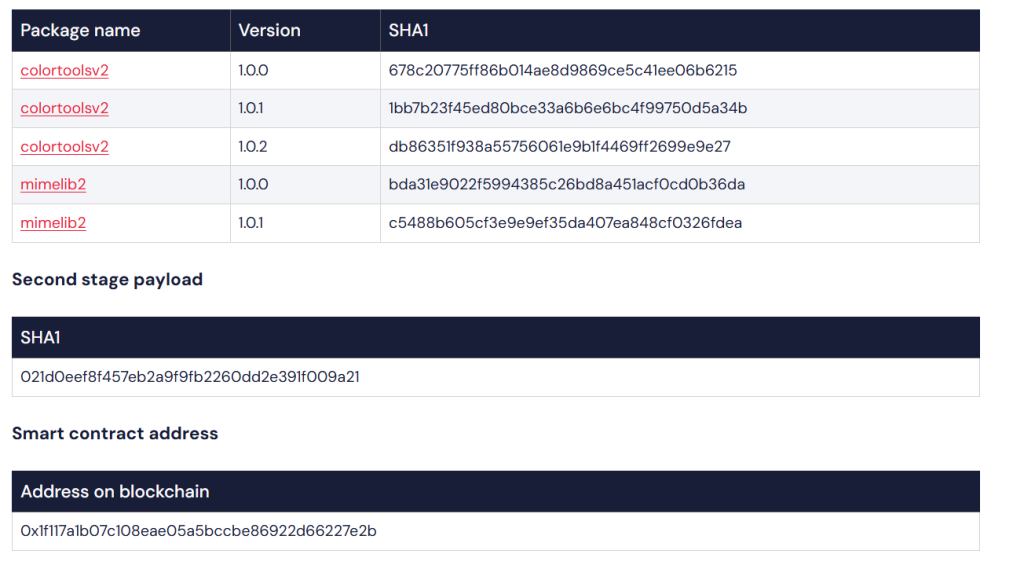
Hackers Exploit Ethereum to Inject Malware in Popular Coding LibrariesSource: ReversingLabs

How Ethereum Smart Contracts Turn Into Malware Command Centers

These packages are part of broader open-source libraries affecting both NPM and GitHub, where malicious supply chain actors use advanced social engineering and deception tactics to trick developers into incorporating harmful code into their projects.

According to ReversingLabs, 2025 has witnessed a diverse range of malicious campaigns targeting NPM, the leading online repository for JavaScript packages.

In March, RL documented the discovery of NPM packages ethers-provider2 and ethers-providerz

Since discovering the ethers campaign, researchers have detected numerous additional infostealers, downloaders, and droppers found on NPM.

At the beginning of July, RL researcher Karlo Zanki discovered and reported a new NPM campaign involving a basic package that deployed blockchain in a novel way to deliver a malicious second stage.

The exact package colortoolsv2 is being used to infiltrate Ethereum smart contracts.

According to RL researchers, the malware is a basic NPM package containing just two files.

The major file is a script named index.js, which contains a hidden malicious payload.

Once installed in a project, the script would run to fetch blockchain data and execute a harmful command by loading the URL for a command and control (C2) server that would then download second-stage malware to the requesting system.

Although “downloader” malware is a common method hackers use in NPM repositories to target victims, this specific malware is unusual as it uses Ethereum smart contracts to host the URLs where malicious commands are located for downloading the second-stage malware.

Notably, the cybersecurity researchers acknowledge that they haven’t encountered this approach previously.

Two-File Malware Hides a $2.5M Bridge Exploit Method

The researchers uncovered a Solana-trading-bot infected by the malicious colortoolsv2 package called solana-trading-bot-v2, which appears to be a trustworthy GitHub project to the average observer.

Hackers Exploit Ethereum to Inject Malware in Popular Coding LibrariesSource: ReversingLabs

It has thousands of commits, several active contributors, and a decent number of stars and watchers, all characteristics of legitimate open-source repositories.

However, all these details were fabricated, and any developer who installs it risks having user wallets that interact with the bot drained of funds.

Software supply chain attacks targeting smart contracts and blockchain infrastructure are now on the rise.

In July, hackers exploited a vulnerability in Arcadia Finance’s Rebalancer contract, draining approximately $2.5 million in cryptocurrency from the decentralized finance platform operating on Base blockchain.

The attackers manipulated arbitrary swapData parameters to execute unauthorized swaps that emptied user vaults.

A recent report by blockchain analytics firm Global Ledger revealed that hackers have now stolen $3 billion worth of crypto in 119 separate incidents during the first half of 2025, which is 150% more than all of 2024.

Hackers Exploit Ethereum to Inject Malware in Popular Coding LibrariesSource: Global Ledger

Slava Demchuk, CEO of analytics firm AMLBot, said access-control flaws and smart contract vulnerabilities, especially in bridges, continue to be dominant attack methods.

Demchuk told Cryptonews that these hackers are exploiting the interconnected and composable nature of decentralized finance (DeFi) protocols to amplify the impact.

Blockchain auditors advised that it is critical for developers to assess each library they are considering implementing before deciding to include it in their development cycle.

Sorumluluk Reddi: Bu sitede yeniden yayınlanan makaleler, halka açık platformlardan alınmıştır ve yalnızca bilgilendirme amaçlıdır. MEXC'nin görüşlerini yansıtmayabilir. Tüm hakları telif sahiplerine aittir. Herhangi bir içeriğin üçüncü taraf haklarını ihlal ettiğini düşünüyorsanız, kaldırılması için lütfen [email protected] ile iletişime geçin. MEXC, içeriğin doğruluğu, eksiksizliği veya güncelliği konusunda hiçbir garanti vermez ve sağlanan bilgilere dayalı olarak alınan herhangi bir eylemden sorumlu değildir. İçerik, finansal, yasal veya diğer profesyonel tavsiye niteliğinde değildir ve MEXC tarafından bir tavsiye veya onay olarak değerlendirilmemelidir.

Ayrıca Şunları da Beğenebilirsiniz

The Channel Factories We’ve Been Waiting For

The Channel Factories We’ve Been Waiting For

The post The Channel Factories We’ve Been Waiting For appeared on BitcoinEthereumNews.com. Visions of future technology are often prescient about the broad strokes while flubbing the details. The tablets in “2001: A Space Odyssey” do indeed look like iPads, but you never see the astronauts paying for subscriptions or wasting hours on Candy Crush.  Channel factories are one vision that arose early in the history of the Lightning Network to address some challenges that Lightning has faced from the beginning. Despite having grown to become Bitcoin’s most successful layer-2 scaling solution, with instant and low-fee payments, Lightning’s scale is limited by its reliance on payment channels. Although Lightning shifts most transactions off-chain, each payment channel still requires an on-chain transaction to open and (usually) another to close. As adoption grows, pressure on the blockchain grows with it. The need for a more scalable approach to managing channels is clear. Channel factories were supposed to meet this need, but where are they? In 2025, subnetworks are emerging that revive the impetus of channel factories with some new details that vastly increase their potential. They are natively interoperable with Lightning and achieve greater scale by allowing a group of participants to open a shared multisig UTXO and create multiple bilateral channels, which reduces the number of on-chain transactions and improves capital efficiency. Achieving greater scale by reducing complexity, Ark and Spark perform the same function as traditional channel factories with new designs and additional capabilities based on shared UTXOs.  Channel Factories 101 Channel factories have been around since the inception of Lightning. A factory is a multiparty contract where multiple users (not just two, as in a Dryja-Poon channel) cooperatively lock funds in a single multisig UTXO. They can open, close and update channels off-chain without updating the blockchain for each operation. Only when participants leave or the factory dissolves is an on-chain transaction…
Paylaş
BitcoinEthereumNews2025/09/18 00:09
Wyoming-based crypto bank Custodia files rehearing petition against Fed

Wyoming-based crypto bank Custodia files rehearing petition against Fed

The post Wyoming-based crypto bank Custodia files rehearing petition against Fed appeared on BitcoinEthereumNews.com. A Wyoming-based crypto bank has filed another
Paylaş
BitcoinEthereumNews2025/12/16 22:06
US economy adds 64,000 jobs in November but unemployment rate climbs to 4.6%

US economy adds 64,000 jobs in November but unemployment rate climbs to 4.6%

The post US economy adds 64,000 jobs in November but unemployment rate climbs to 4.6% appeared on BitcoinEthereumNews.com. The economy moved in two directions at
Paylaş
BitcoinEthereumNews2025/12/16 22:18