TLDR JPMorgan analysts identified Hyperliquid as a fast-growing platform for crude oil futures traders, per a March 18 report HYPE jumped ~3.5% to $42.50 followingTLDR JPMorgan analysts identified Hyperliquid as a fast-growing platform for crude oil futures traders, per a March 18 report HYPE jumped ~3.5% to $42.50 following

Hyperliquid (HYPE) Price: JPMorgan Flags DEX Role in Crude Oil Trading as HYPE Eyes $50

2026/03/20 17:14
Okuma süresi: 3 dk
Bu içerikle ilgili geri bildirim veya endişeleriniz için lütfen [email protected] üzerinden bizimle iletişime geçin.

TLDR

  • JPMorgan analysts identified Hyperliquid as a fast-growing platform for crude oil futures traders, per a March 18 report
  • HYPE jumped ~3.5% to $42.50 following the launch of S&P 500 perpetual futures via Trade[XYZ]
  • S&P Dow Jones Indices licensed its flagship index to Trade[XYZ] for blockchain-based derivatives on Hyperliquid
  • HYPE bottomed at $22 and has been forming higher highs and higher lows since mid-January
  • Key resistance sits at $42–$44; a breakout could target $50 then $59.80

HYPE climbed roughly 3.5% to $42.50 this week, driven by two separate catalysts — a JPMorgan report on decentralized oil futures trading and the launch of the first officially licensed S&P 500 perpetual contract on the platform.
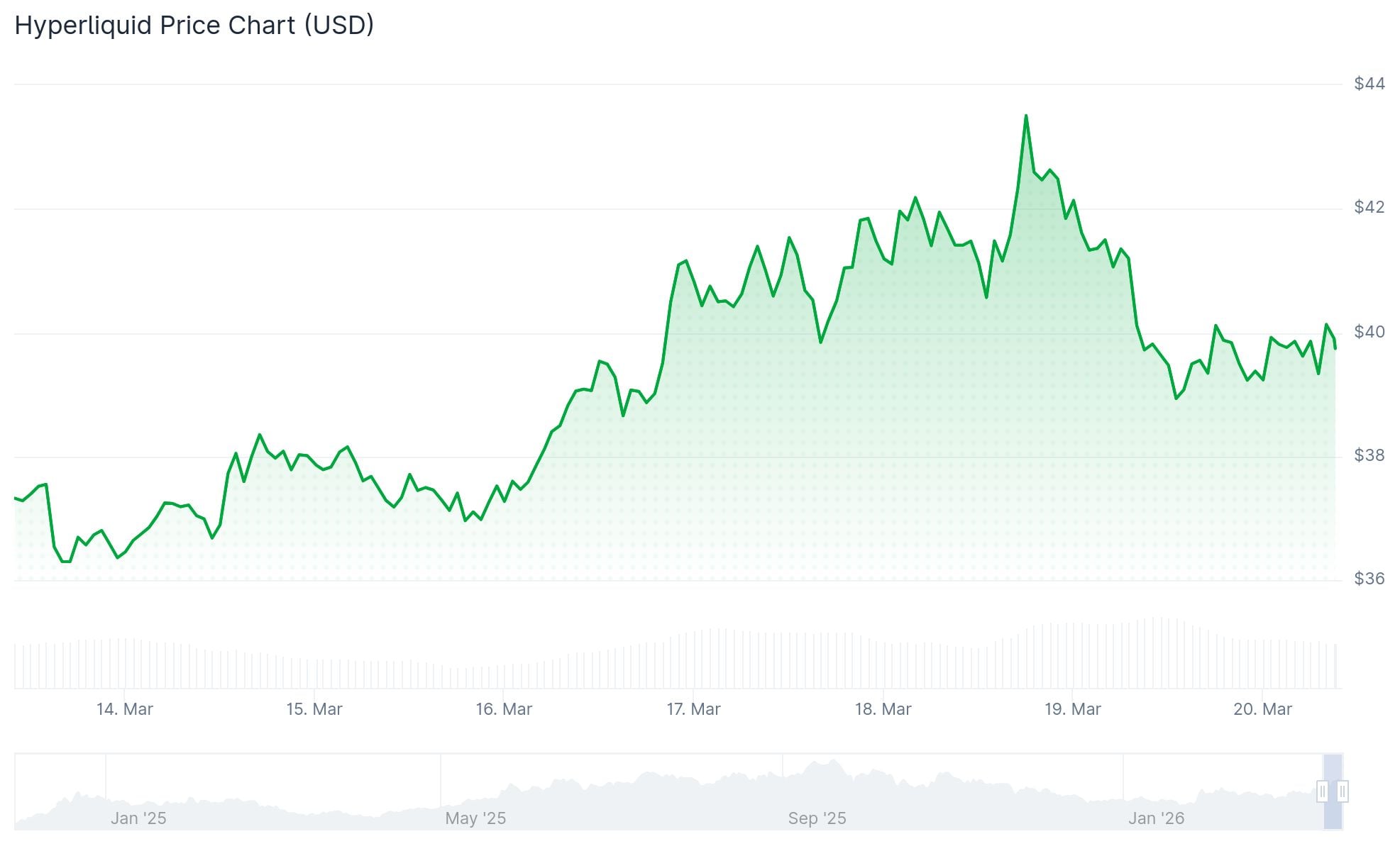
Hyperliquid (HYPE) PriceHyperliquid (HYPE) Price

JPMorgan analysts, in a March 18 report, flagged Hyperliquid as a rapidly growing venue for crude oil futures traders. The report noted that traders from traditional markets are using oil-linked perpetual contracts on the DEX to trade outside standard exchange hours.

The Chicago Mercantile Exchange closes overnight and on weekends. Geopolitical events don’t follow that schedule. During a recent weekend of escalating conflict in Iran, oil perpetuals on Hyperliquid saw a sharp surge in volume while the CME was shut.

JPMorgan’s report also noted that DEXs are beginning to erode the market share of mid-sized centralized exchanges, driven by better user experience, improved liquidity, and growing institutional comfort with on-chain settlement.

S&P 500 Perpetual Futures Go Live on Hyperliquid

S&P Dow Jones Indices agreed to license its S&P 500 index to Trade[XYZ], a platform focused on real-world asset derivatives built on the Hyperliquid blockchain. The result is what is described as the first officially sanctioned perpetual futures contract on the S&P 500 in DeFi.

Qualified traders outside the United States can open leveraged long or short positions on the index at any time, with no expiration date. The contract uses S&P DJI’s institutional-grade, real-time index feeds — unlike previous unofficial replications of S&P 500 exposure in DeFi.

The S&P 500 underpins over $1 trillion in daily volume across traditional instruments. Bringing an authorized version on-chain opens around-the-clock access that mirrors crypto market hours rather than stock exchange schedules.

Technical Picture: Key Levels to Watch

HYPE made a major bottom at $22 following a downtrend that ran from November through mid-January. Since then, the asset has formed a V-shaped recovery with higher highs and higher lows.

On March 16, the price broke out of a rising wedge pattern on the daily chart. The 20 EMA is crossing above the 50 EMA, and the RSI is near 70. The MACD shows a bullish crossover with rising histogram bars.

Market analyst Mizer noted that if HYPE fails to hold above $42–$44, a pullback toward $40–$38, or as low as $36–$32, is possible. He also pointed out that HYPE’s price action has been closely correlated with Bitcoin.

Overhead resistance sits between $42 and $44. A sustained break above that zone sets up initial targets of $50 and then $59.80, according to technical analysis cited in the source articles.

The post Hyperliquid (HYPE) Price: JPMorgan Flags DEX Role in Crude Oil Trading as HYPE Eyes $50 appeared first on CoinCentral.

Piyasa Fırsatı
Hyperliquid Logosu
Hyperliquid Fiyatı(HYPE)
$39.21
$39.21$39.21
-0.70%
USD
Hyperliquid (HYPE) Canlı Fiyat Grafiği
Sorumluluk Reddi: Bu sitede yeniden yayınlanan makaleler, halka açık platformlardan alınmıştır ve yalnızca bilgilendirme amaçlıdır. MEXC'nin görüşlerini yansıtmayabilir. Tüm hakları telif sahiplerine aittir. Herhangi bir içeriğin üçüncü taraf haklarını ihlal ettiğini düşünüyorsanız, kaldırılması için lütfen [email protected] ile iletişime geçin. MEXC, içeriğin doğruluğu, eksiksizliği veya güncelliği konusunda hiçbir garanti vermez ve sağlanan bilgilere dayalı olarak alınan herhangi bir eylemden sorumlu değildir. İçerik, finansal, yasal veya diğer profesyonel tavsiye niteliğinde değildir ve MEXC tarafından bir tavsiye veya onay olarak değerlendirilmemelidir.

Ayrıca Şunları da Beğenebilirsiniz

The Channel Factories We’ve Been Waiting For

The Channel Factories We’ve Been Waiting For

The post The Channel Factories We’ve Been Waiting For appeared on BitcoinEthereumNews.com. Visions of future technology are often prescient about the broad strokes while flubbing the details. The tablets in “2001: A Space Odyssey” do indeed look like iPads, but you never see the astronauts paying for subscriptions or wasting hours on Candy Crush.  Channel factories are one vision that arose early in the history of the Lightning Network to address some challenges that Lightning has faced from the beginning. Despite having grown to become Bitcoin’s most successful layer-2 scaling solution, with instant and low-fee payments, Lightning’s scale is limited by its reliance on payment channels. Although Lightning shifts most transactions off-chain, each payment channel still requires an on-chain transaction to open and (usually) another to close. As adoption grows, pressure on the blockchain grows with it. The need for a more scalable approach to managing channels is clear. Channel factories were supposed to meet this need, but where are they? In 2025, subnetworks are emerging that revive the impetus of channel factories with some new details that vastly increase their potential. They are natively interoperable with Lightning and achieve greater scale by allowing a group of participants to open a shared multisig UTXO and create multiple bilateral channels, which reduces the number of on-chain transactions and improves capital efficiency. Achieving greater scale by reducing complexity, Ark and Spark perform the same function as traditional channel factories with new designs and additional capabilities based on shared UTXOs.  Channel Factories 101 Channel factories have been around since the inception of Lightning. A factory is a multiparty contract where multiple users (not just two, as in a Dryja-Poon channel) cooperatively lock funds in a single multisig UTXO. They can open, close and update channels off-chain without updating the blockchain for each operation. Only when participants leave or the factory dissolves is an on-chain transaction…
Paylaş
BitcoinEthereumNews2025/09/18 00:09
Gold continues to hit new highs. How to invest in gold in the crypto market?

Gold continues to hit new highs. How to invest in gold in the crypto market?

As Bitcoin encounters a "value winter", real-world gold is recasting the iron curtain of value on the blockchain.
Paylaş
PANews2025/04/14 17:12
XRP Multi-Year Accumulation Signals Potential 1000% Breakout

XRP Multi-Year Accumulation Signals Potential 1000% Breakout

The post XRP Multi-Year Accumulation Signals Potential 1000% Breakout appeared on BitcoinEthereumNews.com. XRP Builds Multi-Year Base as Whales Accumulate and Volume
Paylaş
BitcoinEthereumNews2026/03/21 00:04