Nevada Court Temporarily Blocks Kalshi from Operating in Nevada
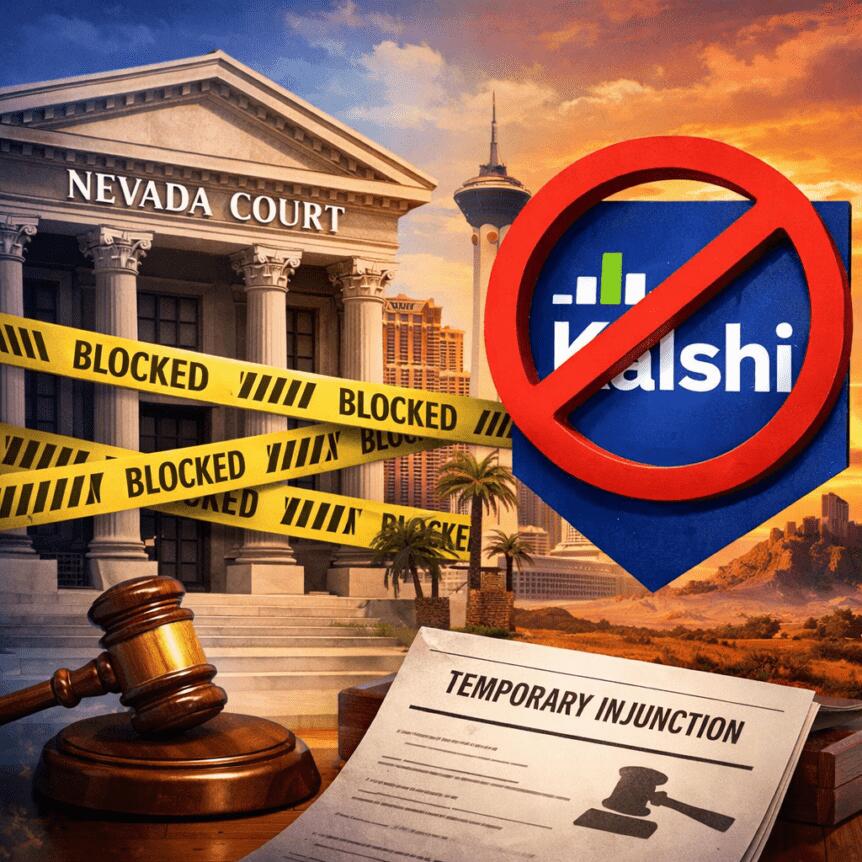
A Nevada judge has halted Kalshi from operating in the state for now, ruling that the company’s prediction-market contracts could violate Nevada gambling laws by serving as unlicensed sports pools. The temporary restraining order (TRO) lasts 14 days and follows a Nevada Gaming Control Board action aimed at blocking Kalshi’s activity while the case unfolds.
In issuing the TRO, Carson City District Court Judge Jason Woodbury aligned with the state regulator’s position that Kalshi’s sports, election and entertainment event contracts may require a state license. Nevada Gaming Control Board Chair Mike Dreitzer said the board’s duty is to protect the public when prediction markets “facilitate unlicensed gambling,” a point he emphasized when speaking to Reuters about the ruling.
The decision arrives the same week that a federal appeals court denied Kalshi’s emergency bid to stay a parallel federal court proceeding, effectively allowing Nevada regulators to proceed with their actions in state court. Kalshi has argued that its contracts fall under the exclusive purview of the U.S. Commodity Futures Trading Commission, a stance that has been contested in multiple state forums.
Key takeaways
- The court’s TRO blocks Kalshi from offering sports, election and entertainment-related event contracts in Nevada for 14 days, pending a preliminary injunction hearing.
- Judge Woodbury found the early record suggests such contracts could be classified as a “sports pool” under Nevada law, a category Kalshi has not been licensed to operate.
- The panel signaled skepticism toward Kalshi’s federal preemption argument, indicating that, at this stage, the balance of authority weighs against preemption in this context.
- A preliminary injunction hearing is set for April 3 to determine whether Kalshi can continue operating in Nevada while the broader dispute proceeds.
Nevada’s view and Kalshi’s legal posture
The Nevada Gaming Control Board filed suit last month, contending that Kalshi needed a state license to offer its contract-based prediction markets for sports and related events. The board’s position rests on the premise that such offerings amount to gambling activities that fall within Nevada’s licensing framework. Kalshi has argued that its products are regulated by the federal CFTC, and that federal preemption should bar state-level licensing claims in this arena.
Judge Woodbury’s ruling frames the question as a nuanced, evolving area of law. In his order, he noted that, at the moment, state and federal authorities have not reached a settled consensus on how prediction markets should be treated under preemption doctrine. He concluded that, for now, the balance of legal authority does not favor Kalshi’s preemption argument in the Nevada context.
The court’s decision places Kalshi in a tense position in a state where regulators have long maintained strict oversight of gambling-like activities. The TRO does not resolve the larger question of whether Kalshi can operate in Nevada at all; it merely freezes activity while the injunction request is litigated.
Kalshi has pursued its own legal strategy in other jurisdictions, including filings designed to preemptively challenge potential enforcement actions by various states. Separately, Kalshi’s opponents in other states have taken measures to restrict the company’s offerings; for example, a Massachusetts judge earlier banned Kalshi from offering sports event contracts, a ruling that was later lifted on appeal. The Arizona attorney general has also pursued criminal charges against Kalshi, accusing the platform of running an illegal gambling operation—a charge Kalshi’s leadership has rejected as an overstep.
As the Nevada matter advances, observers are watching how the two tracks—state licensing enforcement and federal preemption theory—will influence Kalshi’s expansion plans and the broader regulatory risk facing prediction markets in the United States.
Earlier coverage tied Kalshi’s case to similar disputes in other states and highlighted how regulators have increasingly scrutinized prediction-market operators. The appellate decision denying Kalshi’s emergency request in the federal case underscores the uphill path for operators seeking shelter behind federal preemption in a patchwork state-by-state regime.
For investors and builders in the prediction-market space, the Nevada decision reinforces the importance of understanding licensing regimes at the state level and remaining mindful of evolving federal-state tensions in the sector. The outcome of the April 3 hearing will be a key signal of where the regulatory balance currently stands and what it could mean for Kalshi’s ability to operate nationwide.
What comes next in the Kalshi saga
With the temporary pause in place, Kalshi must await the court’s ruling on the preliminary injunction. If the injunction is granted, Kalshi would face a longer halt while the broader dispute over licensing, preemption and regulatory authority is resolved. If denied, Kalshi could resume activity in Nevada under any court-specified conditions or timelines.
Beyond Nevada, the case adds to a growing calendar of state-level actions and civil actions that have tested the legality of prediction markets in the United States. The Massachusetts and Arizona developments, in particular, illustrate the divergent approaches states are taking toward enforcement and criminal risk, underscoring a landscape where operators must navigate a mosaic of rules rather than a single national framework.
As regulators weigh calls for clearer guidelines, the next months will be critical for Kalshi’s strategic planning and for market participants who rely on prediction markets for hedging and pricing diverse outcomes. The April 3 hearing will be a focal point for clarifying whether Kalshi can continue to offer its existing suites of contracts in Nevada or whether broader licensing changes will be required to operate there in the near term.
In the meantime, traders and developers should monitor not only the Nevada case but also the evolving federal-state dialogue on preemption, licensing, and the precise contours of what constitutes gambling in prediction markets. The outcome could shape the pace at which prediction markets scale in the United States and influence how regulators balance consumer protection with innovation.
Sources cited in coverage include Reuters’ reporting on the Nevada TRO and Kalshi’s ongoing legal battles, as well as prior reporting on Kalshi’s status in other states.
Reuters reporting on the Nevada TRO and regulator comments and coverage of the appeals court denial provide context for the broader regulatory arc Kalshi faces as it eyes expansion beyond Nevada.
This article was originally published as Nevada Court Temporarily Blocks Kalshi from Operating in Nevada on Crypto Breaking News – your trusted source for crypto news, Bitcoin news, and blockchain updates.
Ayrıca Şunları da Beğenebilirsiniz

The Next Bitcoin Story Of 2025

XRP price dips to $1.40: What’s behind the latest decline?