

A comprehensive review of the stablecoin ecosystem of 12 public chains: SUI has the fastest growth, and USDT TRON issuance exceeds Ethereum
Author: Frank, PANews
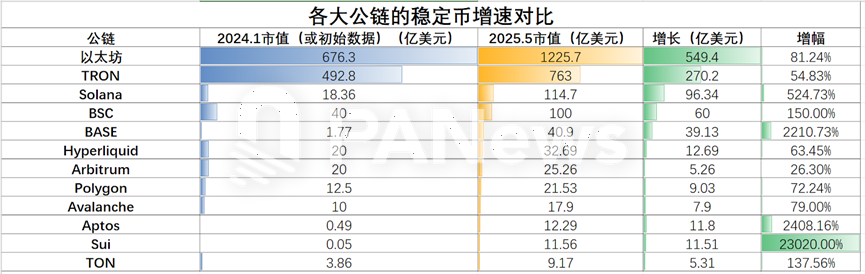
In 2025, stablecoins have become the most concerned area in the crypto market. As of May 22, the total market value of stablecoins has exceeded 245 billion US dollars. Behind the rapid growth of stablecoins is a battlefield where various public chains compete secretly. As one of the most important forms of asset precipitation, stablecoins are not only an indicator of changes in asset flows, but also an important measure of the market recognition of public chains. PANews analyzed the stablecoin data of the top 12 public chains, trying to outline a panoramic picture of the development of public chain stablecoins.
Ethereum: Relying on USDC's growth rate to maintain half of the market
Ethereum's stablecoin market value is 122.5 billion US dollars, accounting for 50% of all stablecoin issuance. The most popular stablecoin on Ethereum is still USDT, accounting for about 50%. However, from the perspective of USDT, Ethereum's issuance has declined since 2025. According to PANews statistics, the issuance of USDT on the Ethereum chain increased by 83.1% in 2024, but in 2025, as of May 21, Ethereum's USDT issuance has dropped by 5.07%. This also directly makes TRON the largest public chain for USDT issuance.

In addition to USDT, Ethereum is also the largest public chain for USDC issuance. As of May 22, the issuance of UDSC on Ethereum has reached 36.9 billion, accounting for 60.82% of Ethereum's issuance. In October 2024, the issuance of USDC on Ethereum was only 25.2 billion US dollars, an increase of 46.4% in about half a year. The substantial growth of USDC has also become the main reason why Ethereum has been able to retain half of the stablecoin market.
TRON: The largest public chain for USDT issuance and the busiest on-chain USD “distribution hub”
Tron's stablecoins mainly come from USDT, accounting for more than 99%, and it has now become the largest public chain issuing USDT. Tron's total share of the global stablecoin market is about 31.3%. According to CryptoQuant data, Tron's average daily USDT transaction volume reached about 2.4 million, while Ethereum's data was only 284,000.

In terms of transaction volume, the Tron network processes an average of $20 billion worth of USDT transfers per day, accounting for nearly 29% of all stablecoin transactions worldwide. In terms of user activity, more than 1 million independent accounts conduct USDT transactions on Tron every day, accounting for 28% of all active stablecoin wallet addresses on all blockchains.
Growth trend: The supply of USDT on TRON will increase from $48.8 billion in 2024 to $59.7 billion. In 2025, Tether will issue an additional $18 billion of USDT on TRON, bringing the total supply of USDT on TRON to $77.7 billion. The reason is that TRON's low fees and high transaction speed make it the preferred network for large-scale USDT transactions, especially favored by retail users and emerging markets.
In addition, the close cooperation between Tron founder Justin Sun and the Trump family also provides more possibilities for the stablecoin prospects of Tron. In May, Zack Witkoff, co-founder of the Trump family project WLFI (World Liberty Financial), said that the US dollar stablecoin USD1 issued by WLFI will also be issued natively on the Tron chain. Justin Sun also revealed in January this year that he hopes to significantly reduce transaction fees and eventually achieve free transfers. But as of now, the next step of the plan has not been revealed.
Solana: An acceleration engine at high TPS
As the most popular public chain in the past two years, stablecoins are also one of the options with significant growth on the Solana chain. From $1.8 billion at the beginning of 2024, it has increased to a peak of $13.1 billion in May, an increase of 627%. Whether in terms of size or growth rate, Solana is the most emerging force in the stablecoin field that cannot be ignored.
Of course, Solana’s current total stablecoin market value is about $11.4 billion, which is still far behind TRON and Ethereum, especially more than 10 times that of Ethereum. However, considering that Solana’s DEX transaction volume has exceeded Ethereum, but the issuance of stablecoins is still far behind Ethereum, the application of stablecoins in Solana’s ecosystem is not yet widespread.

From the internal structure, USDC is the preferred stablecoin on Solana, accounting for 73% of the market share on Solana. USDT's share on Solana is about 20%. PYUSD issued by PayPal currently has a market value of US$200 million on the Solana chain, second only to Ethereum, accounting for about 24.36%. Solana is now one of the preferred options for many new stablecoins.

BSC: Zero Gas and USD1 dual drive
As of May 2025, BSC accounts for about 2.4% of the global stablecoin market share. The stablecoin market value of the BSC chain has experienced several leaps in growth since 2024, from $4 billion to the current $10 billion, an increase of about 150%. There were two concentrated growths, one from November 2024 to January 2025, from about $5 billion to $7 billion. The second was from the end of April to May 2025, from a rapid increase from $7 billion to $9 billion. From the analysis results, the first growth may be mainly due to the zero GAS fee activity launched by the BSC chain. The second was driven by the issuance of the USD1 stablecoin on the BSC chain. The recently popular USD1 currently has 99.26% of its issuance on the BSC chain, with a total issuance of about $2.1 billion.
The proportion of BUSD and FUSD, which BSC previously promoted, has dropped to about 3% in total. The issuance volume of USDT accounts for about 59%, and USD1 accounts for about 21%.
Visa Onchain Analytics data shows that with the recent increase in popularity of Binance Wallet, the proportion of stablecoin DEX transactions on the BSC chain has increased from less than 10% in April to 28%, which is almost the same as the proportion of centralized exchanges.
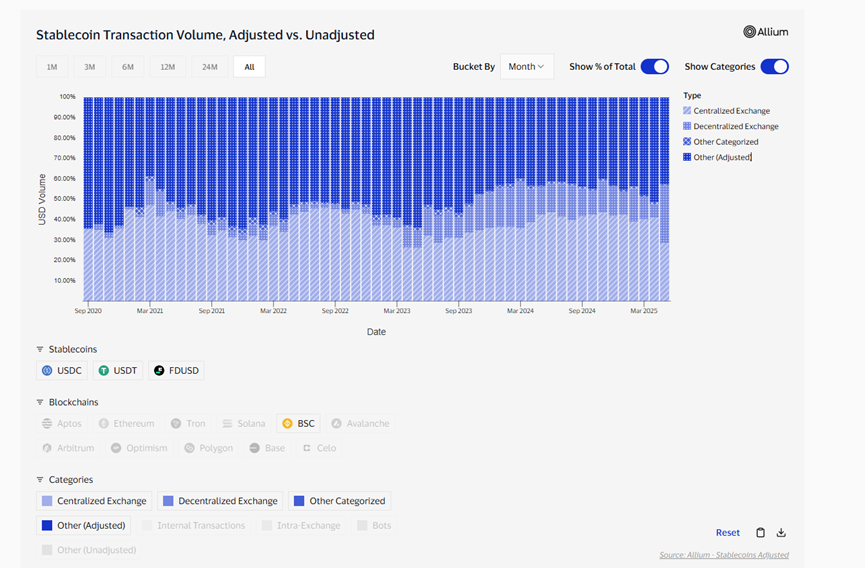
In addition, in May, BSC accounted for 38.1% of all chains in terms of the number of stablecoin transactions, ranking first. In terms of the cumulative transaction volume of USDT, BSC was only lower than Tron and Ethereum at 358 billion US dollars. It can be said that in the stablecoin track, BSC and Solana have become the most competitive new forces.
Base: The growth champion empowered by Coinbase
As the Ethereum L2 incubated by Coinbase, Base has achieved significant growth in all aspects of data in this cycle, and the same is true in the field of stablecoins. In terms of the market value of stablecoins, Base has grown from US$177 million in January 2024 to US$4.09 billion, with a growth rate of 2210%, the largest increase among the top five public chains in terms of stablecoin market value.
USDC is the most mainstream stablecoin on the Base chain, accounting for 97.8%. Base is also the public chain with the largest cumulative transaction volume of USDC besides Ethereum.
Hyperliquid: The new vault for derivatives whales
As a new gaming platform for whales, Hyperliquid has not been launched for long, but it has shown great potential. In less than half a year, the market value of its stablecoin has reached 3.26 billion US dollars, ahead of Arbitrum, Polygon, Avalanche and other old public chains.
From the perspective of ecological applications, Hyperliquid, as a decentralized derivatives exchange, mainly uses USDC as a trading object. Therefore, USDC is the largest stablecoin on Hyperliquid, accounting for 97.8%. However, it is worth noting that as a public chain, Hyperliquid has recently added feUSD, USDT, and USDe to its stablecoin categories. Although the current issuance and transaction volumes are not high, it has also opened up some new ports for the application of the public chain ecosystem.
Arbitrum: Big Dive After Incentive Disconnect
Arbitrum, as the highly-watched Ethereum L2, has seen its stablecoin market value rise and fall in this cycle. In 2024, Arbitrum's stablecoin market value grew from $2 billion to a peak of $6.9 billion. However, in early 2025, Arbitrum's stablecoin market value experienced a big dive, falling rapidly to $2.73 billion in January. On January 2, the outflow in a single day decreased by $2 billion.
This sharp decline may be mainly due to three reasons. First, on December 17, the last round of Incentives Detox incentives ended, and the liquidity subsidies of about 50 protocols were "cut off" at one time, and market-making funds were withdrawn in a concentrated manner after the rewards expired. Second, Tether announced that it would migrate USDT on Arbitrum to the new cross-chain standard "USDT0" from January 29. In addition, the high-yield competitive chain Blast deposit contract promised 5% annualized + Airdrop Points for USDC/USDT, and has continued to absorb L2 assets since it went online at the end of November.
Polygon: USDC migration and payment test field
From 2024 to now, the market value of Polygon stablecoin has increased from 1.26 billion to about 2.15 billion US dollars, an annual increase of nearly 70%. The key driving force comes from the launch of Circle's native USDC and the pilot of legal currency and stablecoin settlement by giants such as Visa and Mastercard on the PoS chain, which has brought enterprise-level growth.
Currently, the stablecoin share on the Polygon chain is dominated by USDT and USDC, which account for 40.79% and 47% of the market respectively.
Avalanche: Fee reductions failed to lead to explosive growth
Avalanche's growth in the past year seems a bit flat. Although the overall stablecoin market value has also increased by 79%, from the chart, this growth has stagnated since May 2024. It has always fluctuated between $1 billion and $2 billion. At the end of 2024, the Avalanche 9000 upgrade reduced the C-Chain basic fee by 96%, and the cost of small transfers and batch settlements of stablecoins was greatly reduced. However, this benefit has not been able to continue to provide momentum for Avalanche. Perhaps only when the overall activity of the ecosystem is improved can the development of stablecoins be truly driven.
Aptos: The dark horse of the Move ecosystem
The total market value of stablecoins on Aptos exceeded $1 billion for the first time in the first quarter of 2025. Judging from the growth since 2024, the overall growth as of May reached 2408%, making it one of the fastest growing public chains. As public chains of the MOVE ecosystem, Aptos and Sui are both emerging competitors. The stablecoins on the Aptos chain are mainly composed of USDT and USDC, of which USDT accounts for about 62.39% and USDC accounts for about 32%. Given that the native USDC was only launched on Aptos in January 2025, this growth has been rapid.
Sui: A high-speed growth chain with a 230-fold increase
Sui's stablecoin growth is the largest among all public chains. At the beginning of 2024, the market value of Sui's stablecoin was only about 5 million US dollars. By May 2025, this figure increased to 1.156 billion US dollars, an exaggerated increase of 230 times. Currently, USDC is the most issued stablecoin in Sui's network, accounting for about 75%.
However, the current volume of stablecoins in the Sui ecosystem is not too high, and the types of stablecoins issued are relatively small. How to attract more large funds to enter the market is the main growth problem facing the Sui ecosystem, and the Cetus theft incident on May 22 will also shake its security performance to a certain extent. It can be said that opportunities and concerns coexist.
TON: Telegram’s social support is weak in growth
TON, as a newcomer to the battlefield in 2024, has also achieved rapid growth in one year. In April 2024, Tether announced the simultaneous issuance of USDT and XAUT on the TON chain, becoming its 15th supporting network, with the goal of directly introducing Telegram's 900 million users into the on-chain dollar payment ecosystem. After the launch, wallets and various Telegram transaction bots were quickly integrated, and new users could receive and pay USDT with their mobile phone numbers without any threshold. This also provides a foundation for the growth of stablecoins in the TON ecosystem. By June 2024, the issuance of USDT on TON reached US$519 million.
However, after a short period of growth, the growth of stablecoins in the TON ecosystem began to decline in 2025, and has now fallen from $1.4 billion at the beginning of the year to around $900 million. This may be related to the fact that the TON ecosystem has no obvious hot spots after clicking on the mini-game.
Conclusion
At present, the competition landscape of stablecoins in public chains is still changing rapidly. Although public chains such as Ethereum and Tron still have a large first-mover advantage, the rise of several popular public chains such as Solana and BSC is gradually eroding the market share of the top chains, and the issuance of new stablecoins such as USD1 is no longer limited to Ethereum. As a newer public chain, Apots and Sui's MOVE ecological public chain has a clear advantage in growth rate, although the minting time of stablecoins is shorter.
It is foreseeable that the competition for stablecoins will become more intense. For the old public chains, there is a double pressure of continuing to grow while maintaining the market. For the new public chains, it is a period of rapid expansion with wild market growth. As stablecoin bills are gradually implemented around the world, the story of stablecoins has just begun.
Ayrıca Şunları da Beğenebilirsiniz

Gold edges higher as Fed easing outlook cushions downside

Flare Mainnet Launches FXRP, Bringing XRP Into DeFi
