This article explores how neural networks can be combined with domain decomposition methods to solve complex nonlinear systems in fluid dynamics. Experiments on shallow water equations and Euler’s equations demonstrate that even simple neural architectures can approximate shock waves and discontinuities with surprising accuracy. While still at proof-of-concept stage, these results highlight the potential of AI-powered solvers for tackling problems that challenge traditional numerical methods.This article explores how neural networks can be combined with domain decomposition methods to solve complex nonlinear systems in fluid dynamics. Experiments on shallow water equations and Euler’s equations demonstrate that even simple neural architectures can approximate shock waves and discontinuities with surprising accuracy. While still at proof-of-concept stage, these results highlight the potential of AI-powered solvers for tackling problems that challenge traditional numerical methods.

AI Learns to Predict Shock Waves

Abstract and 1. Introduction

1.1. Introductory remarks

1.2. Basics of neural networks

1.3. About the entropy of direct PINN methods

1.4. Organization of the paper

  1. Non-diffusive neural network solver for one dimensional scalar HCLs

    2.1. One shock wave

    2.2. Arbitrary number of shock waves

    2.3. Shock wave generation

    2.4. Shock wave interaction

    2.5. Non-diffusive neural network solver for one dimensional systems of CLs

    2.6. Efficient initial wave decomposition

  2. Gradient descent algorithm and efficient implementation

    3.1. Classical gradient descent algorithm for HCLs

    3.2. Gradient descent and domain decomposition methods

  3. Numerics

    4.1. Practical implementations

    4.2. Basic tests and convergence for 1 and 2 shock wave problems

    4.3. Shock wave generation

    4.4. Shock-Shock interaction

    4.5. Entropy solution

    4.6. Domain decomposition

    4.7. Nonlinear systems

  4. Conclusion and References

4.6. Domain decomposition

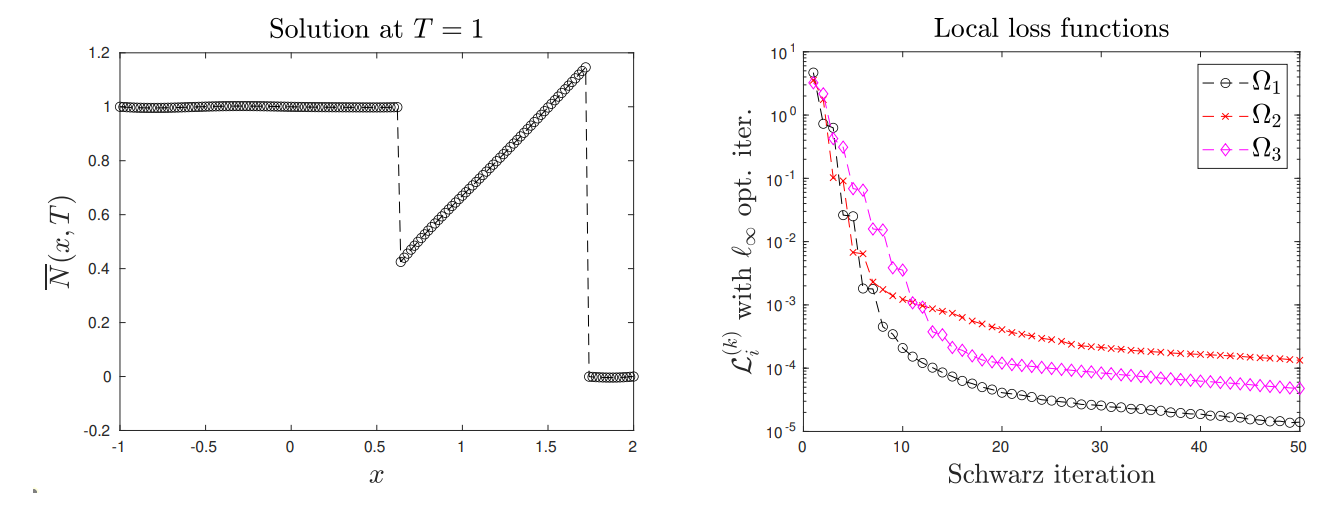
In this subsection, we propose an experiment illustrating the combination of the neural network based HCL solver developed in this paper with the domain decomposition method from Subsection 3.2. We numerically illustrate the convergence of the algorithm. The neural networks have 30 neurons and one hidden layer, and the number of learning nodes is 900 learning nodes.

\
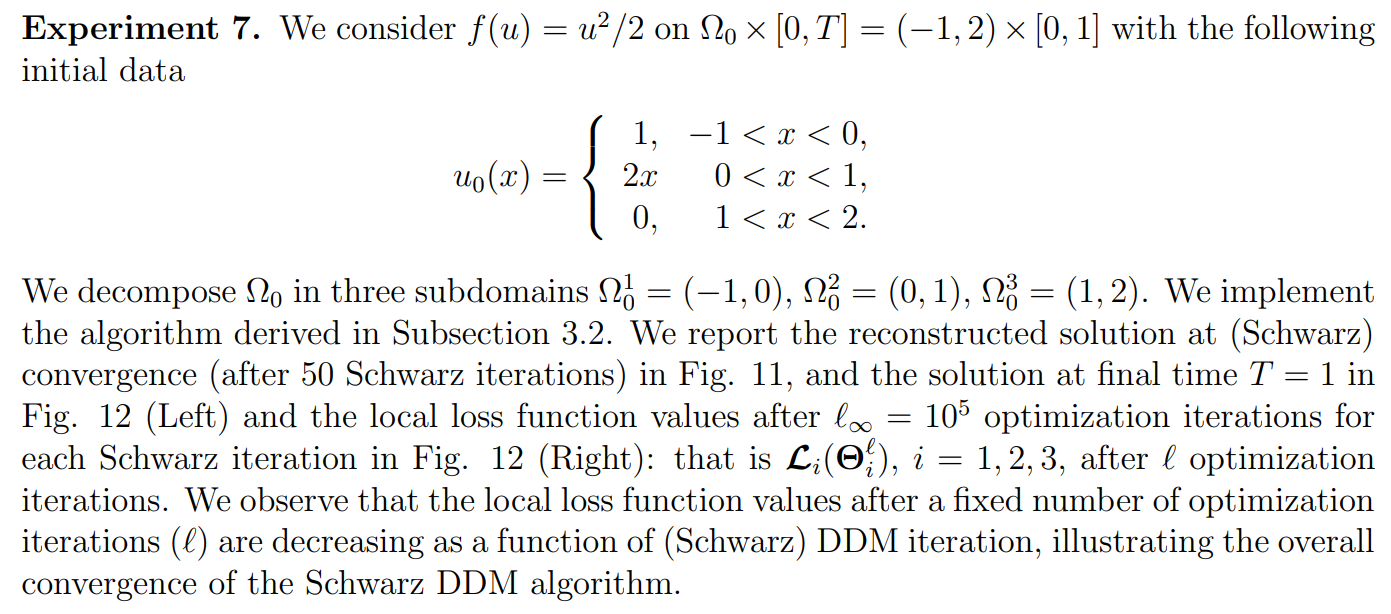
\ Figure 11: Experiment 7. Reconstructed space-time solution.
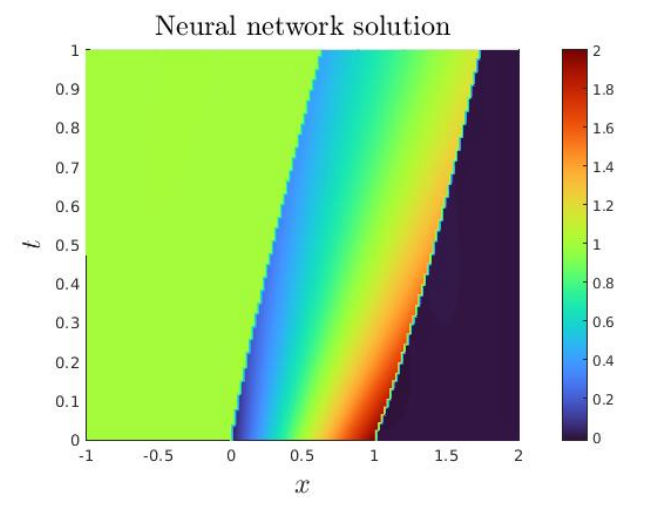
\ Figure 12: Experiment 7. (Left) Solution at T = 1. (Right) Local loss function values after a fixed number ℓ∞ of optimization iterations.

\ The DDM naturally makes sense for much more computationally complex problems. This test however illustrates a proof-of-concept of the SWR approach.

4.7. Nonlinear systems

In this subsection, we are interested in the numerical approximation of hyperbolic systems with shock waves.

\ Experiment 8. In this experiment we focus on the initial wave decomposition for a Riemann problem. The system considered here is the Shallow water equations (m = 2).

\ \

\ \ where h is the height of a compressible fluid, u its velocity, and g is the gravitational constant taken here equal to 1. The spatial domain is (−0.1, 0.1), the final time is T = 0.0025, and we impose null Dirichlet boundary conditions.

\ Experiment 8a. The initial data is given by

\ \
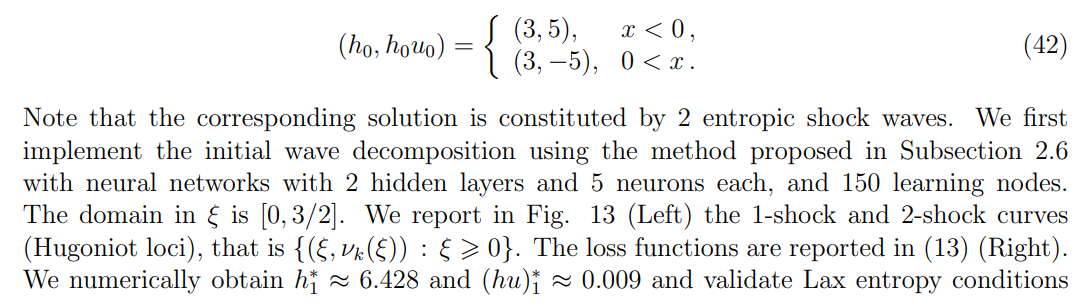
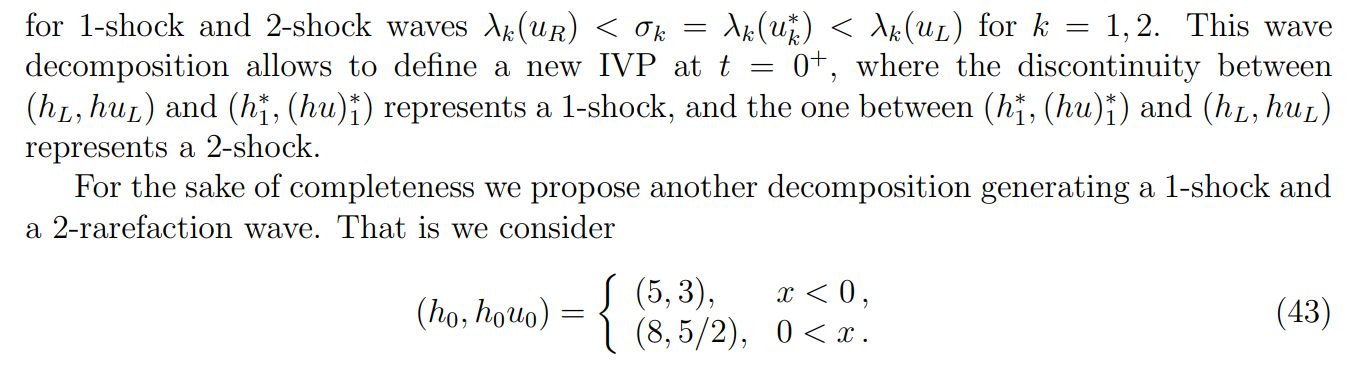
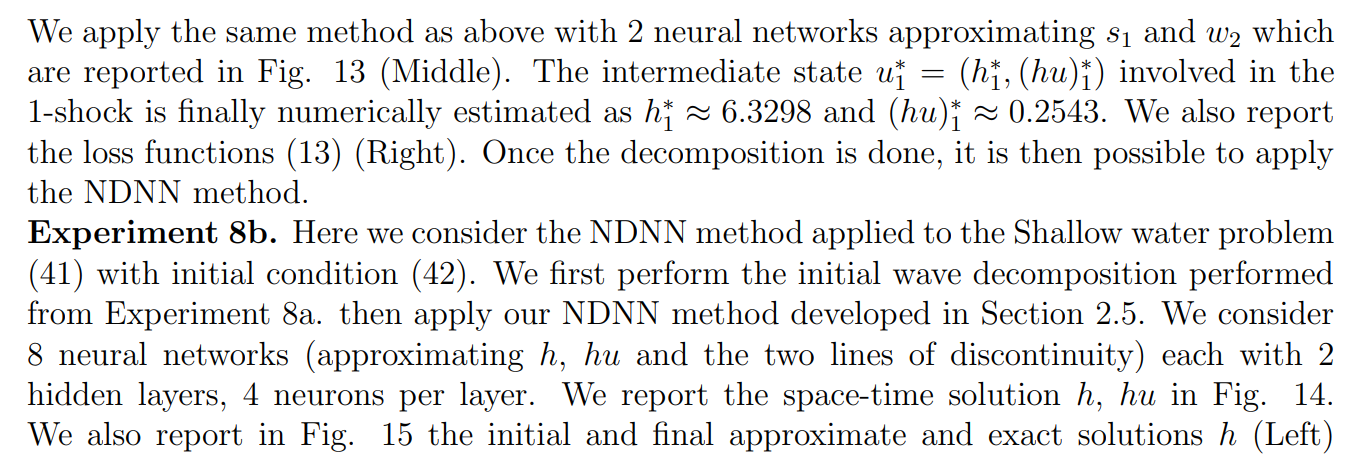
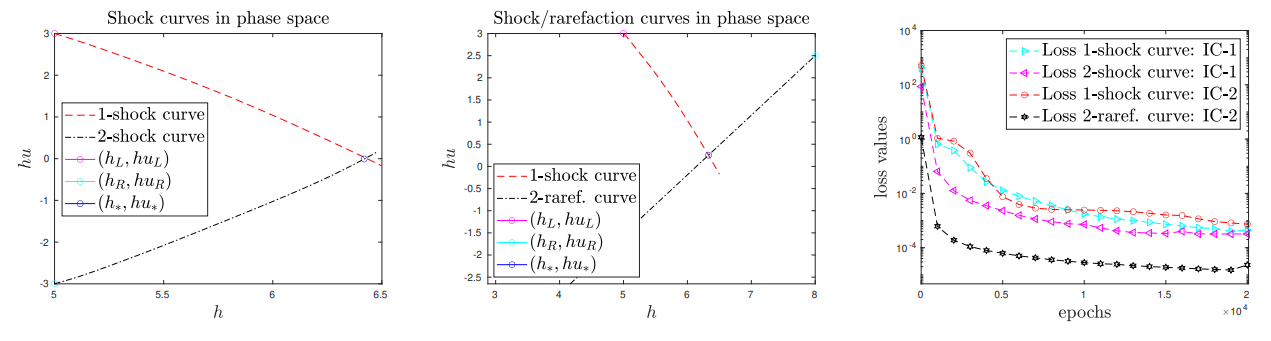
\ \ \ Figure 13: Experiment 8a. (Left) Shock curves in phase space with initial condition (42). (Middle) 1-shock curve and 2-rarefaction curve with initial condition (43). (Right) Loss functions for constructing simple waves (42) and (43)
\ \ \

\ \ \

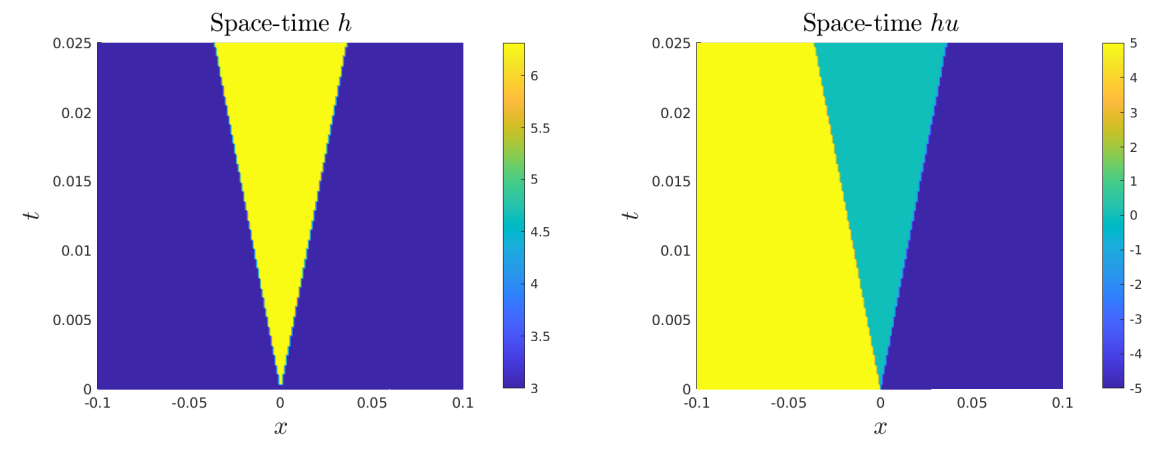
\ \ \ Figure 14: Experiment 8b. Approximate space-time solution (Left) h : (x, t) 7→ h(x, t). (Right) hu : (x, t) 7→ hu(x, t).

\ \ and hu (Middle), as well as the loss function Fig. 15 (Right). This experiment shows that

\ \ Figure 15: Experiment 8b. (Left) Approximate component x 7→ h(x, T). (Middle) Approximate component x 7→ hu(x, T). (Right) Loss function.
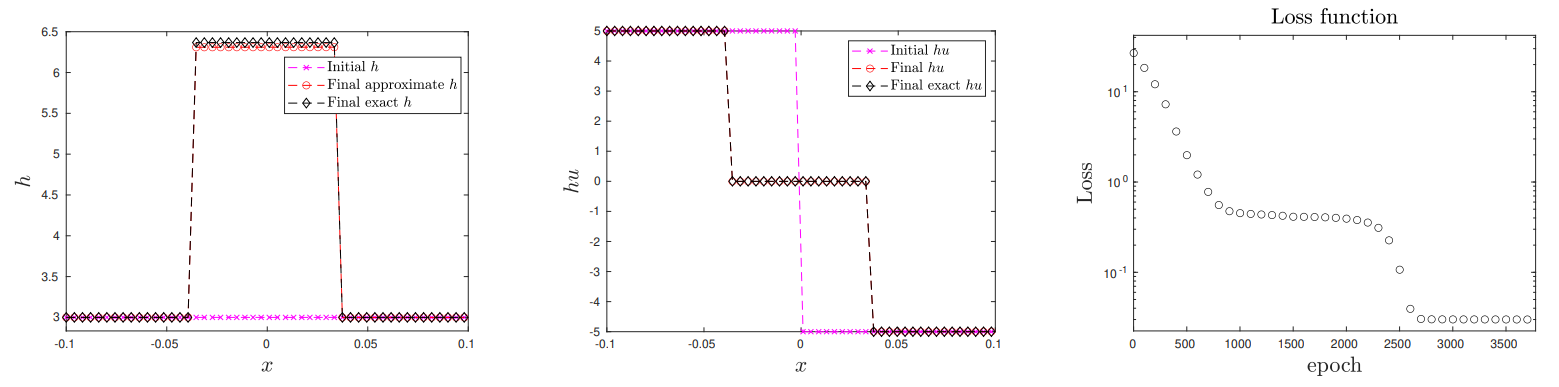
\ \ the proposed methodology allows for the computation of the solution to (at least simple) Riemann problems.

\ Experiment 9. In this last experiment, we consider Euler’s equations modeling compressible inviscid fluid flows. This is a 3-equation HCL which reads as follows (in conservative form)

\ \
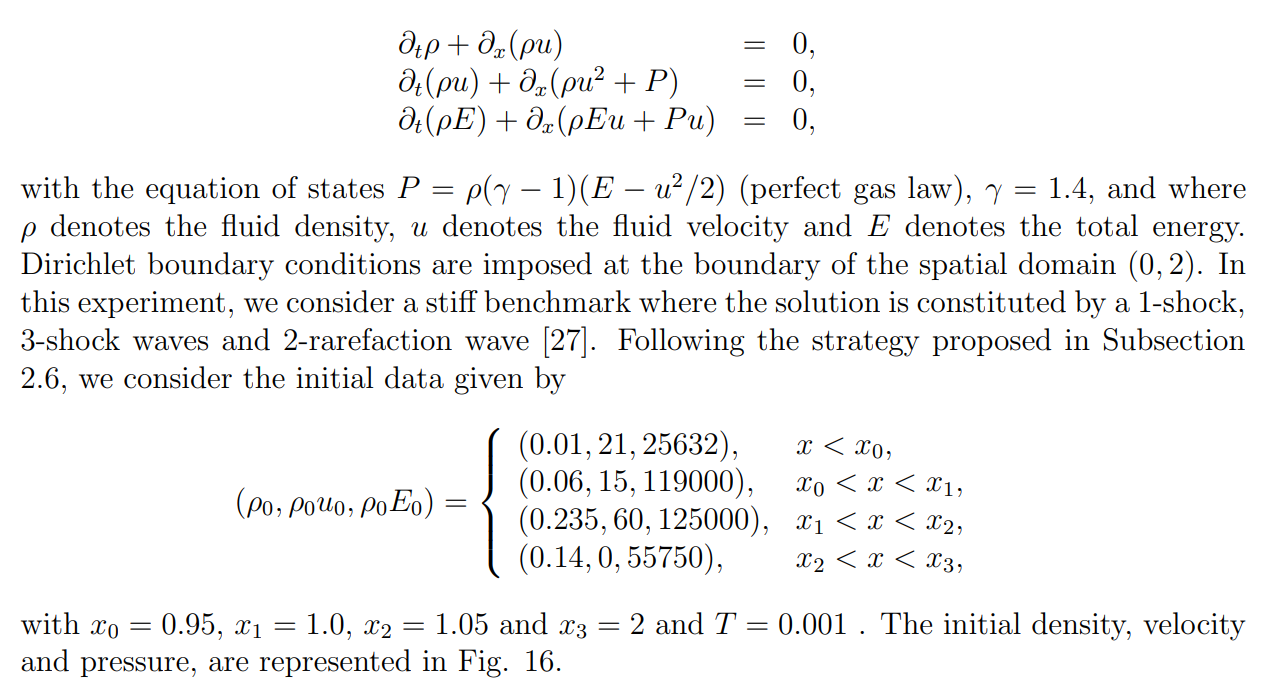
\ \ \ Figure 16: Experiment 9. Initial data (Left) Density. (Middle) Velocity (Right) Pressure.
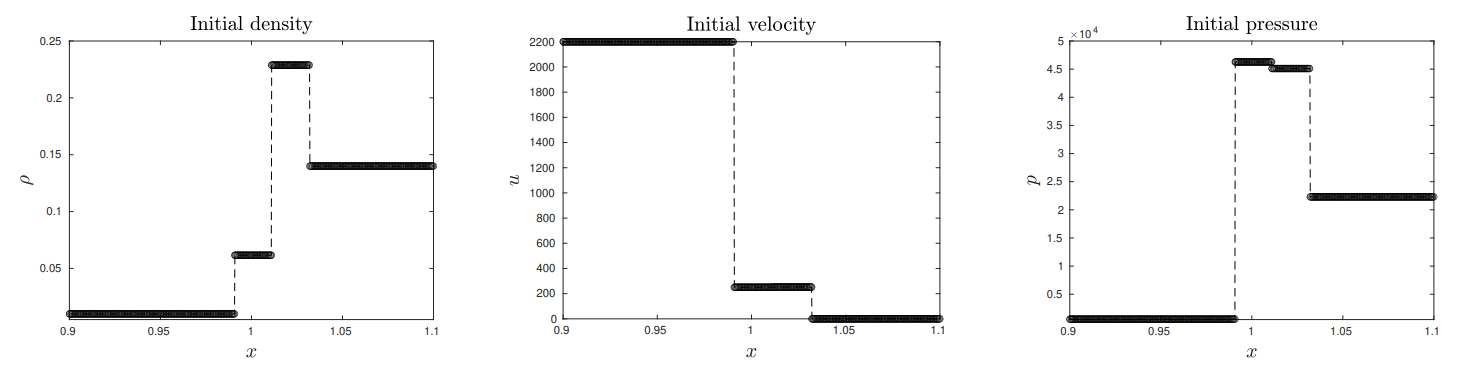
\ \ We implement the method developed in Subsection 2.5 with m = 3, 1 hidden layer and 30 neurons for each conservative component ρ, ρu, ρE and for the 3 lines of discontinuity. In Fig. 17 we report the density, velocity and pressure at initial and final times T. This test illustrates the precision of the proposed approach, with in particular an accurate approximation of the 2-contact discontinuity which is often hard to obtain with standard solvers.

\

:::info Authors:

(1) Emmanuel LORIN, School of Mathematics and Statistics, Carleton University, Ottawa, Canada, K1S 5B6 and Centre de Recherches Mathematiques, Universit´e de Montr´eal, Montreal, Canada, H3T 1J4 ([email protected]);

(2) Arian NOVRUZI, a Corresponding Author from Department of Mathematics and Statistics, University of Ottawa, Ottawa, ON K1N 6N5, Canada ([email protected]).

:::


:::info This paper is available on arxiv under CC by 4.0 Deed (Attribution 4.0 International) license.

:::

\

Piyasa Fırsatı
Waves Logosu
Waves Fiyatı(WAVES)
$0.6946
$0.6946$0.6946
-1.61%
USD
Waves (WAVES) Canlı Fiyat Grafiği
Sorumluluk Reddi: Bu sitede yeniden yayınlanan makaleler, halka açık platformlardan alınmıştır ve yalnızca bilgilendirme amaçlıdır. MEXC'nin görüşlerini yansıtmayabilir. Tüm hakları telif sahiplerine aittir. Herhangi bir içeriğin üçüncü taraf haklarını ihlal ettiğini düşünüyorsanız, kaldırılması için lütfen [email protected] ile iletişime geçin. MEXC, içeriğin doğruluğu, eksiksizliği veya güncelliği konusunda hiçbir garanti vermez ve sağlanan bilgilere dayalı olarak alınan herhangi bir eylemden sorumlu değildir. İçerik, finansal, yasal veya diğer profesyonel tavsiye niteliğinde değildir ve MEXC tarafından bir tavsiye veya onay olarak değerlendirilmemelidir.

Ayrıca Şunları da Beğenebilirsiniz

Unstoppable: Why No Public Company Can Ever Catch MicroStrategy’s Massive Bitcoin Holdings

Unstoppable: Why No Public Company Can Ever Catch MicroStrategy’s Massive Bitcoin Holdings

BitcoinWorld Unstoppable: Why No Public Company Can Ever Catch MicroStrategy’s Massive Bitcoin Holdings Imagine trying to build a mountain of gold, only to discover
Paylaş
bitcoinworld2025/12/17 14:30
Eric Trump Says Banks Tried to Shut Him Out – Turns to Bitcoin Instead

Eric Trump Says Banks Tried to Shut Him Out – Turns to Bitcoin Instead

The post Eric Trump Says Banks Tried to Shut Him Out – Turns to Bitcoin Instead appeared on BitcoinEthereumNews.com. Bitcoin 18 September 2025 | 10:05 Eric Trump, co-founder of American Bitcoin and son of U.S. President Donald Trump, has revealed that he holds a significant personal stake in the crypto company and has no intention of selling. Trump said his ownership amounts to roughly 7.5% of shares and emphasized that both he and the board are committed to keeping their holdings locked in for the long term. According to Trump, the move reflects not only loyalty to the firm but also resistance to pressure from traditional financial institutions. He claimed that major U.S. banks have repeatedly tried to restrict his access to financial services, including efforts by Capital One, JPMorgan, and Bank of America. “They tried to shut us out of the system,” he said, describing the experience as the turning point that convinced him of crypto’s advantages. Trump argued that blockchain-based systems allow transactions to be handled “faster, cheaper, and more transparently” than legacy banking. He framed his support for American Bitcoin as both a business decision and a statement against what he called an ongoing “de-banking” campaign targeting the Trump Organization and its affiliates. By underscoring his commitment, Trump signaled that he views cryptocurrency not just as a financial instrument but as a defense against the limitations of traditional finance. His comments also echo a broader narrative that digital assets are becoming an alternative for those who feel sidelined by conventional institutions. The information provided in this article is for educational purposes only and does not constitute financial, investment, or trading advice. Coindoo.com does not endorse or recommend any specific investment strategy or cryptocurrency. Always conduct your own research and consult with a licensed financial advisor before making any investment decisions. Author Alex is an experienced financial journalist and cryptocurrency enthusiast. With over 8 years of experience…
Paylaş
BitcoinEthereumNews2025/09/18 15:08
How Crypto Could Reshape Finance, AI, and Privacy by 2026: A16z Crypto

How Crypto Could Reshape Finance, AI, and Privacy by 2026: A16z Crypto

The post How Crypto Could Reshape Finance, AI, and Privacy by 2026: A16z Crypto appeared on BitcoinEthereumNews.com. From stablecoin payments to AI-driven agents
Paylaş
BitcoinEthereumNews2025/12/17 14:38