Spot Bitcoin and Ethereum exchange-traded funds (ETFs) in the United States reversed course sharply last week, shedding more than $1.7 billion. This shift came amid Bitcoin and Ethereum price volatility during the past week as both assets shed more than 8% during the reporting period. Bitcoin and Ethereum ETFs Bleed Cash Amid Market Volatility According to data from SoSoValue, spot Bitcoin ETFs recorded $903 million in net withdrawals. The outflows ended a month-long streak of inflows that had reflected growing institutional confidence. That sentiment shifted as macroeconomic uncertainty deepened, prompting many institutional investors to trim exposure and adopt a defensive stance. Ethereum products mirrored the downturn but endured even heavier losses. Ethereum ETFs Net Daily Inflow This Week. Source: SoSoValue Data from SoSoValue shows that the nine US-listed spot Ethereum ETFs saw redemptions, amounting to $796 million in outflows. This is their largest weekly withdrawal since launching earlier this year. The synchronized retreat across both assets reflects a broader cooling in crypto ETF demand. Institutional allocators once viewed these vehicles as a convenient entry point into digital assets. They are now reassessing their strategies in light of growing macro headwinds. Over the past week, persistent inflation concerns, slowing global growth, and heightened uncertainty around US monetary policy have reduced appetite for volatile assets. In this environment, digital assets—long categorized as high risk—were among the first to be pared from portfolios. Meanwhile, institutional strategies have also grown more defensive, especially as investors are increasingly being exposed to losses. CryptoQuant data shows that Bitcoin treasury firms raising capital through PIPE deals are under pressure, as share prices trend toward discounted issuance levels. At the same time, investor attention is rotating toward newly launched ETFs tied to alternative tokens like Solana and XRP. These vehicles have drawn capital away from Bitcoin and Ethereum funds, introducing fresh competition and encouraging experimentation with underrepresented assets. The redirection of inflows suggests that while risk sentiment has cooled, appetite for diversification within crypto remains active — just more selective and opportunistic than before.Spot Bitcoin and Ethereum exchange-traded funds (ETFs) in the United States reversed course sharply last week, shedding more than $1.7 billion. This shift came amid Bitcoin and Ethereum price volatility during the past week as both assets shed more than 8% during the reporting period. Bitcoin and Ethereum ETFs Bleed Cash Amid Market Volatility According to data from SoSoValue, spot Bitcoin ETFs recorded $903 million in net withdrawals. The outflows ended a month-long streak of inflows that had reflected growing institutional confidence. That sentiment shifted as macroeconomic uncertainty deepened, prompting many institutional investors to trim exposure and adopt a defensive stance. Ethereum products mirrored the downturn but endured even heavier losses. Ethereum ETFs Net Daily Inflow This Week. Source: SoSoValue Data from SoSoValue shows that the nine US-listed spot Ethereum ETFs saw redemptions, amounting to $796 million in outflows. This is their largest weekly withdrawal since launching earlier this year. The synchronized retreat across both assets reflects a broader cooling in crypto ETF demand. Institutional allocators once viewed these vehicles as a convenient entry point into digital assets. They are now reassessing their strategies in light of growing macro headwinds. Over the past week, persistent inflation concerns, slowing global growth, and heightened uncertainty around US monetary policy have reduced appetite for volatile assets. In this environment, digital assets—long categorized as high risk—were among the first to be pared from portfolios. Meanwhile, institutional strategies have also grown more defensive, especially as investors are increasingly being exposed to losses. CryptoQuant data shows that Bitcoin treasury firms raising capital through PIPE deals are under pressure, as share prices trend toward discounted issuance levels. At the same time, investor attention is rotating toward newly launched ETFs tied to alternative tokens like Solana and XRP. These vehicles have drawn capital away from Bitcoin and Ethereum funds, introducing fresh competition and encouraging experimentation with underrepresented assets. The redirection of inflows suggests that while risk sentiment has cooled, appetite for diversification within crypto remains active — just more selective and opportunistic than before.
Bitcoin and Ethereum ETFs Lose $1.7 Billion as Institutions Retreat

2025/09/29 04:34
Okuma süresi: 2 dk

Spot Bitcoin and Ethereum exchange-traded funds (ETFs) in the United States reversed course sharply last week, shedding more than $1.7 billion.

This shift came amid Bitcoin and Ethereum price volatility during the past week as both assets shed more than 8% during the reporting period.

Bitcoin and Ethereum ETFs Bleed Cash Amid Market Volatility

According to data from SoSoValue, spot Bitcoin ETFs recorded $903 million in net withdrawals. The outflows ended a month-long streak of inflows that had reflected growing institutional confidence.

That sentiment shifted as macroeconomic uncertainty deepened, prompting many institutional investors to trim exposure and adopt a defensive stance.

Ethereum products mirrored the downturn but endured even heavier losses.

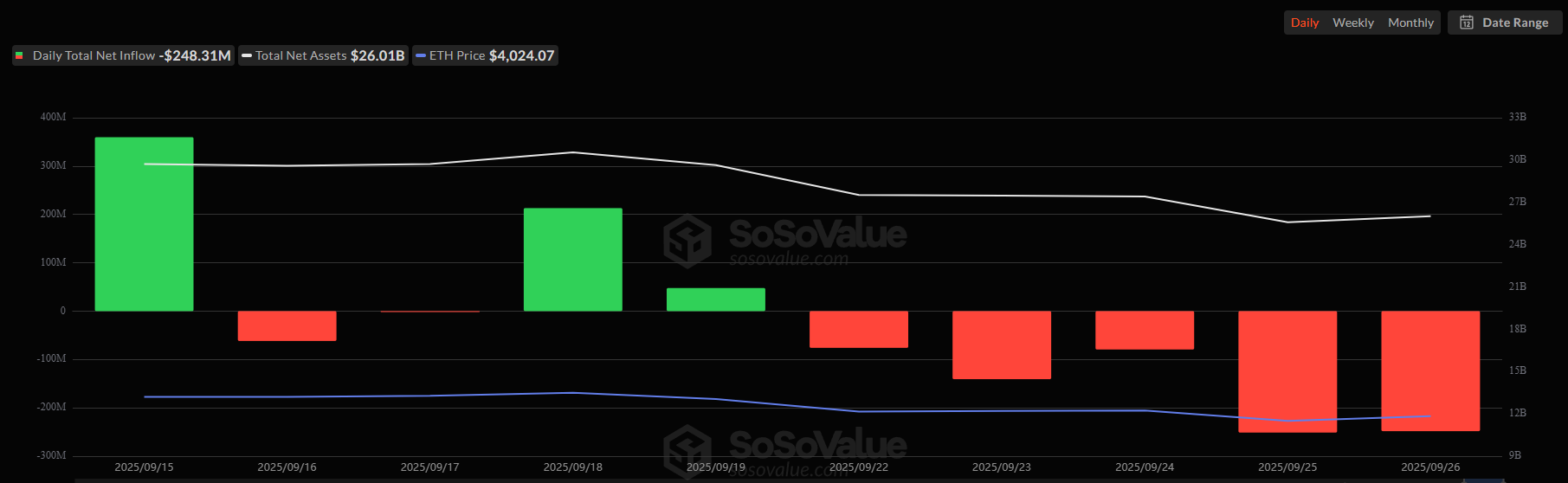
Ethereum ETFs Net Daily Inflow This Week. Ethereum ETFs Net Daily Inflow This Week. Source: SoSoValue

Data from SoSoValue shows that the nine US-listed spot Ethereum ETFs saw redemptions, amounting to $796 million in outflows. This is their largest weekly withdrawal since launching earlier this year.

The synchronized retreat across both assets reflects a broader cooling in crypto ETF demand.

Institutional allocators once viewed these vehicles as a convenient entry point into digital assets. They are now reassessing their strategies in light of growing macro headwinds.

Over the past week, persistent inflation concerns, slowing global growth, and heightened uncertainty around US monetary policy have reduced appetite for volatile assets. In this environment, digital assets—long categorized as high risk—were among the first to be pared from portfolios.

Meanwhile, institutional strategies have also grown more defensive, especially as investors are increasingly being exposed to losses.

CryptoQuant data shows that Bitcoin treasury firms raising capital through PIPE deals are under pressure, as share prices trend toward discounted issuance levels.

At the same time, investor attention is rotating toward newly launched ETFs tied to alternative tokens like Solana and XRP.

These vehicles have drawn capital away from Bitcoin and Ethereum funds, introducing fresh competition and encouraging experimentation with underrepresented assets.

The redirection of inflows suggests that while risk sentiment has cooled, appetite for diversification within crypto remains active — just more selective and opportunistic than before.

Piyasa Fırsatı
Moonveil Logosu
Moonveil Fiyatı(MORE)
$0.0006709
$0.0006709$0.0006709
+1.94%
USD
Moonveil (MORE) Canlı Fiyat Grafiği
Sorumluluk Reddi: Bu sitede yeniden yayınlanan makaleler, halka açık platformlardan alınmıştır ve yalnızca bilgilendirme amaçlıdır. MEXC'nin görüşlerini yansıtmayabilir. Tüm hakları telif sahiplerine aittir. Herhangi bir içeriğin üçüncü taraf haklarını ihlal ettiğini düşünüyorsanız, kaldırılması için lütfen [email protected] ile iletişime geçin. MEXC, içeriğin doğruluğu, eksiksizliği veya güncelliği konusunda hiçbir garanti vermez ve sağlanan bilgilere dayalı olarak alınan herhangi bir eylemden sorumlu değildir. İçerik, finansal, yasal veya diğer profesyonel tavsiye niteliğinde değildir ve MEXC tarafından bir tavsiye veya onay olarak değerlendirilmemelidir.

Ayrıca Şunları da Beğenebilirsiniz

Tokyo’s Metaplanet Launches Miami Subsidiary to Amplify Bitcoin Income

Tokyo’s Metaplanet Launches Miami Subsidiary to Amplify Bitcoin Income

Metaplanet Inc., the Japanese public company known for its bitcoin treasury, is launching a Miami subsidiary to run a dedicated derivatives and income strategy aimed at turning holdings into steady, U.S.-based cash flow. Japanese Bitcoin Treasury Player Metaplanet Opens Miami Outpost The new entity, Metaplanet Income Corp., sits under Metaplanet Holdings, Inc. and is based […]
Paylaş
Coinstats2025/09/18 00:32
New 15% global tariff reshapes landscape – Commerzbank

New 15% global tariff reshapes landscape – Commerzbank

The post New 15% global tariff reshapes landscape – Commerzbank appeared on BitcoinEthereumNews.com. Commerzbank’s Economic Research team, led by Dr. Vincent Stamer
Paylaş
BitcoinEthereumNews2026/02/23 21:03
The GENIUS Act Is Already Law. Banks Shouldn’t Try to Rewrite It Now

The GENIUS Act Is Already Law. Banks Shouldn’t Try to Rewrite It Now

The post The GENIUS Act Is Already Law. Banks Shouldn’t Try to Rewrite It Now appeared on BitcoinEthereumNews.com. Healthy competition drives innovation and better products for consumers; it is at the center of American economic leadership. Unfortunately, now that the bipartisan GENIUS Act has been signed into law, major legacy financial institutions seem to be having second thoughts about the innovations that stablecoins can bring to financial markets. Bank lobbying groups and public affairs teams have been peppering Congress with complaints about the law, urging members to reopen debate and introduce changes to the legislation that will ensure the stablecoin market doesn’t grow too quickly, protecting banks’ profits and stifling consumer choice. This reactionary response is both overblown and unnecessary. What legacy financial firms should do instead is embrace competition and offer exciting new products and services that consumers want, not try to kneecap emerging players through anti-innovation rules and regulations. The GENIUS Act was carefully designed with a thorough bipartisan process to strengthen consumer safeguards, ensure regulatory oversight, and preserve financial stability. Efforts to roll back its provisions are less about protecting families and more about protecting entrenched banking interests from the competition that helps ensure the U.S. banking system stays the strongest and most innovative in the world. Critics warn that allowing stablecoins to provide rewards could lead to massive deposit outflows from community banks, with figures as high as $6.6 trillion cited. But closer examination shows this fear is unfounded. A July 2025 analysis by consulting firm Charles River Associates found no statistically significant relationship between stablecoin adoption and community bank deposit outflows. In fact, the overwhelming majority of stablecoin reserves remain in the traditional financial system — either in commercial bank accounts or in short-term Treasuries — where they continue to support liquidity and credit in the broader U.S. economy. The dire estimates rely on unrealistic assumptions that every dollar of stablecoin issuance permanently…
Paylaş
BitcoinEthereumNews2025/09/18 09:39
