Bitcoin exchange-traded funds (ETFs) dominated institutional flows, with a massive $407.78 million in daily net inflows on July 2, bringing cumulative inflows to $49.04 billion . In contrast, Ethereum ETFs faced modest $1.8 million outflows, according to data from SosoValue . The stark difference resulted from Bitcoin’s continued institutional appeal as BTC reached weekly highs of $109,000 on July 2, positioning it for potential breakouts toward $112,000 targets. Source: Cryptonews Fidelity’s FBTC led Bitcoin ETF inflows with $183.96 million , followed by ARK21Shares’ ARKB at $83 million and Bitwise’s BITB contributing $64.94 million . BlackRock’s IBIT, despite recording zero inflows on the day, maintains its dominant position with $76.31 billion in net assets and $52.42 billion in cumulative inflows since launch. Source: SosoValue The performance disparity between Bitcoin and Ethereum ETFs followed the broader market trend, as Bitcoin maintains psychological support above the $100,000 level defended since early May. Total Bitcoin ETF assets under management reached $136.68 billion , representing 6.30% of Bitcoin’s total market capitalization. This indicates a significant level of institutional adoption. Trading volumes also surged to $5.22 billion across Bitcoin ETFs, with IBIT alone generating $4.08 billion in daily trading activity. Institutional Momentum Drives Record Bitcoin ETF Adoption Bitcoin ETF inflows demonstrate sustained institutional conviction, despite broader market volatility, with the latest inflows representing the continuation of aggressive accumulation patterns seen so far in 2025. Particularly, Fidelity’s FBTC leadership, with $183.96 million in inflows, resulted from the growing competition among major asset managers for Bitcoin market share, following BlackRock’s early dominance. The growing competition has led to a broad-based institutional adoption, rather than concentrated buying from a single entity. Interestingly, corporate treasury strategies are increasingly embracing ETF structures over direct ownership of Bitcoin. Design giant, Figma, recently revealed in its IPO filing that it has $69.5 million in Bitcoin ETF holdings , plus $30 million earmarked for future cryptocurrency investments. 🚀 Design giant @figma goes public revealing $70M Bitcoin ETF holdings and $30M ready to buy more as corporate Bitcoin adoption explodes to 141 public companies holding $91 billion. #Figma #IPO #Bitcoin https://t.co/Q9CtjTalum — Cryptonews.com (@cryptonews) July 2, 2025 This pattern is becoming increasingly adopted, and public companies that can’t hold directly prefer regulated exposure through established financial products. Regionally, European expansion is also accelerating through structured products, such as the recent UniCredit’s Bitcoin ETF certificate , designed for Italian professional clients. The five-year instrument offers capital protection with 85% upside participation. Moreover, the regulatory landscape continues to evolve favorably with the SEC’s July 1 guidance streamlining token-based ETF approvals and enabling a 75-day review process. The new guidance establishes clearer pathways for crypto ETF approvals by implementing standardized disclosure frameworks that encompass custody practices, conflicts of interest, and creation and redemption mechanisms. Ethereum ETFs Face Headwinds Despite Previous Momentum Ethereum ETFs experienced modest $1.8 million outflows on July 2, contrasting sharply with their previous dominance, as they had recorded $240.29 million in daily inflows during June , surpassing Bitcoin ETFs’ performance at that time. The June surge represented the strongest performance of Ethereum ETFs in four months, coinciding with ETH climbing above $2,800 for the first time since February. Source: Cryptonews BlackRock’s ETHA led that momentum with $163.6 million in single-day inflows, maintaining a 23-day streak without outflows while managing over 1.55 million ETH valued at $4.23 billion. Current outflows may result from profit-taking following Ethereum’s technical breakout above multi-year descending trendlines. The asset completed an inverse head-and-shoulders pattern with projected targets around $3,300, but recent rejection from $2,834 highs suggests consolidation phases before continued advances. Ethereum staking also reached an all-time high of 34.65 million ETH locked on the Beacon Chain, representing nearly 29% of the circulating supply. Long-term holders are holding on through staking despite short-term ETF flow volatility. They’re prioritizing yield generation over immediate liquidity. Regulatory developments further support the growth of multi-asset crypto ETFs, as seen in Grayscale’s Digital Large Cap Fund conversion , which holds Bitcoin (79.9%), Ethereum (11.3%), and also XRP, Solana, and Cardano. Similarly, the REX Osprey Solana Staking ETF was launched on Wednesday as the first US-listed fund to incorporate crypto staking. This regulatory development could enable similar Ethereum staking products that combine institutional access with yield generation.Bitcoin exchange-traded funds (ETFs) dominated institutional flows, with a massive $407.78 million in daily net inflows on July 2, bringing cumulative inflows to $49.04 billion . In contrast, Ethereum ETFs faced modest $1.8 million outflows, according to data from SosoValue . The stark difference resulted from Bitcoin’s continued institutional appeal as BTC reached weekly highs of $109,000 on July 2, positioning it for potential breakouts toward $112,000 targets. Source: Cryptonews Fidelity’s FBTC led Bitcoin ETF inflows with $183.96 million , followed by ARK21Shares’ ARKB at $83 million and Bitwise’s BITB contributing $64.94 million . BlackRock’s IBIT, despite recording zero inflows on the day, maintains its dominant position with $76.31 billion in net assets and $52.42 billion in cumulative inflows since launch. Source: SosoValue The performance disparity between Bitcoin and Ethereum ETFs followed the broader market trend, as Bitcoin maintains psychological support above the $100,000 level defended since early May. Total Bitcoin ETF assets under management reached $136.68 billion , representing 6.30% of Bitcoin’s total market capitalization. This indicates a significant level of institutional adoption. Trading volumes also surged to $5.22 billion across Bitcoin ETFs, with IBIT alone generating $4.08 billion in daily trading activity. Institutional Momentum Drives Record Bitcoin ETF Adoption Bitcoin ETF inflows demonstrate sustained institutional conviction, despite broader market volatility, with the latest inflows representing the continuation of aggressive accumulation patterns seen so far in 2025. Particularly, Fidelity’s FBTC leadership, with $183.96 million in inflows, resulted from the growing competition among major asset managers for Bitcoin market share, following BlackRock’s early dominance. The growing competition has led to a broad-based institutional adoption, rather than concentrated buying from a single entity. Interestingly, corporate treasury strategies are increasingly embracing ETF structures over direct ownership of Bitcoin. Design giant, Figma, recently revealed in its IPO filing that it has $69.5 million in Bitcoin ETF holdings , plus $30 million earmarked for future cryptocurrency investments. 🚀 Design giant @figma goes public revealing $70M Bitcoin ETF holdings and $30M ready to buy more as corporate Bitcoin adoption explodes to 141 public companies holding $91 billion. #Figma #IPO #Bitcoin https://t.co/Q9CtjTalum — Cryptonews.com (@cryptonews) July 2, 2025 This pattern is becoming increasingly adopted, and public companies that can’t hold directly prefer regulated exposure through established financial products. Regionally, European expansion is also accelerating through structured products, such as the recent UniCredit’s Bitcoin ETF certificate , designed for Italian professional clients. The five-year instrument offers capital protection with 85% upside participation. Moreover, the regulatory landscape continues to evolve favorably with the SEC’s July 1 guidance streamlining token-based ETF approvals and enabling a 75-day review process. The new guidance establishes clearer pathways for crypto ETF approvals by implementing standardized disclosure frameworks that encompass custody practices, conflicts of interest, and creation and redemption mechanisms. Ethereum ETFs Face Headwinds Despite Previous Momentum Ethereum ETFs experienced modest $1.8 million outflows on July 2, contrasting sharply with their previous dominance, as they had recorded $240.29 million in daily inflows during June , surpassing Bitcoin ETFs’ performance at that time. The June surge represented the strongest performance of Ethereum ETFs in four months, coinciding with ETH climbing above $2,800 for the first time since February. Source: Cryptonews BlackRock’s ETHA led that momentum with $163.6 million in single-day inflows, maintaining a 23-day streak without outflows while managing over 1.55 million ETH valued at $4.23 billion. Current outflows may result from profit-taking following Ethereum’s technical breakout above multi-year descending trendlines. The asset completed an inverse head-and-shoulders pattern with projected targets around $3,300, but recent rejection from $2,834 highs suggests consolidation phases before continued advances. Ethereum staking also reached an all-time high of 34.65 million ETH locked on the Beacon Chain, representing nearly 29% of the circulating supply. Long-term holders are holding on through staking despite short-term ETF flow volatility. They’re prioritizing yield generation over immediate liquidity. Regulatory developments further support the growth of multi-asset crypto ETFs, as seen in Grayscale’s Digital Large Cap Fund conversion , which holds Bitcoin (79.9%), Ethereum (11.3%), and also XRP, Solana, and Cardano. Similarly, the REX Osprey Solana Staking ETF was launched on Wednesday as the first US-listed fund to incorporate crypto staking. This regulatory development could enable similar Ethereum staking products that combine institutional access with yield generation.

Bitcoin ETFs Pull $408M—Fidelity & ARK Spark the Next BTC Wave As ETH Struggles

Bitcoin exchange-traded funds (ETFs) dominated institutional flows, with a massive $407.78 million in daily net inflows on July 2, bringing cumulative inflows to $49.04 billion.

In contrast, Ethereum ETFs faced modest $1.8 million outflows, according to data from SosoValue.

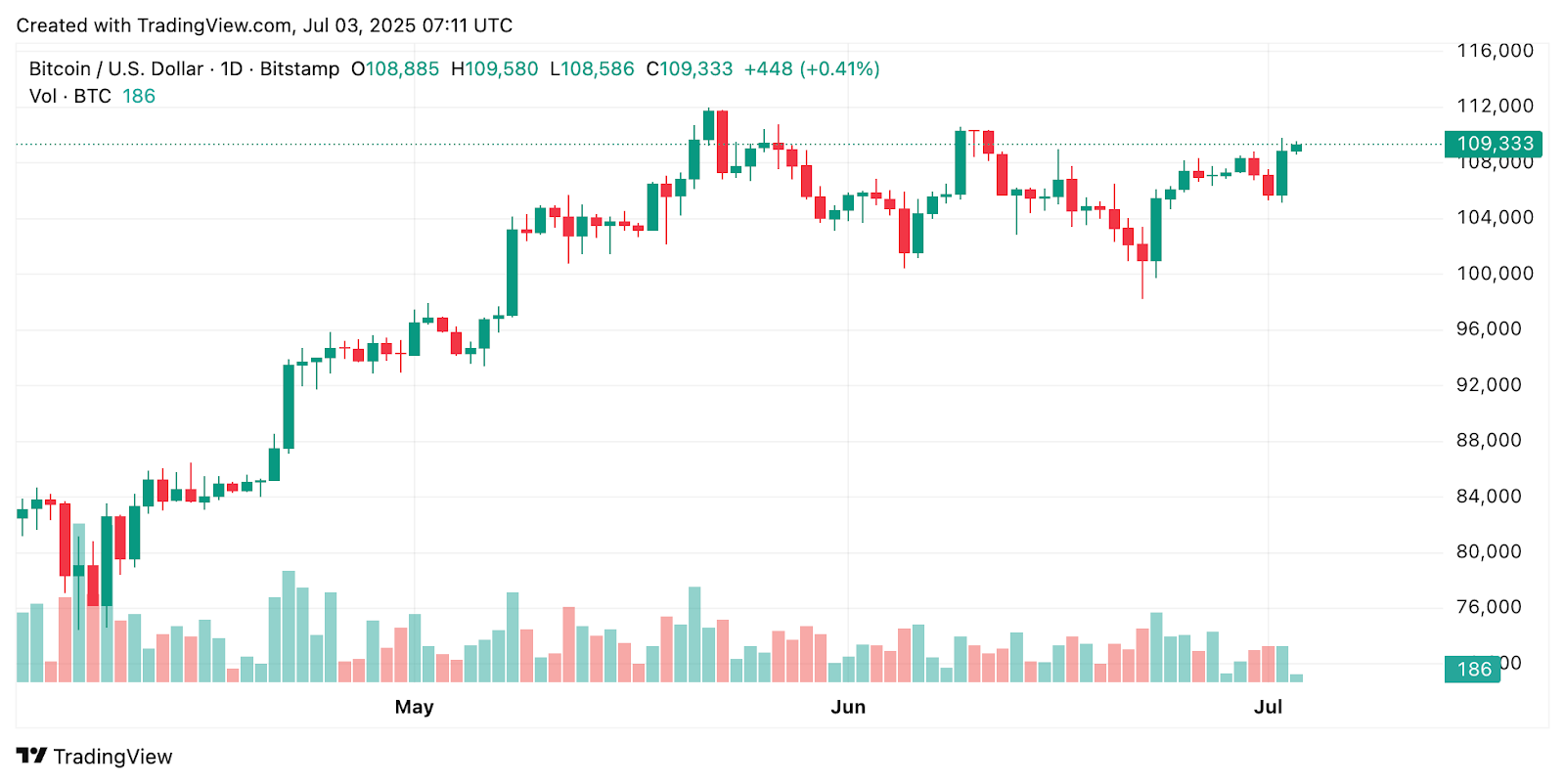
The stark difference resulted from Bitcoin’s continued institutional appeal as BTC reached weekly highs of $109,000 on July 2, positioning it for potential breakouts toward $112,000 targets.
Bitcoin ETFs Explode with $408M Inflows While Ethereum ETFs Struggle with $1.8M OutflowsSource: Cryptonews

Fidelity’s FBTC led Bitcoin ETF inflows with $183.96 million, followed by ARK21Shares’ ARKB at $83 million and Bitwise’s BITB contributing $64.94 million.

BlackRock’s IBIT, despite recording zero inflows on the day, maintains its dominant position with $76.31 billion in net assets and $52.42 billion in cumulative inflows since launch.

Bitcoin ETFs Explode with $408M Inflows While Ethereum ETFs Struggle with $1.8M OutflowsSource: SosoValue

The performance disparity between Bitcoin and Ethereum ETFs followed the broader market trend, as Bitcoin maintains psychological support above the $100,000 level defended since early May.

Total Bitcoin ETF assets under management reached $136.68 billion, representing 6.30% of Bitcoin’s total market capitalization. This indicates a significant level of institutional adoption.

Trading volumes also surged to $5.22 billion across Bitcoin ETFs, with IBIT alone generating $4.08 billion in daily trading activity.

Institutional Momentum Drives Record Bitcoin ETF Adoption

Bitcoin ETF inflows demonstrate sustained institutional conviction, despite broader market volatility, with the latest inflows representing the continuation of aggressive accumulation patterns seen so far in 2025.

Particularly, Fidelity’s FBTC leadership, with $183.96 million in inflows, resulted from the growing competition among major asset managers for Bitcoin market share, following BlackRock’s early dominance.

The growing competition has led to a broad-based institutional adoption, rather than concentrated buying from a single entity.

Interestingly, corporate treasury strategies are increasingly embracing ETF structures over direct ownership of Bitcoin.

Design giant, Figma, recently revealed in its IPO filing that it has $69.5 million in Bitcoin ETF holdings, plus $30 million earmarked for future cryptocurrency investments.

This pattern is becoming increasingly adopted, and public companies that can’t hold directly prefer regulated exposure through established financial products.

Regionally, European expansion is also accelerating through structured products, such as the recent UniCredit’s Bitcoin ETF certificate, designed for Italian professional clients. The five-year instrument offers capital protection with 85% upside participation.

Moreover, the regulatory landscape continues to evolve favorably with the SEC’s July 1 guidance streamlining token-based ETF approvals and enabling a 75-day review process.

The new guidance establishes clearer pathways for crypto ETF approvals by implementing standardized disclosure frameworks that encompass custody practices, conflicts of interest, and creation and redemption mechanisms.

Ethereum ETFs Face Headwinds Despite Previous Momentum

Ethereum ETFs experienced modest $1.8 million outflows on July 2, contrasting sharply with their previous dominance, as they had recorded $240.29 million in daily inflows during June, surpassing Bitcoin ETFs’ performance at that time.

The June surge represented the strongest performance of Ethereum ETFs in four months, coinciding with ETH climbing above $2,800 for the first time since February.

Bitcoin ETFs Explode with $408M Inflows While Ethereum ETFs Struggle with $1.8M OutflowsSource: Cryptonews

BlackRock’s ETHA led that momentum with $163.6 million in single-day inflows, maintaining a 23-day streak without outflows while managing over 1.55 million ETH valued at $4.23 billion.

Current outflows may result from profit-taking following Ethereum’s technical breakout above multi-year descending trendlines.

The asset completed an inverse head-and-shoulders pattern with projected targets around $3,300, but recent rejection from $2,834 highs suggests consolidation phases before continued advances.

Ethereum staking also reached an all-time high of 34.65 million ETH locked on the Beacon Chain, representing nearly 29% of the circulating supply.

Long-term holders are holding on through staking despite short-term ETF flow volatility. They’re prioritizing yield generation over immediate liquidity.

Regulatory developments further support the growth of multi-asset crypto ETFs, as seen in Grayscale’s Digital Large Cap Fund conversion, which holds Bitcoin (79.9%), Ethereum (11.3%), and also XRP, Solana, and Cardano.

Similarly, the REX Osprey Solana Staking ETF was launched on Wednesday as the first US-listed fund to incorporate crypto staking.

This regulatory development could enable similar Ethereum staking products that combine institutional access with yield generation.

Piyasa Fırsatı
Threshold Logosu
Threshold Fiyatı(T)
$0.009002
$0.009002$0.009002
-0.51%
USD
Threshold (T) Canlı Fiyat Grafiği
Sorumluluk Reddi: Bu sitede yeniden yayınlanan makaleler, halka açık platformlardan alınmıştır ve yalnızca bilgilendirme amaçlıdır. MEXC'nin görüşlerini yansıtmayabilir. Tüm hakları telif sahiplerine aittir. Herhangi bir içeriğin üçüncü taraf haklarını ihlal ettiğini düşünüyorsanız, kaldırılması için lütfen [email protected] ile iletişime geçin. MEXC, içeriğin doğruluğu, eksiksizliği veya güncelliği konusunda hiçbir garanti vermez ve sağlanan bilgilere dayalı olarak alınan herhangi bir eylemden sorumlu değildir. İçerik, finansal, yasal veya diğer profesyonel tavsiye niteliğinde değildir ve MEXC tarafından bir tavsiye veya onay olarak değerlendirilmemelidir.

Ayrıca Şunları da Beğenebilirsiniz

BFX Presale Raises $7.5M as Solana Holds $243 and Avalanche Eyes $1B Treasury — Best Cryptos to Buy in 2025

BFX Presale Raises $7.5M as Solana Holds $243 and Avalanche Eyes $1B Treasury — Best Cryptos to Buy in 2025

BFX presale hits $7.5M with tokens at $0.024 and 30% bonus code BLOCK30, while Solana holds $243 and Avalanche builds a $1B treasury to attract institutions.
Paylaş
Blockchainreporter2025/09/18 01:07
FCA komt in 2026 met aangepaste cryptoregels voor Britse markt

FCA komt in 2026 met aangepaste cryptoregels voor Britse markt

De Britse financiële waakhond, de FCA, komt in 2026 met nieuwe regels speciaal voor crypto bedrijven. Wat direct opvalt: de toezichthouder laat enkele klassieke financiële verplichtingen los om beter aan te sluiten op de snelle en grillige wereld van digitale activa. Tegelijkertijd wordt er extra nadruk gelegd op digitale beveiliging,... Het bericht FCA komt in 2026 met aangepaste cryptoregels voor Britse markt verscheen het eerst op Blockchain Stories.
Paylaş
Coinstats2025/09/18 00:33
BlackRock boosts AI and US equity exposure in $185 billion models

BlackRock boosts AI and US equity exposure in $185 billion models

The post BlackRock boosts AI and US equity exposure in $185 billion models appeared on BitcoinEthereumNews.com. BlackRock is steering $185 billion worth of model portfolios deeper into US stocks and artificial intelligence. The decision came this week as the asset manager adjusted its entire model suite, increasing its equity allocation and dumping exposure to international developed markets. The firm now sits 2% overweight on stocks, after money moved between several of its biggest exchange-traded funds. This wasn’t a slow shuffle. Billions flowed across multiple ETFs on Tuesday as BlackRock executed the realignment. The iShares S&P 100 ETF (OEF) alone brought in $3.4 billion, the largest single-day haul in its history. The iShares Core S&P 500 ETF (IVV) collected $2.3 billion, while the iShares US Equity Factor Rotation Active ETF (DYNF) added nearly $2 billion. The rebalancing triggered swift inflows and outflows that realigned investor exposure on the back of performance data and macroeconomic outlooks. BlackRock raises equities on strong US earnings The model updates come as BlackRock backs the rally in American stocks, fueled by strong earnings and optimism around rate cuts. In an investment letter obtained by Bloomberg, the firm said US companies have delivered 11% earnings growth since the third quarter of 2024. Meanwhile, earnings across other developed markets barely touched 2%. That gap helped push the decision to drop international holdings in favor of American ones. Michael Gates, lead portfolio manager for BlackRock’s Target Allocation ETF model portfolio suite, said the US market is the only one showing consistency in sales growth, profit delivery, and revisions in analyst forecasts. “The US equity market continues to stand alone in terms of earnings delivery, sales growth and sustainable trends in analyst estimates and revisions,” Michael wrote. He added that non-US developed markets lagged far behind, especially when it came to sales. This week’s changes reflect that position. The move was made ahead of the Federal…
Paylaş
BitcoinEthereumNews2025/09/18 01:44
