Three of China’s largest Bitcoin hardware manufacturers are establishing production facilities in the United States as President Donald Trump’s tariff policies reshape the cryptocurrency industry. The three industry leaders, Bitmain, Canaan, and MicroBT, collectively control over 90% of the global mining rig market. These companies are the architects of Bitcoin’s physical infrastructure, manufacturing the specialized ASIC (Application-Specific Integrated Circuit) machines that form the backbone of the world’s most valuable cryptocurrency network. Every Bitcoin mined globally likely passes through hardware bearing Chinese engineering fingerprints. 95% Market Control Sparks “Digital Dependency Trap” and Security Risks According to a June 18 Reuters report, these Bitcoin mining giants are establishing U.S. operations to circumvent potential tariffs. However, critics have raised security concerns about Chinese involvement in sectors spanning semiconductor manufacturing and energy infrastructure. Guang Yang, chief technology officer at crypto technology provider Conflux Network, described the situation as extending beyond trade policy. “The U.S.-China trade war goes beyond tariffs,” Yang stated. “It’s a strategic pivot toward ‘politically acceptable’ hardware sources.” Bitmain, the largest of the three companies by revenue, initiated U.S. production of mining equipment in December , one month after Trump’s presidential election victory. Canaan began trial production in the United States on April 2 to avoid tariffs following Trump’s announcement of new trade levies. One of the largest manufacturers of #bitcoin mining machines, Canaan, has set up a base of operations outside of China. CEO Zhang says, Kazakhstan is essential to "expanding after-sales geographical coverage and providing […] support growing international customer base" pic.twitter.com/7D5Xh2ici5 — Documenting ₿itcoin 📄 (@DocumentingBTC) June 23, 2021 Third-ranked MicroBT announced in a statement that it is “actively implementing a localization strategy in the U.S.” to “avoid the impact of tariffs.” $11.9B by 2028: The Market These Giants Are Fighting for According to Frost & Sullivan’s “2024 Global Blockchain Hardware Industry White Paper,” the ASIC-based Bitcoin mining hardware market demonstrates substantial consolidation. When measured by computing power sold, these three Chinese companies command 95.4% of the global market share. The Bitcoin ecosystem encompasses five primary segments: hardware supply, mining farm operations, mining pool management, trading platforms, and payment processing services. Hardware manufacturers like Canaan, the first Bitcoin mining company to go public and the second-largest by computing power , focus exclusively on integrated circuit (IC) design, manufacturing, and equipment sales. Industry analysts project continued sector expansion, with the market expected to reach $11.9 billion by 2028, representing a compound annual growth rate of 15.3%, contingent on Bitcoin’s continued price appreciation driven by supply scarcity. Source: Frost & Sullivan China’s Historical Bitcoin Mining Advantage Understanding today’s migration requires examining how China achieved such overwhelming market control in the first place. The foundation was laid during the historic 2017 Bitcoin boom, when three key factors aligned to create Chinese mining supremacy. During the early expansion phase, Chinese officials recognized cryptocurrency mining as a profitable venture that attracted substantial foreign investment. Consequently, authorities initially overlooked the mining sector while simultaneously restricting Bitcoin trading and initial coin offerings. Hydro-power plants go on sale in China since #Bitcoin mining crackdown has reduced demand for electricity. – South China Morning Post pic.twitter.com/QKEbUzWN4g — Bitcoin Archive (@BTC_Archive) June 30, 2021 China’s extensive hydroelectric infrastructure further strengthened the country’s mining operations, providing the cheap energy essential for profitable Bitcoin production. Does Chinese Hardware Control America’s Bitcoin Network? While the United States leads global Bitcoin mining operations with over 38% of total network activity , American miners depend almost entirely on Chinese-manufactured equipment. America Leads Bitcoin Mining Operation/ Source: Bitbo This creates what security analysts describe as a “digital dependency trap,” a scenario where America’s cryptocurrency infrastructure relies fundamentally on hardware produced by its primary economic rival. Guang Yang, Conflux Network’s chief technology officer, frames this dependency in geopolitical terms that extend far beyond trade economics . “The U.S.-China trade war goes beyond tariffs,” Yang explains. “It’s a strategic pivot toward ‘politically acceptable’ hardware sources.” His assessment reflects growing concerns within the cryptocurrency community about supply chain vulnerabilities that could impact national economic security.Three of China’s largest Bitcoin hardware manufacturers are establishing production facilities in the United States as President Donald Trump’s tariff policies reshape the cryptocurrency industry. The three industry leaders, Bitmain, Canaan, and MicroBT, collectively control over 90% of the global mining rig market. These companies are the architects of Bitcoin’s physical infrastructure, manufacturing the specialized ASIC (Application-Specific Integrated Circuit) machines that form the backbone of the world’s most valuable cryptocurrency network. Every Bitcoin mined globally likely passes through hardware bearing Chinese engineering fingerprints. 95% Market Control Sparks “Digital Dependency Trap” and Security Risks According to a June 18 Reuters report, these Bitcoin mining giants are establishing U.S. operations to circumvent potential tariffs. However, critics have raised security concerns about Chinese involvement in sectors spanning semiconductor manufacturing and energy infrastructure. Guang Yang, chief technology officer at crypto technology provider Conflux Network, described the situation as extending beyond trade policy. “The U.S.-China trade war goes beyond tariffs,” Yang stated. “It’s a strategic pivot toward ‘politically acceptable’ hardware sources.” Bitmain, the largest of the three companies by revenue, initiated U.S. production of mining equipment in December , one month after Trump’s presidential election victory. Canaan began trial production in the United States on April 2 to avoid tariffs following Trump’s announcement of new trade levies. One of the largest manufacturers of #bitcoin mining machines, Canaan, has set up a base of operations outside of China. CEO Zhang says, Kazakhstan is essential to "expanding after-sales geographical coverage and providing […] support growing international customer base" pic.twitter.com/7D5Xh2ici5 — Documenting ₿itcoin 📄 (@DocumentingBTC) June 23, 2021 Third-ranked MicroBT announced in a statement that it is “actively implementing a localization strategy in the U.S.” to “avoid the impact of tariffs.” $11.9B by 2028: The Market These Giants Are Fighting for According to Frost & Sullivan’s “2024 Global Blockchain Hardware Industry White Paper,” the ASIC-based Bitcoin mining hardware market demonstrates substantial consolidation. When measured by computing power sold, these three Chinese companies command 95.4% of the global market share. The Bitcoin ecosystem encompasses five primary segments: hardware supply, mining farm operations, mining pool management, trading platforms, and payment processing services. Hardware manufacturers like Canaan, the first Bitcoin mining company to go public and the second-largest by computing power , focus exclusively on integrated circuit (IC) design, manufacturing, and equipment sales. Industry analysts project continued sector expansion, with the market expected to reach $11.9 billion by 2028, representing a compound annual growth rate of 15.3%, contingent on Bitcoin’s continued price appreciation driven by supply scarcity. Source: Frost & Sullivan China’s Historical Bitcoin Mining Advantage Understanding today’s migration requires examining how China achieved such overwhelming market control in the first place. The foundation was laid during the historic 2017 Bitcoin boom, when three key factors aligned to create Chinese mining supremacy. During the early expansion phase, Chinese officials recognized cryptocurrency mining as a profitable venture that attracted substantial foreign investment. Consequently, authorities initially overlooked the mining sector while simultaneously restricting Bitcoin trading and initial coin offerings. Hydro-power plants go on sale in China since #Bitcoin mining crackdown has reduced demand for electricity. – South China Morning Post pic.twitter.com/QKEbUzWN4g — Bitcoin Archive (@BTC_Archive) June 30, 2021 China’s extensive hydroelectric infrastructure further strengthened the country’s mining operations, providing the cheap energy essential for profitable Bitcoin production. Does Chinese Hardware Control America’s Bitcoin Network? While the United States leads global Bitcoin mining operations with over 38% of total network activity , American miners depend almost entirely on Chinese-manufactured equipment. America Leads Bitcoin Mining Operation/ Source: Bitbo This creates what security analysts describe as a “digital dependency trap,” a scenario where America’s cryptocurrency infrastructure relies fundamentally on hardware produced by its primary economic rival. Guang Yang, Conflux Network’s chief technology officer, frames this dependency in geopolitical terms that extend far beyond trade economics . “The U.S.-China trade war goes beyond tariffs,” Yang explains. “It’s a strategic pivot toward ‘politically acceptable’ hardware sources.” His assessment reflects growing concerns within the cryptocurrency community about supply chain vulnerabilities that could impact national economic security.

Chinese Bitcoin Hardware Titans Control 95% of Market, Now Coming to America to Dodge Trump Tariff War

2025/06/19 04:26
Okuma süresi: 3 dk
Bu içerikle ilgili geri bildirim veya endişeleriniz için lütfen [email protected] üzerinden bizimle iletişime geçin.

Three of China’s largest Bitcoin hardware manufacturers are establishing production facilities in the United States as President Donald Trump’s tariff policies reshape the cryptocurrency industry.

The three industry leaders, Bitmain, Canaan, and MicroBT, collectively control over 90% of the global mining rig market.

These companies are the architects of Bitcoin’s physical infrastructure, manufacturing the specialized ASIC (Application-Specific Integrated Circuit) machines that form the backbone of the world’s most valuable cryptocurrency network.

Every Bitcoin mined globally likely passes through hardware bearing Chinese engineering fingerprints.

95% Market Control Sparks “Digital Dependency Trap” and Security Risks

According to a June 18 Reuters report, these Bitcoin mining giants are establishing U.S. operations to circumvent potential tariffs. However, critics have raised security concerns about Chinese involvement in sectors spanning semiconductor manufacturing and energy infrastructure.

Guang Yang, chief technology officer at crypto technology provider Conflux Network, described the situation as extending beyond trade policy.

“The U.S.-China trade war goes beyond tariffs,” Yang stated. “It’s a strategic pivot toward ‘politically acceptable’ hardware sources.”

Bitmain, the largest of the three companies by revenue, initiated U.S. production of mining equipment in December, one month after Trump’s presidential election victory.

Canaan began trial production in the United States on April 2 to avoid tariffs following Trump’s announcement of new trade levies.

Third-ranked MicroBT announced in a statement that it is “actively implementing a localization strategy in the U.S.” to “avoid the impact of tariffs.”

$11.9B by 2028: The Market These Giants Are Fighting for

According to Frost & Sullivan’s “2024 Global Blockchain Hardware Industry White Paper,” the ASIC-based Bitcoin mining hardware market demonstrates substantial consolidation. When measured by computing power sold, these three Chinese companies command 95.4% of the global market share.

The Bitcoin ecosystem encompasses five primary segments: hardware supply, mining farm operations, mining pool management, trading platforms, and payment processing services.

Hardware manufacturers like Canaan, the first Bitcoin mining company to go public and the second-largest by computing power, focus exclusively on integrated circuit (IC) design, manufacturing, and equipment sales.

Industry analysts project continued sector expansion, with the market expected to reach $11.9 billion by 2028, representing a compound annual growth rate of 15.3%, contingent on Bitcoin’s continued price appreciation driven by supply scarcity.
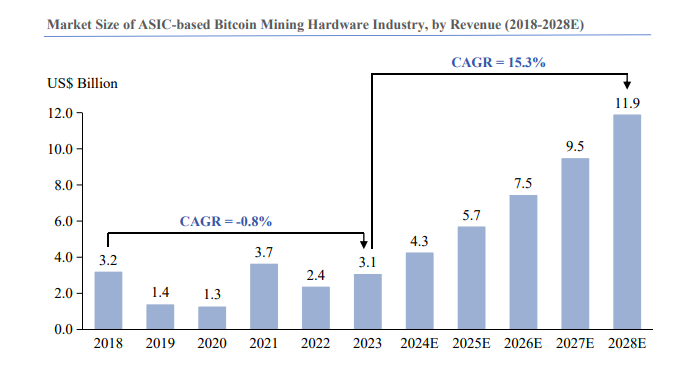
Chinese Bitcoin Hardware Titans Control 95% of Market, Now Coming to America to Dodge Trump Tariff WarSource: Frost & Sullivan

China’s Historical Bitcoin Mining Advantage

Understanding today’s migration requires examining how China achieved such overwhelming market control in the first place.

The foundation was laid during the historic 2017 Bitcoin boom, when three key factors aligned to create Chinese mining supremacy.

During the early expansion phase, Chinese officials recognized cryptocurrency mining as a profitable venture that attracted substantial foreign investment.

Consequently, authorities initially overlooked the mining sector while simultaneously restricting Bitcoin trading and initial coin offerings.

China’s extensive hydroelectric infrastructure further strengthened the country’s mining operations, providing the cheap energy essential for profitable Bitcoin production.

Does Chinese Hardware Control America’s Bitcoin Network?

While the United States leads global Bitcoin mining operations with over 38% of total network activity, American miners depend almost entirely on Chinese-manufactured equipment.

Chinese Bitcoin Hardware Titans Control 95% of Market, Now Coming to America to Dodge Trump Tariff WarAmerica Leads Bitcoin Mining Operation/ Source: Bitbo

This creates what security analysts describe as a “digital dependency trap,” a scenario where America’s cryptocurrency infrastructure relies fundamentally on hardware produced by its primary economic rival.

Guang Yang, Conflux Network’s chief technology officer, frames this dependency in geopolitical terms that extend far beyond trade economics.

“The U.S.-China trade war goes beyond tariffs,” Yang explains. “It’s a strategic pivot toward ‘politically acceptable’ hardware sources.”

His assessment reflects growing concerns within the cryptocurrency community about supply chain vulnerabilities that could impact national economic security.

Piyasa Fırsatı
Harvest Finance Logosu
Harvest Finance Fiyatı(FARM)
$11.74
$11.74$11.74
-1.26%
USD
Harvest Finance (FARM) Canlı Fiyat Grafiği
Sorumluluk Reddi: Bu sitede yeniden yayınlanan makaleler, halka açık platformlardan alınmıştır ve yalnızca bilgilendirme amaçlıdır. MEXC'nin görüşlerini yansıtmayabilir. Tüm hakları telif sahiplerine aittir. Herhangi bir içeriğin üçüncü taraf haklarını ihlal ettiğini düşünüyorsanız, kaldırılması için lütfen [email protected] ile iletişime geçin. MEXC, içeriğin doğruluğu, eksiksizliği veya güncelliği konusunda hiçbir garanti vermez ve sağlanan bilgilere dayalı olarak alınan herhangi bir eylemden sorumlu değildir. İçerik, finansal, yasal veya diğer profesyonel tavsiye niteliğinde değildir ve MEXC tarafından bir tavsiye veya onay olarak değerlendirilmemelidir.

Ayrıca Şunları da Beğenebilirsiniz

What happened in crypto today: Hormuz tensions, oil prices impact the market

What happened in crypto today: Hormuz tensions, oil prices impact the market

The post What happened in crypto today: Hormuz tensions, oil prices impact the market appeared on BitcoinEthereumNews.com. Trump’s 48-hour ultimatum over the Strait
Paylaş
BitcoinEthereumNews2026/03/23 10:02
Tokyo’s Metaplanet Launches Miami Subsidiary to Amplify Bitcoin Income

Tokyo’s Metaplanet Launches Miami Subsidiary to Amplify Bitcoin Income

Metaplanet Inc., the Japanese public company known for its bitcoin treasury, is launching a Miami subsidiary to run a dedicated derivatives and income strategy aimed at turning holdings into steady, U.S.-based cash flow. Japanese Bitcoin Treasury Player Metaplanet Opens Miami Outpost The new entity, Metaplanet Income Corp., sits under Metaplanet Holdings, Inc. and is based […]
Paylaş
Coinstats2025/09/18 00:32
A Netflix ‘KPop Demon Hunters’ Short Film Has Been Rated For Release

A Netflix ‘KPop Demon Hunters’ Short Film Has Been Rated For Release

The post A Netflix ‘KPop Demon Hunters’ Short Film Has Been Rated For Release appeared on BitcoinEthereumNews.com. KPop Demon Hunters Netflix Everyone has wondered what may be the next step for KPop Demon Hunters as an IP, given its record-breaking success on Netflix. Now, the answer may be something exactly no one predicted. According to a new filing with the MPA, something called Debut: A KPop Demon Hunters Story has been rated PG by the ratings body. It’s listed alongside some other films, and this is obviously something that has not been publicly announced. A short film could be well, very short, a few minutes, and likely no more than ten. Even that might be pushing it. Using say, Pixar shorts as a reference, most are between 4 and 8 minutes. The original movie is an hour and 36 minutes. The “Debut” in the title indicates some sort of flashback, perhaps to when HUNTR/X first arrived on the scene before they blew up. Previously, director Maggie Kang has commented about how there were more backstory components that were supposed to be in the film that were cut, but hinted those could be explored in a sequel. But perhaps some may be put into a short here. I very much doubt those scenes were fully produced and simply cut, but perhaps they were finished up for this short film here. When would Debut: KPop Demon Hunters theoretically arrive? I’m not sure the other films on the list are much help. Dead of Winter is out in less than two weeks. Mother Mary does not have a release date. Ne Zha 2 came out earlier this year. I’ve only seen news stories saying The Perfect Gamble was supposed to come out in Q1 2025, but I’ve seen no evidence that it actually has. KPop Demon Hunters Netflix It could be sooner rather than later as Netflix looks to capitalize…
Paylaş
BitcoinEthereumNews2025/09/18 02:23