Institutional investors poured US$3.75 billion into crypto funds, lifting AuM to a record US$244 billion as Ethereum absorbed US$2.87 billion of the inflows.Institutional investors poured US$3.75 billion into crypto funds, lifting AuM to a record US$244 billion as Ethereum absorbed US$2.87 billion of the inflows.

Ethereum Soaks Up Record Institutional Flows as Digital-asset AuM Tops $244 Billion

ethereum66

This week felt like another turning point for institutional crypto adoption. According to CoinShares’ latest weekly report, digital-asset investment products saw a massive US$3.75 billion of inflows. This is the fourth-largest weekly total on record, pushing assets under management to an all-time high of US$244 billion. What stood out was how concentrated the buying was: Ethereum alone attracted roughly US$2.87 billion, or about 77 percent of the week’s inflows.

Crypto Investment Flows

That level of demand for ether is striking. CoinShares notes that Ethereum’s year-to-date inflows have climbed to about US$11 billion, a figure that dwarfs Bitcoin on a proportional basis and underlines how many professional managers now treat ETH as a core portfolio exposure rather than a niche bet. The reasons are familiar but persuasive: staking and liquid-staking products have matured, custody and operational plumbing have improved, and institutions increasingly have ways to earn yield on Ethereum holdings without taking on risky self-custody operations.

Other networks also saw meaningful interest. Solana pulled in about US$176.5 million and XRP roughly US$125.9 million, signalling that flows outside the “big two” still matter. Meanwhile, Litecoin and Ton experienced only modest redemptions, essentially rounding errors compared with the headline flows into ETH. Prices didn’t simply run straight up on the news.

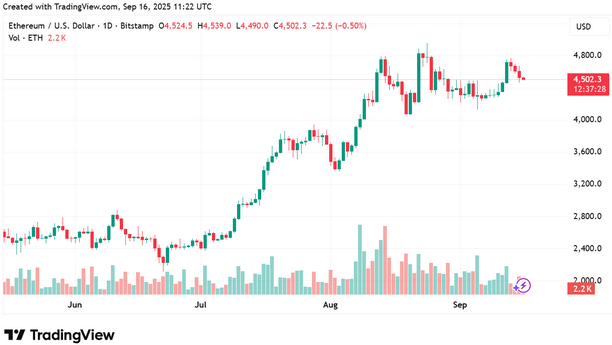
The crypto market gave back some gains on the day as traders took profits and digested macro headlines. Ethereum was trading in the mid-US$4,000s, down a few percent over 24 hours; Bitcoin was near the US$115,000 area; Solana and XRP both showed intraday volatility but remained well bid after the inflows. Short-term traders said much of the selling reflected caution ahead of comments from Fed officials at the Jackson Hole symposium, a regular mood-ring event for risk assets.

Potential Impact

Why this matters is less about one week than about what repeated weeks like this tell us. When big, managed products see concentrated inflows, it suggests capital is being allocated with an eye toward durability; pension funds, asset managers, and wealth managers are making capacity-conscious decisions. For Ethereum, that has knock-on effects: deeper derivatives markets, more robust staking markets, and potentially steadier liquidity for DeFi protocols.

Technically, market watchers called the recent dip a normal retracement after heavy buying. Several analysts flagged the US$4,000–4,100 area as a sensible support zone, the sort of level where longer-term investors might step in if it holds. If ETH keeps that base, momentum could try to push toward the next resistance band in the mid-US$4,600s to US$5,000s.

A run like this doesn’t happen in isolation. Product innovation, clearer custody and staking frameworks, and incremental regulatory clarity have all lowered the barriers for institutional allocations. CoinShares’ data have repeatedly shown that when those pieces fall into place, the checkbooks follow. What to watch now is simple: whether flows remain steady in the coming weeks or whether this turns into a few headline-grabbing weeks of concentrated buying.

Sorumluluk Reddi: Bu sitede yeniden yayınlanan makaleler, halka açık platformlardan alınmıştır ve yalnızca bilgilendirme amaçlıdır. MEXC'nin görüşlerini yansıtmayabilir. Tüm hakları telif sahiplerine aittir. Herhangi bir içeriğin üçüncü taraf haklarını ihlal ettiğini düşünüyorsanız, kaldırılması için lütfen [email protected] ile iletişime geçin. MEXC, içeriğin doğruluğu, eksiksizliği veya güncelliği konusunda hiçbir garanti vermez ve sağlanan bilgilere dayalı olarak alınan herhangi bir eylemden sorumlu değildir. İçerik, finansal, yasal veya diğer profesyonel tavsiye niteliğinde değildir ve MEXC tarafından bir tavsiye veya onay olarak değerlendirilmemelidir.

Ayrıca Şunları da Beğenebilirsiniz

The Channel Factories We’ve Been Waiting For

The Channel Factories We’ve Been Waiting For

The post The Channel Factories We’ve Been Waiting For appeared on BitcoinEthereumNews.com. Visions of future technology are often prescient about the broad strokes while flubbing the details. The tablets in “2001: A Space Odyssey” do indeed look like iPads, but you never see the astronauts paying for subscriptions or wasting hours on Candy Crush.  Channel factories are one vision that arose early in the history of the Lightning Network to address some challenges that Lightning has faced from the beginning. Despite having grown to become Bitcoin’s most successful layer-2 scaling solution, with instant and low-fee payments, Lightning’s scale is limited by its reliance on payment channels. Although Lightning shifts most transactions off-chain, each payment channel still requires an on-chain transaction to open and (usually) another to close. As adoption grows, pressure on the blockchain grows with it. The need for a more scalable approach to managing channels is clear. Channel factories were supposed to meet this need, but where are they? In 2025, subnetworks are emerging that revive the impetus of channel factories with some new details that vastly increase their potential. They are natively interoperable with Lightning and achieve greater scale by allowing a group of participants to open a shared multisig UTXO and create multiple bilateral channels, which reduces the number of on-chain transactions and improves capital efficiency. Achieving greater scale by reducing complexity, Ark and Spark perform the same function as traditional channel factories with new designs and additional capabilities based on shared UTXOs.  Channel Factories 101 Channel factories have been around since the inception of Lightning. A factory is a multiparty contract where multiple users (not just two, as in a Dryja-Poon channel) cooperatively lock funds in a single multisig UTXO. They can open, close and update channels off-chain without updating the blockchain for each operation. Only when participants leave or the factory dissolves is an on-chain transaction…
Paylaş
BitcoinEthereumNews2025/09/18 00:09
Red Dog Pet Resort & Spa Selects MoeGo as Its Enterprise Operating System to Power Multi-State Expansion
Red Dog Pet Resort & Spa Selects MoeGo as Its Enterprise Operating System to Power Multi-State Expansion

MoeGo Becomes Enterprise Operating System for Red Dog Pet Resort & Spa to Standardize and Scale Nationwide Operations BOSTON, Dec. 29, 2025 /PRNewswire/ — Red Dog
Paylaş
AI Journal2025/12/30 02:45
Ethereum Price Prediction: ETH Targets $10,000 In 2026 But Layer Brett Could Reach $1 From $0.0058

Ethereum Price Prediction: ETH Targets $10,000 In 2026 But Layer Brett Could Reach $1 From $0.0058

Ethereum price predictions are turning heads, with analysts suggesting ETH could climb to $10,000 by 2026 as institutional demand and network upgrades drive growth. While Ethereum remains a blue-chip asset, investors looking for sharper multiples are eyeing Layer Brett (LBRETT). Currently in presale at just $0.0058, the Ethereum Layer 2 meme coin is drawing huge [...] The post Ethereum Price Prediction: ETH Targets $10,000 In 2026 But Layer Brett Could Reach $1 From $0.0058 appeared first on Blockonomi.
Paylaş
Blockonomi2025/09/17 23:45