"Dead code" refers to parts of a codebase that are written but never executed, called, imported, or otherwise needed during the normal operation of the application. Cleaning up unused code improves clarity, performance, and long-term maintainability."Dead code" refers to parts of a codebase that are written but never executed, called, imported, or otherwise needed during the normal operation of the application. Cleaning up unused code improves clarity, performance, and long-term maintainability.

Everything You Need to Know About Dead Code

What Is "Dead Code"?

Dead code refers to parts of a codebase that are written but never executed, called, imported, or otherwise needed during the normal operation of the application.

Over time, as features are added, changed, or removed, some code becomes obsolete but is accidentally left behind. This can lead to:

  • Increased bundle size
  • Slower build times
  • Harder maintenance and onboarding
  • Potential security risks

Cleaning up unused code improves clarity, performance, and long-term maintainability.

What Is Considered "Dead Code"?

Here are the common categories of unused code:

  1. Unused Variables

    Declared but never used in any operation.

  2. Unused Functions or Methods

    Defined but never called anywhere.

  3. Unused Imports

    Imported modules or packages that are never referenced.

  4. Unused Exports

    Functions or components exported from a module but not imported elsewhere.

  5. Unused Files

    Complete files (components, modules, etc.) that are never imported or required.

  6. Unused Dependencies

    Libraries listed in your package manager (e.g., package.json) that are not imported or used in the codebase.

Some exceptions:

  • Disabled Features

    Features that are temporarily disabled or taken out, but will be used in the future.

  • Helper functions

    Utility functions that help with common tasks can be reviewed regularly to check if it needs to be removed.

Tools for Scanning Dead Code

The following tools help detect and analyze unused code, imports, functions, variables, and dependencies. Choose tools based on your tech stack:

  • ts-prune
  • Detects unused exported functions, constants, and types in TypeScript projects.
  • On Maintenance (no further update)
  • depcheck
  • Checks for unused npm dependencies and missing ones.
  • knip.dev (We are using this!)
  • Knip finds and fixes unused dependencies, exports and files in your JavaScript and TypeScript projects. Less code and dependencies lead to improved performance, less maintenance and easier refactorings.

How to Scan and Remove Unused Code with knip

Follow these steps to identify and safely remove unused code from your project using knip:

  1. Install knip (if not already installed):
   yarn add -D knip    # or    npm install -D knip 
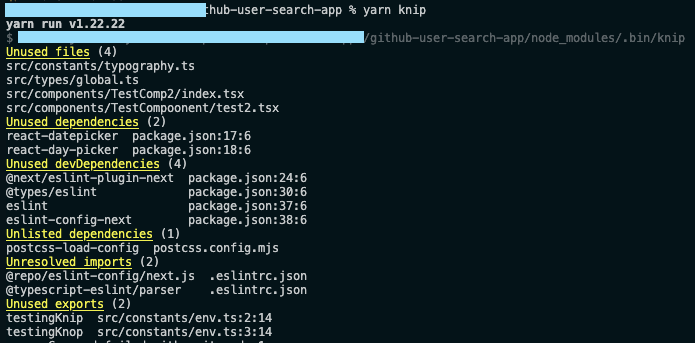
  1. Run the analysis:
   yarn knip 

Note: Replace yarn with your preferred package manager (npm, pnpm, etc.).

\

  1. Review the list of unused files or exports:

  2. Go through the list from top-down, starting with high-level components, constants, and utilities.

  3. Search your codebase to verify whether each flagged file or export is truly unused.

    • If it's used elsewhere, skip it.
    • If it has no references, it’s safe to delete.

  4. Remove confirmed dead code

  5. Delete unused files, exports, or lines confidently after reviewing

    • Check with your teammates if the components/files is not used anymore or just temporarily not used

    • Validate your codebase:

    • Run linters and TypeScript checks to catch any issues:

        yarn lint   npx tsc --noEmit 
    • Start the development server to confirm everything still works:

        yarn dev 
    • Final step: Commit your changes with a clear message, e.g.:
   git commit -m "chore: remove unused code and dependencies" 

Getting rid of dead code might feel like a chore, but it’s totally worth it. Cleaner code means fewer headaches, faster builds, and easier debugging down the line. With the right tools and a step-by-step approach, it’s not that hard to keep your codebase in shape. If you’re working in a fast-paced company where keeping track of all the new code is challenging, making this part of your regular workflow is a must.

If you have any other better approach or just want to share your own process, feel free to share in the comment! I would love to hear your thought!

Sorumluluk Reddi: Bu sitede yeniden yayınlanan makaleler, halka açık platformlardan alınmıştır ve yalnızca bilgilendirme amaçlıdır. MEXC'nin görüşlerini yansıtmayabilir. Tüm hakları telif sahiplerine aittir. Herhangi bir içeriğin üçüncü taraf haklarını ihlal ettiğini düşünüyorsanız, kaldırılması için lütfen [email protected] ile iletişime geçin. MEXC, içeriğin doğruluğu, eksiksizliği veya güncelliği konusunda hiçbir garanti vermez ve sağlanan bilgilere dayalı olarak alınan herhangi bir eylemden sorumlu değildir. İçerik, finansal, yasal veya diğer profesyonel tavsiye niteliğinde değildir ve MEXC tarafından bir tavsiye veya onay olarak değerlendirilmemelidir.

Ayrıca Şunları da Beğenebilirsiniz

The Channel Factories We’ve Been Waiting For

The Channel Factories We’ve Been Waiting For

The post The Channel Factories We’ve Been Waiting For appeared on BitcoinEthereumNews.com. Visions of future technology are often prescient about the broad strokes while flubbing the details. The tablets in “2001: A Space Odyssey” do indeed look like iPads, but you never see the astronauts paying for subscriptions or wasting hours on Candy Crush.  Channel factories are one vision that arose early in the history of the Lightning Network to address some challenges that Lightning has faced from the beginning. Despite having grown to become Bitcoin’s most successful layer-2 scaling solution, with instant and low-fee payments, Lightning’s scale is limited by its reliance on payment channels. Although Lightning shifts most transactions off-chain, each payment channel still requires an on-chain transaction to open and (usually) another to close. As adoption grows, pressure on the blockchain grows with it. The need for a more scalable approach to managing channels is clear. Channel factories were supposed to meet this need, but where are they? In 2025, subnetworks are emerging that revive the impetus of channel factories with some new details that vastly increase their potential. They are natively interoperable with Lightning and achieve greater scale by allowing a group of participants to open a shared multisig UTXO and create multiple bilateral channels, which reduces the number of on-chain transactions and improves capital efficiency. Achieving greater scale by reducing complexity, Ark and Spark perform the same function as traditional channel factories with new designs and additional capabilities based on shared UTXOs.  Channel Factories 101 Channel factories have been around since the inception of Lightning. A factory is a multiparty contract where multiple users (not just two, as in a Dryja-Poon channel) cooperatively lock funds in a single multisig UTXO. They can open, close and update channels off-chain without updating the blockchain for each operation. Only when participants leave or the factory dissolves is an on-chain transaction…
Paylaş
BitcoinEthereumNews2025/09/18 00:09
South Korean Court Sentences Crypto Exchange Employee for Espionage

South Korean Court Sentences Crypto Exchange Employee for Espionage

The post South Korean Court Sentences Crypto Exchange Employee for Espionage appeared on BitcoinEthereumNews.com. Key Points: Employee sentenced for espionage involving
Paylaş
BitcoinEthereumNews2025/12/30 04:09
Trust Wallet Faces Wave of Fraudulent Claims After $7 Million Chrome Extension Hack

Trust Wallet Faces Wave of Fraudulent Claims After $7 Million Chrome Extension Hack

Trust Wallet's Christmas security breach has taken an unexpected turn. The company now faces nearly double the number of compensation claims compared to actual
Paylaş
Brave Newcoin2025/12/30 04:32