

Interpreting the 6 current situations of Web3 AI track: Compared with AI Agent, institutions pay more attention to infrastructure
Author: 0xJeff
Compiled by: Tim, PANews
It has been about two and a half weeks since the AI Agent market bottomed out (about $4 billion in total market cap), and the market is now entering a full-scale bull market led by Virtuals. Yes, this time the protagonist is only Virtuals. The current rally is comparable to the grand occasion in October-November last year, when Virtuals took the lead in launching the AI Agent tokenization platform, establishing its position as an AI pioneer and providing a top-level token distribution network for all AI projects willing to conduct a "fair launch".
What’s different this time is the latest feature: Genesis Launch, a fairer mechanism for launching projects and rewarding early backers. This brings us to the first trend we’re exploring.
1. Fair launch and gamification launch platform

Genesis Launch has completely changed the market landscape. Gamblers who used to blindly follow various junk projects or tokens manipulated by small groups on PumpFun can now make 5 to 10 times the profit almost every time a new project goes online.
The goal of being fairer than before can be achieved by introducing a "points" system, which can coordinate the interests of different stakeholders. The new project adopts a fixed market value and fixed supply launch model, and both are launched with a baseline market value of 112,000 VIRTUAL (approximately $200,000 fully diluted valuation). Participants can obtain up to 0.5 VIRTUAL of the total token supply, hold the official top AI Agent token, or actively participate in community discussions on the Virtuals ecosystem.
A recently introduced cooling-off period, designed to discourage selling, further increases the appeal of the Virtuals Genesis Launchpad project by forcing sellers to think twice before selling.
So far, Genesis Launchpad has proven to be very successful, with BasisOS being the most successful project, generating 200x returns for participants. Since then, a large number of short-term traders have emerged on the Virtuals platform, earning 5-40x returns on their investments.
After the great success of Genesis Launches, capital and market attention once again converged on the Virtuals ecosystem, raising the valuation levels of almost all AI Agent projects on the platform.
Despite the resurgence of hype, the lack of quality projects remains one of the biggest challenges facing the Virtuals ecosystem, which leads us to the second trend.
2. Hype and trading take precedence over fundamentals

As a trader and speculator, you can profit by investing in mediocre products and suboptimal teams, thanks to the Genesis project launch mechanism. In this model, the probability of a project valuation being hyped up from $200,000 is much higher than the risk of a subsequent price collapse (especially when it is confirmed that the project has no insiders or pre-sale rounds).
If you have a unique idea, you can directly issue tokens without the need for an actual product. There is no need to identify the target user group, verify market demand, or worry about revenue growth and user retention. You just need to make every effort to create market enthusiasm and launch the project (it’s better to have a demo, but it doesn’t matter if you don’t have one)
Any project that meets the basic requirements (complete documentation, excellent product concept and good team image) can successfully issue tokens on the Virtuals Genesis Launchpad.
For investors, it is important to clearly view investing in these new projects as short-term speculation rather than mid- to long-term fundamental investments, because nine times out of ten, these AI projects touted as having good fundamentals are essentially garbage.
As a large number of low-quality projects emerge, the opportunities and gaps for high-quality projects (AI and non-AI) are also expanding, which leads to the third industry trend.
3. Scarcity of high-quality DeFi on Virtuals platforms
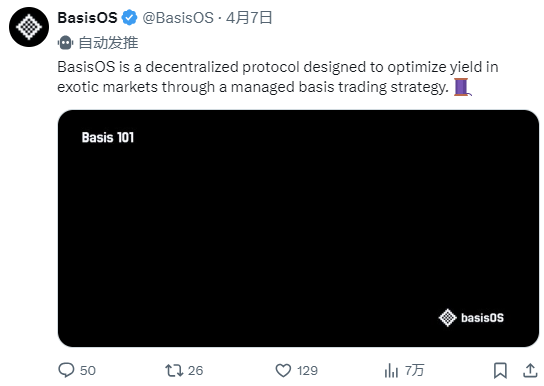
Two months ago, I had a conversation with the Logarithm\BasisOS team. I know their products (similar to Ethena's Delta neutral strategy, but not dependent on stablecoins). This team impressed me during the Logarithm period by building products under the LPDFi narrative (products that leverage Uniswap V3 liquidity). Out of recognition for the team, I provided them with token economic model suggestions, issuance plans, etc. At that time, I really didn't expect the project to soar so much, because although its DeFi products have fundamentals, the so-called "AI products" are obviously too early. But in the end, none of this matters, and the project continues to outperform the entire market.
Based on the success of BasisOS, there is still a blank area for DeFi projects to issue tokens on the Virtuals asset platform. Despite the lack of the traditional DeFi token economic model that incentivizes TVL through token release, the traffic effect and market attention brought by the first launch of the Virtuals asset platform (especially when the project has a strong DeFi product) will be enough to ensure that your fund pool obtains sufficient TVL.
Beyond the eye candy, there is a new trend and experimentation emerging that resembles the 2023-24 Ethereum garbage project era. This brings us to the fourth trend.
4. Use transaction volume revenue as a growth engine

There was a time when many Ponzi-style DeFi projects emerged. These projects supported the token mechanism through 1-3% transaction fees, used these funds to expand the project treasury to maintain the operation of the Ponzi mechanism, and returned the proceeds to the token holders. At that time, the project creators could even earn millions of dollars in a week or two, thanks to the scarcity of tokens in the market and the abundant funds of Ethereum users (people were very bold at that time and followed the trend to invest in junk projects).
Now we see a similar situation in the field of AI Agents.
Typically, the Virtuals platform charges a 1% handling fee for each transaction, of which 70% will be returned to the project creator. Other project launch platforms generally charge a transaction fee of 1%-2%, and provide project creators with a fee return ratio of 70%-100%.
The Squidllora project, which is intelligently powered by the Allora Network (and recently launched on the auto.fun platform), is using creator fees to expand its treasury and trade mainstream cryptocurrencies through Allora's prediction model inference (if you don't know Allora, its essence is a Bittensor variant focused on the financial field, that is, many scientists use a competitive mechanism to create the best prediction model for crypto assets in different time dimensions). The project will repurchase its native tokens through part of the profits generated by the transaction.
This has great potential for well-funded teams, as they no longer need to rely on transaction fees to maintain operations. These teams can now issue AI Agent tokens and use them as a marketing tool and user growth funnel, providing initial momentum for launching new AI experimental projects by aggregating market attention and transaction fee income.
However, taking a step back and looking at the AI Agent frontier, although many teams are publicly launching products, other than the Virtuals ecosystem, other projects have not made much progress. This leads to the fifth trend we want to discuss.
5. Virtuals’ dominance and other ecosystems’ weakness

The continued rise in the valuation level of the Virtuals ecosystem is driven by Genesis Launches. This wave of new project launches does not necessarily mean substantial improvements in fundamentals or technology. Its main driving factor comes from the significant optimization of the transaction structure. In fact, more participants are pouring into the Virtuals ecosystem because they are sure that they can profit from it. This trend may continue until the price of existing projects reaches a local peak.
Once this happens, some attention will naturally shift to other ecosystems such as Creator.Bid, Arc.fun, auto.fun, and especially those lower-cap projects with clear improvements in fundamentals (such as new features, new product launches, new partnerships, etc.).
Creator.Bid and Arc are probably the two best ecosystems at the moment, and there are also some undervalued potential projects that have not yet exploded (such as the 3-4 targets in the Creator.Bid ecosystem that are deeply integrated with subnets or focus on building Bittensor products, and the Handshake project that contributes to Arc's Ryzome network).
Of course, the best investment strategy is to hoard these tokens in advance, when most people have not yet realized their value.
6. Institutional investment opportunities in AI are limited

Although the token prices of important AI Agent ecosystems such as Virtuals and AI16Z continue to soar, many institutional investors can only stay away from them because these skyrocketing assets are only suitable for small retail investors or high-risk speculators. The liquidity of the relevant markets is extremely scarce, and the LP mechanism has structural fragility problems (especially on the Virtuals platform).
The lack of proper liquidity infrastructure, coupled with the rise of interest in decentralized AI, is driving institutional investment in areas such as decentralized infrastructure, autonomous intelligent L1 blockchains, and decentralized AI labs, rather than current AI Agent tokens.
What are these tokens that you are curious about?
They include GRASS, TAO (and its subnets), VANA, FLOCK, PROMPT, and a series of tokens that have not yet been issued, such as Nous Research, Pluralis, Prime Intellect and other projects. These teams are building AI moats with real Web3 attributes, giving the ownership of high-performance models to the general public (rather than centralized AI laboratories). In short, these projects focus on truly complex artificial intelligence technologies, and it is difficult for ordinary people to understand their operating mechanisms and how to participate in the investment, because they represent the most cutting-edge innovative practices in the field of decentralized AI.
How to develop the best investment strategy based on trends?
My strategy is to gradually invest profits from short-term small AI Agent transactions (especially genesis projects with mediocre teams) into the decentralized AI space. AI projects with fundamental value will take time to grow because most of them are infrastructure-centric and lack consumer-facing products. Just as we have seen models such as ChatGPT, Grok, Anthropic suddenly perform well in completing daily tasks, real-time research, programming, etc., decentralized Web3 models will eventually become powerful in performing certain Web2-native and Web3-native tasks.
Does this mean you should invest heavily in decentralized AI infrastructure?
Not necessarily. The success of the crypto space is mainly driven by market hype and marketing strategies. Whether a project can be successful in the long term depends 90% on marketing and 10% on model design. The key to success is to create products that meet market demand, provide a smooth user interface and experience, formulate a thorough launch plan and execute it accurately, design a sustainable token economic model, and plan an effective user growth and retention strategy. These elements together constitute a winning marketing system.
My core investment philosophy has always been to bet on teams that know how to combine marketing channels with technology. This logic is similar to the strategy of venture capital institutions investing in vertical SaaS companies in the Web2 era. These companies focus on solutions for niche scenarios. Although they may use a common basic model behind them, they are combined with their own unique proprietary data.
I think this view will be very durable in the short to medium term, especially in the Web3 space because everything is driven by hype and community, and things that are easy to understand will be more popular.
The transaction structure of the crypto market is also moving in this direction, and the fair launch model is gradually becoming the market norm. At the same time, more and more teams in other ecosystems are beginning to integrate the two dimensions of technology and market more deeply. They not only invest more time in establishing technical cooperation with infrastructure projects, but also focus on marketing and market entry strategies to transform market enthusiasm into attention for actual artificial intelligence technology.
Quick summary
- Virtuals' Genesis Launch model has achieved great success in both market attention and return rate.
- There is still more hype than fundamentals, and most of these are just short-term operations.
- DeFi projects with solid fundamentals are finding growth potential through the Virtuals ecosystem.
- The revenue creators receive from transaction volume is sparking a new wave of experimentation.
- The Virtuals ecosystem currently holds the lead, but other alternative ecosystems may soon gain market attention and attract investment.
- Institutional investors are taking a wait-and-see approach and prefer to invest in decentralized AI infrastructure rather than AI Agent tokens.
Ayrıca Şunları da Beğenebilirsiniz

The Channel Factories We’ve Been Waiting For
Let insiders trade – Blockworks
