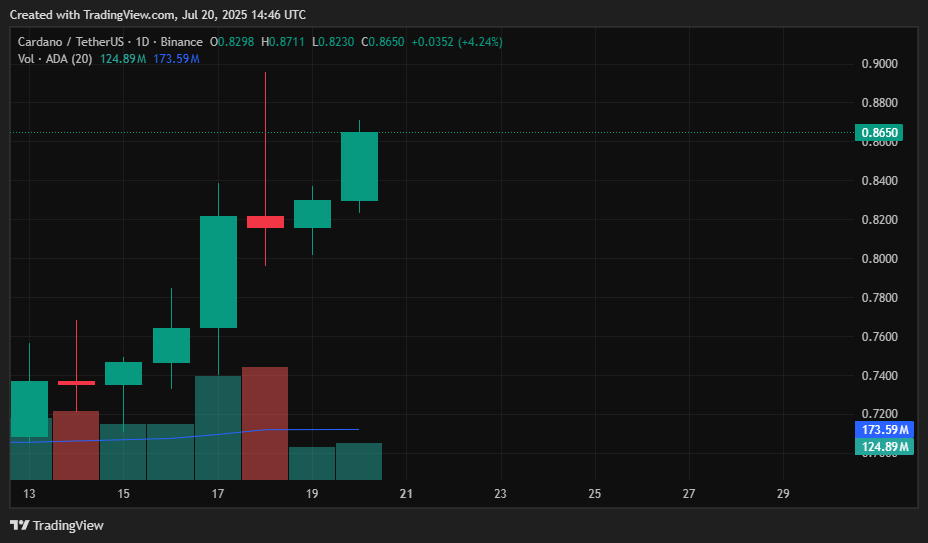
Cardano has recently made some waves — in the past 24 hours, it briefly hit around $0.87 (as of July 20, 2025). It’s been a while since ADA climbed that high — the last time was back in May when…Cardano has recently made some waves — in the past 24 hours, it briefly hit around $0.87 (as of July 20, 2025). It’s been a while since ADA climbed that high — the last time was back in May when…

Realistic ADA price prediction 2030: Will Cardano hit $10 or fall short?

Cardano has recently made some waves — in the past 24 hours, it briefly hit around $0.87 (as of July 20, 2025). It’s been a while since ADA climbed that high — the last time was back in May when it reached roughly $0.84.

In this piece, we’ll take a closer look at what Cardano (ADA) is, whether ADA will hit $10 by 2030, and what factors could influence that. So, what will ADA be worth in 2030?

Table of Contents

  • What is Cardano?
  • Cardano price factors
  • Cardano price prediction 2030

What is Cardano?

Cardano is a smart contract platform that officially launched in 2017, built with a clear mission: to solve the core issues that have plagued earlier blockchains — namely, scalability, sustainability, and security. Unlike many projects that charge ahead with minimal testing, Cardano chose a different path. It was founded by Charles Hoskinson, one of Ethereum’s original co-founders, but it set itself apart early by following a slow, methodical, and research-first approach. Every update is peer-reviewed and rigorously tested, emphasizing academic research and formal methods — a rare trait in the fast-paced crypto world.

Cardano’s native token, ADA, is named in honor of Ada Lovelace — a 19th-century mathematician often recognized as the world’s first computer programmer.

ADA is more than just a cryptocurrency. It fuels the entire Cardano ecosystem. Token holders can use ADA to pay for transactions, stake their tokens to help secure the network, vote on governance proposals, and earn passive income through staking rewards. This creates an active, engaged community that helps guide the network’s direction — a kind of decentralized democracy in action.

Cardano is playing the long game, prioritizing solid infrastructure and real-world utility over flashy launches. It’s not the loudest voice in the room, but it’s quietly building a foundation designed to last — and in the ever-volatile world of crypto, that kind of discipline and patience stands out.

What exactly will shape Cardano’s price in the coming years, and what could the Cardano future price 2030 look like?

Cardano price factors

As of July 18, 2025, Cardano is sitting at $0.82, with a 2.55% bump in the last 24 hours and a solid 10.3% gain over the past week. That kind of movement isn’t going unnoticed — it’s a sign that investor interest is picking up, and momentum might just be building.
Realistic ADA price prediction 2030: Will Cardano hit $10 or fall short? - 1

One key driver is the July 16 announcement from Apex Fusion, a next-generation blockchain protocol that builds on Cardano’s open-source foundations. The project revealed a strategic partnership with Well-Typed, a respected Haskell engineering firm with deep roots in Cardano’s early development, dating back to the Byron phase. This collaboration is set to strengthen VECTOR — Apex Fusion’s enterprise-grade implementation of the Cardano codebase, with advanced formal verification and high-assurance engineering. For long-term investors, this adds technical credibility and reinforces confidence in Cardano’s evolution as a secure and scalable blockchain platform.

That same day, Emurgo — one of Cardano’s founding organizations — introduced the Cardano Card, a multi-functional financial tool designed to bridge crypto with real-world utility. While it already works as a payment card, its roadmap goes much further: staking ADA, earning DeFi yields, accessing collateralized loans, and even channeling part of its revenue back into the Cardano treasury. This vision positions Cardano not just as a smart contract platform, but as a comprehensive financial ecosystem — a move that could boost long-term demand for ADA as adoption grows.

Developments like these could play a significant role in shaping Cardano’s trajectory. Many long-term holders and analysts are watching closely to see whether ADA can move beyond speculation and become a core infrastructure layer in the future decentralized economy.

What can we expect from the Cardano price in 2030? Could ADA retest or even surpass its 2021 all-time high of $3.10 in five years? These are the big questions — and as the project continues to evolve, many are eyeing the Cardano expected price in 2030 and setting a potential target price based on broader crypto market trends, adoption, and the project’s unique approach to sustainability and innovation.

Cardano price prediction 2030

When it comes to long-term ADA price forecasts, there’s no clear consensus — and honestly, the numbers are all over the place depending on who you ask.

CoinCodex takes a fairly modest approach, predicting that Cardano could be trading between $1.13 and $2.12 by 2030. It’s not the kind of forecast that gets headlines, but it does point to slow, steady growth — especially if Cardano keeps expanding its ecosystem and gaining real-world adoption.

Wallet Investor’s projections say ADA could hit $5.72 by July 2030, which would be a massive win for long-term holders. But their lower estimate? An eye-watering $0.000001 — worthless.

DigitalCoinPrice’s projections put ADA somewhere between $3.81 and $4.36 by the end of the decade. Those numbers suggest a strong belief in Cardano’s long-term potential.

Of course, these are just projections — not promises. Still, they offer a snapshot of what could be possible. Will Cardano hit the higher end of these predictions? Maybe. But if it sticks to its research-driven approach and continues to build real utility quietly, it might just surprise everyone by 2030.

Disclosure: This article does not represent investment advice. The content and materials featured on this page are for educational purposes only.

Piyasa Fırsatı
Waves Logosu
Waves Fiyatı(WAVES)
$0.6804
$0.6804$0.6804
+0.78%
USD
Waves (WAVES) Canlı Fiyat Grafiği
Sorumluluk Reddi: Bu sitede yeniden yayınlanan makaleler, halka açık platformlardan alınmıştır ve yalnızca bilgilendirme amaçlıdır. MEXC'nin görüşlerini yansıtmayabilir. Tüm hakları telif sahiplerine aittir. Herhangi bir içeriğin üçüncü taraf haklarını ihlal ettiğini düşünüyorsanız, kaldırılması için lütfen [email protected] ile iletişime geçin. MEXC, içeriğin doğruluğu, eksiksizliği veya güncelliği konusunda hiçbir garanti vermez ve sağlanan bilgilere dayalı olarak alınan herhangi bir eylemden sorumlu değildir. İçerik, finansal, yasal veya diğer profesyonel tavsiye niteliğinde değildir ve MEXC tarafından bir tavsiye veya onay olarak değerlendirilmemelidir.

Ayrıca Şunları da Beğenebilirsiniz

Whales keep selling XRP despite ETF success — Data signals deeper weakness

Whales keep selling XRP despite ETF success — Data signals deeper weakness

The post Whales keep selling XRP despite ETF success — Data signals deeper weakness appeared on BitcoinEthereumNews.com. XRP ETFs have crossed $1 billion in assets
Paylaş
BitcoinEthereumNews2025/12/20 02:55
Foreigner’s Lou Gramm Revisits The Band’s Classic ‘4’ Album, Now Reissued
Foreigner’s Lou Gramm Revisits The Band’s Classic ‘4’ Album, Now Reissued

The post Foreigner’s Lou Gramm Revisits The Band’s Classic ‘4’ Album, Now Reissued appeared on BitcoinEthereumNews.com. American-based rock band Foreigner performs onstage at the Rosemont Horizon, Rosemont, Illinois, November 8, 1981. Pictured are, from left, Mick Jones, on guitar, and vocalist Lou Gramm. (Photo by Paul Natkin/Getty Images) Getty Images Singer Lou Gramm has a vivid memory of recording the ballad “Waiting for a Girl Like You” at New York City’s Electric Lady Studio for his band Foreigner more than 40 years ago. Gramm was adding his vocals for the track in the control room on the other side of the glass when he noticed a beautiful woman walking through the door. “She sits on the sofa in front of the board,” he says. “She looked at me while I was singing. And every now and then, she had a little smile on her face. I’m not sure what that was, but it was driving me crazy. “And at the end of the song, when I’m singing the ad-libs and stuff like that, she gets up,” he continues. “She gives me a little smile and walks out of the room. And when the song ended, I would look up every now and then to see where Mick [Jones] and Mutt [Lange] were, and they were pushing buttons and turning knobs. They were not aware that she was even in the room. So when the song ended, I said, ‘Guys, who was that woman who walked in? She was beautiful.’ And they looked at each other, and they went, ‘What are you talking about? We didn’t see anything.’ But you know what? I think they put her up to it. Doesn’t that sound more like them?” “Waiting for a Girl Like You” became a massive hit in 1981 for Foreigner off their album 4, which peaked at number one on the Billboard chart for 10 weeks and…
Paylaş
BitcoinEthereumNews2025/09/18 01:26
New York Regulators Push Banks to Adopt Blockchain Analytics

New York Regulators Push Banks to Adopt Blockchain Analytics

New York’s top financial regulator urged banks to adopt blockchain analytics, signaling tighter oversight of crypto-linked risks. The move reflects regulators’ concern that traditional institutions face rising exposure to digital assets. While crypto-native firms already rely on monitoring tools, the Department of Financial Services now expects banks to use them to detect illicit activity. NYDFS Outlines Compliance Expectations The notice, issued on Wednesday by Superintendent Adrienne Harris, applies to all state-chartered banks and foreign branches. In its industry letter, the New York State Department of Financial Services (NYDFS) emphasized that blockchain analytics should be integrated into compliance programs according to each bank’s size, operations, and risk appetite. The regulator cautioned that crypto markets evolve quickly, requiring institutions to update frameworks regularly. “Emerging technologies introduce evolving threats that require enhanced monitoring tools,” the notice stated. It stressed the need for banks to prevent money laundering, sanctions violations, and other illicit finance linked to virtual currency transactions. To that end, the Department listed specific areas where blockchain analytics can be applied: Screening customer wallets with crypto exposure to assess risks. Verifying the origin of funds from virtual asset service providers (VASPs). Monitoring the ecosystem holistically to detect money laundering or sanctions exposure. Identifying and assessing counterparties, such as third-party VASPs. Evaluating expected versus actual transaction activity, including dollar thresholds. Weighing risks tied to new digital asset products before rollout. These examples highlight how institutions can tailor monitoring tools to strengthen their risk management frameworks. The guidance expands on NYDFS’s Virtual Currency-Related Activities (VCRA) framework, which has governed crypto oversight in the state since 2022. Regulators Signal Broader Impact Market observers say the notice is less about new rules and more about clarifying expectations. By formalizing the role of blockchain analytics in traditional finance, New York is reinforcing the idea that banks cannot treat crypto exposure as a niche concern. Analysts also believe the approach could ripple beyond New York. Federal agencies and regulators in other states may view the guidance as a blueprint for aligning banking oversight with the realities of digital asset adoption. For institutions, failure to adopt blockchain intelligence tools may invite regulatory scrutiny and undermine their ability to safeguard customer trust. With crypto now firmly embedded in global finance, New York’s stance suggests that blockchain analytics are no longer optional for banks — they are essential to protecting the financial system’s integrity.
Paylaş
Coinstats2025/09/18 08:49