Telegram shutting down Huione Guarantee, the largest illicit marketplace in history, with over $27 billion in transactions, paradoxically strengthened the dark market as rival platforms experienced a 400% volume surge and quickly absorbed the criminal user base. Following blockchain analytics firm Elliptic’s investigation, Telegram banned thousands of channels and accounts linked to Huione on May 13, 2025. However, the successor platform, Tudou Guarantee, immediately captured the displaced criminal activity, processing equal volumes within weeks of the shutdown. 🚨 Telegram dark markets expand to fill the gap left by Huione Guarantee In May, Telegram shut down Huione Guarantee — the largest dark market to have ever existed, responsible for more than $27 billion in USDT transactions — following research from Elliptic. Elliptic’s… pic.twitter.com/ZY2m1ju3i0 — Elliptic (@elliptic) June 23, 2025 Elliptic tracked over 30 highly active guarantee marketplaces in Southeast Asia that continue to facilitate money laundering, stolen data trading, and “pig butchering” scam infrastructure. The Hydra Effect: How Huione Multiply Under Pressure The $27 billion Huione marketplace had operated as a sophisticated criminal ecosystem, offering everything from fake documents and stolen personal data to money laundering services and intimidation-for-hire through Telegram’s encrypted infrastructure. The platform’s reach extended far beyond simple financial crime, with ties to human trafficking operations disguised as legitimate IT companies across Cambodia, Laos, and Myanmar, where victims were forced to execute romance scams and crypto fraud under constant surveillance. Huione has been connected to Cambodia’s ruling elite and its role in laundering proceeds for North Korea’s Lazarus Group. This made it a primary target for the U.S. Treasury’s FinCEN , which designated the entire Huione Group as a money laundering concern in May 2025. The criminal enterprise strategically acquired a 30% stake in Tudou Guarantee in December 2024, effectively ensuring operational continuity before enforcement action materialized. Source: Elliptic This planning enabled the seamless migration of hundreds of thousands of users. Tudou’s transaction volumes surged from negligible levels to over 300,000 by June 15. The same merchants who previously operated through Huione immediately established operations on Tudou , offering identical services, including stolen data, money laundering capabilities, and specialized tools for pig butchering scams targeting Western victims. Beyond Tudou’s dominance, multiple smaller platforms experienced exponential growth as the criminal ecosystem fragmented and diversified. According to Elliptic, Shuangying marketplace saw user numbers triple from 40,000 to 110,000 transactions, and Fully Light expanded from 20,000 to over 80,000 transactions. Source: Elliptic These platforms use Telegram’s encryption for communication and comprehensive business operations, including reputation management, order fulfillment, and dispute resolution among vendors and clients. They also use Tether’s USDT stablecoin as the primary medium of exchange, which provides these criminals with dollar-denominated stability while avoiding traditional banking systems. The UN estimates that Telegram-based criminal activity generates up to $36.5 billion annually through scams, money laundering, and stolen data sales. Ongoing Enforcement Challenges On Telegram’s Encrypted Crime Economy Despite Telegram’s cooperation in removing thousands of channels and banning associated accounts, Chainalysis research revealed that Huione’s core cryptocurrency processing infrastructure remained operational, which Elliptic also confirmed. Source: Elliptic The platform is simply migrating to new domains and quietly resuming Telegram’s presence within weeks of the apparent shutdown. This resilience stems from the platform’s complex architecture, which separates public-facing marketing infrastructure from core financial processing systems. This allows criminal operations to continue even when their most visible components face disruption. The enforcement action’s limited impact becomes particularly evident when examining the broader criminal ecosystem that Huione enabled, including forcing trafficking victims into crypto scam operations across Southeast Asian compounds where legitimate job seekers are lured with false IT positions before being held against their will and coerced into executing fraudulent schemes. 📰 A new United Nations report is calling out Telegram for affecting organized crime in Southeast Asia amid Pavel Durov's legal woes. #Telegram #PavelDurov #UN https://t.co/q0ZEMy6TIU — Cryptonews.com (@cryptonews) October 7, 2024 These physical operations, often disguised as customer service centers, create a hybrid criminal model that combines digital financial crime with traditional human trafficking, making comprehensive enforcement exponentially more complex as it requires coordination across multiple jurisdictions and crime categories. While Telegram has begun responding to pressure by removing certain features and updating content policies, the platform’s core encrypted messaging capabilities remain attractive to criminals who exploit the technology’s legitimate privacy protections to operate sophisticated marketplace ecosystems. The challenge for regulators lies in addressing criminal abuse without undermining the privacy rights and communication security that make encrypted platforms valuable for legitimate users worldwide. Telegram CEO Pavel Durov is also fighting this battle with the regulators. He was recently arrested and released on bail , but surveillance remains.Telegram shutting down Huione Guarantee, the largest illicit marketplace in history, with over $27 billion in transactions, paradoxically strengthened the dark market as rival platforms experienced a 400% volume surge and quickly absorbed the criminal user base. Following blockchain analytics firm Elliptic’s investigation, Telegram banned thousands of channels and accounts linked to Huione on May 13, 2025. However, the successor platform, Tudou Guarantee, immediately captured the displaced criminal activity, processing equal volumes within weeks of the shutdown. 🚨 Telegram dark markets expand to fill the gap left by Huione Guarantee In May, Telegram shut down Huione Guarantee — the largest dark market to have ever existed, responsible for more than $27 billion in USDT transactions — following research from Elliptic. Elliptic’s… pic.twitter.com/ZY2m1ju3i0 — Elliptic (@elliptic) June 23, 2025 Elliptic tracked over 30 highly active guarantee marketplaces in Southeast Asia that continue to facilitate money laundering, stolen data trading, and “pig butchering” scam infrastructure. The Hydra Effect: How Huione Multiply Under Pressure The $27 billion Huione marketplace had operated as a sophisticated criminal ecosystem, offering everything from fake documents and stolen personal data to money laundering services and intimidation-for-hire through Telegram’s encrypted infrastructure. The platform’s reach extended far beyond simple financial crime, with ties to human trafficking operations disguised as legitimate IT companies across Cambodia, Laos, and Myanmar, where victims were forced to execute romance scams and crypto fraud under constant surveillance. Huione has been connected to Cambodia’s ruling elite and its role in laundering proceeds for North Korea’s Lazarus Group. This made it a primary target for the U.S. Treasury’s FinCEN , which designated the entire Huione Group as a money laundering concern in May 2025. The criminal enterprise strategically acquired a 30% stake in Tudou Guarantee in December 2024, effectively ensuring operational continuity before enforcement action materialized. Source: Elliptic This planning enabled the seamless migration of hundreds of thousands of users. Tudou’s transaction volumes surged from negligible levels to over 300,000 by June 15. The same merchants who previously operated through Huione immediately established operations on Tudou , offering identical services, including stolen data, money laundering capabilities, and specialized tools for pig butchering scams targeting Western victims. Beyond Tudou’s dominance, multiple smaller platforms experienced exponential growth as the criminal ecosystem fragmented and diversified. According to Elliptic, Shuangying marketplace saw user numbers triple from 40,000 to 110,000 transactions, and Fully Light expanded from 20,000 to over 80,000 transactions. Source: Elliptic These platforms use Telegram’s encryption for communication and comprehensive business operations, including reputation management, order fulfillment, and dispute resolution among vendors and clients. They also use Tether’s USDT stablecoin as the primary medium of exchange, which provides these criminals with dollar-denominated stability while avoiding traditional banking systems. The UN estimates that Telegram-based criminal activity generates up to $36.5 billion annually through scams, money laundering, and stolen data sales. Ongoing Enforcement Challenges On Telegram’s Encrypted Crime Economy Despite Telegram’s cooperation in removing thousands of channels and banning associated accounts, Chainalysis research revealed that Huione’s core cryptocurrency processing infrastructure remained operational, which Elliptic also confirmed. Source: Elliptic The platform is simply migrating to new domains and quietly resuming Telegram’s presence within weeks of the apparent shutdown. This resilience stems from the platform’s complex architecture, which separates public-facing marketing infrastructure from core financial processing systems. This allows criminal operations to continue even when their most visible components face disruption. The enforcement action’s limited impact becomes particularly evident when examining the broader criminal ecosystem that Huione enabled, including forcing trafficking victims into crypto scam operations across Southeast Asian compounds where legitimate job seekers are lured with false IT positions before being held against their will and coerced into executing fraudulent schemes. 📰 A new United Nations report is calling out Telegram for affecting organized crime in Southeast Asia amid Pavel Durov's legal woes. #Telegram #PavelDurov #UN https://t.co/q0ZEMy6TIU — Cryptonews.com (@cryptonews) October 7, 2024 These physical operations, often disguised as customer service centers, create a hybrid criminal model that combines digital financial crime with traditional human trafficking, making comprehensive enforcement exponentially more complex as it requires coordination across multiple jurisdictions and crime categories. While Telegram has begun responding to pressure by removing certain features and updating content policies, the platform’s core encrypted messaging capabilities remain attractive to criminals who exploit the technology’s legitimate privacy protections to operate sophisticated marketplace ecosystems. The challenge for regulators lies in addressing criminal abuse without undermining the privacy rights and communication security that make encrypted platforms valuable for legitimate users worldwide. Telegram CEO Pavel Durov is also fighting this battle with the regulators. He was recently arrested and released on bail , but surveillance remains.

Telegram Shuts Down Huione’s Largest Crypto Scam Market Ever, But Rivals Take Over with 400% Volume Surge

Telegram shutting down Huione Guarantee, the largest illicit marketplace in history, with over $27 billion in transactions, paradoxically strengthened the dark market as rival platforms experienced a 400% volume surge and quickly absorbed the criminal user base.

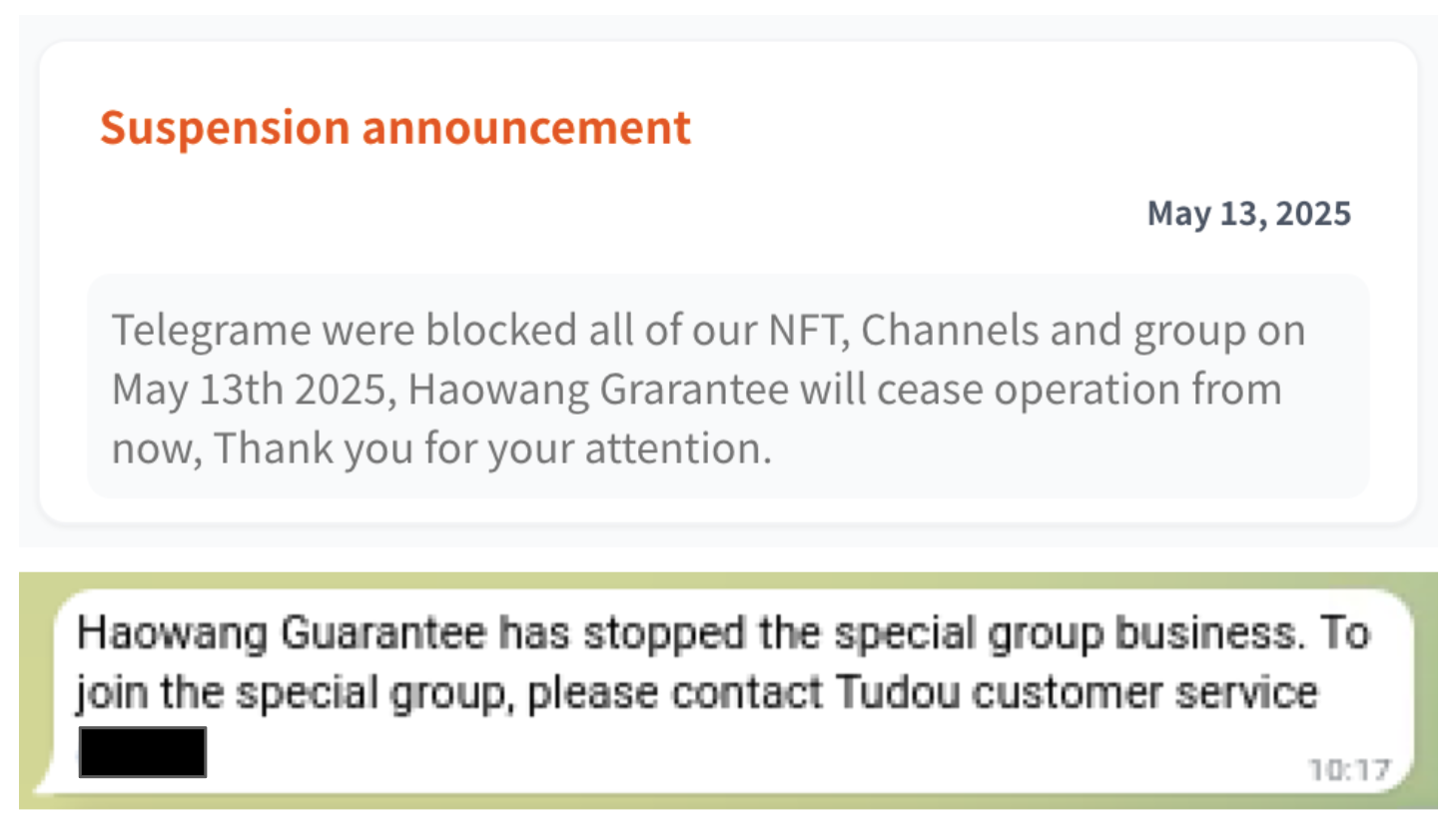
Following blockchain analytics firm Elliptic’s investigation, Telegram banned thousands of channels and accounts linked to Huione on May 13, 2025.

However, the successor platform, Tudou Guarantee, immediately captured the displaced criminal activity, processing equal volumes within weeks of the shutdown.

Elliptic tracked over 30 highly active guarantee marketplaces in Southeast Asia that continue to facilitate money laundering, stolen data trading, and “pig butchering” scam infrastructure.

The Hydra Effect: How Huione Multiply Under Pressure

The $27 billion Huione marketplace had operated as a sophisticated criminal ecosystem, offering everything from fake documents and stolen personal data to money laundering services and intimidation-for-hire through Telegram’s encrypted infrastructure.

The platform’s reach extended far beyond simple financial crime, with ties to human trafficking operations disguised as legitimate IT companies across Cambodia, Laos, and Myanmar, where victims were forced to execute romance scams and crypto fraud under constant surveillance.

Huione has been connected to Cambodia’s ruling elite and its role in laundering proceeds for North Korea’s Lazarus Group. This made it a primary target for the U.S. Treasury’s FinCEN, which designated the entire Huione Group as a money laundering concern in May 2025.

The criminal enterprise strategically acquired a 30% stake in Tudou Guarantee in December 2024, effectively ensuring operational continuity before enforcement action materialized.
Telegram Shuts Down Huione's Largest Crypto Scam Market Ever, But Rivals Take Over with 400% Volume SurgeSource: Elliptic

This planning enabled the seamless migration of hundreds of thousands of users. Tudou’s transaction volumes surged from negligible levels to over 300,000 by June 15.

The same merchants who previously operated through Huione immediately established operations on Tudou, offering identical services, including stolen data, money laundering capabilities, and specialized tools for pig butchering scams targeting Western victims.

Beyond Tudou’s dominance, multiple smaller platforms experienced exponential growth as the criminal ecosystem fragmented and diversified.

According to Elliptic, Shuangying marketplace saw user numbers triple from 40,000 to 110,000 transactions, and Fully Light expanded from 20,000 to over 80,000 transactions.

Telegram Shuts Down Huione's Largest Crypto Scam Market Ever, But Rivals Take Over with 400% Volume SurgeSource: Elliptic

These platforms use Telegram’s encryption for communication and comprehensive business operations, including reputation management, order fulfillment, and dispute resolution among vendors and clients.

They also use Tether’s USDT stablecoin as the primary medium of exchange, which provides these criminals with dollar-denominated stability while avoiding traditional banking systems.

The UN estimates that Telegram-based criminal activity generates up to $36.5 billion annually through scams, money laundering, and stolen data sales.

Ongoing Enforcement Challenges On Telegram’s Encrypted Crime Economy

Despite Telegram’s cooperation in removing thousands of channels and banning associated accounts, Chainalysis research revealed that Huione’s core cryptocurrency processing infrastructure remained operational, which Elliptic also confirmed.

Telegram Shuts Down Huione's Largest Crypto Scam Market Ever, But Rivals Take Over with 400% Volume SurgeSource: Elliptic

The platform is simply migrating to new domains and quietly resuming Telegram’s presence within weeks of the apparent shutdown.

This resilience stems from the platform’s complex architecture, which separates public-facing marketing infrastructure from core financial processing systems. This allows criminal operations to continue even when their most visible components face disruption.

The enforcement action’s limited impact becomes particularly evident when examining the broader criminal ecosystem that Huione enabled, including forcing trafficking victims into crypto scam operations across Southeast Asian compounds where legitimate job seekers are lured with false IT positions before being held against their will and coerced into executing fraudulent schemes.

These physical operations, often disguised as customer service centers, create a hybrid criminal model that combines digital financial crime with traditional human trafficking, making comprehensive enforcement exponentially more complex as it requires coordination across multiple jurisdictions and crime categories.

While Telegram has begun responding to pressure by removing certain features and updating content policies, the platform’s core encrypted messaging capabilities remain attractive to criminals who exploit the technology’s legitimate privacy protections to operate sophisticated marketplace ecosystems.

The challenge for regulators lies in addressing criminal abuse without undermining the privacy rights and communication security that make encrypted platforms valuable for legitimate users worldwide.

Telegram CEO Pavel Durov is also fighting this battle with the regulators. He was recently arrested and released on bail, but surveillance remains.

Piyasa Fırsatı
Threshold Logosu
Threshold Fiyatı(T)
$0.008635
$0.008635$0.008635
-1.99%
USD
Threshold (T) Canlı Fiyat Grafiği
Sorumluluk Reddi: Bu sitede yeniden yayınlanan makaleler, halka açık platformlardan alınmıştır ve yalnızca bilgilendirme amaçlıdır. MEXC'nin görüşlerini yansıtmayabilir. Tüm hakları telif sahiplerine aittir. Herhangi bir içeriğin üçüncü taraf haklarını ihlal ettiğini düşünüyorsanız, kaldırılması için lütfen [email protected] ile iletişime geçin. MEXC, içeriğin doğruluğu, eksiksizliği veya güncelliği konusunda hiçbir garanti vermez ve sağlanan bilgilere dayalı olarak alınan herhangi bir eylemden sorumlu değildir. İçerik, finansal, yasal veya diğer profesyonel tavsiye niteliğinde değildir ve MEXC tarafından bir tavsiye veya onay olarak değerlendirilmemelidir.

Ayrıca Şunları da Beğenebilirsiniz

Why 100 Percent Test Coverage is Not Possible — Lessons from Testing Banking and Healthcare Systems

Why 100 Percent Test Coverage is Not Possible — Lessons from Testing Banking and Healthcare Systems

Quality is not about testing everything; quality is about testing what is most important.
Paylaş
Hackernoon2025/12/26 16:05
US eyes crypto mining at disputed nuclear plant in Russia-Ukraine conflict: report

US eyes crypto mining at disputed nuclear plant in Russia-Ukraine conflict: report

The plant is located in Ukraine and has been under Russian control since 2022, with its future management a key issue in peace talks.
Paylaş
Coinstats2025/12/26 18:58
Google's AP2 protocol has been released. Does encrypted AI still have a chance?

Google's AP2 protocol has been released. Does encrypted AI still have a chance?

Following the MCP and A2A protocols, the AI Agent market has seen another blockbuster arrival: the Agent Payments Protocol (AP2), developed by Google. This will clearly further enhance AI Agents' autonomous multi-tasking capabilities, but the unfortunate reality is that it has little to do with web3AI. Let's take a closer look: What problem does AP2 solve? Simply put, the MCP protocol is like a universal hook, enabling AI agents to connect to various external tools and data sources; A2A is a team collaboration communication protocol that allows multiple AI agents to cooperate with each other to complete complex tasks; AP2 completes the last piece of the puzzle - payment capability. In other words, MCP opens up connectivity, A2A promotes collaboration efficiency, and AP2 achieves value exchange. The arrival of AP2 truly injects "soul" into the autonomous collaboration and task execution of Multi-Agents. Imagine AI Agents connecting Qunar, Meituan, and Didi to complete the booking of flights, hotels, and car rentals, but then getting stuck at the point of "self-payment." What's the point of all that multitasking? So, remember this: AP2 is an extension of MCP+A2A, solving the last mile problem of AI Agent automated execution. What are the technical highlights of AP2? The core innovation of AP2 is the Mandates mechanism, which is divided into real-time authorization mode and delegated authorization mode. Real-time authorization is easy to understand. The AI Agent finds the product and shows it to you. The operation can only be performed after the user signs. Delegated authorization requires the user to set rules in advance, such as only buying the iPhone 17 when the price drops to 5,000. The AI Agent monitors the trigger conditions and executes automatically. The implementation logic is cryptographically signed using Verifiable Credentials (VCs). Users can set complex commission conditions, including price ranges, time limits, and payment method priorities, forming a tamper-proof digital contract. Once signed, the AI Agent executes according to the conditions, with VCs ensuring auditability and security at every step. Of particular note is the "A2A x402" extension, a technical component developed by Google specifically for crypto payments, developed in collaboration with Coinbase and the Ethereum Foundation. This extension enables AI Agents to seamlessly process stablecoins, ETH, and other blockchain assets, supporting native payment scenarios within the Web3 ecosystem. What kind of imagination space can AP2 bring? After analyzing the technical principles, do you think that's it? Yes, in fact, the AP2 is boring when it is disassembled alone. Its real charm lies in connecting and opening up the "MCP+A2A+AP2" technology stack, completely opening up the complete link of AI Agent's autonomous analysis+execution+payment. From now on, AI Agents can open up many application scenarios. For example, AI Agents for stock investment and financial management can help us monitor the market 24/7 and conduct independent transactions. Enterprise procurement AI Agents can automatically replenish and renew without human intervention. AP2's complementary payment capabilities will further expand the penetration of the Agent-to-Agent economy into more scenarios. Google obviously understands that after the technical framework is established, the ecological implementation must be relied upon, so it has brought in more than 60 partners to develop it, almost covering the entire payment and business ecosystem. Interestingly, it also involves major Crypto players such as Ethereum, Coinbase, MetaMask, and Sui. Combined with the current trend of currency and stock integration, the imagination space has been doubled. Is web3 AI really dead? Not entirely. Google's AP2 looks complete, but it only achieves technical compatibility with Crypto payments. It can only be regarded as an extension of the traditional authorization framework and belongs to the category of automated execution. There is a "paradigm" difference between it and the autonomous asset management pursued by pure Crypto native solutions. The Crypto-native solutions under exploration are taking the "decentralized custody + on-chain verification" route, including AI Agent autonomous asset management, AI Agent autonomous transactions (DeFAI), AI Agent digital identity and on-chain reputation system (ERC-8004...), AI Agent on-chain governance DAO framework, AI Agent NPC and digital avatars, and many other interesting and fun directions. Ultimately, once users get used to AI Agent payments in traditional fields, their acceptance of AI Agents autonomously owning digital assets will also increase. And for those scenarios that AP2 cannot reach, such as anonymous transactions, censorship-resistant payments, and decentralized asset management, there will always be a time for crypto-native solutions to show their strength? The two are more likely to be complementary rather than competitive, but to be honest, the key technological advancements behind AI Agents currently all come from web2AI, and web3AI still needs to keep up the good work!
Paylaş
PANews2025/09/18 07:00