The post Travis Hill FDIC Nomination Moves to Senate Confirmation appeared on BitcoinEthereumNews.com. President Donald Trump has put forward Travis Hill—currently acting chair—as the permanent head of the the US Federal Deposit Insurance Corporation. His nomination arrives at a moment of increased scrutiny over the regulatory treatment of crypto firms and community banking alike. Senate to Review Travis Hill FDIC Nomination Travis Hill has served as Acting Chairman of the FDIC since January 2025, and previously held the role of Vice Chairman beginning in January 2023. His earlier FDIC tenure (2018–2022) included oversight roles relating to policy coordination and regulatory design. Before joining the FDIC, Hill worked as senior counsel to the Senate Banking, Housing, and Urban Affairs Committee from 2013 to 2018. Sponsored Sponsored With the formal nomination, Hill’s appointment must now pass through Senate confirmation, specifically by the Senate Committee on Banking, Housing, and Urban Affairs, before he can assume the role permanently. The administration’s move follows speculation that Hill was already the frontrunner for the top job, given his interim leadership and previous alignment with key regulatory shifts. If confirmed, Hill will assume responsibility over the banking regulator’s supervision, deposit insurance, and resolution functions. The nomination reflects the administration’s desire to solidify its signal on regulatory direction, particularly concerning the intersection of banking oversight and emerging financial sectors. Crypto Industry Watches FDIC Leadership Shift Hill has drawn attention in crypto and financial circles for his opposition to “debanking”—the practice of banks severing relationships with clients in industries deemed risky, including crypto firms. During his acting tenure, the FDIC withdrew a policy that required prior government approval for banks to engage in crypto activities (FIL-16-2022), replacing it with guidance emphasizing risk management instead. Such changes are seen by many in the crypto community as an easing of regulatory friction between digital asset firms and the traditional banking infrastructure. Some observers note,… The post Travis Hill FDIC Nomination Moves to Senate Confirmation appeared on BitcoinEthereumNews.com. President Donald Trump has put forward Travis Hill—currently acting chair—as the permanent head of the the US Federal Deposit Insurance Corporation. His nomination arrives at a moment of increased scrutiny over the regulatory treatment of crypto firms and community banking alike. Senate to Review Travis Hill FDIC Nomination Travis Hill has served as Acting Chairman of the FDIC since January 2025, and previously held the role of Vice Chairman beginning in January 2023. His earlier FDIC tenure (2018–2022) included oversight roles relating to policy coordination and regulatory design. Before joining the FDIC, Hill worked as senior counsel to the Senate Banking, Housing, and Urban Affairs Committee from 2013 to 2018. Sponsored Sponsored With the formal nomination, Hill’s appointment must now pass through Senate confirmation, specifically by the Senate Committee on Banking, Housing, and Urban Affairs, before he can assume the role permanently. The administration’s move follows speculation that Hill was already the frontrunner for the top job, given his interim leadership and previous alignment with key regulatory shifts. If confirmed, Hill will assume responsibility over the banking regulator’s supervision, deposit insurance, and resolution functions. The nomination reflects the administration’s desire to solidify its signal on regulatory direction, particularly concerning the intersection of banking oversight and emerging financial sectors. Crypto Industry Watches FDIC Leadership Shift Hill has drawn attention in crypto and financial circles for his opposition to “debanking”—the practice of banks severing relationships with clients in industries deemed risky, including crypto firms. During his acting tenure, the FDIC withdrew a policy that required prior government approval for banks to engage in crypto activities (FIL-16-2022), replacing it with guidance emphasizing risk management instead. Such changes are seen by many in the crypto community as an easing of regulatory friction between digital asset firms and the traditional banking infrastructure. Some observers note,…

Travis Hill FDIC Nomination Moves to Senate Confirmation

President Donald Trump has put forward Travis Hill—currently acting chair—as the permanent head of the the US Federal Deposit Insurance Corporation.

His nomination arrives at a moment of increased scrutiny over the regulatory treatment of crypto firms and community banking alike.

Senate to Review Travis Hill FDIC Nomination

Travis Hill has served as Acting Chairman of the FDIC since January 2025, and previously held the role of Vice Chairman beginning in January 2023. His earlier FDIC tenure (2018–2022) included oversight roles relating to policy coordination and regulatory design. Before joining the FDIC, Hill worked as senior counsel to the Senate Banking, Housing, and Urban Affairs Committee from 2013 to 2018.

Sponsored

Sponsored

With the formal nomination, Hill’s appointment must now pass through Senate confirmation, specifically by the Senate Committee on Banking, Housing, and Urban Affairs, before he can assume the role permanently. The administration’s move follows speculation that Hill was already the frontrunner for the top job, given his interim leadership and previous alignment with key regulatory shifts.

If confirmed, Hill will assume responsibility over the banking regulator’s supervision, deposit insurance, and resolution functions. The nomination reflects the administration’s desire to solidify its signal on regulatory direction, particularly concerning the intersection of banking oversight and emerging financial sectors.

Crypto Industry Watches FDIC Leadership Shift

Hill has drawn attention in crypto and financial circles for his opposition to “debanking”—the practice of banks severing relationships with clients in industries deemed risky, including crypto firms. During his acting tenure, the FDIC withdrew a policy that required prior government approval for banks to engage in crypto activities (FIL-16-2022), replacing it with guidance emphasizing risk management instead.

Such changes are seen by many in the crypto community as an easing of regulatory friction between digital asset firms and the traditional banking infrastructure. Some observers note, however, that the structural constraints and capital requirements for banking will continue to limit access for certain crypto businesses, regardless of regulatory goodwill.

Responses from the crypto community have ranged from cautious optimism to demands for clearer, consistent rules. Some proponents believe Hill’s elevation could promote more integrated banking-crypto partnerships, but many underscore that real impacts depend on how his policies evolve post-confirmation.

Banking Sector Reactions to Travis Hill’s FDIC Nomination

The nomination has elicited reactions from traditional banking institutions and community groups. The Independent Community Bankers of America (ICBA) extended congratulations, noting that Hill’s leadership has demonstrated an understanding of the regulatory burdens on smaller banks, and calling for expedited Senate confirmation.

Meanwhile, other trade associations such as the American Bankers Association (ABA) are closely watching how Hill balances oversight, financial stability, and innovation—a tension particularly acute in areas like crypto, fintech, and nonbank entity growth. Some members emphasize that preserving a level playing field, mitigating systemic risk, and maintaining consumer protections will be critical benchmarks of success.

Overall, the nomination underscores a broader reorientation in regulatory posture, and stakeholders across sectors are awaiting further signals from Hill’s confirmation hearings and subsequent policy actions.

Source: https://beincrypto.com/travis-hill-nominated-as-permanent-fdic-chair/

Piyasa Fırsatı
null Logosu
null Fiyatı(null)
--
----
USD
null (null) Canlı Fiyat Grafiği
Sorumluluk Reddi: Bu sitede yeniden yayınlanan makaleler, halka açık platformlardan alınmıştır ve yalnızca bilgilendirme amaçlıdır. MEXC'nin görüşlerini yansıtmayabilir. Tüm hakları telif sahiplerine aittir. Herhangi bir içeriğin üçüncü taraf haklarını ihlal ettiğini düşünüyorsanız, kaldırılması için lütfen [email protected] ile iletişime geçin. MEXC, içeriğin doğruluğu, eksiksizliği veya güncelliği konusunda hiçbir garanti vermez ve sağlanan bilgilere dayalı olarak alınan herhangi bir eylemden sorumlu değildir. İçerik, finansal, yasal veya diğer profesyonel tavsiye niteliğinde değildir ve MEXC tarafından bir tavsiye veya onay olarak değerlendirilmemelidir.

Ayrıca Şunları da Beğenebilirsiniz

The Channel Factories We’ve Been Waiting For

The Channel Factories We’ve Been Waiting For

The post The Channel Factories We’ve Been Waiting For appeared on BitcoinEthereumNews.com. Visions of future technology are often prescient about the broad strokes while flubbing the details. The tablets in “2001: A Space Odyssey” do indeed look like iPads, but you never see the astronauts paying for subscriptions or wasting hours on Candy Crush.  Channel factories are one vision that arose early in the history of the Lightning Network to address some challenges that Lightning has faced from the beginning. Despite having grown to become Bitcoin’s most successful layer-2 scaling solution, with instant and low-fee payments, Lightning’s scale is limited by its reliance on payment channels. Although Lightning shifts most transactions off-chain, each payment channel still requires an on-chain transaction to open and (usually) another to close. As adoption grows, pressure on the blockchain grows with it. The need for a more scalable approach to managing channels is clear. Channel factories were supposed to meet this need, but where are they? In 2025, subnetworks are emerging that revive the impetus of channel factories with some new details that vastly increase their potential. They are natively interoperable with Lightning and achieve greater scale by allowing a group of participants to open a shared multisig UTXO and create multiple bilateral channels, which reduces the number of on-chain transactions and improves capital efficiency. Achieving greater scale by reducing complexity, Ark and Spark perform the same function as traditional channel factories with new designs and additional capabilities based on shared UTXOs.  Channel Factories 101 Channel factories have been around since the inception of Lightning. A factory is a multiparty contract where multiple users (not just two, as in a Dryja-Poon channel) cooperatively lock funds in a single multisig UTXO. They can open, close and update channels off-chain without updating the blockchain for each operation. Only when participants leave or the factory dissolves is an on-chain transaction…
Paylaş
BitcoinEthereumNews2025/09/18 00:09
Franklin Templeton CEO Dismisses 50bps Rate Cut Ahead FOMC

Franklin Templeton CEO Dismisses 50bps Rate Cut Ahead FOMC

The post Franklin Templeton CEO Dismisses 50bps Rate Cut Ahead FOMC appeared on BitcoinEthereumNews.com. Franklin Templeton CEO Jenny Johnson has weighed in on whether the Federal Reserve should make a 25 basis points (bps) Fed rate cut or 50 bps cut. This comes ahead of the Fed decision today at today’s FOMC meeting, with the market pricing in a 25 bps cut. Bitcoin and the broader crypto market are currently trading flat ahead of the rate cut decision. Franklin Templeton CEO Weighs In On Potential FOMC Decision In a CNBC interview, Jenny Johnson said that she expects the Fed to make a 25 bps cut today instead of a 50 bps cut. She acknowledged the jobs data, which suggested that the labor market is weakening. However, she noted that this data is backward-looking, indicating that it doesn’t show the current state of the economy. She alluded to the wage growth, which she remarked is an indication of a robust labor market. She added that retail sales are up and that consumers are still spending, despite inflation being sticky at 3%, which makes a case for why the FOMC should opt against a 50-basis-point Fed rate cut. In line with this, the Franklin Templeton CEO said that she would go with a 25 bps rate cut if she were Jerome Powell. She remarked that the Fed still has the October and December FOMC meetings to make further cuts if the incoming data warrants it. Johnson also asserted that the data show a robust economy. However, she noted that there can’t be an argument for no Fed rate cut since Powell already signaled at Jackson Hole that they were likely to lower interest rates at this meeting due to concerns over a weakening labor market. Notably, her comment comes as experts argue for both sides on why the Fed should make a 25 bps cut or…
Paylaş
BitcoinEthereumNews2025/09/18 00:36
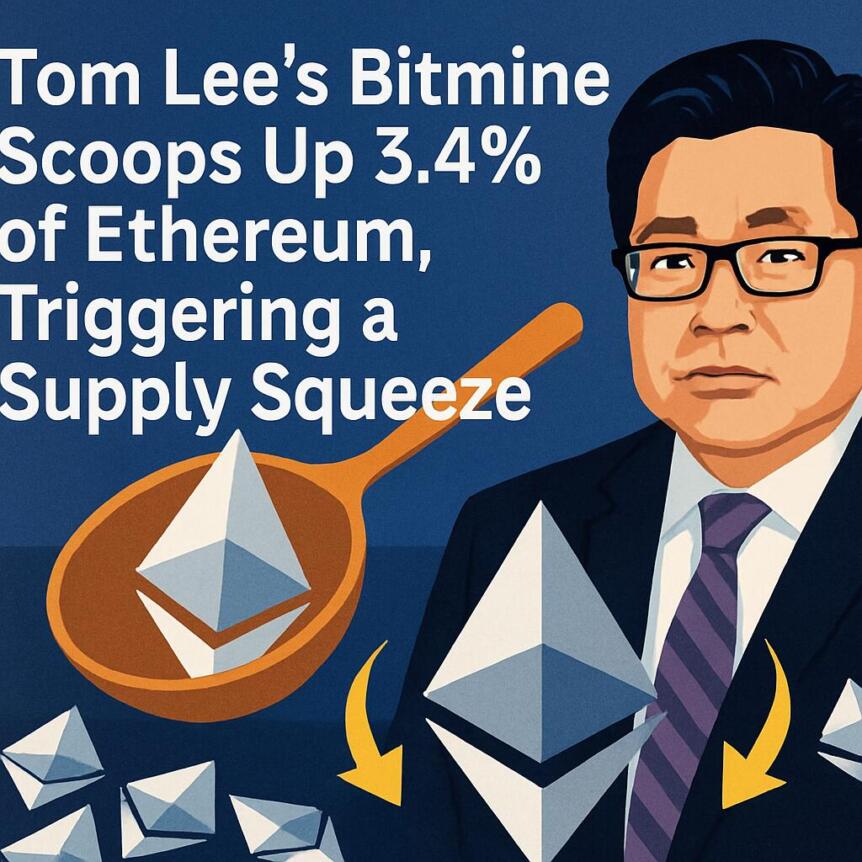
Tom Lee’s Bitmine Scoops Up 3.4% of Ethereum, Triggering a Supply Squeeze

Tom Lee’s Bitmine Scoops Up 3.4% of Ethereum, Triggering a Supply Squeeze

Bitmine Immersion now controls 3.4% of Ethereum amid shrinking exchange supply and rising institutional accumulation.
Paylaş
Crypto Breaking News2026/01/20 16:27