📑 Table of Contents Polkadot: A Network of Networks The Vision Behind Polkadot’s Creation How Polkadot’s Modular Technology Works Governance and Community Power Polkadot in Action: Examples and Partners DOT Tokenomics Explained Polkadot’s Roadmap and Future Outlook FAQ: 10 Unanswered Questions About Polkadot 🌐 Polkadot: A Network of Networks Polkadot is one of the most [...]]]>📑 Table of Contents Polkadot: A Network of Networks The Vision Behind Polkadot’s Creation How Polkadot’s Modular Technology Works Governance and Community Power Polkadot in Action: Examples and Partners DOT Tokenomics Explained Polkadot’s Roadmap and Future Outlook FAQ: 10 Unanswered Questions About Polkadot 🌐 Polkadot: A Network of Networks Polkadot is one of the most [...]]]>

Polkadot (DOT) in 2025: The Network of Networks Powering Interoperable Web3

2025/10/03 08:09

📑 Table of Contents

  • Polkadot: A Network of Networks
  • The Vision Behind Polkadot’s Creation
  • How Polkadot’s Modular Technology Works
  • Governance and Community Power
  • Polkadot in Action: Examples and Partners
  • DOT Tokenomics Explained
  • Polkadot’s Roadmap and Future Outlook
  • FAQ: 10 Unanswered Questions About Polkadot

🌐 Polkadot: A Network of Networks

Polkadot is one of the most promising innovations in blockchain technology. Unlike traditional single-chain blockchains such as Bitcoin or Ethereum, Polkadot is designed as a network of blockchains. Through its modular architecture, it enables a wide range of specialized applications to run in parallel while benefiting from shared security and interoperability.

The native token DOT functions as a cryptocurrency, governance tool, and utility token. Its goal is to build an interoperable Web3 ecosystem where blockchains can communicate securely and efficiently. This design allows projects to develop custom solutions without compromising network stability or scalability.

🚀 The Vision Behind Polkadot’s Creation

Polkadot was conceived by Dr. Gavin Wood, one of Ethereum’s co-founders, in 2016. His vision was to overcome the limitations of existing blockchains. The development is led by the Web3 Foundation and Parity Technologies. The mission: to build a decentralized internet free from gatekeepers, where users retain full control over their data and applications.

⚙ How Polkadot’s Modular Technology Works

Polkadot is built on a modular architecture with three key components:

  • Relay Chain: The central chain providing security, governance, and transaction validation.
  • Parachains: Independent blockchains that run in parallel, customized for specific applications like DeFi, gaming, or identity management.
  • Bridges: Connect Polkadot with external blockchains such as Ethereum and Bitcoin, enhancing interoperability.

This design allows scalability, specialization, and seamless communication between blockchains.

🏛 Governance and Community Power

Unlike off-chain governance models, Polkadot implements on-chain governance. DOT holders directly vote on protocol upgrades, parameter adjustments, and feature integrations. This democratic model empowers the community and promotes transparency. A notable example is Parachain Auctions, where projects compete for relay chain slots, and the community votes on which projects are integrated.

💡 Polkadot in Action: Examples and Partner Projects

Polkadot supports a wide variety of applications, including:

  • DeFi: Acala (stablecoins, financial products) and Parallel Finance (lending, staking, trading).
  • Smart Contracts: Moonbeam, offering Ethereum compatibility for developers.
  • Digital Identity: KILT Protocol, providing verifiable credentials.
  • Other Sectors: Energy, logistics, and sustainability through collaborations with companies and NGOs.

ProjectFocus AreaRole within Polkadot
AcalaDeFi / StablecoinsFinancial hub for decentralized services
MoonbeamSmart ContractsEthereum-compatible environment
KILT ProtocolDigital IdentityIdentity verification and data management

💰 DOT Tokenomics Explained

The DOT token underpins the economic model of Polkadot. Unlike capped-supply cryptocurrencies, DOT uses an inflation-based model to ensure continuous network incentives. Key functions include:

  • Governance: Voting on protocol changes and new features.
  • Staking: Securing the network by rewarding validators and nominators.
  • Parachain Auctions: Funding slots on the relay chain for project integration.
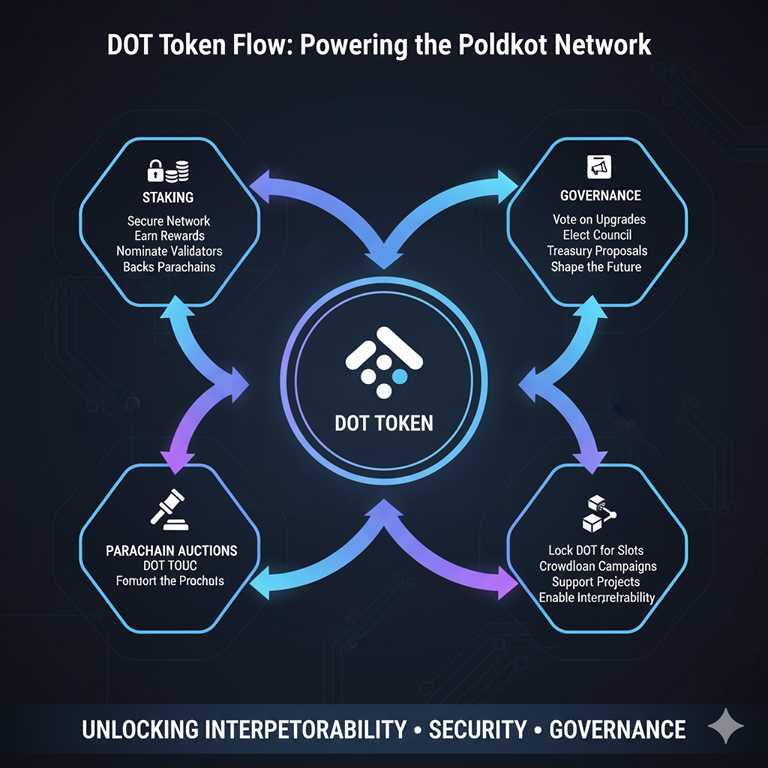
infographic showing the DOT Token flow, including staking, governance, and parachain auctions

🔮 Polkadot’s Roadmap and Future Outlook

In 2025, Polkadot is focused on expanding its parachain ecosystem and building additional bridges to external networks. Regulatory clarity could accelerate institutional adoption. With its multi-chain architecture, Polkadot is becoming a key infrastructure provider for Web3.

The development of Polkadot 2.0 will transform the platform into a global computing environment. Its JAM architecture (Join-Accumulate Machine) introduces vertical scalability and service-oriented design, aiming to support decentralized Web3 cloud functions.
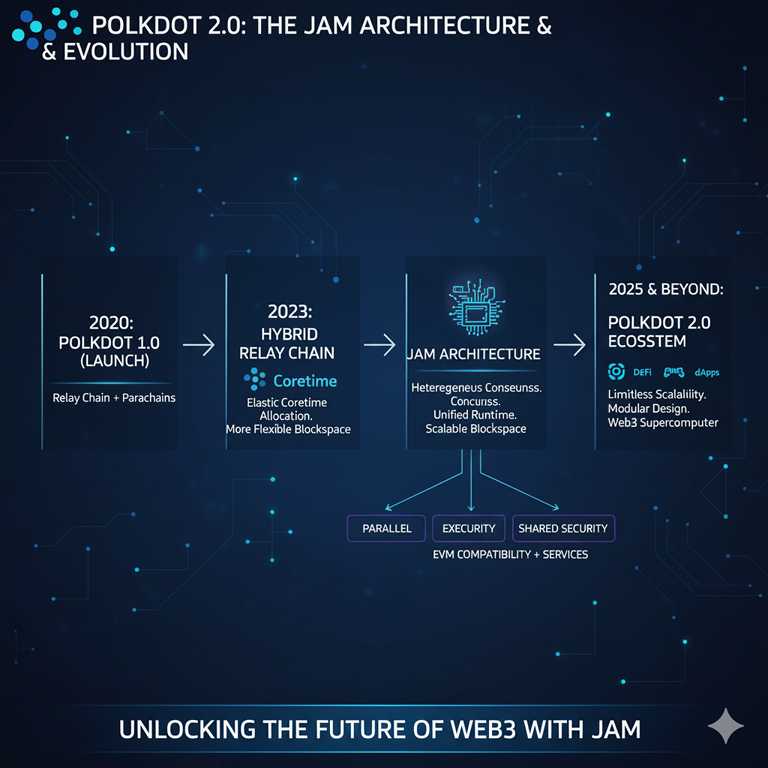
image of the Polkadot 2.0 roadmap timeline, including JAM architecture features

❓ FAQ: 10 Unanswered Questions About Polkadot

1. How will Polkadot 2.0 impact developers?
Polkadot 2.0 will expand opportunities for developers by introducing the JAM (Join-Accumulate Machine) architecture. This enables vertical scalability, more flexible runtime environments, and a service-oriented infrastructure, allowing developers to build Web3 apps with greater efficiency and customizability.
2. Can Polkadot surpass Ethereum in adoption?
Polkadot could surpass Ethereum in specific niches like interoperability, parachain customization, and enterprise blockchain use cases. However, Ethereum’s dominant ecosystem and first-mover advantage in DeFi and NFTs make it difficult to overtake on a broad scale.
3. How secure are Polkadot’s parachains?
Parachains benefit from shared security provided by the relay chain. However, individual parachains can still face risks such as vulnerabilities in their own smart contract code or governance decisions. Shared security reduces systemic risk, but not all parachain-level risks.
4. Will regulatory changes affect Polkadot’s growth?
Yes, regulation will play a major role. Stricter frameworks could limit adoption in some regions, while clear guidelines might accelerate institutional and enterprise integration. Polkadot’s flexibility and governance model position it well to adapt to evolving compliance requirements.
5. What role do bridges play in Polkadot’s success?
Bridges are essential to Polkadot’s interoperability. They allow data and assets to flow between Polkadot and external blockchains like Ethereum and Bitcoin. Successful bridge deployment will determine Polkadot’s ability to become a true hub in the multi-chain ecosystem.
6. Can DOT tokenomics remain sustainable long-term?
DOT’s inflationary model incentivizes validators and nominators to secure the network. Over the long term, governance may adjust inflation parameters to balance rewards, security, and scarcity. The model is flexible but depends on active and responsible community governance.
7. How does Polkadot compare to Cosmos?
Both Polkadot and Cosmos aim to solve interoperability. Polkadot emphasizes shared security and a unified relay chain, while Cosmos prioritizes chain sovereignty with independent blockchains connected by the IBC protocol. The choice depends on whether projects value independence or pooled security.
8. Could Polkadot attract more enterprises?
Yes, Polkadot’s customizable parachains, regulatory adaptability, and strong developer community make it attractive to enterprises seeking tailored blockchain solutions. Its compliance-friendly approach and focus on interoperability also appeal to institutional use cases.
9. How active is the Polkadot developer community?
Polkadot consistently ranks among the top blockchain projects in GitHub commits and developer activity. Its community is one of the most active, with continuous contributions to core protocol upgrades, parachain development, and tooling for Web3.
10. What’s next for parachain auctions?
Parachain auctions will likely evolve with new models, such as shorter leasing terms, dynamic pricing, or alternative allocation mechanisms. These changes aim to increase accessibility for projects and further decentralize participation in the ecosystem.
]]>
Piyasa Fırsatı
Polkadot Logosu
Polkadot Fiyatı(DOT)
$1.884
$1.884$1.884
-0.26%
USD
Polkadot (DOT) Canlı Fiyat Grafiği
Sorumluluk Reddi: Bu sitede yeniden yayınlanan makaleler, halka açık platformlardan alınmıştır ve yalnızca bilgilendirme amaçlıdır. MEXC'nin görüşlerini yansıtmayabilir. Tüm hakları telif sahiplerine aittir. Herhangi bir içeriğin üçüncü taraf haklarını ihlal ettiğini düşünüyorsanız, kaldırılması için lütfen [email protected] ile iletişime geçin. MEXC, içeriğin doğruluğu, eksiksizliği veya güncelliği konusunda hiçbir garanti vermez ve sağlanan bilgilere dayalı olarak alınan herhangi bir eylemden sorumlu değildir. İçerik, finansal, yasal veya diğer profesyonel tavsiye niteliğinde değildir ve MEXC tarafından bir tavsiye veya onay olarak değerlendirilmemelidir.

Ayrıca Şunları da Beğenebilirsiniz

CEO Sandeep Nailwal Shared Highlights About RWA on Polygon

CEO Sandeep Nailwal Shared Highlights About RWA on Polygon

The post CEO Sandeep Nailwal Shared Highlights About RWA on Polygon appeared on BitcoinEthereumNews.com. Polygon CEO Sandeep Nailwal highlighted Polygon’s lead in global bonds, Spiko US T-Bill, and Spiko Euro T-Bill. Polygon published an X post to share that its roadmap to GigaGas was still scaling. Sentiments around POL price were last seen to be bearish. Polygon CEO Sandeep Nailwal shared key pointers from the Dune and RWA.xyz report. These pertain to highlights about RWA on Polygon. Simultaneously, Polygon underlined its roadmap towards GigaGas. Sentiments around POL price were last seen fumbling under bearish emotions. Polygon CEO Sandeep Nailwal on Polygon RWA CEO Sandeep Nailwal highlighted three key points from the Dune and RWA.xyz report. The Chief Executive of Polygon maintained that Polygon PoS was hosting RWA TVL worth $1.13 billion across 269 assets plus 2,900 holders. Nailwal confirmed from the report that RWA was happening on Polygon. The Dune and https://t.co/W6WSFlHoQF report on RWA is out and it shows that RWA is happening on Polygon. Here are a few highlights: – Leading in Global Bonds: Polygon holds 62% share of tokenized global bonds (driven by Spiko’s euro MMF and Cashlink euro issues) – Spiko U.S.… — Sandeep | CEO, Polygon Foundation (※,※) (@sandeepnailwal) September 17, 2025 The X post published by Polygon CEO Sandeep Nailwal underlined that the ecosystem was leading in global bonds by holding a 62% share of tokenized global bonds. He further highlighted that Polygon was leading with Spiko US T-Bill at approximately 29% share of TVL along with Ethereum, adding that the ecosystem had more than 50% share in the number of holders. Finally, Sandeep highlighted from the report that there was a strong adoption for Spiko Euro T-Bill with 38% share of TVL. He added that 68% of returns were on Polygon across all the chains. Polygon Roadmap to GigaGas In a different update from Polygon, the community…
Paylaş
BitcoinEthereumNews2025/09/18 01:10
Major Ethereum Whale Returns: Buys $119M In ETH Amid Market Drop

Major Ethereum Whale Returns: Buys $119M In ETH Amid Market Drop

Ethereum is struggling to regain momentum after failing to reclaim the $3,200 level, keeping the market in a fragile equilibrium. Despite several recovery attempts
Paylaş
Bitcoinist2025/12/16 04:00
U.S. Court Finds Pastor Found Guilty in $3M Crypto Scam

U.S. Court Finds Pastor Found Guilty in $3M Crypto Scam

The post U.S. Court Finds Pastor Found Guilty in $3M Crypto Scam appeared on BitcoinEthereumNews.com. Crime 18 September 2025 | 04:05 A Colorado judge has brought closure to one of the state’s most unusual cryptocurrency scandals, declaring INDXcoin to be a fraudulent operation and ordering its founders, Denver pastor Eli Regalado and his wife Kaitlyn, to repay $3.34 million. The ruling, issued by District Court Judge Heidi L. Kutcher, came nearly two years after the couple persuaded hundreds of people to invest in their token, promising safety and abundance through a Christian-branded platform called the Kingdom Wealth Exchange. The scheme ran between June 2022 and April 2023 and drew in more than 300 participants, many of them members of local church networks. Marketing materials portrayed INDXcoin as a low-risk gateway to prosperity, yet the project unraveled almost immediately. The exchange itself collapsed within 24 hours of launch, wiping out investors’ money. Despite this failure—and despite an auditor’s damning review that gave the system a “0 out of 10” for security—the Regalados kept presenting it as a solid opportunity. Colorado regulators argued that the couple’s faith-based appeal was central to the fraud. Securities Commissioner Tung Chan said the Regalados “dressed an old scam in new technology” and used their standing within the Christian community to convince people who had little knowledge of crypto. For him, the case illustrates how modern digital assets can be exploited to replicate classic Ponzi-style tactics under a different name. Court filings revealed where much of the money ended up: luxury goods, vacations, jewelry, a Range Rover, high-end clothing, and even dental procedures. In a video that drew worldwide attention earlier this year, Eli Regalado admitted the funds had been spent, explaining that a portion went to taxes while the remainder was used for a home renovation he claimed was divinely inspired. The judgment not only confirms that INDXcoin qualifies as a…
Paylaş
BitcoinEthereumNews2025/09/18 09:14