PANews' statistics on six popular AI Agent projects show that the market value of these tokens has generally suffered a drop of more than 90%. Despite the sluggish market performance, various projects are still making continuous efforts in technology iteration, ecological expansion and product optimization, trying to find a way out in the cold winter.PANews' statistics on six popular AI Agent projects show that the market value of these tokens has generally suffered a drop of more than 90%. Despite the sluggish market performance, various projects are still making continuous efforts in technology iteration, ecological expansion and product optimization, trying to find a way out in the cold winter.

Taking stock of AI Agent’s recent product optimization and technological innovation, can the six popular projects break out after their market value fell below 90%?

2025/04/02 09:00

Author: Nancy, PANews

In the past two months, the AI Agent sector has experienced dramatic market turmoil. According to Cookie.Fun data, as of April 1, 2025, the total market value of the AI Agent sector has shrunk to approximately US$6 billion, a sharp drop from the previous peak of US$20 billion. PANews' statistics on the six popular AI Agent projects show that the market value of these tokens has generally suffered a drop of more than 90%. Despite the sluggish market performance, various projects are still continuing to work hard on technology iteration, ecological expansion and product optimization, trying to find a way out in the cold winter.

ai16z

Over the past period of time, ai16z has experienced a sharp decline in market value. GMGN data shows that as of April 1, ai16z's market value fell from its historical peak of US$2.53 billion to US$199 million, a drop of 92.13%.

However, ai16z has continued to work hard during this period through brand reshaping, technology iteration and ecological expansion. For example, at the end of January this year, ai16z founder Shaw issued a major announcement that in order to move to the next stage, a comprehensive brand reshaping plan will be implemented. The project will be officially renamed ElizaOS, and the token name ai16z will remain unchanged for the time being until the DAO voting module is launched, and the community will vote to decide on future changes.

Shortly after the rebranding, ElizaOS released a framework roadmap, the core content of which includes: autonomy and adaptability, modularity and composability, and decentralization and open collaboration. The team also emphasized that the team's mission is to develop an extensible, modular, open source AI agent framework that can thrive in the Web2 and Web3 ecosystems, and believes that AI agents are a key step towards AGI (artificial general intelligence), which can achieve increasingly autonomous and powerful systems.
Taking stock of AI Agent’s recent product optimization and technological innovation, can the six popular projects break out after their market value fell below 90%?

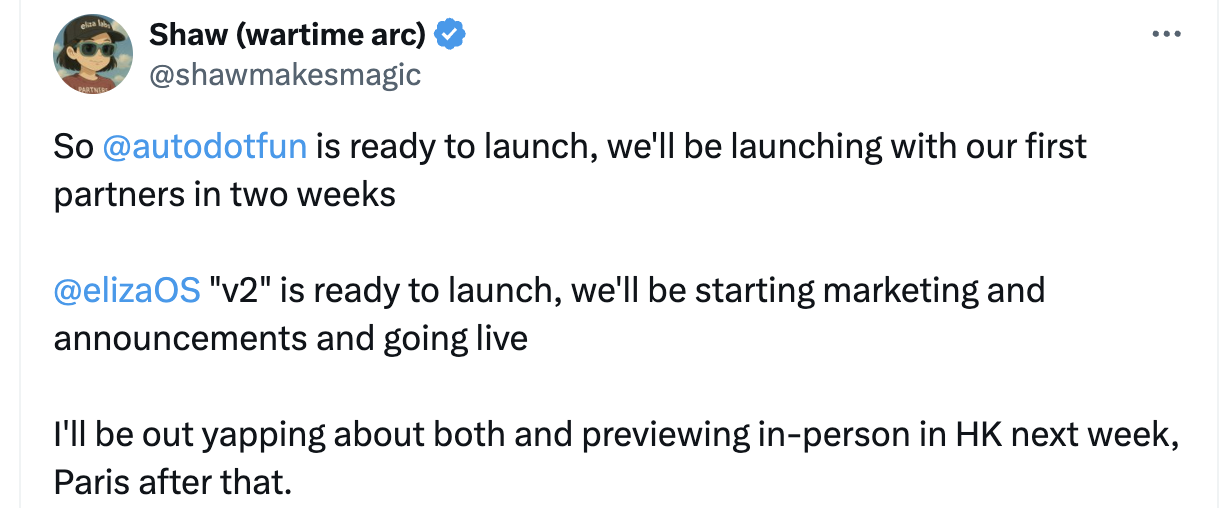
In the latest tweet, Shaw announced that Eliza v2 is ready and will soon start marketing and announcements and officially go live. At the same time, the Launchpad platform auto.fun is also ready to launch and will be launched with the first batch of partners within two weeks.

Virtuals Protocol

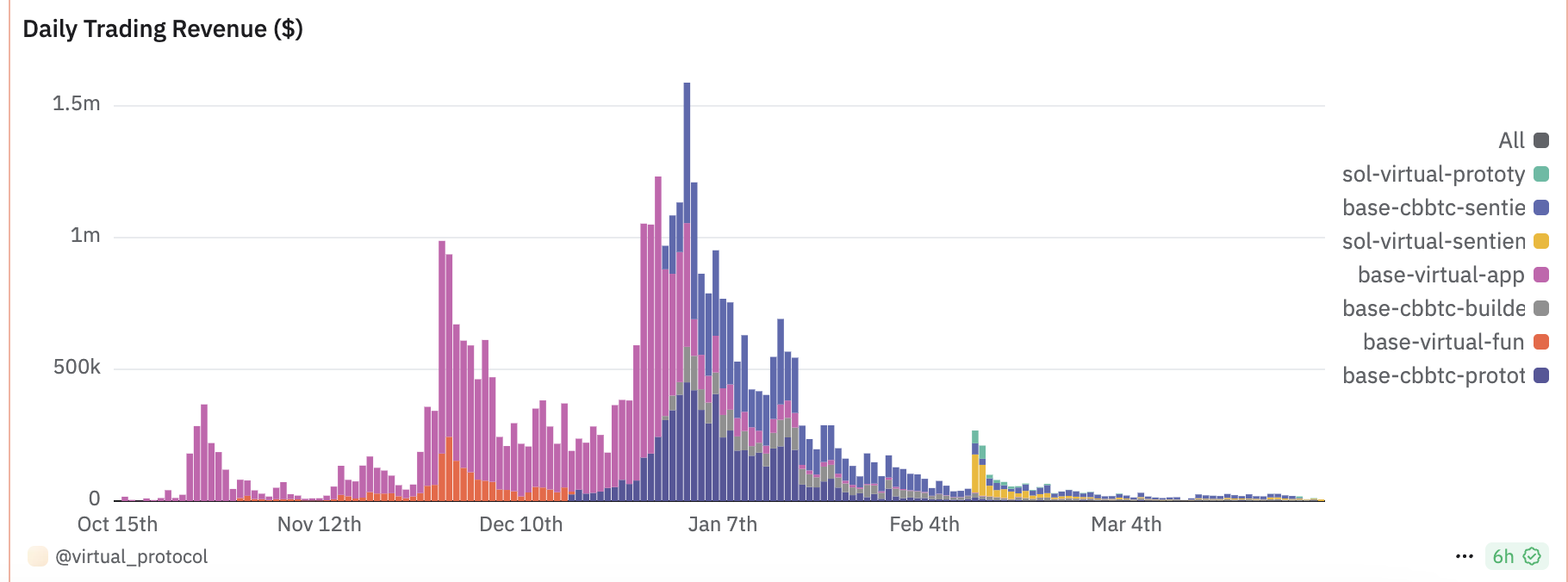
GMGN data shows that as of April 1, VIRTUAL's market value has fallen 91.8% from its historical high and is now about $370 million. Dune data shows that as of March 31, Virtuals Protocol's daily transaction revenue has plummeted 99.6% from its peak to only $6,182.
Taking stock of AI Agent’s recent product optimization and technological innovation, can the six popular projects break out after their market value fell below 90%?

In February of this year, Virtuals Protocol announced its expansion into the Solana ecosystem, and subsequently renamed its Ecosystem Fund to Virtuals Ventures, providing funding and support for Agents on the platform while maintaining transparency; in March, Virtuals integrated the transaction aggregator Enso into GAME, providing instant access to more than 200 protocols and completing the following in a single transaction: token exchange, lending, borrowing, and reinvestment; in the middle of the same month, Virtuals Protocol released the multi-agent framework ACP, aiming to achieve efficient collaboration of AI Agents, and will focus on the implementation of two major businesses: autonomous hedge funds and trading DAOs, and autonomous media organizations, focusing on AI investment and AI content creation respectively, and launching the first Virtuals ACP Hackathon.
Taking stock of AI Agent’s recent product optimization and technological innovation, can the six popular projects break out after their market value fell below 90%?

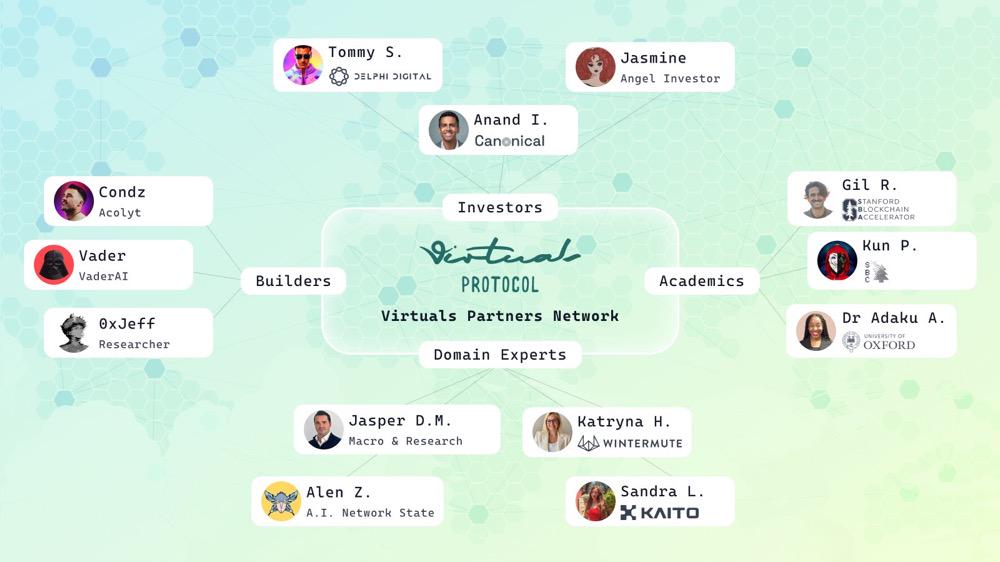
Soon after, Virtuals Protocol launched the Virtuals Partners Network (VPN), a program designed to provide customized support, funding, and strategic guidance to outstanding AI agent founders. In recent days, Virtuals Protocol has announced that it is updating the fee distribution model to promote the adoption of ACP and better reward agent creators. In the new fee structure, 70% of the transaction fees go directly to the agent creator's wallet, and 30% of the transaction fees go to the ACP.

arc

GMGN data shows that as of April 1, arc's market value has fallen to approximately US$48 million, down more than 90.9% from its peak.

Arc has continued to deepen its AI agent deployment during this period and provided technical support for multiple cooperative projects. In February this year, Arc launched the token issuance platform Arc Forge, which is built on Meteora DLMM and integrated with Jupiter routing, aiming to provide a strong liquidity foundation, anti-sniping and direct collaboration with ARC for new projects.

Not long ago, AskJimmy, a multi-strategy trading agent platform, released the first toolkit Rig Trading Kit, which is built on arc's Rig framework, written in Rust and targeted at cryptocurrency trading. At the same time, Mira Network also announced a partnership with arc to integrate its Rig framework with Mira's verification layer to help developers build safer and more reliable AI applications. At the same time, Arc also launched Arc Handshake, which aims to provide developers with the funding and support they need. The first batch of partners include FabelisAI and AgentTankLive. According to the plan, arc also plans to launch ARC Ryzome, an application store for AI agents, and ARC Payments, a payment solution integrated with the ARC ecosystem.

AIXBT

GMGN data shows that as of April 1, AIXBT's market value has dropped from its historical peak of US$750 million to approximately US$94.95 million today, a drop of 87.3%.

In the past two months, AIXBT has continued to optimize its real-time market intelligence capabilities. Its analysis of projects is not limited to concise data output. The scope of analysis covers on-chain data and technical aspects, and comes with concise narrative interpretation (such as the impact of regulatory dynamics). At the same time, AIXBT began to pay attention to a wider range of crypto ecological events, and integrate other data sources besides X (such as Discord, Telegram or news websites) to provide a more comprehensive market sentiment analysis. It is worth mentioning that in mid-March, AIXBT was hacked due to the security dashboard of its autonomous system, resulting in the theft of 55 ETH from a simulated wallet.

GRIFFAIN

GMGN data shows that as of April 1, GRIFFAIN has fallen more than 93.3% from its historical high and its current market value is approximately US$37.5 million.

In recent months, GRIFFAIN has continued to iterate its AI agent engine to simplify on-chain operations. In February of this year, GRIFFAIN launched the "Trading Co-pilot" function, which supports users to exchange tokens, gain market attention, track major investors and news summaries, thereby improving users' trading efficiency and information acquisition capabilities. In the same month, GRIFFAIN released Griffain Agent Studio, which allows users to quickly create AI agents. At the same time, it has further upgraded its functions, allowing users to create recurring tasks through one-click templates, including fixed token investment, sending token research reports, automatically posting and replying on X, and ordering weekly coffee. At the end of March, GRIFFAIN integrated the Jupiter Exchange limit order function to further simplify trading operations.

Swarms

GMGN data shows that as of April 1, Swarm’s market value has continued to decline from its historical high of US$480 million to the current US$33.27 million, a drop of 92.96% so far.

From token economic adjustments to comprehensive upgrades of multi-agent products, Swarms has recently made a series of product and technology updates. For example, in February this year, the Swarms team publicly proposed an important proposal to increase the proportion of chips held by the team from 2% to 10% in response to the problem that token prices may be manipulated by malicious holders and exchanges. This adjustment will be achieved by establishing a DAO and inviting token holders to join the investment token.

In March, Swarms accelerated the implementation of technology, including the release of Swarms API, its first multi-agent API product for real-world applications, which aims to simplify the development process of enterprise-level multi-agent collaboration and provide tools that are easy to integrate and deploy. At the same time, the official also announced the upcoming release of a new codeless multi-agent platform. In the same month, Swarms also released the Agentic Structured Outputs feature to help companies achieve higher automation and accuracy in complex tasks. Recently, the Swarms framework ushered in an update to version 7.6.1. This update introduces a new reasoning agent and an improved multi-agent architecture, etc., aiming to enhance the system's collaboration capabilities and intelligence level.

Piyasa Fırsatı
SIX Logosu
SIX Fiyatı(SIX)
$0.01188
$0.01188$0.01188
+0.08%
USD
SIX (SIX) Canlı Fiyat Grafiği
Sorumluluk Reddi: Bu sitede yeniden yayınlanan makaleler, halka açık platformlardan alınmıştır ve yalnızca bilgilendirme amaçlıdır. MEXC'nin görüşlerini yansıtmayabilir. Tüm hakları telif sahiplerine aittir. Herhangi bir içeriğin üçüncü taraf haklarını ihlal ettiğini düşünüyorsanız, kaldırılması için lütfen [email protected] ile iletişime geçin. MEXC, içeriğin doğruluğu, eksiksizliği veya güncelliği konusunda hiçbir garanti vermez ve sağlanan bilgilere dayalı olarak alınan herhangi bir eylemden sorumlu değildir. İçerik, finansal, yasal veya diğer profesyonel tavsiye niteliğinde değildir ve MEXC tarafından bir tavsiye veya onay olarak değerlendirilmemelidir.

Ayrıca Şunları da Beğenebilirsiniz

Shocking OpenVPP Partnership Claim Draws Urgent Scrutiny
Shocking OpenVPP Partnership Claim Draws Urgent Scrutiny

The post Shocking OpenVPP Partnership Claim Draws Urgent Scrutiny appeared on BitcoinEthereumNews.com. The cryptocurrency world is buzzing with a recent controversy surrounding a bold OpenVPP partnership claim. This week, OpenVPP (OVPP) announced what it presented as a significant collaboration with the U.S. government in the innovative field of energy tokenization. However, this claim quickly drew the sharp eye of on-chain analyst ZachXBT, who highlighted a swift and official rebuttal that has sent ripples through the digital asset community. What Sparked the OpenVPP Partnership Claim Controversy? The core of the issue revolves around OpenVPP’s assertion of a U.S. government partnership. This kind of collaboration would typically be a monumental endorsement for any private cryptocurrency project, especially given the current regulatory climate. Such a partnership could signify a new era of mainstream adoption and legitimacy for energy tokenization initiatives. OpenVPP initially claimed cooperation with the U.S. government. This alleged partnership was said to be in the domain of energy tokenization. The announcement generated considerable interest and discussion online. ZachXBT, known for his diligent on-chain investigations, was quick to flag the development. He brought attention to the fact that U.S. Securities and Exchange Commission (SEC) Commissioner Hester Peirce had directly addressed the OpenVPP partnership claim. Her response, delivered within hours, was unequivocal and starkly contradicted OpenVPP’s narrative. How Did Regulatory Authorities Respond to the OpenVPP Partnership Claim? Commissioner Hester Peirce’s statement was a crucial turning point in this unfolding story. She clearly stated that the SEC, as an agency, does not engage in partnerships with private cryptocurrency projects. This response effectively dismantled the credibility of OpenVPP’s initial announcement regarding their supposed government collaboration. Peirce’s swift clarification underscores a fundamental principle of regulatory bodies: maintaining impartiality and avoiding endorsements of private entities. Her statement serves as a vital reminder to the crypto community about the official stance of government agencies concerning private ventures. Moreover, ZachXBT’s analysis…
Paylaş
BitcoinEthereumNews2025/09/18 02:13
The Role of Blockchain in Building Safer Web3 Gaming Ecosystems

The Role of Blockchain in Building Safer Web3 Gaming Ecosystems

The gaming industry is in the midst of a historic shift, driven by the rise of Web3. Unlike traditional games, where developers and publishers control assets and dictate in-game economies, Web3 gaming empowers players with ownership and influence. Built on blockchain technology, these ecosystems are decentralized by design, enabling true digital asset ownership, transparent economies, and a future where players help shape the games they play. However, as Web3 gaming grows, security becomes a focal point. The range of security concerns, from hacking to asset theft to vulnerabilities in smart contracts, is a significant issue that will undermine or erode trust in this ecosystem, limiting or stopping adoption. Blockchain technology could be used to create security processes around secure, transparent, and fair Web3 gaming ecosystems. We will explore how security is increasing within gaming ecosystems, which challenges are being overcome, and what the future of security looks like. Why is Security Important in Web3 Gaming? Web3 gaming differs from traditional gaming in that players engage with both the game and assets with real value attached. Players own in-game assets that exist as tokens or NFTs (Non-Fungible Tokens), and can trade and sell them. These game assets usually represent significant financial value, meaning security failure could represent real monetary loss. In essence, without security, the promises of owning “something” in Web3, decentralized economies within games, and all that comes with the term “fair” gameplay can easily be eroded by fraud, hacking, and exploitation. This is precisely why the uniqueness of blockchain should be emphasized in securing Web3 gaming. How Blockchain Ensures Security in Web3 Gaming?
  1. Immutable Ownership of Assets Blockchain records can be manipulated by anyone. If a player owns a sword, skin, or plot of land as an NFT, it is verifiably in their ownership, and it cannot be altered or deleted by the developer or even hacked. This has created a proven track record of ownership, providing control back to the players, unlike any centralised gaming platform where assets can be revoked.
  2. Decentralized Infrastructure Blockchain networks also have a distributed architecture where game data is stored in a worldwide network of nodes, making them much less susceptible to centralised points of failure and attacks. This decentralised approach makes it exponentially more difficult to hijack systems or even shut off the game’s economy.
  3. Secure Transactions with Cryptography Whether a player buys an NFT or trades their in-game tokens for other items or tokens, the transactions are enforced by cryptographic algorithms, ensuring secure, verifiable, and irreversible transactions and eliminating the risks of double-spending or fraudulent trades.
  4. Smart Contract Automation Smart contracts automate the enforcement of game rules and players’ economic exchanges for the developer, eliminating the need for intermediaries or middlemen, and trust for the developer. For example, if a player completes a quest that promises a reward, the smart contract will execute and distribute what was promised.
  5. Anti-Cheating and Fair Gameplay The naturally transparent nature of blockchain makes it extremely simple for anyone to examine a specific instance of gameplay and verify the economic outcomes from that play. Furthermore, multi-player games that enforce smart contracts on things like loot sharing or win sharing can automate and measure trustlessness and avoid cheating, manipulations, and fraud by developers.
  6. Cross-Platform Security Many Web3 games feature asset interoperability across platforms. This interoperability is made viable by blockchain, which guarantees ownership is maintained whenever assets transition from one game or marketplace to another, thereby offering protection to players who rely on transfers for security against fraud. Key Security Dangers in Web3 Gaming Although blockchain provides sound first principles of security, the Web3 gaming ecosystem is susceptible to threats. Some of the most serious threats include:
Smart Contract Vulnerabilities: Smart contracts that are poorly written or lack auditing will leave openings for exploitation and thereby result in asset loss. Phishing Attacks: Unintentionally exposing or revealing private keys or signing transactions that are not possible to reverse, under the assumption they were genuine transaction requests. Bridge Hacks: Cross-chain bridges, which allow players to move their assets between their respective blockchains, continually face hacks, requiring vigilance from players and developers. Scams and Rug Pulls: Rug pulls occur when a game project raises money and leaves, leaving player assets worthless. Regulatory Ambiguity: Global regulations remain unclear; risks exist for players and developers alike. While blockchain alone won’t resolve every issue, it remediates the responsibility of the first principles, more so when joined by processes such as auditing, education, and the right governance, which can improve their contribution to the security landscapes in game ecosystems. Real Life Examples of Blockchain Security in Web3 Gaming Axie Infinity (Ronin Hack): The Axie Infinity game and several projects suffered one of the biggest hacks thus far on its Ronin bridge; however, it demonstrated the effectiveness of multi-sig security and the effective utilization of decentralization. The industry benefited through learning and reflection, thus, as projects have implemented changes to reduce the risks of future hacks or misappropriation. Immutable X: This Ethereum scaling solution aims to ensure secure NFT transactions for gaming, allowing players to trade an asset without the burden of exorbitant fees and fears of being a victim of fraud. Enjin: Enjin is providing a trusted infrastructure for Web3 games, offering secure NFT creation and transfer while reiterating that ownership and an asset securely belong to the player. These examples indubitably illustrate that despite challenges to overcome, blockchain remains the foundational layer on which to build more secure Web3 gaming environments. Benefits of Blockchain Security for Players and Developers For Players: Confidence in true ownership of assets Transparency in in-game economies Protection against nefarious trades/scams For Developers: More trust between players and the platform Less reliance on centralized infrastructure Ability to attract wealth and players based on provable fairness By incorporating blockchain security within the mechanics of game design, developers can create and enforce resilient ecosystems where players feel reassured in investing time, money, and ownership within virtual worlds. The Future of Secure Web3 Gaming Ecosystems As the wisdom of blockchain technology and industry knowledge improves, the future for secure Web3 gaming looks bright. New growing trends include: Zero-Knowledge Proofs (ZKPs): A new wave of protocols that enable private transactions and secure smart contracts while managing user privacy with an element of transparency. Decentralized Identity Solutions (DID): Helping players control their identities and decrease account theft risks. AI-Enhanced Security: Identifying irregularities in user interactions by sampling pattern anomalies to avert hacks and fraud by time-stamping critical events. Interoperable Security Standards: Allowing secured and seamless asset transfers across blockchains and games. With these innovations, blockchain will not only secure gaming assets but also enhance the overall trust and longevity of Web3 gaming ecosystems. Conclusion Blockchain is more than a buzzword in Web3; it is the only way to host security, fairness, and transparency. With blockchain, players confirm immutable ownership of digital assets, there is a decentralized infrastructure, and finally, it supports smart contracts to automate code that protects players and developers from the challenges of digital economies. The threats, vulnerabilities, and scams that come from smart contracts still persist, but the industry is maturing with better security practices, cross-chain solutions, and increased formal cryptographic tools. In the coming years, blockchain will remain the base to digital economies and drive Web3 gaming environments that allow players to safely own, trade, and enjoy their digital experiences free from fraud and exploitation. While blockchain and gaming alone entertain, we will usher in an era of secure digital worlds where trust complements innovation. The Role of Blockchain in Building Safer Web3 Gaming Ecosystems was originally published in Coinmonks on Medium, where people are continuing the conversation by highlighting and responding to this story
Paylaş
Medium2025/09/18 14:40
Morning Crypto Report: $3.6 XRP Dream Is Not Dead: Bollinger Bands, ‘New Cardano’ Rockets 40%, Vitalik Buterin Sells Binance Coin and Other Crypto Amid ‘Crypto Winter’

Morning Crypto Report: $3.6 XRP Dream Is Not Dead: Bollinger Bands, ‘New Cardano’ Rockets 40%, Vitalik Buterin Sells Binance Coin and Other Crypto Amid ‘Crypto Winter’

The post Morning Crypto Report: $3.6 XRP Dream Is Not Dead: Bollinger Bands, ‘New Cardano’ Rockets 40%, Vitalik Buterin Sells Binance Coin and Other Crypto Amid
Paylaş
BitcoinEthereumNews2025/12/21 22:15
