When a network brags about throughput, it’s really bragging about how much chaos it can swallow before it chokes. That’s why the most interesting part of SolanaWhen a network brags about throughput, it’s really bragging about how much chaos it can swallow before it chokes. That’s why the most interesting part of Solana

How Solana neutralized a 6 Tbps attack using a specific traffic-shaping protocol that makes spam impossible to scale

When a network brags about throughput, it’s really bragging about how much chaos it can swallow before it chokes. That’s why the most interesting part of Solana’s latest “stress test” is that there’s no story at all.

A delivery network called Pipe published data that put a recent barrage against Solana at roughly 6 terabits per second, and Solana’s co-founders backed the broad thrust of it in public posts. If the number is right, it’s the kind of traffic volume usually reserved for the internet’s biggest targets, the sort of thing Cloudflare writes long blog posts about because it isn’t supposed to be normal.

And yet Solana kept producing blocks. There was no coordinated restart or validator-wide group chat turning into a late-night disaster movie.

CryptoSlate’s own reporting on the incident said block production remained steady and confirmations kept moving, with no meaningful jump in user fees. There was even a counterpoint tucked into the chatter: SolanaFloor noted that an Anza contributor argued the 6 Tbps number was a short peak burst rather than a constant week-long wall of traffic, which matters because “peak” can be both true and slightly theatrical.

That kind of nuance is fine. In real-world denial-of-service, the peak is often the point, because a short punch can still knock over a system tuned for a steady state.

Cloudflare’s threat reporting points out how many large attacks end quickly, sometimes too quickly for humans to react, which is why modern defense is supposed to be automatic. Solana’s latest incident now shows a network that learned how to make spam boring.

What kind of attack was this, and what do attackers actually want?

A DDoS is the internet’s crudest but most effective weapon: overwhelm a target’s normal traffic by flooding it with junk traffic from many machines at once. Cloudflare’s definition is blunt; it’s a malicious attempt to disrupt normal traffic by overwhelming the target or nearby infrastructure with a flood of internet traffic, typically sourced from compromised systems.

That’s the web2 version, and it’s the version Pipe is gesturing at with a terabits-per-second chart. Crypto networks add a second, more crypto-native flavor on top: spam that isn’t “junk packets at a website” so much as “endless transactions at a chain,” often because there’s money on the other side of congestion.

Solana’s own outage history is like a handbook for that incentive problem. In September 2021, the chain went offline for more than 17 hours, and Solana’s early postmortem framed the flood of bot-driven transactions as, in effect, a denial-of-service event tied to a Raydium-hosted IDO.

In April 2022, Solana’s official outage report described an even more intense wall of inbound transactions, 6 million per second, with individual nodes seeing more than 100 Gbps. The report said there was no evidence of a classic denial-of-service campaign, and that the fingerprints looked like bots trying to win an NFT mint where the first caller gets the prize.

The network stopped producing blocks that day and had to coordinate a restart.

So what do attackers want, besides attention and the joy of ruining everyone’s Sunday? Sometimes it’s straightforward extortion: pay us, or we keep the firehose on.

Sometimes it’s reputational damage, because a chain that can’t stay live can’t credibly host the kind of apps people want to build. Sometimes it’s market gamesmanship, where broken UX creates odd pricing, delayed liquidations, and forced reroutes that reward people positioned for disorder.

In the on-chain spam version, the goal can be direct: win the mint, win the trade, win the liquidation, win the block space.

What’s different now is that Solana has built more ways to refuse the invitation.

The design changes that kept Solana running

Solana became better at staying online by changing where the pain shows up. In 2022, failures had a familiar shape: too many inbound requests, too much node-level resource strain, too little ability to slow bad actors, and knock-on effects that turned congestion into liveness problems.

The upgrades that matter most sit at the edge of the network, where traffic hits validators and leaders. One is the transition to QUIC for network communication, which Solana later listed as part of its stability work, alongside local fee markets and stake-weighted quality of service.

QUIC isn’t magic, but it’s built for controlled, multiplexed connections rather than the older connection patterns that make abuse cheap.

More importantly, Solana’s validator-side documentation describes how QUIC is used inside the Transaction Processing Unit path: limits on concurrent QUIC connections per client identity, limits on concurrent streams per connection, and limits that scale with the sender’s stake. It also describes packets-per-second rate limiting applied based on stake, and notes the server can drop streams with a throttling code, with clients expected to back off.

That turns “spam” into “spam that gets shoved into the slow lane.” It’s no longer enough to have bandwidth and a botnet, because now you need privileged access to leader capacity, or you’re competing for a narrower slice of it.

Solana’s developer guide for stake-weighted QoS spells this out: with the feature enabled, a validator holding 1% of stake has the right to transmit up to 1% of the packets to the leader. That stops low-stake senders from flooding out everyone else and raises Sybil resistance.

In other words, stake becomes a kind of bandwidth claim, not just voting weight.

Then there’s the fee side, which is where Solana tries to avoid “one noisy app ruins the whole city.” Local fee markets and priority fees give users a way to compete for execution without turning every busy moment into a chain-wide auction.

Solana’s fee documentation explains how priority fees work through compute units, with users able to set a compute unit limit and an optional compute unit price, which acts like a tip to encourage prioritization. It also notes a practical gotcha: the priority fee is based on the requested compute unit limit, not the compute actually used, so sloppy settings can mean paying for unused headroom.

That prices computationally heavy behavior and gives the network a knob to make abuse more expensive where it hurts.

Put those pieces together, and you get a different failure mode. Instead of a flood of inbound noise pushing nodes into memory death spirals, the network has more ways to throttle, prioritize, and contain.

Solana itself, looking back at the 2022 era, framed QUIC, local fee markets, and stake-weighted QoS as concrete steps taken to keep reliability from being sacrificed for speed.

That’s why a terabit-scale weekend can pass without real repercussions: the chain has more automatic “no’s” at the front door and more ways to keep the line moving for users who aren’t trying to break it.

None of this means Solana is immune to ugly days. Even people cheering the 6 Tbps anecdote argue about what the number means and how long it lasted, which is a polite way of saying internet measurements are messy and bragging rights don’t come with an audit report.

And the trade-offs don’t vanish. A system that ties better traffic treatment to stake is, by design, friendlier to well-capitalized operators than hobbyist validators. A system that stays fast under load can still become a venue for bots that are willing to pay.

Still, the fact that the network was quiet matters. Solana’s earlier outages weren’t “people noticed a little latency.” Block production ceased completely, followed by public restarts and long coordination windows, including the April 2022 halt that took hours to resolve.

In contrast, this week’s story is that the chain remained live while traffic allegedly hit a scale more at home in Cloudflare’s threat reports than in crypto lore.

Solana is behaving like a network that expects to be attacked and has decided the attacker should be the one who gets tired first.

The post How Solana neutralized a 6 Tbps attack using a specific traffic-shaping protocol that makes spam impossible to scale appeared first on CryptoSlate.

Piyasa Fırsatı
WHY Logosu
WHY Fiyatı(WHY)
$0.00000001279
$0.00000001279$0.00000001279
0.00%
USD
WHY (WHY) Canlı Fiyat Grafiği
Sorumluluk Reddi: Bu sitede yeniden yayınlanan makaleler, halka açık platformlardan alınmıştır ve yalnızca bilgilendirme amaçlıdır. MEXC'nin görüşlerini yansıtmayabilir. Tüm hakları telif sahiplerine aittir. Herhangi bir içeriğin üçüncü taraf haklarını ihlal ettiğini düşünüyorsanız, kaldırılması için lütfen [email protected] ile iletişime geçin. MEXC, içeriğin doğruluğu, eksiksizliği veya güncelliği konusunda hiçbir garanti vermez ve sağlanan bilgilere dayalı olarak alınan herhangi bir eylemden sorumlu değildir. İçerik, finansal, yasal veya diğer profesyonel tavsiye niteliğinde değildir ve MEXC tarafından bir tavsiye veya onay olarak değerlendirilmemelidir.

Ayrıca Şunları da Beğenebilirsiniz

Trump Media & Crypto.com Partner For Shareholder Token Airdrop

Trump Media & Crypto.com Partner For Shareholder Token Airdrop

Trump Media & Technology Group (NASDAQ:DJT) has announced plans to distribute a new digital token to its shareholders, leveraging Crypto.com‘s infraread more
Paylaş
Coinstats2026/01/01 00:23
Tria’s $20m beta surge: How a self-custodial neobank is redefining onchain finance
Tria’s $20m beta surge: How a self-custodial neobank is redefining onchain finance

CEO Vijit Katta shares with crypto.news how Tria is reshaping digital asset banking and paving the way for a frictionless, user-controlled financial future.
Paylaş
Crypto.news2026/01/01 01:00
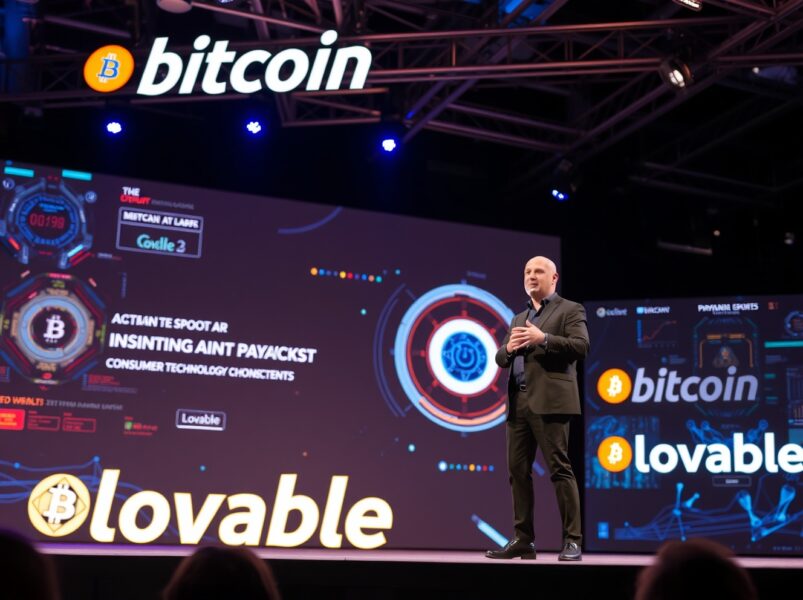
Lovable AI’s Astonishing Rise: Anton Osika Reveals Startup Secrets at Bitcoin World Disrupt 2025

Lovable AI’s Astonishing Rise: Anton Osika Reveals Startup Secrets at Bitcoin World Disrupt 2025

BitcoinWorld Lovable AI’s Astonishing Rise: Anton Osika Reveals Startup Secrets at Bitcoin World Disrupt 2025 Are you ready to witness a phenomenon? The world of technology is abuzz with the incredible rise of Lovable AI, a startup that’s not just breaking records but rewriting the rulebook for rapid growth. Imagine creating powerful apps and websites just by speaking to an AI – that’s the magic Lovable brings to the masses. This groundbreaking approach has propelled the company into the spotlight, making it one of the fastest-growing software firms in history. And now, the visionary behind this sensation, co-founder and CEO Anton Osika, is set to share his invaluable insights on the Disrupt Stage at the highly anticipated Bitcoin World Disrupt 2025. If you’re a founder, investor, or tech enthusiast eager to understand the future of innovation, this is an event you cannot afford to miss. Lovable AI’s Meteoric Ascent: Redefining Software Creation In an era where digital transformation is paramount, Lovable AI has emerged as a true game-changer. Its core premise is deceptively simple yet profoundly impactful: democratize software creation. By enabling anyone to build applications and websites through intuitive AI conversations, Lovable is empowering the vast majority of individuals who lack coding skills to transform their ideas into tangible digital products. This mission has resonated globally, leading to unprecedented momentum. The numbers speak for themselves: Achieved an astonishing $100 million Annual Recurring Revenue (ARR) in less than a year. Successfully raised a $200 million Series A funding round, valuing the company at $1.8 billion, led by industry giant Accel. Is currently fielding unsolicited investor offers, pushing its valuation towards an incredible $4 billion. As industry reports suggest, investors are unequivocally “loving Lovable,” and it’s clear why. This isn’t just about impressive financial metrics; it’s about a company that has tapped into a fundamental need, offering a solution that is both innovative and accessible. The rapid scaling of Lovable AI provides a compelling case study for any entrepreneur aiming for similar exponential growth. The Visionary Behind the Hype: Anton Osika’s Journey to Innovation Every groundbreaking company has a driving force, and for Lovable, that force is co-founder and CEO Anton Osika. His journey is as fascinating as his company’s success. A physicist by training, Osika previously contributed to the cutting-edge research at CERN, the European Organization for Nuclear Research. This deep technical background, combined with his entrepreneurial spirit, has been instrumental in Lovable’s rapid ascent. Before Lovable, he honed his skills as a co-founder of Depict.ai and a Founding Engineer at Sana. Based in Stockholm, Osika has masterfully steered Lovable from a nascent idea to a global phenomenon in record time. His leadership embodies a unique blend of profound technical understanding and a keen, consumer-first vision. At Bitcoin World Disrupt 2025, attendees will have the rare opportunity to hear directly from Osika about what it truly takes to build a brand that not only scales at an incredible pace in a fiercely competitive market but also adeptly manages the intense cultural conversations that inevitably accompany such swift and significant success. His insights will be crucial for anyone looking to understand the dynamics of high-growth tech leadership. Unpacking Consumer Tech Innovation at Bitcoin World Disrupt 2025 The 20th anniversary of Bitcoin World is set to be marked by a truly special event: Bitcoin World Disrupt 2025. From October 27–29, Moscone West in San Francisco will transform into the epicenter of innovation, gathering over 10,000 founders, investors, and tech leaders. It’s the ideal platform to explore the future of consumer tech innovation, and Anton Osika’s presence on the Disrupt Stage is a highlight. His session will delve into how Lovable is not just participating in but actively shaping the next wave of consumer-facing technologies. Why is this session particularly relevant for those interested in the future of consumer experiences? Osika’s discussion will go beyond the superficial, offering a deep dive into the strategies that have allowed Lovable to carve out a unique category in a market long thought to be saturated. Attendees will gain a front-row seat to understanding how to identify unmet consumer needs, leverage advanced AI to meet those needs, and build a product that captivates users globally. The event itself promises a rich tapestry of ideas and networking opportunities: For Founders: Sharpen your pitch and connect with potential investors. For Investors: Discover the next breakout startup poised for massive growth. For Innovators: Claim your spot at the forefront of technological advancements. The insights shared regarding consumer tech innovation at this event will be invaluable for anyone looking to navigate the complexities and capitalize on the opportunities within this dynamic sector. Mastering Startup Growth Strategies: A Blueprint for the Future Lovable’s journey isn’t just another startup success story; it’s a meticulously crafted blueprint for effective startup growth strategies in the modern era. Anton Osika’s experience offers a rare glimpse into the practicalities of scaling a business at breakneck speed while maintaining product integrity and managing external pressures. For entrepreneurs and aspiring tech leaders, his talk will serve as a masterclass in several critical areas: Strategy Focus Key Takeaways from Lovable’s Journey Rapid Scaling How to build infrastructure and teams that support exponential user and revenue growth without compromising quality. Product-Market Fit Identifying a significant, underserved market (the 99% who can’t code) and developing a truly innovative solution (AI-powered app creation). Investor Relations Balancing intense investor interest and pressure with a steadfast focus on product development and long-term vision. Category Creation Carving out an entirely new niche by democratizing complex technologies, rather than competing in existing crowded markets. Understanding these startup growth strategies is essential for anyone aiming to build a resilient and impactful consumer experience. Osika’s session will provide actionable insights into how to replicate elements of Lovable’s success, offering guidance on navigating challenges from product development to market penetration and investor management. Conclusion: Seize the Future of Tech The story of Lovable, under the astute leadership of Anton Osika, is a testament to the power of innovative ideas meeting flawless execution. Their remarkable journey from concept to a multi-billion-dollar valuation in record time is a compelling narrative for anyone interested in the future of technology. By democratizing software creation through Lovable AI, they are not just building a company; they are fostering a new generation of creators. His appearance at Bitcoin World Disrupt 2025 is an unmissable opportunity to gain direct insights from a leader who is truly shaping the landscape of consumer tech innovation. Don’t miss this chance to learn about cutting-edge startup growth strategies and secure your front-row seat to the future. Register now and save up to $668 before Regular Bird rates end on September 26. To learn more about the latest AI market trends, explore our article on key developments shaping AI features. This post Lovable AI’s Astonishing Rise: Anton Osika Reveals Startup Secrets at Bitcoin World Disrupt 2025 first appeared on BitcoinWorld.
Paylaş
Coinstats2025/09/17 23:40